Introduction
Contact centers face a persistent operational challenge: agents spend roughly 10% of their time searching for information across multiple sources during live calls. This knowledge gap translates directly into longer handle times, inconsistent responses, and escalations that could have been avoided. When 60% of failed first-call resolution attempts stem from agents lacking the right information at the right moment, the quality of your knowledge management system stops being an IT decision and becomes a revenue decision.
Agent productivity and First-Call Resolution (FCR) are the two metrics most directly influenced by knowledge accessibility. A well-built knowledge base doesn't just store answers — it surfaces the right one in context, before an agent has to go looking.
This article evaluates the top knowledge base platforms built to improve FCR rates, reduce average handle time (AHT), and give agents accurate, guided resolutions at the moment they're needed.
TLDR
- Purpose-built contact center knowledge bases deliver real-time answers to agents, cutting AHT and repeat contacts that generic repositories can't address
- FCR gains depend on AI-powered search, guided decision trees, and governance that keeps content current and compliant
- Knowledge delivery models differ—some push content contextually, others require manual search, directly impacting resolution speed
- Platform fit varies by integration depth, resolution complexity, and how well the tool aligns with your agent desktop environment
- Match knowledge delivery workflows to your CRM architecture and product complexity before selecting a platform
What Is a Knowledge Base System for Contact Centers?
A contact center knowledge base system is a structured repository containing policies, procedures, troubleshooting steps, and product information designed for real-time access during customer interactions. Unlike training libraries or onboarding materials, these systems actively support live resolution efforts.
Not all knowledge platforms are built for this environment. Generic enterprise platforms handle broad information storage — useful, but not designed for live interactions. Contact center-specific systems do three things those platforms don't:
- Reduce resolution time by surfacing answers during the call, not after
- Guide agents through complex queries with structured decision paths
- Ensure consistent answers across voice, chat, email, and messaging channels
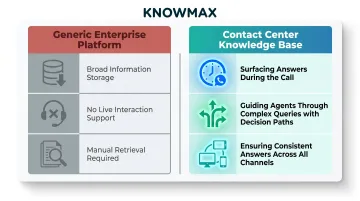
Only the latter category meaningfully impacts FCR (First-Call Resolution) and AHT (Average Handle Time).
The more capable platforms now go further. Gartner's 2025 Market Guide states that "AI-powered taxonomy automation, knowledge capture, creation and curation are rendering conventional KM practices obsolete." These systems understand agent intent rather than matching keywords, proactively surfacing relevant content without requiring agents to leave the interaction screen.
Top Knowledge Base Systems for Agent Productivity and FCR
The following platforms were selected based on:
- AI-powered retrieval capabilities and intent-based search
- Guided resolution tools (decision trees, agent assist)
- CRM and telephony integration depth
- Enterprise-grade security certifications
- Adoption by large-scale support operations
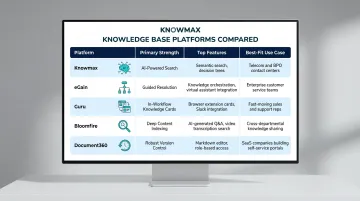
Knowmax
Knowmax is an AI-powered knowledge management platform built specifically for contact centers and BPO environments, serving enterprise clients across telecom, banking, e-commerce, and healthcare. The platform delivers knowledge across both agent-assisted and self-service channels from a single content management layer.
What differentiates Knowmax for FCR improvement is its combination of AI-intent search, interactive decision trees guiding agents step-by-step through complex resolutions, and visual device guides that reduce guesswork. The platform achieved a 21% FCR improvement for a leading telecommunications operator while maintaining call quality above 90%.
It integrates natively with Salesforce, Zendesk, Freshworks, Genesys, and Talkdesk, supports content in 25+ languages with AI authoring and auto-translation, and holds SOC 2, ISO 27001, GDPR, and HIPAA certifications across the full platform.
| Feature Category | Details |
|---|---|
| Key Features | AI-intent search, interactive decision trees, visual troubleshooting guides, AI content authoring, omnichannel delivery, CRM and telephony integrations |
| Best For | Contact centers and BPOs needing guided resolution tools with deep CRM integration across telecom, banking, and insurance verticals |
| Integrations | Salesforce, Zendesk, Freshworks, Genesys, Talkdesk, SAP, IVR and messaging platforms |
eGain
In high-volume environments where a wrong answer creates a compliance risk, eGain's guided engagement model keeps agents on the most accurate resolution path. The platform covers voice, chat, email, and social channels, serving enterprises where regulatory accuracy is non-negotiable.
The AI knowledge hub consolidates information silos and applies machine learning to surface responses ranked by both relevance and compliance risk — directly reducing misrouting and unnecessary escalations.
eGain reports a 37% FCR improvement and a 30-point NPS rise for a premier telco client managing 25 million conversations annually, though these are vendor-stated outcomes.
| Feature Category | Details |
|---|---|
| Key Features | AI knowledge hub, guided engagement, self-service automation, omnichannel interaction hub, intent-based content retrieval |
| Best For | Large enterprises and regulated industries requiring compliance-aware knowledge delivery and multi-channel agent guidance |
| Integrations | Salesforce, ServiceNow, Genesys, Avaya, and major CRM/telephony platforms |
Guru
Guru embeds verified knowledge directly inside the tools agents already use—including browser extensions for Salesforce, Zendesk, and other CRMs—minimizing context switching during live interactions. Knowledge cards appear contextually based on the agent's current screen activity.
Guru's verification system assigns content ownership to subject matter experts who confirm accuracy on scheduled intervals, ensuring agents never work with outdated information. Its AI suggestion engine proactively surfaces relevant cards based on screen context, reducing manual search time mid-call. Cards surface automatically — agents get the right answer without leaving their active screen or triggering a manual search.
| Feature Category | Details |
|---|---|
| Key Features | In-workflow knowledge cards, expert verification system, AI-suggested content, browser extension, analytics on knowledge gaps |
| Best For | Support teams that work primarily in browser-based CRMs and need knowledge delivered without tab-switching |
| Integrations | Salesforce, Zendesk, Slack, Microsoft Teams, Intercom, Chrome browser |
Bloomfire
Bloomfire is an enterprise knowledge management platform with strong AI-powered search and content governance capabilities, designed to make institutional knowledge accessible across large organizations, including customer support teams.
Bloomfire's deep-indexing AI search covers video transcription and unstructured content analysis. Agents can surface answers buried in recorded training sessions, policy documents, or past resolution threads — content that standard search tools miss entirely. Its knowledge gap analytics identify which topics generate frequent searches without satisfactory results, giving managers a data-driven basis for content improvement. The platform suits organizations managing diverse content formats where search accuracy directly impacts resolution speed.
| Feature Category | Details |
|---|---|
| Key Features | AI-powered deep-index search, Synapse conversational AI, content verification, knowledge gap analytics, customizable dashboards |
| Best For | Enterprises managing large volumes of diverse content formats (video, documents, PDFs) with a focus on search accuracy and content governance |
| Integrations | Salesforce, Slack, Microsoft Teams, SharePoint, Google Drive |
Document360
Document360 is a structured knowledge base platform designed for technical documentation management, offering version control, category organization, and content review workflows that ensure agents and customers always access accurate, up-to-date information.
Document360 is best suited for contact centers supporting technically complex products requiring multiple documentation versions across product updates. Its AI writing assistant and context-aware search help agents navigate complex troubleshooting articles quickly. The platform supports both internal agent-facing and external customer-facing knowledge bases from a single content layer, making it efficient for organizations maintaining dual portals.
| Feature Category | Details |
|---|---|
| Key Features | Markdown editor, version control, AI writing assistant, category management, review workflows, dual internal/external portal |
| Best For | Technical product support teams managing frequent documentation updates across multiple product versions |
| Integrations | Zendesk, Intercom, Freshdesk, Slack, Chrome extension |
Key Features That Drive FCR and Agent Productivity
Not all knowledge base features equally impact FCR. The most influential are those that reduce the time between a customer asking a question and an agent delivering a verified, complete answer—and those that prevent incorrect or inconsistent responses.
AI-Intent Search vs. Keyword Search
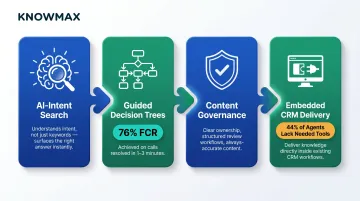
Keyword search forces agents to know exact terminology, creating dead-end searches during live calls where every second of silence erodes satisfaction. AI-intent search interprets what the agent means and returns relevant content even when phrasing differs. When only 29% of agents turn to their online knowledge tool when they need help, the difference between intent-based and keyword-based retrieval determines whether the tool gets used at all.
Guided Resolution Tools (Decision Trees)
Interactive decision trees walk agents through branching question-answer flows, ensuring they never miss a diagnostic step. This directly ties to FCR because it reduces the chance of resolving the wrong issue or providing an incomplete fix that leads to a callback. Calls lasting 1-3 minutes achieve 76% FCR, while calls at 15 minutes drop to 62% FCR. Faster knowledge access produces shorter calls — and shorter calls close more cleanly.
Content Freshness and Governance
Outdated knowledge is a direct FCR risk. Agents acting on superseded policies or discontinued product information produce incorrect resolutions that require follow-up contacts. Despite 94% of call centers claiming regular updates, only 19% of agents are satisfied with their tools — a gap that points to content quality and relevance failures, not just update frequency.
Closing that gap requires structured governance:
- Content ownership: Assign subject-matter owners accountable for accuracy in each domain
- Scheduled review workflows: Trigger mandatory reviews when policies change or products are discontinued
- Update notifications: Alert agents when articles they frequently access have been revised
CRM and Telephony Integration
Knowledge bases that surface inside the agent's CRM or ticketing interface — rather than a separate tab — reduce average handle time by eliminating context-switching. Knowmax follows this approach with native integrations across Genesys, Talkdesk, Salesforce, and Zendesk.
The case for embedded delivery is backed by real friction data:
- 44% of agents report lacking the tools they need to do their job
- 34% say the right information simply isn't available when a customer asks for it
Embedded knowledge delivery directly addresses both gaps — making it one of the highest-impact architectural choices for FCR improvement.
How We Selected These Knowledge Base Systems
Every system on this list was evaluated against criteria specific to contact center performance — not general enterprise document management. Each had to meet all of the following:
- Contact center relevance, with agent-facing delivery (not just content storage)
- AI-driven or guided resolution tools (semantic search, decision trees, or agent assist)
- Deep integration with CRM and telephony platforms
- Enterprise-grade security certifications: SOC 2, ISO 27001, and GDPR compliance
- Demonstrated adoption by large-scale support operations
Generic wikis and document repositories without AI search and structured agent delivery were excluded.
The most common mistake in this category: selecting a platform based on how easy it is to write content, without testing how fast agents can find it during a live call. Retrieval speed and guided resolution capability drive FCR outcomes — content authoring ease does not. Gartner's evaluation framework for Customer Service Knowledge Management Systems includes semantic search, guided assistance, and usage analytics as mandatory features, not optional enhancements.
Conclusion
FCR and agent productivity are not just training problems—they are knowledge access problems. A well-implemented knowledge base removes the bottleneck between agents and verified answers, making resolution speed a product of system design rather than individual expertise.
Every 1% improvement in FCR yields $286,000 in annual savings for a midsize contact center—plus a 1.4-point NPS gain. Those numbers make platform selection a financial decision, not just an operational one.
Before committing to a platform, evaluate it against your specific environment:
- Call complexity and escalation patterns
- CRM and CCaaS stack compatibility
- Channels agents work across (voice, chat, email, self-service)
- Scalability as volume and product lines grow
- Multilingual support and content update speed
Knowmax is built specifically for contact center environments, combining guided decision trees, AI-powered search, and native CRM integrations to reduce AHT and improve FCR. Schedule a consultation to see how it performs in your specific environment.
Frequently Asked Questions
What is an enterprise knowledge base?
An enterprise knowledge base is a centralized, searchable repository of organizational information—policies, procedures, product details, and troubleshooting guides—designed to be accessed by employees, agents, or customers to resolve questions accurately and consistently at scale.
What is an enterprise assistant?
An enterprise assistant is an AI-powered tool embedded in employee workflows that answers queries, surfaces relevant documents, and guides task completion by drawing from a connected knowledge base, acting as an on-demand knowledge resource without manual search.
How does a knowledge base improve First-Call Resolution?
A knowledge base improves FCR by giving agents instant access to verified, step-by-step resolution guidance during the call—reducing the need for escalations, callbacks, or follow-up contacts caused by incomplete or incorrect information.
What features should a contact center knowledge base have?
Critical features include AI-powered intent search, interactive decision trees for guided resolution, content verification workflows, CRM/telephony integration for in-workflow delivery, and analytics that identify knowledge gaps from agent search behavior.
How do I measure the ROI of a knowledge base system in a contact center?
Track ROI by measuring FCR rate, average handle time (AHT), agent onboarding time, escalation rate, and CSAT scores before and after implementation. Most organizations also monitor repeat contact rates as a direct indicator of knowledge quality.
What is the difference between an internal and external knowledge base?
An internal knowledge base is designed for agents and employees to use during customer interactions or daily operations, while an external knowledge base is a customer-facing self-service portal. Many platforms, including Knowmax, support both from a single content management layer.