Introduction
Contact centers operate under constant operational pressure across multiple channels — phone, chat, email, and self-service — while leadership tracks AHT, FCR, and CSAT simultaneously. 87% of contact centers cite CSAT as their most important metric, and 74% track accuracy as a top quality assurance priority.
That dual pressure makes knowledge access a front-line efficiency issue, not a back-office concern.
The stakes are concrete: 40% of agents report that difficulty finding the right information is their top cause of frustration and longer handle times. Every second an agent spends searching for an answer is a second the customer waits — and a second that pushes AHT up.
This article breaks down exactly how knowledge management platforms move those numbers — covering the specific mechanisms that reduce AHT, improve FCR, and keep CSAT on target.
TL;DR
- Agents get instant access to accurate information, cutting wasted search time during live interactions
- Consistent answers across every channel reduce repeat contacts and stop trust from eroding
- New agents ramp up faster when fragmented training materials are replaced with guided, searchable knowledge
- Without a knowledge platform, contact centers absorb rising AHT, higher error rates, and training costs that grow with every attrition cycle
- Gains compound over time — the more consistently the platform is used and maintained, the sharper the efficiency returns
What Is a Knowledge Management Platform in a Contact Center?
A knowledge management platform in a contact center is a centralized system that stores, organizes, and surfaces the right information to agents at the right moment — during a call, a chat, or a ticket resolution — without requiring them to search across multiple tools or escalate unnecessarily.
It sits between the agent and the resolution, giving them immediate access to:
- Product information and pricing details
- Step-by-step troubleshooting flows
- Policy documents and compliance scripts
- Process guides for common and edge-case scenarios
Organizations managing an average of 3.9 different contact center technologies simultaneously need this centralized layer to maintain operational consistency across teams and channels.
What separates a contact center KM platform from a shared drive or general wiki is how it delivers answers. Rather than returning keyword matches, it understands agent intent, fits into existing workflows, and eliminates context switching — so agents stay focused on the customer, not the search bar.
Key Advantages of Knowledge Management Platforms for Contact Center Productivity
The advantages below are grounded in operational outcomes—the metrics contact center managers, workforce planners, and CX leaders track daily: handle time, resolution rates, quality scores, and agent readiness.
Advantage 1: Faster Resolution Through Instant, Intent-Based Knowledge Access
Every second an agent spends searching for information is a second the customer waits. With dozens to hundreds of agents doing this simultaneously, the cumulative impact on AHT is significant. A KM platform with AI-powered search eliminates this by surfacing relevant answers instantly, based on what the agent is asking, not just the keywords they type.
Instead of toggling between product manuals, shared drives, email threads, and chat histories, agents get a single search interface that understands intent and returns contextually accurate results. Platforms like Knowmax go further by offering AI-powered decision trees that guide agents through complex queries step by step, reducing reliance on memorization or supervisor escalation.
Why this creates an advantage:
Research shows that knowledge workers spend roughly 20% of their workweek searching for information—equivalent to one full day per week. In contact centers specifically, 40% of agents cite difficulty finding the right information as the leading cause of frustration and increased handle time.
Even a 30-second reduction per call, at scale, translates directly into cost savings and capacity gains. The industry benchmark for cost per call falls between $2.70 and $5.60, meaning small per-call improvements compound into significant operational savings across high-volume operations.
Faster access means shorter calls, less hold time, fewer escalations, and more consistent answers. All of these improve CSAT and reduce operational cost per contact. Average Handle Time reached 697 seconds in 2024, reflecting an 18% year-over-year increase as simpler inquiries shift to self-service and agents handle increasingly complex issues.
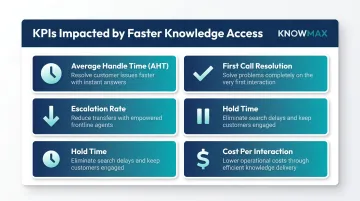
KPIs impacted:
- Average Handle Time (AHT)
- First Call Resolution (FCR)
- Escalation rate
- Hold time
- Cost per interaction
When this advantage matters most:
This advantage is critical during high-volume periods—product launches, seasonal spikes, regulatory changes—when agents face unfamiliar query types and can't rely on accumulated experience alone. More than 66% of consumers are only willing to wait on hold for less than two minutes before hanging up or becoming frustrated, making fast information retrieval essential during peak periods.
Advantage 2: Consistent, Error-Free Answers Across Every Channel
In contact centers managing phone, chat, email, and self-service simultaneously, information inconsistency is a recurring problem. Agents give different answers to the same question, customers receive conflicting guidance across channels, and compliance gaps emerge. A KM platform creates a single source of truth that all agents and all channels draw from.
By centralizing approved content and pushing updates instantly across all touchpoints, a KM platform ensures that whether a customer calls, chats, or self-serves, they receive the same accurate answer. Guided decision trees and structured resolution flows further reduce agent interpretation errors by walking agents through the correct response path rather than leaving it to judgment.
The operational case:
Inconsistent answers are one of the most common drivers of repeat contacts. Approximately 23% of all service interactions are repeat contacts, and CSAT scores drop by an average of 15% for every subsequent call required to resolve the same issue.
Analysis of non-FCR calls shows that 49% stem from organizational errors and 38% from agent errors. Both are directly addressable through centralized, governed knowledge.
In regulated industries like banking, insurance, and telecom, agents giving incorrect or outdated information exposes the organization to compliance violations. A governed KM platform with version control and content approval workflows eliminates this risk. The CFPB's 2023 report on consumer finance documented compliance risks when customers receive inaccurate guidance, creating UDAAP liability.
Consistency reduces the burden on quality assurance teams. When agents follow structured knowledge flows, QA scores improve and coaching time decreases.
KPIs impacted:
- First Call Resolution (FCR)
- Repeat contact rate
- Quality/compliance scores
- CSAT
- QA audit pass rates
Most critical in:
This advantage is especially impactful in large, distributed contact center teams or BPO environments where hundreds of agents handle the same query types. Only 7% of contact centers deliver truly seamless omnichannel transitions, and 56% of customers report having to repeat themselves due to disconnected support channels. A single outdated knowledge article can create organization-wide inconsistency at scale.
Advantage 3: Faster Agent Onboarding and Lower Knowledge Attrition
Contact centers face persistently high agent turnover and frequent new hire cycles. Every time an agent leaves, they take institutional knowledge with them—and every new hire represents weeks of reduced productivity while they get up to speed. A KM platform shortens that ramp-up window by giving new agents structured, searchable access to everything they need to handle queries independently.
Instead of relying on trainer-led sessions, shadowing, or printed SOP binders, new agents can find step-by-step guidance, troubleshooting flows, and policy details directly in the platform during live interactions. This makes the platform a real-time job aid, not just a training resource. Even a new hire on day five can handle a call with the same accuracy as a tenured agent.
The cost picture:
. In all three scenarios, getting agents productive quickly is a direct operational priority.
What Happens When Knowledge Management Is Missing in Contact Centers
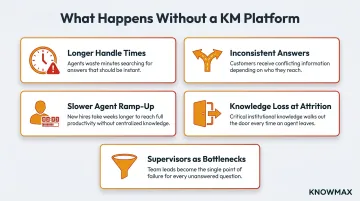
The absence of a KM platform doesn't mean no knowledge exists—it means that knowledge is fragmented, inconsistently stored, and unevenly distributed. The consequences are predictable and measurable:
- Longer handle times: Agents searching across multiple tools during live calls add 30–60 seconds of dead time per interaction. At scale, that compounds into thousands of lost hours per month.
- Inconsistent answers: Without a single source of truth, different agents give different responses to the same question—driving repeat contacts, customer frustration, and compliance risk. Centralized knowledge management improves FCR by an average of 20%; its absence is a measurable gap.
- Slower agent ramp-up: New hires rely on whoever is available rather than a structured resource, creating uneven learning experiences and extended onboarding timelines.
- Knowledge loss at attrition: When experienced agents leave, their expertise leaves with them. Without centralized documentation, every departure is a permanent loss.
- Supervisors as bottlenecks: As volumes and complexity grow, supervisors spend time fielding agent questions instead of coaching performance. Typical contact centers run 8 to 12 agents per supervisor, dropping to 5 in complex environments — a ratio that reflects how much leadership bandwidth knowledge gaps consume.
Contact centers that optimize for AHT alone see 12% lower FCR on average compared to those that prioritize resolution. Without the right knowledge infrastructure, speed and accuracy aren't balanced — one consistently comes at the expense of the other.
How to Get the Most Value from a Contact Center Knowledge Management Platform
A knowledge management platform delivers compounding returns—but only when it is used consistently, kept current, and integrated into daily workflows rather than treated as a side resource. Contact centers that get the most value from their KM platform typically do three things well.
Integrate the platform into the agent's existing workflow
The KM platform should surface information within the CRM or ticketing tool agents already use during calls, not require them to open a separate browser tab. Platforms that integrate with tools like Salesforce, Zendesk, Genesys, and Freshworks ensure agents access knowledge in the flow of work—not outside of it.
Purpose-built contact center KM platforms like Knowmax add specific value through integrations across CRM, telephony, and IVR systems. When knowledge appears contextually within the agent desktop, agents adopt it without friction and stop losing time switching between applications.
Treat content maintenance as an ongoing operational task, not a launch activity
Assign ownership for knowledge updates, review articles after major product or policy changes, and use platform analytics to identify which searches return no results—those are the knowledge gaps that directly impact agent performance.
A 2024 Gartner survey of 187 customer service leaders found that 61% have a backlog of knowledge articles to edit, and more than one-third have no formal process for revising outdated articles. Content governance is the prerequisite for KM ROI—skip it and the platform underperforms regardless of features. Build these habits early:
- Schedule quarterly content audits tied to product or policy release cycles
- Assign subject matter experts as named article owners with review accountability
- Implement version control workflows so agents always access current, compliant content
Measure knowledge platform usage alongside contact center KPIs
Track search frequency, article usage rates, and time-to-resolution alongside AHT and FCR. If agents are not using the platform, investigate whether content quality, search accuracy, or integration friction is the barrier.
High-performing contact centers treat KM analytics as operational data, not a vanity report:
- Analyze failed searches weekly to surface content gaps before they affect call volume
- Identify which articles correlate with the fastest resolutions and prioritize keeping them current
- Cross-reference knowledge usage rates with quality scores to pinpoint where agent behavior and content quality diverge
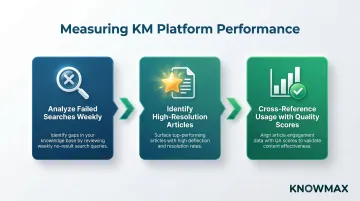
When measurement is built into the operational rhythm, the KM platform improves alongside the contact center—not months behind it.
Conclusion
Knowledge management platforms drive contact center productivity not through abstract efficiency gains, but through concrete operational improvements: agents find answers faster, answers are more consistent, and new hires become productive sooner.
These gains compound over time. The more current the knowledge base, the more tightly integrated the platform, the more consistently agents use it — and the more measurable the results across AHT, FCR, CSAT, and training costs.
SQM Group research shows a direct 1:1 ratio: every 1% improvement in FCR produces a corresponding 1% improvement in CSAT, with a midsize contact center saving approximately $286,000 annually for each 1% FCR gain.
KM is an ongoing practice that requires attention to content quality, platform integration, and usage measurement—not a one-time deployment that delivers value automatically. Organizations that treat knowledge management as a core operational discipline, not just a technology purchase, see sustained improvements in efficiency, quality, and agent confidence.
Frequently Asked Questions
How does knowledge management improve productivity?
Knowledge management improves productivity by reducing the time employees spend searching for information, minimising errors from outdated or inconsistent answers, and enabling faster independent decision-making. In a contact center, this directly translates to lower AHT, fewer escalations, and faster agent ramp-up.
What is a knowledge management platform in a contact center?
A knowledge management platform is a centralised system that organises and delivers accurate information to agents at the moment they need it—during live calls, chats, or ticket resolution. It replaces fragmented sources like shared drives, email threads, and verbal knowledge transfers with a single, searchable source of truth.
How does a knowledge management platform reduce average handle time?
By giving agents instant, AI-powered access to the right answer without switching between multiple tools or waiting for a supervisor, a KM platform directly cuts the time spent searching during a call. This reduces hold time and overall AHT, with research showing agents spend roughly 20% of their time searching for information without such tools.
What features should a contact center knowledge management platform have?
Key features include AI-powered intent-based search, guided decision trees, omnichannel content delivery, and CRM or telephony integrations. Version control, approval workflows, and usage analytics for identifying content gaps are also essential for keeping knowledge current and reliable.
How does knowledge management help with agent onboarding in contact centers?
A KM platform functions as a real-time job aid for new agents, giving them searchable, structured guidance during live interactions. This reduces dependency on trainers and accelerates time-to-proficiency, compressing typical 3-6 month ramp-up timelines significantly.
What metrics improve when a contact center implements a knowledge management platform?
Key metrics that improve include AHT, First Call Resolution (FCR), CSAT scores, agent quality scores, and time to proficiency for new hires. Research shows centralised KM tools improve FCR by an average of 20%.