Introduction
Support teams face a stark reality: 91% of customer service leaders are under executive pressure to implement AI, yet only 1% of companies consider themselves at AI maturity. Getting AI deployed is only part of the problem. Behind every hallucination-prone chatbot and every inconsistent automated response lies the same root cause: a weak or poorly maintained knowledge base.
Employees waste 21% of their work time searching for knowledge across scattered drives, emails, and wikis, while another 14% recreate information they can't find. The result is longer handle times, lower first-contact resolution rates, and customers who get different answers depending on which channel they use.
This piece breaks down how the knowledge base drives AI agent accuracy, speeds up human agent responses, and creates the consistency that makes omnichannel support actually work — with specific patterns, failure modes, and what structured knowledge management changes in practice.
TLDR
- Unstructured or inaccurate knowledge bases cause AI agents to hallucinate, contradict themselves, or fail to resolve queries
- Human agents rely on the same repository to resolve issues quickly, cutting search time and accelerating onboarding
- Knowledge quality directly determines support outcomes: organizations with strong knowledge bases achieve higher FCR, lower AHT, and better CSAT
- Interaction data reveals knowledge gaps; AI-assisted authoring and regular audits close them, creating a continuous improvement loop
Why the Knowledge Base Is the Brain Behind AI Agent Performance
AI agents don't inherently "know" anything. They retrieve, reason over, and respond based on whatever knowledge has been made accessible to them. A sophisticated language model trained on billions of web pages cannot tell a customer their specific return policy, troubleshoot a unique product error, or explain a recent policy change—unless that information exists in a structured, retrievable knowledge base.
The difference between a generic LLM and a reliable support AI comes down to grounding. AI agents built on retrieval-augmented generation (RAG) architecture pull information from enterprise knowledge bases before responding. RAG enhances output accuracy by up to 13% compared to models relying solely on internal parameters, and reduces outdated responses by 15–20% in fast-evolving fields.
Without this grounding, AI agents fill knowledge gaps with plausible-sounding fabrications—a pattern known as hallucination. The business consequences are concrete: wrong answers, lost customer trust, and a surge in escalated complaints.
What a Support Knowledge Base Must Contain
A knowledge base built to power AI agents must include more than just FAQs. Effective repositories contain:
- Product details and FAQs — specifications, features, compatibility information
- Service policies and SOPs — return procedures, warranty terms, escalation protocols
- Troubleshooting workflows — diagnostic steps, error code explanations, resolution paths
- Decision trees — conditional logic for multi-step issue resolution
- Customer-facing communication standards — tone, approved phrasing, compliance language
The breadth and structure of this content sets the ceiling for AI capability. Content volume alone isn't enough — articles need consistent structure and accurate metadata so the AI can surface the right answer in context, not just the closest match.
How Knowledge Base Gaps Translate Into AI Errors at Scale
Knowledge base quality determines AI output quality. If the repository contains outdated policies, duplicate articles with conflicting information, or unstructured content with no metadata, the AI agent surfaces incorrect answers at scale. Poor data quality costs companies an average of $12.9 million annually, and AI amplifies these costs by distributing bad information faster than any human agent could.
49% of non-first-contact-resolution calls trace to organizational policies and procedures, not individual agent failures. When knowledge is fragmented, inconsistent, or absent, technology doesn't fix the gap—it automates the error.
How a Knowledge Base Trains AI Agents to Resolve Issues Accurately
AI agents use a multi-step process during live interactions:
- Input parsing — Natural language processing interprets the customer's question
- Intent detection — The system identifies what the customer is trying to accomplish
- Knowledge retrieval — Semantic search locates relevant content in the knowledge base
- Contextual reasoning — The AI synthesizes retrieved information with conversation context
- Response generation — The system formulates a coherent, accurate answer
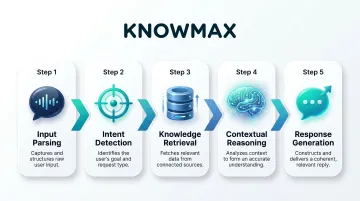
Each step depends on knowledge base quality. When metadata is poor, retrieval suffers. When content is ambiguous or incomplete, reasoning breaks down and resolution fails.
Structured vs. Unstructured Knowledge: What AI Agents Need
AI agents perform best when knowledge is structured into retrievable units. FAQs, decision trees, and policy manuals with clear metadata enable semantic search to find the right content quickly. Unstructured knowledge—raw documents, chat logs, scattered emails—requires considerably more processing and yields less accurate results.
Interactive formats like decision trees encode procedural reasoning, not just facts. Platforms that support auto-traversal — like Knowmax — let AI agents dynamically navigate each decision tree step based on customer inputs, while retaining the flexibility to pause or override when needed. This enables AI to handle multi-step, conditional support scenarios rather than just single-question queries.
Continuous Learning: How Agent Interactions Improve the Knowledge Base
The feedback loop between AI behavior and knowledge quality is where most platforms fall short — and where the right system creates compounding value. When queries return no results, when responses require escalation, or when the system flags low-confidence answers, these signals identify knowledge gaps.
Organizations using Knowledge-Centered Service (KCS) methodology treat knowledge creation as a byproduct of resolving customer issues. 95% of companies collect customer feedback, but only 10% use it to drive improvements — meaning most organizations are sitting on actionable data they never act on.
Knowmax addresses this directly: interaction analytics surface outdated articles, flag missing content, and recommend updates — so every support interaction feeds back into a sharper, more accurate knowledge base. The result is fewer escalations, higher first-contact resolution, and AI agents that improve without manual intervention.
How a Knowledge Base Empowers Human Support Agents
Human agents face the same fundamental challenge as AI agents: needing fast, accurate access to the right information during a customer interaction. A knowledge base serves as the single source of truth, eliminating searches across multiple platforms, documents, or colleagues during live calls.
Knowledge Base as an Onboarding and Training Accelerator
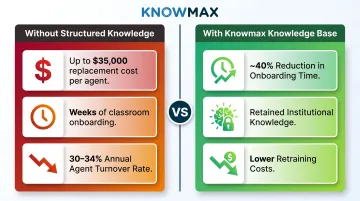
A well-structured knowledge base dramatically shortens new agent onboarding. Instead of weeks of classroom training, new agents learn by doing, guided by the knowledge base through their first real interactions. Knowmax customers have documented approximately 40% reductions in employee onboarding time, achieved through centralized knowledge hubs, interactive training modules, and guided workflows.
Annual contact center agent turnover runs 30-34%, with replacement costs up to $35,000 per agent. That institutional knowledge doesn't have to leave with them. When expertise is captured in a structured knowledge base, a 1,000-agent team with 40% turnover can save millions annually in retraining costs alone.
Real-Time Guidance During Customer Interactions
AI-powered knowledge bases provide in-the-moment, context-aware article suggestions to agents during live calls or chats. Knowmax's Co-Pilot for Chrome delivers instant, relevant results directly within the agent's CRM or helpdesk interface, eliminating the need to toggle between screens or manually search.
This co-pilot functionality reduces average handle time and increases first contact resolution without requiring agents to memorize every policy or procedure. Enterprise deployments using AI agent assist tools consistently report:
- 20-30% reduction in average handle time on assisted contacts
- 10-15% improvement in first contact resolution
- 10-20 point increase in CSAT scores
The Measurable Support Outcomes a Strong Knowledge Base Drives
Knowledge base quality connects directly to First Contact Resolution (FCR). When agents—AI or human—have instant access to verified, complete answers, customers don't need to call back or be transferred. The industry average FCR is 69%, and only 5% of contact centers achieve world-class (80%+) FCR. Every 1% improvement in FCR results in approximately $360,000 (based on UK contact center benchmarks) in annual savings for a typical midsize call center.
Because all agents and AI bots draw from the same knowledge base, customers receive identical, accurate answers whether they reach out via phone, chat, email, or self-service. This omnichannel consistency eliminates the frustration of conflicting information across channels. Organizations implementing enterprise knowledge systems have seen 28% improvement in Net Promoter Scores and 42% increase in service consistency across departments and geographies.
The customer satisfaction impact is concrete. 63% of consumers will switch to a competitor after just one bad experience—a rate that grew 9% year-over-year. That number makes knowledge quality a revenue issue, not just an operational one.
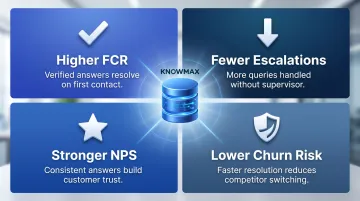
The outcomes compound across every interaction:
- Higher FCR — verified answers resolve issues on first contact, cutting callbacks
- Fewer escalations — agents and AI bots handle more queries without supervisor intervention
- Stronger NPS — consistent, accurate responses across channels build customer trust
- Lower churn risk — faster resolution directly reduces the friction that drives customers to competitors
Best Practices for a Knowledge Base That Powers Both AI and Human Agents
A knowledge base that serves both AI and human agents effectively requires thoughtful structure:
- Logical taxonomy — Organise content with clear categories, consistent metadata tags, and search-optimised formatting so both agents and AI can retrieve it reliably
- Plain language — FAQ-style content supports both NLP retrieval and human readability
- Multiple formats — Articles, decision trees, visual guides, and SOPs address different support scenarios
Knowmax's AI authoring tools help knowledge teams keep pace with content demands at scale. Auto-summarisation condenses lengthy documents, one-click rephrasing improves clarity and tone, and built-in translation covers 25+ languages — so global teams can maintain quality without manual bottlenecks at each locale.
Governance Model for Continuous Quality
Keeping a knowledge base current requires ongoing governance:
- Assign content ownership — Designate subject matter experts responsible for specific articles or categories
- Set regular review cycles — Quarterly audits identify stale content, knowledge gaps, and orphaned articles
- Automate update syncs — Connect with CRM and policy systems to reflect changes automatically
- Use AI gap detection — Knowmax uses interaction analytics to surface outdated or missing articles before they affect agent performance
Integration as a Prerequisite
A knowledge base only delivers full value when embedded into the tools agents already use. Knowmax integrates with leading CRM platforms (Salesforce, Zendesk), CCaaS systems (Genesys, Talkdesk), and messaging platforms (Freshchat), and is listed on the Salesforce AppExchange, Zendesk Marketplace, Genesys AppFoundry, Freshworks Marketplace, and SAP store. The result: agents get accurate, contextual guidance without switching tabs or interrupting the conversation.
Frequently Asked Questions
How does a knowledge base help users and agents?
A knowledge base gives end users instant access to self-service answers while providing support agents real-time retrieval of verified information during live interactions. This reduces wait times, speeds up resolution, and ensures consistency across all touchpoints.
What is the role of a knowledge-based agent in support and agent training?
A knowledge-based agent uses a structured repository to guide customer interactions, adhere to SOPs, and continuously improve through feedback. The same repository serves as the primary learning resource for new agents during onboarding and ongoing training.
Is a knowledge base the best solution for customer support?
A knowledge base directly addresses the most common driver of agent performance issues: inconsistent information access. It delivers the strongest results when paired with AI-powered search and integrated into your existing support tools.
How does a knowledge base improve AI agent accuracy?
Structured, well-tagged content lets AI agents retrieve contextually relevant answers through semantic search and RAG. This grounds responses in verified, policy-specific information — reducing hallucinations and improving answer reliability.
What types of content should a knowledge base include for AI agents?
Essential content types include product FAQs, service policies, troubleshooting decision trees, SOP documentation, and escalation workflows. Both structured and procedural content improve the agent's ability to handle complex, multi-step queries.
How do you maintain and update a knowledge base for AI agents?
A sustainable maintenance process typically involves:
- Assigning clear content ownership to specific teams or roles
- Using interaction data and AI gap detection to surface outdated articles
- Setting regular review cycles tied to product or policy changes
- Using AI authoring tools to update and translate content across 25+ languages without creating bottlenecks