Introduction
Many L&D professionals and enterprise training managers struggle with a critical decision: choosing between an LCMS (Learning Content Management System) and an LMS (Learning Management System). These platforms share similar names but serve fundamentally different purposes. Selecting the wrong system can slow down onboarding, inflate training costs, or leave critical knowledge gaps that impact customer experience and compliance.
The global LMS market was $28.58 billion in 2025 and is projected to reach $123.78 billion by 2033 — that scale reflects how seriously enterprises are treating learning infrastructure decisions.
This guide breaks down the LCMS vs. LMS debate directly. You'll find the key differences between these systems, their distinct use cases, and a practical framework for choosing the right platform — or combination — for your organization.
TL;DR
- An LCMS focuses on creating and managing digital learning content—best suited for teams that build training content in-house
- An LMS delivers, tracks, and administers learning experiences—designed for organizations managing diverse training formats and learner journeys
- The core difference: LCMS is built around content authoring; LMS handles course delivery and learner administration
- Your priority decides the fit: build content (LCMS), deliver it (LMS), or combine both
LCMS vs LMS: Quick Comparison
Understanding the fundamental differences between LCMS and LMS starts with how each platform defines its primary mission.
| Dimension | LCMS | LMS |
|---|---|---|
| Primary Focus | Content creation, management, and versioning | Learner administration, delivery, and tracking |
| Content Authoring | Built-in authoring tools, collaborative workflows | Minimal or external; content uploaded as SCORM/xAPI |
| Analytics Depth | Content-centric (engagement, drop-off points, module performance) | Learner-centric (completion rates, pass/fail, certification status) |
| Best Use Case | Organizations creating high-volume training content in-house | Organizations delivering pre-built courses and managing blended learning paths |
| Standards Support | Produces SCORM, xAPI, cmi5, HTML5 packages | Consumes SCORM, xAPI, cmi5 packages |
The central distinction is content authoring versus course delivery. An LMS manages the learner, while an LCMS manages the content, as Brandon Hall Group describes it. Modern platforms increasingly attempt to combine both functions, but the core divide still determines which tool fits your workflow.
Note the "Best Use Case" row above: neither platform addresses real-time decision support during live customer interactions, a gap that matters most for contact centers and BPOs. That distinction is covered later in this guide.
What is a Learning Content Management System (LCMS)?
An LCMS is a platform that centralizes the creation, management, storage, versioning, and distribution of digital learning content within a single authoring environment. Unlike a general content management system (CMS), an LCMS is purpose-built for instructional design, supporting reusable learning objects and multi-format publishing.
Core LCMS Capabilities
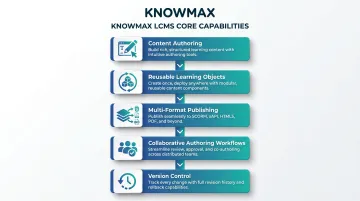
Most LCMS platforms are built around five core capabilities:
- Content authoring: Built-in editors, template libraries, and media management let instructional designers build courses and assessments without external tools.
- Reusable learning objects: Teams build modular content once and reuse it across courses. In enterprise compliance training, 85% of content is identical across departments—only 15% is department-specific, making modularity a significant time saver.
- Multi-format publishing: Exports to SCORM, xAPI, cmi5, and HTML5 for LMS deployment. While SCORM 1.2 is still the most common format in use, xAPI (IEEE 9274.1.1) and cmi5 (IEEE 9274.3.1) are the current ADL-recommended standards.
- Collaborative authoring workflows: Check-in/check-out functionality, review cycles, and SME collaboration are standard—features most LMS platforms don't offer natively.
- Version control: Tracks changes over time, maintains compliance audit trails, and enables rollback when needed.
Use Cases of an LCMS
LCMS platforms excel in organizations with large in-house L&D teams that frequently create and update digital courses. Common applications include:
- Compliance training content that requires quarterly updates
- Product knowledge modules for multi-product portfolios
- Onboarding materials across multiple departments or geographies
- Training content requiring localization into multiple languages
Adoption is strongest in sectors where content velocity is high, regulations change frequently, and localization is non-negotiable — corporate training departments, healthcare compliance teams, telecom/BPO agent enablement programs, and global enterprises managing multi-language content.
Brandon Hall Group identifies four key segments that benefit most from LCMS:
- Multi-platform organizations using different LMS/LXP systems for various audiences
- Training companies and content sellers requiring IP protection and licensing
- Compliance-driven industries needing current, version-controlled content
- Global enterprises managing training across multiple countries and languages
What ties all four together is a shared pain point: frequent updates at scale. When an LCMS pushes a single update via SCORM/xAPI launch files, that change propagates automatically across all connected platforms — no manual updates required in each LMS separately.
What is a Learning Management System (LMS)?
An LMS is a platform designed to administer, assign, track, and deliver learning experiences to learners. It serves primarily as a delivery and management layer, not a content creation tool. Content is authored elsewhere and uploaded, often as SCORM packages.
Core LMS Capabilities
- Manages user registration, role assignments, and learning paths by job function, department, or compliance requirement
- Tracks learner activity, quiz scores, completions, and certification status for compliance dashboards and skills gap analysis
- Integrates online courses with instructor-led training (ILT), virtual sessions, and forums into unified learner dashboards
- Delivers quizzes, tests, and certifications with automated scoring and pass/fail tracking
- Sends automated announcements, reminders, and notifications for course assignments or certification renewals
Where an LMS excels is multi-modal learning management: scheduling ILT sessions, managing waitlists, integrating content formats, and building cohesive learner journeys. An LCMS, by contrast, focuses on authoring that content in the first place.
Use Cases of an LMS
LMS platforms excel in organizations that outsource or have already produced their training content and primarily need to assign, track, and report on learner progress.
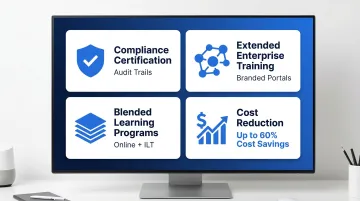
- Compliance certification: Track mandatory training completion, renewal dates, and audit trails for regulatory requirements
- Extended enterprise training: Train partners, customers, and franchise operators through branded portals with role-based access
- Blended learning programs: Combine online modules, virtual instructor sessions, and in-person workshops into structured learning paths
- Cost reduction: LMS adoption can cut training costs by up to 60% by eliminating travel, printing, and instructor fees — and 42% of companies report increased revenue from eLearning
The gap: voluntary engagement on traditional LMS platforms rarely exceeds 30%, and non-mandatory completion rates track similarly low. Delivery infrastructure alone doesn't drive learning — content quality and job relevance do.
LCMS vs LMS: Key Differences That Actually Matter
Content Creation vs. Content Delivery
LCMS tools include course builders, collaborative authoring environments, and template libraries designed to produce learning content. LMS platforms treat content as an input—they deliver it but don't generate it.
A useful way to frame it: the LCMS is where content gets built, reviewed, and refined; the LMS is where learners actually receive it. Both are essential, but they operate at different stages of the learning lifecycle.
Analytics Depth
LCMS analytics focus on the content itself. Instructional designers use metrics like:
- Time-on-page and interaction rates
- Module drop-off points
- Quiz questions with abnormally high failure rates
LMS analytics focus on the learner. L&D administrators and managers track:
- Completion rates and pass/fail statistics
- Certification status and compliance coverage
- Skills gaps by job role and time-to-competency
When integrated, LCMS and LMS analytics provide powerful combined insights: the LCMS can identify that a specific quiz question is objectively too difficult based on content usage data, while the LMS confirms that many learners are failing that section. This dual perspective enables targeted content improvements.
Collaboration and Workflow
LCMS platforms support multi-author workflows with check-in/check-out functionality, review cycles, and SME collaboration. Key workflow capabilities include:
- Simultaneous module editing by multiple instructional designers
- Version control that prevents conflicts and maintains audit trails
- Review cycles with subject matter expert (SME) collaboration
Most LMS platforms don't offer these authoring workflows natively. For distributed L&D teams managing large content libraries, this is where an LCMS accelerates development cycles.
Flexibility and Personalization
The two systems personalize training at different layers:
| Dimension | LCMS | LMS |
|---|---|---|
| Personalization scope | Content level | Assignment level |
| How it works | Dynamically filters content blocks by learner attributes | Assigns different courses or paths by job role, location, or department |
| Examples | Role-based filtering, multi-language localization, audience-specific variants | Learning paths by department, mandatory courses by location |
| Content flexibility | Content adapts within a single course | Course content remains static once delivered |
Integration and Standards
Both systems rely on SCORM, xAPI, and cmi5 standards for interoperability. LCMS platforms typically produce SCORM/xAPI packages that are then hosted and delivered through an LMS.
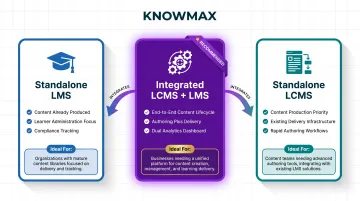
Which setup makes sense depends on your priorities:
- Both systems integrated: Best for teams that need end-to-end content lifecycle management, with authoring in the LCMS, delivery through the LMS, and analytics from both layers.
- Standalone LMS: Works when content is already produced and the primary need is learner administration and compliance tracking.
- Standalone LCMS: Works when the priority is content production and distribution to an existing delivery infrastructure.
When to Choose an LCMS vs an LMS
Decision Framework
Choose an LCMS if:
- Your team creates training content in-house at high volume
- Content requires frequent updates (quarterly regulatory changes, product releases)
- Multiple authors and SMEs collaborate on content development
- You manage large content libraries requiring version control
- Localization into multiple languages is a core requirement
Choose an LMS if:
- Your primary need is learner administration and progress reporting
- Content is stable, pre-built, or outsourced
- You need blended program management (online + ILT)
- Compliance tracking and certification management are priorities
- Automating enrollment and managing waitlists are critical
Use an integrated LCMS + LMS if:
- You need end-to-end content lifecycle management
- Custom content creation capabilities must coexist with complex learner deployment
- Analytics from both content performance and learner progress inform strategy
- Your organization supports multiple audiences across different platforms
Real-World Context: Beyond Traditional LCMS/LMS
For customer-facing teams in telecom, banking, or BPOs, traditional LCMS and LMS tools may fall short. Agents need real-time access to updated knowledge and decision support during live customer interactions—not just course completion tracking.
Contact center agents face unique challenges:
- New agent training typically takes 2-4 weeks for basic roles, 6-12 weeks for complex technical or financial roles
- Time to full proficiency averages 5-8 months
- Annual turnover rates of 30-45% drive repeated onboarding costs
- Average handling time (AHT) directly impacts customer satisfaction and operational costs
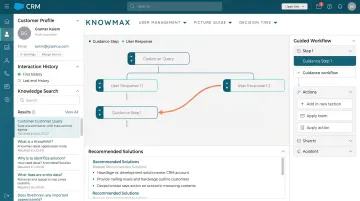
In these environments, AI-powered knowledge management platforms like Knowmax complement or extend learning infrastructure. Knowmax delivers contextual, guided knowledge at the moment of need through:
- Decision trees that transform SOPs into interactive, step-by-step guided workflows
- Knowledge search integrated directly into agent desktops and CRM systems for instant retrieval
- Visual troubleshooting guides that simplify complex technical resolutions
- Omnichannel delivery across voice, chat, email, and self-service portals
- Embedded learning modules that cut onboarding time by up to 40% without leaving the live knowledge environment
Vodafone, for instance, achieved measurable AHT reduction and improved CSAT scores using Knowmax. Concentrix separately handled over 3.7 million transactions via Knowmax-powered chatbots—results that course completion rates alone can't capture.
Decision Prompt Table
| Your Biggest Pain Point | Prioritize |
|---|---|
| Content creation volume and update frequency | LCMS |
| Learner management complexity and compliance tracking | LMS |
| Both content authoring and learner administration | Integrated LCMS + LMS |
| Real-time agent knowledge delivery during live customer interactions | Knowledge management platform (e.g., Knowmax) |
| Budget constraints with stable content library | LMS (with external authoring) |
| Small team managing large content libraries | LCMS (for efficiency and reuse) |
Conclusion
Both LCMS and LMS solve real problems, but they solve different problems. The right choice hinges on whether your organization needs to build and manage training content (LCMS), deliver and track training experiences (LMS), or both.
This is a structural choice with measurable operational consequences: faster agent onboarding, lower AHT, improved compliance rates, and consistent knowledge delivery across channels. For contact centers and customer-facing teams, those outcomes matter far more than course completion percentages.
Use this to guide your decision:
- Build and manage content at scale → invest in an LCMS
- Track learners, compliance, and training effectiveness → invest in an LMS
- Need both functions → integrate the two systems
- Require real-time support during live customer interactions → look beyond traditional learning infrastructure toward AI-powered knowledge platforms
Knowmax supports enterprise customer-facing teams with AI-powered search, decision trees, visual guides, integrated learning modules, and omnichannel deployment. It puts the right knowledge in front of agents and customers when it's actually needed. Explore how Knowmax complements your learning strategy.
Frequently Asked Questions
What is a learning content management system?
An LCMS is a platform for creating, managing, and distributing digital learning content in a centralized environment. Unlike a general CMS, it's purpose-built for instructional design with features like reusable learning objects, collaborative authoring, and multi-format publishing.
What is the purpose of a learning content management system?
The core purpose is enabling organizations to build, store, update, and deliver digital training content efficiently. LCMS platforms reduce duplication, accelerate course development cycles, and maintain version control across large content libraries—critical for compliance-driven industries and global enterprises.
What's the difference between an LMS and an LCMS?
An LMS manages and delivers training to learners through enrollment, tracking, reporting, and certification. An LCMS focuses on creating and managing the learning content itself through authoring tools, version control, and reusable learning objects. One delivers courses; the other builds them.
What are the key features of a learning content management system?
Core features typically include:
- Content authoring tools for building and editing courses
- Reusable learning objects to avoid duplicating content
- Collaborative workflows with review and approval cycles
- Multi-format publishing (SCORM, xAPI, cmi5, HTML5)
- Version control with audit trails
- Content-centric analytics tracking engagement and drop-off points
How much does a learning content management system usually cost, and are there free options?
LCMS pricing varies widely—some open-source options are free, while enterprise platforms typically start around $200/month and scale into thousands annually. Cost depends on user count, feature tier, deployment model (cloud vs. on-premise), and integration needs. Most vendors don't publish pricing publicly and require a custom quote.