Introduction
Contact centers operate at extraordinary scale—with approximately 17 million agents worldwide and 2.86 million in the United States alone—yet most struggle with a fundamental challenge: getting agents production-ready fast enough to meet demand.
New hires must master product catalogues, compliance protocols, CRM workflows, and soft skills within days of joining. When training falls short, the impact shows up fast: longer onboarding cycles, inconsistent responses, elevated Average Handle Time (AHT), and lower First Call Resolution (FCR) rates.
Chronic turnover makes this worse. Contact center attrition runs between 30-45% annually, with each replacement costing $10,000-$20,000.
Traditional classroom training can't keep pace — and 60% of agents say it delivers no value anyway.
This guide breaks down what to look for in a contact center LMS, which platforms are purpose-built for the job, and how the right choice translates into faster onboarding, lower AHT, and better FCR in 2025.
TL;DR
- Contact center LMS platforms must go beyond generic eLearning—prioritize CRM integrations, compliance tracking, and mobile access
- Leading platforms in 2025: Knowmax, TalentLMS, Docebo, SAP Litmos, and 360Learning
- Selection criteria should map to operational outcomes: reduced onboarding time, improved AHT/FCR, and lower error rates
- AI-augmented training delivers 14% higher issue resolution and 9% lower handle time, AI-augmented training delivers 14% higher issue resolution and 9% lower handle time, according to CMS Wire
- Generic LMS tools rarely fit contact center operations—platforms built around workflow integration consistently outperform standalone solutions
What Is an LMS and Why Does It Matter for Contact Centers?
A Learning Management System is a platform used to create, deliver, track, and manage training programs across an organization. For contact centers specifically, it determines how quickly agents become productive — and how consistently they stay that way.
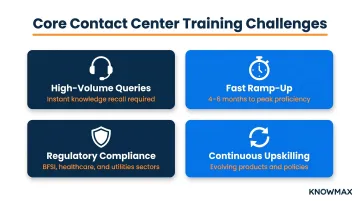
Contact centers face unique training demands:
- High-volume procedural queries requiring instant knowledge recall
- Fast ramp-up timelines—new agents need 4-6 months to reach peak proficiency, consuming 5-10% of total agent cost allocation
- Regulatory compliance across BFSI, healthcare, and utilities sectors
- Continuous upskilling as products, policies, and processes evolve
These pressures make training infrastructure a direct operational cost — not just an HR concern. The platforms below were shortlisted based on four criteria:
- Reducing time-to-proficiency for new agents
- Supporting compliance documentation and audit trails
- Integrating with contact center tools (CRMs, CCaaS, telephony)
- Supporting distributed and remote agent teams
Best Learning Management Systems for Contact Centers in 2025
These platforms were evaluated on their ability to integrate with CRM/telephony systems, deliver role-based training, automate compliance workflows, and provide analytics tied to contact center KPIs.
Knowmax
Knowmax is an AI-powered knowledge management and training platform purpose-built for contact centers and enterprise CX teams—trusted by Vodafone, Airtel, Concentrix, and Walmart.
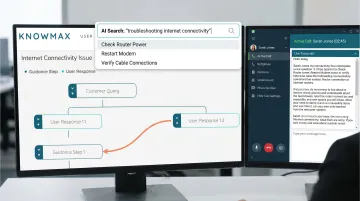
What sets Knowmax apart is its integration of structured knowledge delivery with guided training. Interactive decision trees teach agents how to handle issues step-by-step during live calls, reducing reliance on supervisors and cutting AHT. AI-powered search understands intent, not just keywords, delivering relevant answers in seconds.
| Dimension | Details |
|---|---|
| Key Features | AI-powered search, decision trees, visual troubleshooting guides, multi-language content (25+ languages), SCORM-compatible training modules, CRM integrations (Salesforce, Zendesk, Genesys, Freshworks) |
| Best For | Contact centers needing integrated knowledge + training—especially telecom, banking, insurance, and BPO environments |
| Pricing | Available on request; certifications include SOC 2, ISO 27001, GDPR, and HIPAA |
Knowmax reduces time-to-proficiency by up to 40% and improves FCR by delivering real-time, accurate knowledge during customer interactions.
TalentLMS
TalentLMS is a widely adopted cloud-based LMS built for fast deployment and scale. Large contact center teams use it to onboard agents quickly and track certification completion without heavy L&D overhead.
Its drag-and-drop course builder, gamification features, and deep integrations with Salesforce and Zoom make it practical for contact centers already embedded in major CRM ecosystems.
| Dimension | Details |
|---|---|
| Key Features | SCORM/xAPI support, role-based learning paths, gamification, AI-assisted course creation, certifications, built-in soft skills library |
| Best For | Contact centers of all sizes looking for fast-to-implement, CRM-connected LMS with strong certification tracking |
| Pricing | Free plan for up to 5 users; paid plans start at $119/month (billed annually) |
TalentLMS holds a 4.6 out of 5 stars rating on G2 based on 797 reviews.
Docebo
Docebo is a multi-tenant AI-powered LMS used by large organizations across regulated industries, offering advanced personalization, multi-portal support, and detailed analytics designed for complex, multi-region training operations.
Its AI-driven content recommendations, white-label portals, and compliance management capabilities suit contact centers managing agent training across multiple brands, regions, or outsourced teams.
| Dimension | Details |
|---|---|
| Key Features | AI-driven learning recommendations, multi-portal architecture, SCORM/xAPI/cmi5 support, social learning, integrations with Salesforce and MS Teams |
| Best For | Large or enterprise contact centers needing multi-brand or multi-region training management with advanced analytics |
| Pricing | Plans start at approximately $25,000/year (3-year contract); enterprise pricing available on request |
For global operations, Docebo supports up to 10 branded portals and AI-assisted translation across 45+ languages.
SAP Litmos
SAP Litmos is a mobile-first LMS built for organizations with compliance-heavy training needs. It's a practical choice for contact centers in regulated industries such as banking, insurance, healthcare, and utilities.
Its pre-built compliance content library of 2,700+ original courses, fast course deployment, and real-time mobile analytics allow contact center managers to assign, track, and verify training completion across distributed agent teams without significant L&D overhead.
| Dimension | Details |
|---|---|
| Key Features | Pre-built compliance course library, mobile-first design, gamification, multilingual support, real-time dashboards, AI-assisted content authoring |
| Best For | Contact centers in regulated industries (BFSI, healthcare, utilities) that need compliance training at scale with minimal setup time |
| Pricing | Available on request; Foundation and Platinum AI plans offered |
SAP Litmos provides access to over 98,000 ready-made courses through partnerships.
360Learning
360Learning is a collaborative LMS that enables internal subject matter experts—such as experienced agents and team leads—to co-create and continuously update training content, making it effective for fast-changing contact center environments where product knowledge evolves frequently.
Its built-in peer feedback loops, AI-assisted course creation, and collaborative authoring tools allow contact centers to keep training content current with minimal L&D team involvement. That matters in high-turnover environments where waiting on a dedicated L&D team slows everything down.
| Dimension | Details |
|---|---|
| Key Features | Collaborative course authoring, in-course feedback and reactions, AI-assisted content generation, SCORM/xAPI support, automated compliance workflows, multilingual interface |
| Best For | Contact centers with strong internal expertise where agents and team leads should actively contribute to training content |
| Pricing | Starts at $8/registered user per month |
360Learning's AI features can turn a document into a course in 2 minutes, accelerating content creation cycles.
How We Chose the Best LMS for Contact Centers
These platforms were evaluated on their ability to address core contact center training challenges—not generic eLearning checkboxes. Here's what the evaluation covered:
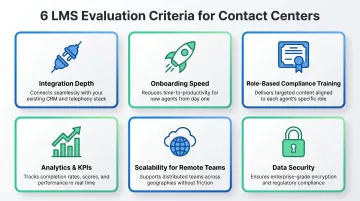
Evaluation Criteria
Integration depth with contact center tech stacks:
- CRM connectivity (Salesforce, Zendesk, Freshdesk)
- Telephony platform support (Genesys, Talkdesk)
- IVR and messaging system compatibility
Onboarding speed and course creation ease:
- Time from purchase to first training deployment
- AI-assisted content authoring capabilities
- Support for SCORM/xAPI standards
Role-based and compliance training capabilities:
- Pre-built compliance libraries for regulated industries
- Ability to create role-specific learning paths
- Certification tracking and audit trails
Analytics tied to agent performance metrics:
- Visibility into training completion rates
- Correlation between training data and AHT/FCR/CSAT
- Knowledge gap identification
Scalability for distributed or remote teams:
- Mobile accessibility
- Multi-language support
- Cloud-native architecture
Data security and regulatory compliance:
- SOC 2, ISO 27001, GDPR, HIPAA certifications
- Regional compliance packages
Each platform was also assessed on ongoing learning support, not just new hire onboarding. Contact center agents need to stay current with product updates, policy changes, and compliance requirements throughout their tenure—so continuous learning capability carried as much weight as initial deployment speed.
One common pitfall worth flagging: selecting an LMS based on price or brand recognition without verifying integration with your existing CRM, telephony, or ticketing system. A platform that doesn't connect to your tech stack creates more friction than it solves.
Conclusion
Choosing the right LMS for a contact center is not just an L&D decision—it directly impacts operational outcomes like AHT, FCR, CSAT, and agent retention. The platform you select should align with your specific environment, team size, and training cadence.
Before finalising any platform, evaluate it against:
- Tech stack compatibility — CRM, CCaaS, and ticketing integrations your agents already use
- Compliance requirements — data residency, GDPR, HIPAA, or industry-specific mandates
- Content velocity — how frequently your product or policy information changes
- Scalability — whether the platform can grow with headcount and new business units
Integration depth and scalability matter more than raw feature count.
For contact centers that need structured training and live knowledge delivery in a single platform, Knowmax combines an LMS with AI-powered search, decision trees, and agent-facing knowledge delivery — so agents learn the process and access it in the same tool. Request a demo to see how it fits your environment.
Frequently Asked Questions
What is the role of a learning management system?
An LMS creates, delivers, tracks, and manages training programs across an organization. In contact centers, it replaces manual classroom instruction with scalable onboarding and continuous upskilling—keeping agents consistently trained on products, processes, and compliance.
How much does a good learning management system cost?
Pricing varies widely: free/freemium options exist for small teams (TalentLMS free plan), mid-market plans typically range from $8 to $119/user per month, and enterprise platforms can exceed $25,000/year. Contact center-specific platforms are often priced on a custom or per-agent basis.
What is the difference between an LMS and a CMS?
An LMS (Learning Management System) is built to deliver and track training, while a CMS (Content Management System) is used to create and publish content. In contact centers, some platforms like Knowmax blend both by combining knowledge content management with guided agent training.
What features should a contact center LMS have?
Key requirements include CRM and telephony integrations, role-based learning paths, compliance tracking with audit trails, and mobile accessibility for distributed teams. AI-powered search or decision trees for just-in-time learning and analytics tied to KPIs like AHT and FCR are also critical.
How does an LMS improve agent performance in a contact center?
A well-implemented LMS reduces time-to-proficiency for new agents, automates compliance training, and gives managers visibility into knowledge gaps. These improvements directly translate to lower AHT, higher FCR, and better CSAT scores.
What are the best learning management systems for contact centers?
The top platforms for 2025 are Knowmax, TalentLMS, Docebo, SAP Litmos, and 360Learning. The best choice depends on team size, industry compliance requirements, and integration needs with existing CRM and telephony systems.