The real driver of inflated AHT is rarely agent effort—it's the absence of the right information at the right moment. Without a structured knowledge base, agents spend 15-20% of their handle time searching for information, often while the customer waits on hold. This friction, not agent capability, is what makes high AHT so costly and so preventable.
This article breaks down agent assist platforms that have demonstrated measurable AHT reduction—not just feature-rich demos. You'll walk away understanding which tools address specific AHT components, how they work in practice, and what proven results look like across real enterprise deployments.
TL;DR
- Agent assist platforms cut AHT across three components: talk time, hold time, and after-call work
- Top platforms combine real-time knowledge surfacing, guided resolution workflows, and automated post-call documentation
- Top picks covered: Knowmax, Balto AI, Observe AI, Cresta, and Dialpad — each targeting a distinct AHT bottleneck
- Key selection criteria include real-time guidance quality, knowledge delivery speed, CRM/telephony integrations, omnichannel coverage, and enterprise scalability
What Is Average Handle Time—and Why Does It Matter?
Average handle time (AHT) is the sum of talk time + hold time + after-call work (ACW). Industry benchmarks in early 2025 hit 6 minutes and 10 seconds, though this varies by sector. Retail averages 3-4 minutes, while technical support typically runs 8-10 minutes and banking sits at 4-6 minutes.
AHT is a quality metric as much as a speed one. Push it below its natural floor and CSAT declines, repeat contacts rise, and cost per contact follows. Intelligent tooling addresses this directly: AI-powered agent assist reduces AHT by eliminating mechanical friction (searching, logging, repeating), not by pressuring agents to rush.
The three specific AHT attack points that agent assist software addresses:
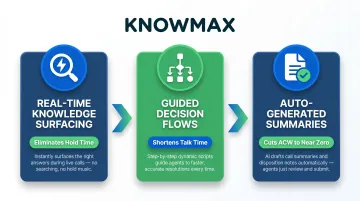
- Real-time knowledge surfacing — eliminates hold time while agents search for answers
- Guided decision flows — shortens talk time by walking agents through complex resolutions
- Auto-generated summaries and CRM updates — cuts ACW from 90+ seconds to near zero
Enterprise investment reflects this ROI case. The global call center AI market is projected to expand from $4.75 billion in 2025 to $15.77 billion by 2031, at a CAGR of 22.14% — growth led by platforms that produce verifiable reductions in handle time, not just feature lists.
Top Agent Assist Platforms That Actually Reduce AHT in 2025
These platforms were selected based on their ability to demonstrably reduce AHT—through knowledge delivery, real-time guidance, ACW automation, or a combination—not just their feature count or brand recognition.
Knowmax
Knowmax is an AI-powered knowledge management platform purpose-built for contact centers across telecom, banking, insurance, and eCommerce. Trusted by Vodafone, Airtel, Walmart, and Concentrix, it reduces AHT at the source.
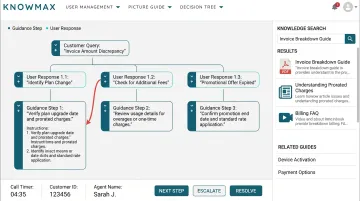
Rather than layering AI onto existing workflows, Knowmax ensures agents never search for answers mid-call — guiding them through complex resolutions with interactive decision trees and visual troubleshooting guides.
What makes Knowmax stand out for AHT reduction:
- AI-powered search understands agent intent (not just keywords), so the right resolution appears instantly
- Interactive decision trees walk agents through step-by-step guided flows that eliminate guesswork and reduce escalations
- Ready repository of 18,000+ device guides for telecom teams means even complex technical queries get resolved without hold time
- Omnichannel delivery ensures the same knowledge surfaces across voice, chat, email, and self-service
- AI author tools support content creation and translation in 25+ languages, making it ideal for multilingual global contact centers
Documented results: A fintech unicorn achieved a 10% reduction in AHT alongside a 28% increase in CSAT. A leading online food delivery app reported a 15% reduction in AHT after implementation.
| Key AHT-Reducing Features | AI-powered intent-based search, interactive decision trees, visual troubleshooting guides, AI-generated content summaries, 18,000+ device repository for telecom |
|---|---|
| Best For | Enterprise contact centers, BPOs, and telecom/banking/eCommerce support teams needing guided resolution and omnichannel knowledge delivery |
| Notable Integrations | Salesforce, Zendesk, Freshworks, Genesys, Talkdesk, SAP; GDPR, SOC 2, ISO 27001, and HIPAA certified |
Balto AI
Balto AI is a real-time voice guidance platform built specifically for live call environments—particularly strong in compliance-heavy industries like insurance, financial services, and healthcare. Balto listens to both sides of a conversation and surfaces the right prompts, compliance disclosures, and objection handlers at the moment they're needed.
Where Balto has an edge:
- Eliminates agent hesitation mid-call with dynamic checklists and real-time prompts, shortening talk time on scripted or compliance-driven interactions
- Win-rate analysis identifies phrasing used by top performers and scales those behaviors across the team
- Supervisor assist alerts allow managers to intervene instantly before a call escalates, preventing AHT from spiraling
Balto reports 20-30% AHT reduction in mature deployments, though this is a vendor-stated benchmark rather than a named customer case study. The platform has guided over 100 million conversations worldwide across 150+ customers.
| Key AHT-Reducing Features | Real-time dynamic prompts, live supervisor assist, AI-powered QA scoring, win-rate analysis and playbook automation |
|---|---|
| Best For | Voice-heavy contact centers in regulated industries (insurance, finance, healthcare) where compliance and in-call guidance are the primary AHT levers |
| Notable Integrations | Salesforce, HubSpot, Zendesk, and major telephony platforms; strong compliance audit capabilities |
Observe AI
Observe AI is a full-stack conversation intelligence platform that combines real-time agent assist with automated QA, ACW automation, and post-call analytics—covering more of the AHT lifecycle than most standalone tools, particularly for teams whose handle time inflates across multiple interaction phases.
Observe AI's approach to AHT:
- Scores 100% of interactions automatically (not a 2-5% QA sample), which means high-AHT call paths are identified and fixed systematically
- AI-generated summaries with CRM sync eliminate after-call work entirely for agents
- Supervisor dashboards with live sentiment alerts help managers catch long-handle calls before they fully inflate the average
Observe AI documents a 23% reduction in AHT across 350+ enterprise customers. Named customers include Figo Pet Insurance (which saved $700,000 annually from Auto QA replacing manual review) and DailyPay (which saved over $2 million by automating QA operations).
| Key AHT-Reducing Features | Real-time knowledge assist, 100% automated QA scoring, AI call summaries with PII redaction, CRM auto-sync, live supervisor dashboards |
|---|---|
| Best For | Mid-to-enterprise contact centers looking to reduce AHT across live call guidance, ACW automation, and coaching in one platform |
| Notable Integrations | Salesforce, HubSpot, ServiceNow, and major CCaaS platforms; SOC 2 compliant |
Cresta
Cresta is an AI platform built for enterprise contact centers that trains on the actual behavior of top-performing agents—then uses those learnings to coach every other agent in real time during live calls and chats. It's purpose-built for high-volume, revenue-generating environments in telecom, retail, automotive, and financial services.
Cresta's AHT lever:
- Generative knowledge assist sidebar surfaces contextually relevant answers based on live conversation and CRM data, bypassing pre-written scripts entirely
- Auto-QA with conversation intelligence scores every interaction and generates individualized coaching workflows that compound AHT improvement over time
- AI agents handle routine interactions autonomously, reducing the volume of calls that reach human agents in the first place
Cresta's documented results vary by use case: Snap Finance achieved a 40% AHT reduction focused on care deflection, while Brinks Home saw an 8% reduction in complex home security support, and a top US telecom reported a 10% reduction in sales chat interactions.
| Key AHT-Reducing Features | Real-time coaching from top-performer patterns, generative knowledge assist sidebar, 100% auto-QA, AI agents for autonomous resolution, conversation intelligence analytics |
|---|---|
| Best For | Large enterprise contact centers in telecom, retail, and financial services where AHT reduction is tied to revenue performance and coaching at scale |
| Notable Integrations | Salesforce, Genesys, Twilio, Five9, and major enterprise CRM/CCaaS platforms |
Dialpad
Dialpad is a cloud communications platform that has embedded AI-powered agent assist throughout its contact center product—making it one of the more accessible options for teams whose AHT inflates during the conversation itself, not before it begins. Dialpad's AI features are included at its base pricing tier, not sold as expensive add-ons.
Dialpad's built-in advantage:
- Real-time transcription and AI-powered knowledge base surfacing eliminates the hold button for information lookups
- Next-best-action suggestions reduce agent decision time mid-call
- Automatic post-call summaries eliminate manual ACW, compounding to significant time savings across large teams
Dialpad positions itself as a contact center platform with AI built in from the start, recommending an AHT target of four to six minutes for most teams. Pricing starts at $15/user/month for basic communications and $80/user/month for the full contact center suite.
| Key AHT-Reducing Features | Real-time knowledge surfacing, live sentiment analysis, next-best-action recommendations, auto-generated ACW summaries, AI transcription |
|---|---|
| Best For | SMB and mid-market teams where AHT inflation is driven by agent search time and manual after-call work, and where budget accessibility matters |
| Notable Integrations | Salesforce, HubSpot, Zendesk, Slack, Microsoft Teams; transparent published pricing |
How We Chose These Agent Assist Platforms
The focus was on platforms that reduce AHT through substantive mechanisms—real-time knowledge delivery, guided resolution workflows, ACW automation, and omnichannel consistency—rather than raw feature count. A common mistake buyers make is selecting tools based on demo impressions or chatbot sophistication rather than asking the specific question: "Does this eliminate the time agents spend searching, hesitating, or logging?"
Core evaluation factors:
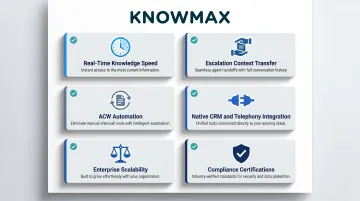
- Retrieves knowledge fast enough to surface answers during live interactions, not after
- Transfers full handoff context so escalations don't force customers to repeat themselves
- Automates ACW through call summaries, CRM sync, and ticket updates
- Connects natively to core CRM and telephony stacks (not just via third-party middleware)
- Scales across deployment sizes from 50 to 5,000+ agents with multi-tenant support
- Meets compliance requirements for regulated industries: GDPR, HIPAA, SOC 2, ISO 27001
At least 50% of generative AI projects were abandoned after proof of concept by end of 2025, most often because of poor data quality, unclear ROI, or integrations that never held up in production. Every platform on this list has documented deployments at scale—not just successful pilots.
Conclusion
Reducing AHT is not about pushing agents to move faster—it's about eliminating the friction that slows every call: searching for answers, navigating unclear processes, and manually logging outcomes. The right agent assist platform addresses each of those friction points directly, so agents spend time resolving issues rather than hunting for information.
Before selecting a platform, audit where your AHT is actually inflated. Each driver points to a different solution:
- Talk time inflation — usually signals knowledge gaps or missing guided workflows
- Hold time — agents searching for answers mid-call, often fixable with AI-powered knowledge retrieval
- ACW (after-call work) — manual logging that automated summarisation can cut significantly
Identifying the primary driver determines which tool type to prioritize, and whether a combined approach—knowledge management plus ACW automation—makes sense.
Teams focused on the knowledge layer—where most agent delays originate—can explore how Knowmax approaches this through guided demos tailored to specific industry needs, with results across telecom, banking, and BPO environments globally.
Frequently Asked Questions
How do AI agents help in customer support?
AI agents help by surfacing relevant information in real time, automating routine tasks like ticket logging and call summaries, guiding agents through complex resolution steps, and ensuring consistent, accurate responses across all customer interactions.
What is the 10-20-70 rule for AI?
The 10-20-70 rule originated from BCG and states that 10% of AI value comes from the technology itself, 20% from data and systems integration, and 70% from organizational change. AI tools like agent assist only deliver ROI when agents, processes, and workflows are aligned to adopt them.
What is average handle time in customer service?
Average handle time (AHT) is talk time + hold time + after-call work. The industry average sits around 6 minutes, though this varies by sector. It's used as a primary efficiency and cost metric in contact centers because it directly impacts labor costs and customer experience.
What features in agent assist software actually reduce AHT?
Core features include real-time knowledge retrieval, decision tree-based guided resolution, automated CRM updates, post-call summary generation, and intelligent routing. Each targets a specific component of AHT: talk time, hold time, or after-call work.
How does a knowledge management tool help reduce average handle time?
Knowledge management tools reduce AHT by ensuring agents instantly access accurate, structured information without switching systems or using hold time to search—reducing both talk time and the error rate that causes callbacks.
Can agent assist software work across all support channels?
Yes. Leading agent assist platforms deliver knowledge and guidance across voice, chat, email, and messaging channels, ensuring consistent AHT improvements regardless of the channel a customer contacts through.