Introduction
Contact centers face mounting operational pressure from multiple fronts: agent attrition averaging 39%, replacement costs topping $10,000–$20,000 per hire, and 87% of customers avoiding a brand after just one poor experience. Meanwhile, 88% of customers expect faster response times year over year, and 71% demand personalised interactions. Most operations aren't built to close that gap with headcount alone.
Generative AI changes how contact centers address these challenges at the infrastructure level. Unlike traditional rule-based automation, it understands intent, context, and sentiment to produce dynamic outputs in real time: summaries, guided workflows, and knowledge articles delivered directly within the agent's workspace.
TLDR:
- Generative AI reduces average handle time by surfacing instant, contextual knowledge during live interactions
- Knowmax powers agent assist, automated summarisation, and self-service across Salesforce, Zendesk, Genesys, and Talkdesk
- Early adopters report 14–34% productivity gains, 21% FCR improvements, and 40% faster agent onboarding
- Start with low-risk use cases like call summarisation and knowledge base optimisation before scaling
- Plan for compliance (GDPR, SOC 2, HIPAA), hallucination risks, and agent adoption from day one
What Is Generative AI in a Contact Center Context?
Generative AI goes beyond fixed decision trees and scripted chatbots. It interprets customer intent, detects sentiment, and generates human-like outputs on demand—think guided responses, article summaries, or next-step workflow recommendations surfaced in real time. This makes it fundamentally different from traditional IVR systems, which rely on rigid, pre-programmed logic.
Enhancement Layer, Not Rip-and-Replace
Generative AI functions as an intelligent layer that enhances your existing stack—CRM, telephony, knowledge base, ticketing—rather than replacing it. For instance, Knowmax integrates directly with platforms like Salesforce, Zendesk, Freshdesk, Genesys, Talkdesk, and SAP via native connectors and open APIs. Agents access AI-powered knowledge without leaving their workspace, eliminating screen toggling and context switching.
Under the hood, the integration works like this:
- APIs sync generative AI with CRM and telephony systems in real time
- When an agent opens a ticket or receives a call, the AI layer analyses conversation context, customer history, and intent
- The system surfaces relevant decision trees, visual guides, or suggested responses directly in the agent's desktop
Over 80% of organisations plan to expand human agent responsibilities, not reduce headcount. Generative AI augments agents by automating repetitive tasks and filling knowledge gaps, so agents spend less time searching for answers and more time resolving the issues that actually require human judgment—escalations, complaints, and nuanced edge cases.
Key Use Cases of Generative AI in Contact Centers
The highest-performing implementations focus on one or two use cases initially, then scale. Each use case below addresses a specific operational pain point and maps to measurable outcomes in AHT, FCR, or CSAT.
Real-Time Agent Assist
Generative AI listens to live conversations, interprets customer intent, and surfaces relevant knowledge articles, guided workflows, and suggested responses directly in the agent's workspace. No manual searches required.
How it works:
- AI monitors conversation context in real time (voice or chat)
- Based on intent and CRM history, it proactively recommends decision trees, troubleshooting guides, or scripts
- Agents select from AI-generated suggestions without toggling between systems
Impact on performance:
- A 5,179-agent study found 14% average productivity gains, with novice agents improving by 34%
- The same study showed 9% reduction in time per interaction and 1.3% higher resolution rates
- A Fortune 500 retailer reduced handling time by 13% using AI-powered workflows and visual guides
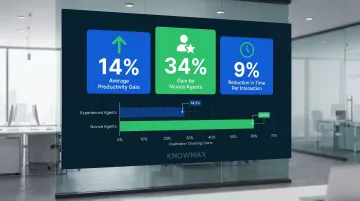
Agents spend less time navigating multiple systems and more time resolving issues. AI fills knowledge gaps instantly, cutting agent ramp-up time from six months to two months.
Automated Interaction Summarisation and After-Call Work
Generative AI converts call transcripts into structured summaries, disposition tags, action items, and CRM updates. This eliminates the manual documentation burden that typically adds 45–90 seconds per interaction.
Why it matters:
- 71% of CX leaders rank eliminating manual or repetitive tasks as the top improvement area
- Automated summarisation enables consistent, auditable records across 100% of interactions rather than selective, inconsistent notes from manual logging
- A leading online food delivery app achieved a 15% AHT reduction partly by automating post-call documentation
That documentation consistency also feeds a more important dependency: the accuracy of the knowledge layer agents draw from when resolving issues.
AI-Powered Knowledge Base Creation and Maintenance
Generative AI detects patterns in call data to identify knowledge gaps, draft new articles, flag outdated content, and suggest improvements, turning knowledge management from a static editorial burden into a continuously updated asset.
Knowmax example:
- The platform's AI author tools create, rephrase, summarise, and auto-translate knowledge content across 25+ languages
- Teams can generate FAQs from scratch, transform SOPs into decision trees, or adjust tone with a single click
- Analytics track failed searches and low-engagement content, automatically recommending updates
Why this is foundational:
Generative AI's output quality in agent assist and self-service depends entirely on the accuracy and completeness of the knowledge layer it draws from.
A leading telecom company saw FCR improve by 21% after deploying AI-powered decision trees and guided workflows—giving agents reliable access to current, accurate information at every interaction.
AI-Driven Self-Service and Virtual Agents
Generative AI powers virtual agents that handle multi-turn conversations, interpret ambiguous requests, and resolve complex queries without escalation. Unlike earlier rule-based bots that broke on anything outside their scripts, these systems handle open-ended queries across conversation turns.
Current state vs. opportunity:
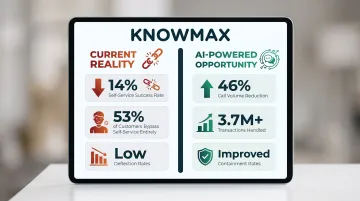
- Average self-service success rate is just 14%
- 53% of customers skip self-service entirely and go straight to a human agent
- 90% of service leaders identify improving self-service as a significant priority
Generative AI-backed chatbots use NLP to understand intent, maintain conversation context across multiple turns, and retrieve precise answers from the knowledge base. Knowmax's chatbot integrations have handled over 3.7 million transactions for clients like Ooredoo, deflecting repetitive queries and reducing call volume by up to 46% for telecom clients.
Sentiment Analysis and Escalation Prediction
Generative AI monitors tone, pacing, and language patterns in real time to detect customer frustration or confusion, enabling the system to surface agent guidance, alert supervisors, or trigger escalation workflows before interactions deteriorate.
Evidence of impact:
- The Stanford/NBER study found customers were less likely to request a supervisor when agents used AI assistance
- Customers are 2.4x more likely to stay with a brand when problems are solved quickly
Real-time sentiment detection shifts the model from reactive damage control to proactive intervention—catching at-risk interactions before they become escalations or churn events.
Agent Training, QA Scoring, and Coaching
Generative AI evaluates 100% of interactions (rather than the 2–5% reviewed manually), auto-scores performance against defined criteria, and generates personalised coaching prompts, freeing supervisors to focus on coaching rather than sampling queues.
The QA coverage gap:
- Manual QA reviews only 2–5% of interactions in most contact centers
- 92% of contact centers have a QA program, but legacy systems accurately monitor just 1–2%
- 49% of executives call automated QA a top technology investment priority
AI-powered QA enables full interaction coverage at scale, identifying coaching opportunities and compliance gaps that manual sampling misses entirely.
Business Outcomes You Can Expect
ROI from generative AI shows up across several interconnected metrics. The gains rarely stay isolated — improvements in AHT ripple into FCR, which feeds into CSAT, which reduces cost-to-serve.
Reduced Average Handle Time (AHT)
By giving agents instant access to the right information and reducing post-call documentation time, generative AI cuts minutes per interaction. Those minutes add up fast at scale.
Documented outcomes:
- 9% reduction in time per chat (NBER/Stanford study)
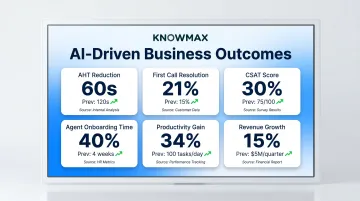
- 15% AHT reduction (leading food delivery app using Knowmax)
- Up to 60 seconds saved per call (McKinsey-cited energy company)
Improved First Contact Resolution (FCR)
Real-time guidance and better knowledge access directly reduce transfers, callbacks, and escalations. FCR is one of the most significant drivers of both customer satisfaction and cost reduction.
Typical baseline: 70–79% FCR across industries
Documented improvements:
- 1.3% increase in chat resolution rate (NBER/Stanford study)
- 21% improvement in FCR accuracy (leading telecom company using Knowmax)
Faster Agent Onboarding and Reduced Training Time
When new agents have AI-assisted guidance during live interactions, the ramp-up period shortens significantly. They don't need to memorize every product, policy, or process before handling calls well.
Typical baseline: 60–90 days for new agent ramp-up
Documented improvements:
- Agents with two months of tenure using AI performed as well as agents with six months of tenure without it—a 3x acceleration (NBER/Stanford study)
- 40% reduction in employee onboarding time (Knowmax customer data)
Lower Agent Error Rates and More Consistent Responses
When AI surfaces the same accurate, up-to-date information to every agent across every channel, variance in answer quality drops, improving customer trust and compliance adherence in the process.
This is particularly critical in regulated industries (banking, insurance, healthcare) where inconsistent responses create compliance risk.
Higher CSAT and Reduced Customer Effort
Faster resolutions, fewer transfers, and more personalised responses directly improve customer satisfaction and effort scores. The operational gains and the customer experience gains are the same gains — one just shows up on the P&L, the other in your NPS.
Documented outcomes:
- 30% increase in CSAT (Knowmax customer data)
- 40% of AI "leader" organisations reported significantly improved CX scores in the past 12 months, compared to 12% of laggards (McKinsey 2026)
Challenges and Risks to Address Before Deployment
AI Hallucinations and Data Accuracy Risks
Generative AI can produce confident but incorrect outputs. In a contact center, an agent following an AI-generated hallucination can damage customer trust and create compliance exposure.
Mitigation strategies:
- Implement human-in-the-loop workflows where agents review AI suggestions before applying them
- Use platforms with built-in guardrails and validation checks
- Maintain high-quality, continuously updated knowledge bases (garbage in, garbage out)
Data Privacy and Regulatory Compliance
Deploying AI in customer interactions triggers obligations under multiple regulatory frameworks. The two most common are GDPR and HIPAA — each with distinct requirements.
GDPR: Article 35 mandates Data Protection Impact Assessments (DPIAs) when AI processes customer data. Fines reach up to €20 million or 4% of global turnover.
HIPAA: Patient communication systems must meet Security and Privacy Rule standards — covering end-to-end encryption, access controls, and staff training.
When evaluating platforms, prioritise vendors that hold SOC 2, ISO 27001, GDPR, and HIPAA certifications (Knowmax holds all four). Also verify:
- Privacy-by-design features: automatic recording pauses for payment data, consent management, data minimisation, audit logging
- Vendor agreements confirming customer data is not used to train AI models
Agent Adoption and Change Management
If agents don't trust AI suggestions or feel monitored rather than supported, adoption stalls.
The trust gap is real: 64% of customers would prefer companies not use AI in customer service, 53% would consider switching to a competitor over AI use, and 37% of laggard organisations aren't comfortable with AI handling end-to-end interactions.
Positioning AI as a co-pilot — not a replacement — is the most effective way to close that gap:
- Involve agents in rollout planning and gather feedback during pilots
- Emphasise that AI handles repetitive tasks, freeing agents for complex, high-value interactions
- Provide training that builds confidence in AI-generated outputs
- Track and share agent productivity gains to demonstrate value
Knowmax supports this through gamified learning tools, role-based training, and real-time AI guidance that surfaces recommended workflows — giving agents control over whether and how to apply them.
Technical Integration Complexity
Connecting generative AI to legacy CRMs, telephony systems, and knowledge bases is a common bottleneck.
Only 25% of call centers have successfully integrated AI into daily operations. McKinsey's research suggests the more common failure point isn't model performance — it's the lack of orchestration and governance around it.
Prioritise platforms with pre-built integrations and flexible APIs. Knowmax offers native connectors for Salesforce, Zendesk, Freshdesk, Genesys, Talkdesk, Exotel, and SAP. Open APIs cover custom integrations, so existing infrastructure stays intact while a structured knowledge layer is added on top.
How to Get Started with Generative AI in Your Contact Center
Successful deployments follow a phased approach — not a single launch event. Each step builds on the last, so you enter broader rollout with evidence, not assumptions.
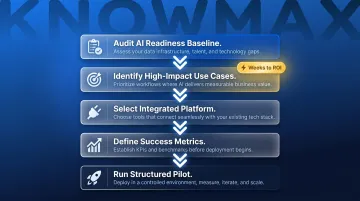
Step 1: Audit Your AI Readiness Baseline
Before selecting a platform, assess your current data assets:
- Call transcript quality: Are interactions recorded and transcribed consistently?
- Knowledge base completeness: How current and accurate is your content? How many knowledge gaps exist?
- CRM data hygiene: Are customer records complete, or do agents waste time searching for context?
This audit establishes your baseline for measuring improvement post-deployment.
Step 2: Identify One or Two High-Impact, Low-Risk Use Cases
Two entry points consistently deliver fast, measurable results without touching the customer-facing experience:
- Call summarization: Cuts AHT quickly and visibly, with no disruption to live interactions
- Agent assist: Lifts productivity for the entire team — especially agents who are still ramping up
Both show ROI in weeks rather than months, carry low risk, and generate the internal momentum needed to justify a broader rollout.
Step 3: Select a Platform That Integrates with Your Existing Stack
Knowmax example:
- Integrates with Salesforce, Zendesk, Freshworks, Genesys, Talkdesk, SAP, Exotel, and others
- Deploys AI-powered knowledge management on top of your existing infrastructure — no rebuilding required
- Chrome extension delivers knowledge directly in agent workflows, eliminating screen toggling
Evaluation checklist:
- Native integrations with your CRM, telephony, and helpdesk systems
- Open APIs for custom connections
- Security certifications (GDPR, SOC 2, HIPAA, ISO 27001)
- Vendor references from your industry vertical
Step 4: Define Success Metrics Before Launch
Measure against your baseline (from Step 1):
- AHT
- FCR
- CSAT/Customer Effort Score
- Agent onboarding time
- QA coverage percentage
Establish a measurement cadence (weekly or monthly) so you can demonstrate impact and justify scaling.
Step 5: Run a Structured Pilot with a Small Cohort
Pilot best practices:
- Select 10–20 agents representing a mix of tenure levels
- Run pilot for 4–8 weeks
- Gather qualitative feedback (agent surveys, focus groups) alongside quantitative metrics
- Use learnings to refine implementation before broader rollout
What to track during pilot:
- Agent adoption rate (% using AI suggestions)
- Accuracy of AI-generated outputs
- Time savings per interaction
- Agent confidence scores
Frequently Asked Questions
What is generative AI in a contact center?
Generative AI creates human-like outputs—summaries, responses, knowledge articles, and guidance—in real time, enabling contact centers to automate documentation, assist agents during live interactions, and power more natural self-service experiences.
How is generative AI different from traditional contact center automation?
Traditional automation relies on fixed rules and decision trees, while generative AI understands context and intent to produce dynamic, adaptive outputs—making it capable of handling complex, variable interactions that rule-based systems cannot.
Can generative AI replace human agents in contact centers?
Generative AI augments agents by handling repetitive tasks and surfacing information instantly, freeing them for complex, high-empathy interactions where human judgment is irreplaceable. Nearly 70% of contact center leaders agree empathy and trust will always require a human touch.
What contact center KPIs improve with generative AI?
Key metrics that typically improve include Average Handle Time (AHT), First Contact Resolution (FCR), Customer Satisfaction Score (CSAT), agent onboarding time, and after-call work duration. Some organisations also see gains in QA coverage and compliance adherence.
What are the biggest risks of deploying generative AI in a contact center?
Deployment risks fall into three areas:
- AI hallucinations generating inaccurate or fabricated outputs
- Data privacy exposure when PII flows through unsecured models
- Low agent adoption when the rollout lacks change management or clear positioning
Where should a contact center start with generative AI?
Start with low-risk, high-visibility use cases like call summarization or agent assist. Pilot with a small team, measure results against a defined baseline, then scale. Prioritize platforms with pre-built integrations to minimize technical complexity.