Introduction
Contact center agents need instant, accurate answers — but the knowledge bases meant to provide them have become sprawling, fragmented repositories that are difficult to navigate and harder to maintain. When an agent can't find the right answer within seconds, customers wait on hold, calls escalate unnecessarily, and inconsistent responses erode trust.
Nearly half of all calls require agents to spend time searching for information. The average agent burns 2.7 minutes per call just hunting for knowledge — time that compounds across thousands of daily interactions into measurable AHT inflation and lower FCR rates.
Generative AI doesn't just improve search — it changes how knowledge is created, kept current, and delivered mid-conversation. This guide covers the use cases worth evaluating now, the KPI improvements you can measure, and the implementation steps that connect GenAI knowledge management to your existing contact center stack.
TLDR
- GenAI drafts knowledge articles directly from tickets and call transcripts, cutting KM team workload
- Intent-based search surfaces the right answer even when agents use different words than article titles
- Guided resolution flows help agents close complex issues on the first call — critical in regulated industries
- CRM and telephony integrations, plus a content governance framework, are prerequisites for deployment
- AHT drops 15–40%, FCR improves 21–37%, and new agent ramp time shrinks by up to 40%
Why Traditional Knowledge Management Fails Contact Centers
Contact centers face three structural breakdowns that make traditional knowledge management ineffective:
Content fragmentation across disconnected systems
Knowledge lives in silos—product wikis, SharePoint folders, ticketing systems, PDF SOPs, and tribal knowledge shared via email or Slack. Agents toggle between 5-8 systems during a single customer interaction, wasting critical seconds trying to remember where the billing dispute process was documented versus the returns policy.
Knowledge decay outpaces manual updates
Product teams ship updates weekly. Pricing changes quarterly. Regulatory requirements shift without warning. Yet 61% of customer service leaders have a backlog of articles to edit, and one-third have no formal process for revising outdated content.
The result: agents cite old policies, give conflicting answers across shifts, and lose customer trust.
Keyword-only search fails agents mid-call
Traditional search requires exact keyword matches. When a customer says "my bill is wrong," but the knowledge article is titled "invoice discrepancy resolution process," keyword search returns nothing. Agents end up improvising, putting customers on hold longer, or escalating unnecessarily.
The Downstream Cost
When agents can't find accurate answers quickly, they put customers on hold (increasing AHT), escalate to specialists who don't need to be involved (wasting expensive labor), or provide inconsistent responses that require follow-up calls (tanking FCR). Employees spend nearly 20% of their workweek searching for internal information—time that could be spent actually solving customer problems.
The Onboarding Compounding Effect
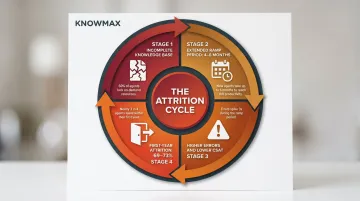
New agents trained on incomplete or outdated knowledge create error patterns that take months to correct. Average call center training takes 4-10 weeks, with time-to-proficiency stretching to 4-6 months. During this ramp period, new agents generate higher handle times, lower satisfaction scores, and higher error rates—all while the contact center absorbs the cost.
With first-year attrition at 69-73%, many agents leave before reaching full proficiency. Every departure resets the cycle—and the knowledge gaps that caused the problem in the first place remain unfixed.
What Generative AI Brings to Contact Center Knowledge Management
Generative AI goes beyond retrieving stored text. It understands context, generates new content from existing sources, and interprets what an agent or customer means rather than the exact words they typed. Traditional keyword search matches strings; generative AI reads intent.
Two Foundational Mechanisms for Contact Centers
1. Retrieval Augmented Generation (RAG)
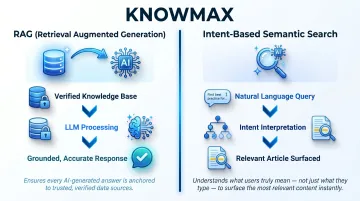
RAG optimizes large language model outputs by referencing an authoritative knowledge base before generating a response. Instead of hallucinating answers or relying solely on pre-trained data, RAG grounds AI responses in verified internal knowledge—your approved SOPs, product documentation, and compliance scripts. This ensures agents receive accurate, consistent information that reflects current policies, not generic or outdated LLM training data.
2. Intent-Based Semantic Search
Semantic search understands the meaning behind a query. When an agent types "customer says their bill is wrong," the system interprets the intent and surfaces the billing dispute resolution article—even if the article title says "invoice discrepancy process." This cuts the friction of keyword-only search and reduces the time agents spend hunting for information—often from minutes to seconds.
What GenAI Does NOT Replace
Generative AI handles information retrieval and content drafting. It does not replace human judgment or escalation decisions. Think of it as an assistant that removes the cognitive load of locating information, so agents can direct their attention where it matters most:
- Handling complex or emotionally sensitive conversations
- Making nuanced escalation calls
- Building genuine rapport with customers
Key Use Cases of Generative AI in Contact Center Knowledge Management
The following five use cases represent the highest-impact opportunities for contact center leaders evaluating GenAI for their environment.
Real-Time Agent Assist and Guided Resolution
AI listens to (or reads) the customer query in real time and proactively surfaces the most relevant knowledge articles, scripts, or decision tree steps — without the agent manually searching. This reduces cognitive load, especially during complex or multi-step troubleshooting scenarios where agents would otherwise toggle between multiple systems or rely on memory.
Generative AI takes this further by powering dynamic, guided decision tree flows that adapt based on customer responses — ensuring agents follow compliant, consistent paths to resolution. For regulated industries like banking and insurance, where scripts must be followed precisely, this eliminates compliance risk at the point of interaction. Knowmax's decision tree software converts complex SOPs into interactive workflows, so agents can navigate high-stakes calls with confidence.
Automated Knowledge Content Creation and Maintenance
GenAI drafts new knowledge articles from raw inputs — support tickets, call transcripts, product update notes — and flags outdated articles for review, reducing the manual authoring burden on KM admins. Knowmax's Max AI includes rephrase, summarize, and auto-translate functions that support content creation in 25+ languages, enabling global contact centers to maintain consistent knowledge across regions without hiring multilingual writers.
Tone, structure, and terminology stay standardized across all articles — reducing the variation that causes inconsistent agent responses across shifts and locations. Instead of ten agents interpreting the same SOP ten different ways, GenAI enforces a single, approved voice.
Intelligent Search That Understands Agent Intent
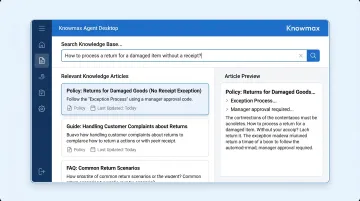
Intent-based semantic search interprets the meaning behind a query — so an agent typing "customer says their bill is wrong" surfaces the billing dispute resolution article even if the article title reads "invoice discrepancy process." This eliminates the keyword-match problem that plagues traditional search.
Agents spend an average of 2.7 minutes per call searching for information — time that GenAI-powered semantic search can cut by 60–80%. Across thousands of daily interactions, that compounds into measurable AHT reduction.
Self-Service and Chatbot Knowledge Enablement
GenAI knowledge management powers the chatbot and virtual agent layer: the same knowledge base agents use connects to customer-facing bots via RAG, ensuring bots answer from verified, approved content rather than generating unreliable responses.
A unified GenAI KM platform serves both agent-facing and customer-facing channels from a single source — eliminating the update overhead and the risk of bots and agents giving conflicting answers. Knowmax's omnichannel platform reflects knowledge base changes in real time across agent desktops, self-service portals, chatbots, and mobile apps.
New Agent Onboarding and Continuous Learning
GenAI-powered KM accelerates time-to-proficiency for new agents: instead of reading static manuals, they ask the knowledge base questions in natural language and get contextual, role-specific answers. AI-assisted onboarding can reduce time-to-proficiency by 20–30%, with some implementations cutting training time by 40–50%.
AI also personalizes knowledge delivery as agents develop:
- Surfaces more advanced content as tenure and performance improve
- Re-surfaces articles where error rates indicate knowledge gaps
- Provides instant feedback tied to specific call outcomes
Knowmax's LMS supports guided learning paths that unlock sequentially, with auto-issued certificates upon course completion.
How Generative AI-Powered Knowledge Management Improves Contact Center KPIs
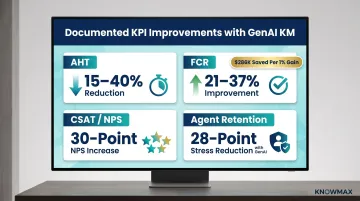
Contact center leaders are measured on four core KPIs — and GenAI knowledge management moves the needle on all of them. The improvements aren't marginal: documented outcomes span from 15% AHT reductions to 30-point NPS gains.
Average Handle Time (AHT)
Faster information retrieval plus AI-generated response suggestions reduce both hold time and after-call work. When agents spend 80% less time searching and receive next-best-action recommendations, handle time drops — often sharply.
Documented AHT reductions range from 15–40% depending on baseline performance and deployment scope. United Airlines achieved a 15% AHT reduction using AI agent assist, while a global bank documented a 67% AHT reduction with unified GenAI knowledge management.
First Call Resolution (FCR)
Guided resolution flows and real-time knowledge delivery reduce transfers and callbacks. When agents have the right answer immediately, they solve the problem on the first attempt — no callbacks, no escalations.
The financial case is specific: industry average FCR sits at 70%, with world-class performance at 80%+. For every 1% improvement in FCR, operating costs fall by 1% — roughly $286,000 in annual savings for a midsize contact center. A leading telecom achieved a 21% FCR improvement after deploying AI-driven knowledge management.
Customer Satisfaction (CSAT/NPS)
When agents are confident, accurate, and fast, customers notice. Consistency across channels — agent, chatbot, email — driven by a shared GenAI knowledge layer is especially important here. 93% of customers expect first-call resolution, and 9 out of 10 times a customer is dissatisfied, FCR was not achieved.
Real-world outcomes back this up: a major telecom saw a 30-point NPS increase, while a government agency improved its Forrester CX Index position by 33% in one year using AI-powered knowledge management.
Agent Satisfaction and Retention
Agents who have the information they need feel more competent and less stressed. 87% of agents report high workplace stress; 74% experience ongoing burnout — and the fastest path to relief is removing the friction of searching for answers mid-call.
The retention math is straightforward:
- Each 1% FCR improvement drives a 2.5% gain in employee satisfaction
- Average agent turnover runs at 31.2% annually, with replacement costs of $10,000–$20,000 per agent
- Salesforce found that 81% of agents feel overwhelmed without generative AI — dropping to 53% with it, a 28-point reduction in reported stress
Even a 5-percentage-point reduction in attrition delivers measurable ROI at that replacement cost.
How to Implement Generative AI Knowledge Management in Your Contact Center
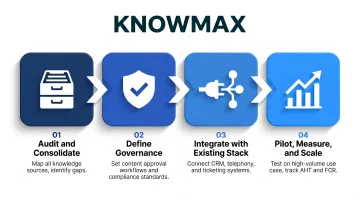
Step 1 — Audit and Consolidate Your Existing Knowledge
Before deploying AI, map where knowledge currently lives—CRM, wiki, SharePoint, ticket history—and identify the most high-impact content gaps. AI is only as good as the knowledge it is grounded in; garbage in, garbage out still applies. Prioritize consolidating frequently accessed content (billing, returns, troubleshooting) and archiving outdated material that creates noise.
Step 2 — Define Governance Before You Scale
Establish who owns content approval, how frequently articles are reviewed, and how AI-generated drafts are validated before going live. Knowmax employs a maker-checker process where team leaders and CX managers review content before publication, ensuring accuracy and compliance.
For healthcare, banking, and government contact centers, data security certifications are non-negotiable. Knowmax holds SOC 2, GDPR, HIPAA, and ISO 27001 certifications, reducing compliance risk and ensuring sensitive customer data is handled securely across regulated industries.
Step 3 — Integrate with Your Existing Contact Center Stack
GenAI KM delivers the most value when embedded directly into the tools agents already use—CRM, telephony, ticketing systems. Native integrations eliminate the need for agents to toggle between systems mid-call, reducing friction and improving efficiency.
Knowmax integrates natively with:
- Salesforce, Zendesk, and Freshworks for CRM-embedded knowledge access
- Genesys and Talkdesk for telephony and CCaaS environments
- Listed on each platform's marketplace for quick deployment within existing workflows
Step 4 — Pilot, Measure, and Scale
Start with a high-volume, well-defined use case—billing queries, return process, device troubleshooting—and measure AHT and FCR before and after deployment. Use those results to build the business case for broader rollout.
Performance gains don't sustain themselves. Two practices keep results on track after launch:
- Quarterly content audits to retire stale articles and fill gaps surfaced by failed searches
- Agent feedback loops to flag inaccurate responses and retrain the model on real query patterns
Frequently Asked Questions
How can generative AI be used in knowledge management?
Generative AI automates content creation, enables intent-based search, summarizes long documents, and delivers personalized answers. Unlike static article browsing, it understands what agents and customers mean — not just the words they type.
What are the best generative AI tools for knowledge management?
The best tools depend on the use case. Contact centers benefit most from purpose-built platforms that combine AI authoring, semantic search, decision trees, and omnichannel delivery with CRM and telephony integrations. General-purpose LLM tools typically lack the contact center-specific workflows and compliance safeguards that enterprise deployments require.
How can generative AI help IT support teams resolve technical issues?
GenAI surfaces relevant troubleshooting steps in real time, generates resolution summaries from past tickets, and powers guided flows that reduce escalations. For both IT helpdesks and technical customer support teams, this accelerates resolution time and ensures consistency across support interactions.
What are the 5 P's of strategic knowledge management?
The 5 P's are People, Process, Platform, Purpose, and Performance. Generative AI primarily accelerates the Platform and Process dimensions by automating content management and improving access speed, but it requires alignment across all five pillars to deliver sustained value.
What are the 4 pillars of generative AI?
The four core pillars are large language models, training data, retrieval and grounding mechanisms like RAG, and human oversight. In a contact center context, all four must work together — gaps in any one pillar compromise the accuracy and trustworthiness of AI-generated responses.
Is AI better than generative AI?
Generative AI is a subset of AI. Traditional AI classifies or predicts based on patterns, while generative AI creates new content. For knowledge management in contact centers, generative AI adds the ability to draft articles, synthesize answers, and understand conversational queries — none of which traditional classification models are designed to handle.