Introduction
Contact centers face a uniquely expensive onboarding challenge: new agents must simultaneously master complex product knowledge, memorize strict SOPs, and handle live customer calls under pressure. Industry data shows that agents typically require 4-6 months to reach full proficiency, with some complex environments extending this to 6-8 months. During this extended ramp period, contact centers hemorrhage money — new agents handle calls slower, escalate more frequently, and deliver lower customer satisfaction scores than their tenured peers.
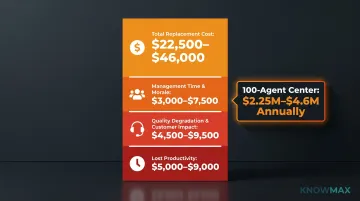
With annual agent turnover averaging 40-45% industry-wide and 69-73% of that attrition occurring within the first year, many agents quit before they ever reach proficiency. Replacing a single agent costs between $22,500 and $46,000 when factoring in recruiting, training, lost productivity, and customer impact. That math compounds fast at scale.
This article examines how AI onboarding agents — purpose-built tools distinct from generic HR platforms or basic chatbots — are helping contact centers compress ramp time by weeks. These systems deliver structured knowledge on demand, provide real-time call guidance, and reduce the classroom training dependency that slows traditional onboarding.
TLDR
- Contact center ramp time averages 4-6 months — agents go live before they've fully absorbed product and process knowledge
- AI onboarding agents surface role-specific knowledge instantly and guide resolutions in real time, not just in scheduled training sessions
- Leading contact centers report 20-35% ramp time reductions alongside drops in escalations, AHT, and early attrition
- Core capabilities: intent-based search, decision trees, visual troubleshooting guides, and CRM/telephony integration
The Real Cost of Slow Agent Ramp Time in Contact Centers
Most contact centers accept 4-6 month ramp times as inevitable, but this assumption ignores the compounding financial damage each delayed week creates. Beyond direct training costs, slow ramp time drives supervisor shadowing overhead, inflated Average Handle Time (AHT), elevated escalation rates, and CSAT degradation.
The hidden cost breakdown:
- Lost productivity: $5,000-$9,000 per agent during ramp
- Quality degradation and customer impact: $4,500-$9,500 combined
- Management time drain and team morale costs: $3,000-$7,500
- Total replacement cost when agents quit before proficiency: $22,500-$46,000 per agent
For a 100-agent contact center, these costs accumulate to $2.25-$4.6 million annually. In larger 1,000-agent operations, attrition costs alone can exceed $6 million per year.
The underlying driver is a knowledge access problem. Research shows that 45% of calls require agents to actively search for answers, adding approximately 2.7 minutes per interaction. New agents face this retrieval drag at an even higher rate, while simultaneously under more pressure to perform.
When they can't locate answers fast enough, they escalate to supervisors — creating bottlenecks that slow their own learning cycle.
That knowledge gap compounds an already fragile foundation: 65% of agents report feeling unprepared after completing their training programs. The gap between classroom knowledge and live call execution causes the majority of ramp delays. 34% of all agent attrition occurs within the first 90 days — often before organizations recoup their training investment.
What Is an AI Onboarding Agent for Contact Centers?
An AI onboarding agent for contact centers is a purpose-built knowledge delivery and guidance system designed for the contact center environment — operating before, during, and after customer interactions. Unlike generic HR tools or standard LMS platforms, it's built around the specific demands of live call handling, not classroom-style training.
Key distinctions from basic tools:
| Tool Type | Primary Function | Limitation for Contact Center Onboarding |
|---|---|---|
| Generic HR onboarding | System access, compliance forms, benefits enrollment | Doesn't address product knowledge or call handling |
| Standard LMS | Scheduled courses, certifications, testing | Knowledge stays in training environment, not accessible during live calls |
| Basic FAQ chatbot | Keyword-based article retrieval | Can't understand intent or guide through complex multi-step resolutions |
| AI onboarding agent | Context-aware knowledge delivery + real-time call guidance | Designed for contact center workflow integration |
What makes these agents different is context-awareness. They surface the right knowledge based on what's happening in the moment — a billing dispute, a device troubleshooting session, a return request — and guide agents through multi-step resolution paths that adapt as the conversation progresses.
Integration is what makes this practical. AI onboarding agents embed directly into the tools agents already use — CRM systems like Salesforce and Zendesk, telephony platforms like Genesys and Talkdesk — so knowledge appears exactly where work happens.
That matters because tab-switching isn't a minor inconvenience. It costs workers nearly 4 hours per week, and for new agents still finding their footing, fragmented tooling compounds every mistake.
Forrester frames this as a shift from "agent assist" — where humans drive work and AI supports — to "agentic" solutions, where AI handles the majority of work and humans manage exceptions. For contact centers, that transition only works when tooling, learning, and orchestration are unified in one place rather than spread across disconnected systems.
How AI Onboarding Agents Cut Ramp Time in Contact Centers
Accelerating Pre-Floor Knowledge Absorption
Traditional training requires new agents to sit through generic PowerPoint decks covering every possible scenario, hoping they'll retain enough information to handle their first live call weeks later. AI onboarding agents flip this model by delivering role-specific knowledge on demand.
Agents query the system in natural language — "How do I process a return for a damaged item?" or "What's the upgrade eligibility for business accounts?" — and receive precise answers about products, policies, and procedures instantly. This eliminates waiting for the next scheduled training session or hunting through outdated PDF manuals.
Before going live, new agents rehearse handling common customer issues by walking through AI-guided resolution paths. These interactive decision trees present branching scenarios that adapt to agent responses, building muscle memory for complex processes — without the pressure of a real customer on the line. The result: fewer first-call errors and fewer unnecessary escalations.
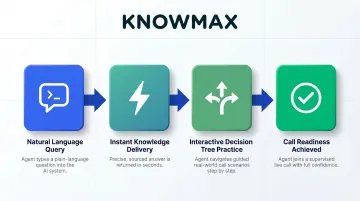
One leading contact center reduced onboarding time by 40% by integrating structured pre-floor practice with their AI knowledge platform, allowing agents to reach supervised call readiness weeks earlier than the previous classroom-only approach.
Supporting Agents During the Live Call Ramp Period
Pre-floor prep builds the foundation. The next phase — live call support — is where ramp time reductions become most visible, because knowledge gaps surface immediately and cost real money.
During an active call, the AI detects context clues (issue type, product mentioned, customer intent) and automatically pushes relevant knowledge articles, resolution steps, or troubleshooting guides to the agent's screen. New agents don't need to manually search mid-call or put customers on hold while hunting for information.
When a customer mentions "internet connection dropping," for instance, the system instantly surfaces the connectivity troubleshooting tree — diagnostic questions and resolution steps organized by likely cause — so the agent follows a guided path rather than relying on memorized procedures.
This same logic replaces multi-step SOP memorization. If a troubleshooting step reveals a particular symptom, the system automatically navigates to the appropriate next action, reducing incorrect resolutions and unnecessary escalations to senior agents.
Measurable impact on ramp time:
McKinsey research found that simulation-led and AI-assisted onboarding reduced agent time-to-proficiency by 20-30%. Real-world deployments confirm these results:
- Cox Communications reduced ramp time by two weeks, with new hires reaching 100-200%+ of revenue attainment goals for the first time
- A Symphony AI deployment achieved 35% faster time to full productivity and 20% reduction in new-agent attrition
- The same implementation projected $1.7M in annual savings from reduced training time and lower attrition across 500+ agents
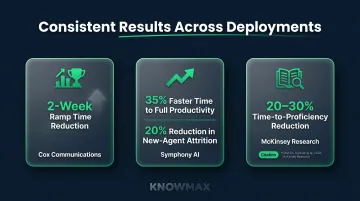
Across deployments, the pattern is consistent: agents who receive real-time guidance during live calls don't just perform better — they reach full independence faster, with less attrition along the way.
Key Capabilities to Look for in a Contact Center AI Onboarding Agent
AI-Powered Knowledge Search and Delivery
Intent-based AI search — which understands what the agent is trying to resolve, not just matching keywords — is critical for new agents who don't yet know the right terminology. A system that returns relevant answers to natural language queries dramatically shortens lookup time during calls.
A new agent searching for "customer wants refund but past deadline" will get relevant results from an intent-based system, even if the official knowledge article is titled "Post-Purchase Return Policy Exception Handling." Keyword-based search would miss this connection, forcing the agent to guess different search terms or escalate.
The knowledge base also needs the right structure: organized by role, product category, issue type, and channel so new agents get contextually appropriate information rather than sifting through a generic document library.
Knowmax addresses this with AI-powered knowledge management that combines decision trees, visual troubleshooting guides, and AI author tools — keeping content current and ensuring agents surface exactly what their role and current call context require.
Guided Resolution and Decision Support Tools
Interactive decision trees act as a "digital senior agent" that walks new hires through every resolution step, reducing cognitive load and ensuring consistent, policy-compliant call handling even in the first week.
Decision trees cut ramp time in four concrete ways:
- New agents follow structured paths instead of memorizing procedures
- Branching logic adapts to customer responses automatically
- The workflow builds compliance and quality in, rather than leaving it to agent recall
- Agents build confidence through guided repetition before handling calls independently
Contact centers supporting technical products — in Telecom, Insurance, and eCommerce — see clear gains from step-by-step visual aids. New agents handling device troubleshooting, installation guidance, or claims processing can follow image-based guides rather than interpreting text-heavy articles, cutting resolution errors during the ramp period.
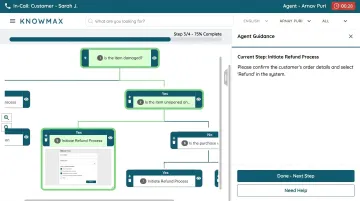
A telecom provider using Knowmax's visual device guides reported a 21% improvement in First Call Resolution and 90% call quality achievement, with new agents reaching performance targets significantly faster than previous cohorts.
Integration and Omnichannel Consistency
The best decision trees and knowledge articles lose their impact if agents have to leave their primary workspace to access them. An AI onboarding agent must integrate natively into the tools agents already use — CRM platforms, telephony systems, and ticketing tools — so knowledge support appears in-flow rather than requiring system switching.
Workers toggle between applications approximately 1,200 times per day, losing over 2 seconds per switch — nearly 4 hours of lost productivity per week, or 5 full workweeks annually. For new agents still learning navigation, that drag compounds fast.
The operational impact of fixing this is measurable:
- One BPO achieved a 20% reduction in AHT by implementing a unified agent desktop
- Knowmax connects with Salesforce, Zendesk, Genesys, Talkdesk, and other leading platforms, delivering knowledge directly within the agent's primary workspace
- Unified access means new agents learn one interface — not multiple disconnected systems
Nearly half of all agents work across multiple channels — voice, chat, email, social — amplifying the importance of consistent knowledge delivery regardless of interaction type.
How to Implement an AI Onboarding Agent in Your Contact Center
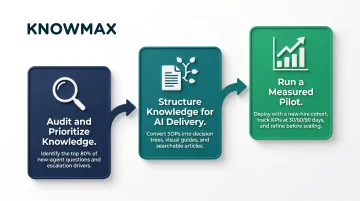
Step 1 — Audit and prioritize knowledge:
Before deploying any AI onboarding agent, identify the top issues that drive 80% of new agent questions, errors, and escalations in their first 90 days. This knowledge gap analysis defines what the AI must be trained on first for maximum ramp-time impact.
To pinpoint where new agents struggle, pull data from:
- Call recordings flagged for errors or long hold times
- Escalation logs from the first 30 and 60 days
- Supervisor notes on recurring coaching topics
Common gaps cluster around specific product categories, exception handling, and multi-step processes that require memorization.
Step 2 — Structure knowledge for AI delivery:
Convert raw documentation into AI-ready formats:
- Decision trees for process-heavy workflows — returns, escalations, account changes
- Visual guides for technical troubleshooting — device setup, diagnostic procedures
- Searchable articles for policy and product information — eligibility rules, feature explanations
Poorly structured content limits how effectively an AI agent can surface the right answer at the right moment. Invest time organizing knowledge by issue type, product category, and agent role rather than dumping existing PDFs into the system.
Step 3 — Run a measured pilot:
Deploy the AI onboarding agent with a new hire cohort and define clear KPIs:
- Days to first unsupervised call (target: 20-30% reduction from baseline)
- Escalation rate at 30/60/90 days compared to previous cohorts
- AHT during ramp compared to tenured agent baseline
- New agent CSAT scores at each milestone
- Agent confidence/preparedness survey results
Use pilot data to continuously refine both the knowledge content and the AI's guidance logic before scaling. Pay attention to which articles are most searched, where agents drop off in decision trees, and which topics generate the most escalations — these signals tell you exactly where to improve before you roll out to the full center.
Frequently Asked Questions
How to onboard AI agent?
Onboarding an AI agent in a contact center involves feeding it structured, role-specific knowledge (SOPs, product guides, decision trees), integrating it with existing CRM and telephony tools, and validating outputs with a pilot cohort before full deployment. Start with high-volume issue categories and refine based on agent usage patterns.
What is the 30 60 90 onboarding rule?
The 30-60-90 rule breaks onboarding into three phases: foundational training (days 1–30), supervised call handling (days 31–60), and independent performance with coaching (days 61–90). AI onboarding agents accelerate each phase by delivering on-demand knowledge and real-time call guidance when agents need it most.
How is AI used in onboarding?
AI is used in contact center onboarding to deliver on-demand knowledge, guide agents through resolution flows in real time, automate repetitive Q&A, and provide managers with visibility into where new hires struggle. This compresses ramp time by replacing static training manuals with live, in-call guidance that adapts to what the agent is handling.
What are the 5 stages of the onboarding process?
The five stages are: Pre-boarding, Orientation, Role-specific Training, Performance Ramp, and Integration. AI onboarding agents compress the middle three stages — where knowledge gaps cause the most delay — by surfacing the right information at the right moment.
What are the 5 C's of onboarding?
The 5 C's are Compliance, Clarification, Culture, Connection, and Check-back. AI onboarding agents primarily accelerate Clarification and Check-back — the two areas where contact center ramp time is lost most, due to unanswered process questions and gaps in ongoing feedback.