Introduction
Contact center leaders face a persistent challenge: agents need to be ready fast, stay updated constantly, and perform consistently across every interaction. Yet most centers still rely on classroom sessions that vary by trainer, static PDFs that go stale within weeks, or tribal knowledge passed down from tenured reps who may leave at any time. This fragmented approach doesn't just slow onboarding—it creates quality variance, compliance gaps, and performance unpredictability.
For contact center operations leaders, "LMS" is more than an L&D talking point. What matters is whether it actually improves Average Handle Time (AHT), First Call Resolution (FCR), onboarding speed, and compliance audit readiness.
That outcome depends on how the system is implemented and whether it connects to measurable operational goals—not just completion checkboxes.
TL;DR
- An LMS replaces scattered training methods with standardized learning paths and version-controlled content — all in one place
- Top operational wins: cutting agent ramp-up from 4–8 weeks, consistent customer handling, and real-time visibility into training gaps
- Unstructured training inflates resolution costs by 55% for bottom-performing agents — and creates measurable compliance exposure
- ROI grows when LMS completion data is tied directly to call quality scores and KPIs
What Is an LMS in the Context of a Contact Center?
An LMS is a software platform that creates, delivers, and tracks training content—the infrastructure through which agents learn procedures, compliance requirements, and customer-handling skills. The contact center use case, though, differs sharply from general corporate training.
Unlike onboarding a marketing team or training office staff, contact center LMS deployments need to handle:
- High-volume onboarding cycles — seasonal spikes, continuous replacement hiring, and BPO environments where 40–60% of agents leave within their first 90 days
- Frequent content updates — version-controlled content that pushes policy changes, product updates, and regulatory revisions to all active modules without manual re-distribution
- Role-specific skill paths — agents, QA analysts, team leaders, and supervisors each need distinct curricula; a single generic track prepares none of them adequately
- Performance-driven outcomes — completion rates are a vanity metric; what matters is whether agents handle calls correctly, faster, and with fewer escalations
An LMS succeeds in a contact center when it shortens the gap between "certified" and "competent": agents who pass assessments should be ready for the messy, unpredictable situations they'll actually face on live calls—not just the clean scenarios built into the training module.
Key Advantages of an LMS for Contact Centers
The advantages below focus on operational outcomes that contact center leaders actually track—cost, efficiency, quality, and risk management. Each benefit connects directly to measurable KPIs.
Faster Agent Onboarding and Reduced Ramp-Up Time
An LMS compresses the time it takes to get a new agent from hire to independent, productive performance—a critical metric in environments with high turnover and continuous hiring.
How an LMS creates this advantage:
Structured learning paths walk new hires through product knowledge, call handling procedures, and compliance requirements in a fixed, reproducible sequence. This replaces ad hoc shadowing sessions that vary by trainer availability and trainer quality, eliminating the inconsistency that leaves some agents "certified but unprepared."
Why this is an advantage:
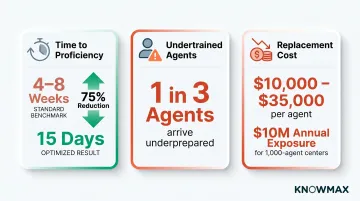
- New contact center agents typically require 4-8 weeks to reach basic proficiency, with complex environments stretching to 4-6 months for peak performance. One documented case reduced training time from 60 days to 15 days—a 75% reduction—using structured digital guides instead of memorization-based classroom training.
- Only 71% of frontline staff felt their training adequately prepared them for success—a figure that dropped 3% over two years—meaning nearly 1 in 3 agents hits the floor undertrained on the edge cases that actually show up on calls.
- Every extra week on ramp-up costs the business in supervision, errors, and partial productivity. Replacing a single agent runs $10,000–$35,000; for a 1,000-agent center at 40% turnover, annual replacement costs approach $10 million.
KPIs impacted:
- Time-to-proficiency
- Training cost per agent
- Supervisor hours spent on coaching new hires
- Early attrition rates (70% of first-year turnover occurs within the first 90 days)
When this advantage matters most:
- Centers with seasonal hiring spikes
- BPOs onboarding large batches simultaneously
- Operations where trainers can't realistically keep pace with hiring volume
- Any center where annual turnover exceeds 30%
Consistent, Compliant Customer Handling Across Every Agent
An LMS ensures that every agent—regardless of hire date, trainer, or team—receives identical foundational training on policies, procedures, compliance requirements, and customer handling standards.
How an LMS creates this consistency:
Centralized content means when a policy changes, one update cascades to all active training modules. Version control eliminates the risk of agents operating on outdated procedures. Mandatory completion ensures no one skips critical modules, and audit-ready records document who completed what and when.
Pairing LMS-delivered compliance training with an AI-powered knowledge base like Knowmax extends consistency beyond training into live calls—agents can access verified, current information in the moment, not just before their shift starts.
Why this is an advantage:
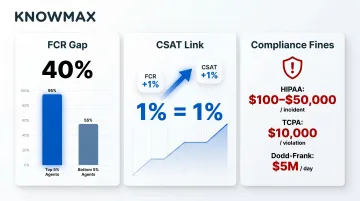
- The FCR performance gap between the top 5% and bottom 5% of agents is 20 percentage points, reaching 30–40% in lower-performing centers—driven largely by inconsistent training, not individual capability.
- For every 1% improvement in FCR, there is a 1% improvement in CSAT—the metric with the highest correlation to customer satisfaction of all contact center KPIs.
- Compliance failures carry hard costs: HIPAA violations run $100–$50,000 per incident, TCPA fines reach $10,000 per violation, and Dodd-Frank penalties can hit $5 million per day—making standardized training a legal necessity, not just an ops preference.
KPIs impacted:
- First Call Resolution
- CSAT scores
- Compliance audit pass rates
- Escalation rates
- Call quality scores
When this advantage matters most:
- Multi-site contact centers
- BPOs managing multiple clients with different protocols
- Any center operating in a regulated industry
- Operations that recently underwent product or policy changes
Actionable Visibility Into Training Gaps and Agent Performance
An LMS gives training managers and operations leaders data on who completed what, how agents scored on assessments, which modules are failing learners, and where knowledge gaps are concentrated—replacing anecdotal QA feedback with structured, trackable evidence.
How an LMS creates this visibility:
Built-in analytics dashboards report on:
- Completion rates by cohort or team
- Assessment scores and failure rates
- Time-to-completion
- Content drop-off points (where learners disengage)
- Module-level performance trends
This lets managers identify which agents need targeted coaching before those gaps show up in live call quality.
Why this is an advantage:
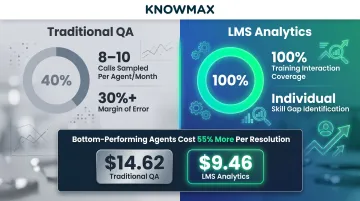
- Most contact centers QA only 8–10 calls per agent per month—against a statistically valid requirement of 278—creating a margin of error exceeding 30%. LMS analytics cover 100% of training interactions, closing that blind spot entirely.
- Deutsche Telekom trained 8,000 service agents using AI-driven capability analytics, achieving a 14-point NPS increase and 10% year-over-year improvement in first-time resolution by identifying individual skill gaps and delivering hyper-personalized micro-trainings.
- The ability to identify and close gaps before they hit the floor means fewer repeat contacts, fewer escalations, and lower AHT—all of which compound into measurable cost savings. Bottom-performing agents cost 55% more per resolution ($14.62 vs. $9.46) due to repeat contacts.
KPIs impacted:
- QA scores
- Assessment pass rates by team
- Average Handle Time
- Repeat contact rate
- Coaching efficiency (time per agent improvement)
When this advantage matters most:
- Large centers where QA can only sample a fraction of calls
- Remote or hybrid teams where manager visibility is lower
- Operations running continuous improvement programs that need data to prioritize coaching effort
What Happens When an LMS Is Missing or Ignored
Without structured LMS-driven training, contact centers experience predictable operational failures:
Inconsistent agent quality: Agent performance varies by trainer, hire date, or team — customers get different answers to the same question depending on who picks up. In low-performing contact centers, FCR variance between best and worst agents reaches 30-40%, a direct marker of training inconsistency.
Compliance exposure: Manual tracking of regulatory module completions creates gaps, especially during high-turnover periods. Nearly 70% of first-year attrition occurs within the first 90 days, meaning compliance records are constantly incomplete when audits arrive.
Slow onboarding: Without a structured path, new agents shadow different tenured reps and absorb different habits. This extends time-to-performance and multiplies supervisor overhead. Only 71% of frontline staff feel training adequately prepared them for the role.
Reactive performance management: Training gaps surface only after errors appear on the floor. Every improvement cycle lags behind the problem. Staff receiving regular, structured feedback report 73% job satisfaction versus 49% for those who don't.
Broken scaling: When hiring volume spikes, informal training collapses. There aren't enough trainers, sessions lose consistency, and new agents enter the floor undertrained — extending ramp time and increasing supervisor load precisely when capacity is most stretched.
How to Get the Most Value from an LMS in Your Contact Center
An LMS delivers its full value only when implementation is treated as an operational initiative, built into how the center runs day to day. Key conditions for success:
1. Build Training Around Real Operational Gaps
Start with what QA actually flags, the questions agents most frequently escalate, and the compliance areas with the highest risk exposure. Generic onboarding modules cover the basics but rarely move the metrics that matter.
2. Keep Content Synchronized With Live Operations
An LMS loses value fast if training materials lag behind policy changes, product launches, or new compliance requirements. Stale content is actively harmful—it trains agents on procedures they'll need to unlearn the moment they hit the floor.
Connecting your LMS to a live knowledge base (like Knowmax) closes this gap. Policy updates push simultaneously to training modules and the agent-facing knowledge base, so agents are never working from two different versions of the truth.
3. Act on the Data the LMS Generates
Completion reports and assessment scores should feed directly into QA workflows and coaching calendars. When a cohort consistently scores low on a particular module, that's a signal to retrain—not a stat to note and forget. The centers that extract real value from an LMS treat its analytics as operational inputs, not reporting outputs.
Conclusion
An LMS delivers on three operational outcomes that contact centers actually measure:
- Speed — agents reach full productivity faster, cutting ramp time from weeks to days
- Consistency — every customer gets the same quality of service, regardless of which agent picks up
- Visibility — training gaps surface in the data before they show up in CSAT scores
These advantages compound over time. Performance data builds up, content gets refined based on real call outcomes, and the behavioral gap between high and low performers narrows. Delayed adoption doesn't avoid the cost — it just shifts it toward extended ramp times, compliance penalties, and customer churn.
Frequently Asked Questions
What are the benefits of a learning management system?
An LMS centralizes content, ensures consistent delivery, accelerates onboarding, and provides analytics-driven improvement. For contact centers specifically, these translate into better FCR, lower AHT, stronger compliance audit readiness, and measurable reductions in cost per resolution.
What is the main purpose of an LMS?
An LMS exists to create, deliver, and track structured learning—ensuring the right people complete the right training and that performance gaps can be identified and closed before they affect live call outcomes. The purpose is operational readiness, not completion metrics.
Is LMS training worth it?
Yes. The cost of undertrained agents—extended ramp time ($10,000–$35,000 per departure), errors 55% more expensive per resolution, attrition hitting 70% within 90 days—consistently outweighs platform investment. A 100-agent center can realize roughly $282,000 in combined productivity and attrition savings annually through structured LMS-driven performance management.
What is the difference between an ERP and an LMS?
An ERP manages business operations—finance, HR, supply chain—while an LMS specifically manages the training and learning lifecycle. They can integrate (for example, pushing new hire data from HR systems into LMS enrollment), but they serve completely different functions.
What is the difference between an LMS and a knowledge base in a contact center?
An LMS trains agents before and between calls through structured learning, assessments, and compliance modules. A knowledge base supports agents during live calls with real-time information retrieval, guided troubleshooting, and decision trees. Both are necessary, and they work best when used together—ensuring training content stays synchronized with operational knowledge.
How long does it take to see results from an LMS in a contact center?
Onboarding speed and training consistency improve within the first few months of structured implementation. Longer-term gains in CSAT, FCR, and compliance outcomes typically emerge over 6–12 months as content is refined based on real performance data.