Introduction
Contact center training teams face a frustrating paradox: agents complete training modules with 95% pass rates, yet first-call resolution (FCR) remains stubbornly below target, customer satisfaction scores plateau, and new hires still take months to reach acceptable performance levels. That gap between "training completed" and "agent ready" carries a real price tag. With annual turnover rates between 30% and 60%, replacing and retraining a single agent can cost $10,000 to $35,000 once you factor in recruiting, onboarding, and lost productivity.
The real issue is that classroom learning rarely transfers to live call performance at the speed or consistency operations require. High-performing contact center training teams approach their Learning Management System (LMS) differently to close that gap. Rather than treating it as a course delivery tool, they use it to:
- Connect training outcomes directly to operational metrics like FCR and AHT
- Build role-specific learning paths that mirror real-world job complexity
- Embed performance support tools that help agents apply knowledge on active calls
- Track where knowledge breaks down — not just where training was completed
This article covers the specific practices that separate those teams from the rest.
TLDR
- Top teams build distinct learning paths for new hires, tenured agents, team leads, and QA analysts — not one-size-fits-all programmes
- Effective LMS measurement ties directly to FCR, AHT, and CSAT — not just module completion rates
- Decision trees and AI-powered knowledge tools close the application gap by supporting agents during live calls, not just in training
- Content refresh triggers tied to product launches, QA trends, and policy changes keep training accurate without manual lag
Why Contact Centers Need a Different LMS Approach
The Unique Demands of Contact Center Training
Contact centers operate in a high-pressure environment where knowledge gaps surface immediately during live customer interactions. Agents must navigate 8 to 12 different applications during a single call and handle queries that are 70% more complex than a decade ago—all under constant time pressure.
New hires typically operate at only 50–60% productivity during their first three months. Yet with annual turnover averaging 38% per SQM Group's 2025 benchmarking data, most centers can't afford a slow ramp.
Compressed onboarding timelines—often 4 to 12 weeks depending on complexity—leave little room for gradual skill building. Meanwhile, product updates, pricing changes, and policy revisions can make training materials obsolete within days, forcing L&D teams to constantly refresh content while simultaneously onboarding new cohorts.
Why Generic LMS Best Practices Fall Short
Most enterprise LMS guidance prioritizes learner engagement, course completion rates, and stakeholder adoption. These metrics matter, but they don't address the contact center's core challenge: ensuring that what agents learn translates into correct behavior during live calls.
A 95% completion rate is meaningless if FCR doesn't improve. Traditional LMS implementations focus on delivering content and measuring consumption—rarely connecting training outcomes to what operations leaders actually track:
- First contact resolution (FCR) rates
- Average handle time (AHT)
- Quality assurance scores
- Customer satisfaction (CSAT)
The gap between "trained" and "performs correctly" is where most contact center training programs lose ground. SQM Group research found that 38% of FCR failures are attributable to agent mistakes—knowledge gaps and skill deficiencies that training is designed to prevent. That means over a third of resolution failures are training outcomes, not motivation or policy issues.
High-performing training teams close this gap by treating the LMS as one piece of a broader performance system—one that connects learning directly to real-time agent support, quality analytics, and rapid content updates when policies change.
Build Role-Based Learning Paths for Every Contact Center Persona
Define Distinct Personas
A single training program fails every contact center role because each requires fundamentally different competencies:
- New hire agents need product knowledge fundamentals, call handling basics, compliance training, and CRM navigation
- Tenured agents benefit from advanced troubleshooting, de-escalation techniques, and product specialization
- Senior or specialized agents (retention, escalations, technical support) require deep domain expertise and complex scenario handling
- Team leads and supervisors need coaching frameworks, quality calibration methods, and escalation management skills
- QA analysts must master evaluation criteria, calibration processes, and constructive feedback delivery
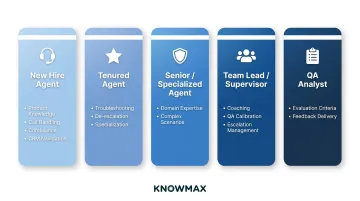
Each persona has different baseline knowledge, different performance expectations, and different learning needs. Forcing them through the same curriculum wastes time and dilutes effectiveness.
Map Learning Objectives to Job-Specific Competencies
Effective role-based paths start with clear competency mapping. Each path targets what that role actually does on the floor:
- New hire paths cover product catalog mastery, standard call flows, compliance requirements (TCPA, PCI, HIPAA), and basic objection handling
- Team lead paths build people skills: delivering feedback, side-by-side coaching, using QA scorecards in development conversations, and managing escalations without undermining agents
- QA analyst paths focus on calibration consistency, identifying root causes of quality failures, and translating quality data into actionable coaching themes
This specificity ensures training time directly builds the skills each role needs to succeed, rather than wasting time on irrelevant content.
Use Adaptive Learning to Prevent Underqualified Progression
High-performing teams configure their LMS to re-route agents who score below thresholds on assessments. If a new hire scores under 80% on a product knowledge quiz, the system automatically assigns reinforcement modules before allowing progression to call simulation or nesting phases.
Moving underprepared agents to the floor is costly. Knowledge gaps show up quickly as customer-facing errors, extended handle times, and quality failures — all preventable with proper gating.
Separate Compliance from Skills Development
Bundling compliance training (harassment prevention, data security, regulatory requirements) with skills development (objection handling, empathy techniques) creates two predictable problems. Agents rush through compliance to reach content they find useful, then mentally disengage from material that carries real legal risk.
Best practice: Create distinct tracks in your LMS. Compliance modules are standalone, time-bound, and completion-gated. Skills development paths are progressive, scenario-based, and performance-gated.
That structural clarity — separating what's mandatory from what's developmental — also makes managing large groups of learners far more tractable.
Leverage Cohort Management for Batch Hiring
Contact centers frequently onboard agents in waves: seasonal ramps, new client launches, expansion hiring. Managing these cohorts manually is inefficient and error-prone.
Use LMS cohort features to:
- Launch entire groups into structured learning paths simultaneously
- Track cohort completion rates and identify at-risk learners early
- Graduate cohorts as a unit once all members meet proficiency thresholds
- Compare cohort performance over time to refine onboarding curriculum
Measure What Matters: Connect LMS Metrics to CX Performance
Move Beyond Completion Rates
Completion rates are a baseline metric—they confirm agents consumed the content. But completion alone doesn't indicate learning, retention, or application. A tiered KPI framework provides much clearer visibility:
Tier 1 (Baseline): Completion rates and on-time enrollment
Tier 2 (Learning): Assessment scores and pass rates
Tier 3 (Proficiency): Time-to-proficiency (days from hire to acceptable QA score)
Tier 4 (Performance): Post-training performance delta (change in FCR, AHT, QA score, or CSAT after completing a module)
Cross-Reference LMS Data with Operational KPIs
The most valuable insight comes from connecting training data to operational outcomes. SQM Group's research demonstrates that every 1% improvement in FCR yields a 1% improvement in CSAT, a 1.4-point NPS increase, and $286,000 in annual operational savings for a midsize call center. That scale of impact puts training effectiveness squarely on the P&L — not just the L&D scorecard.
High-performing teams regularly analyze:
- Which training modules correlate most strongly with FCR improvement
- Whether agents who score higher on product knowledge assessments also achieve better QA scores
- How time-to-proficiency impacts long-term agent retention and performance
Identify the "Trained but Underperforming" Cohort
One of the most actionable LMS analytics practices is identifying agents who completed all required training and passed assessments but still show poor on-floor performance. This cohort signals a specific problem: either the training content doesn't reflect real-world scenarios, or agents can't apply learned knowledge under live call pressure.
The fix isn't motivational coaching. These agents need content refinement, additional scenario-based practice, or better real-time support tools during live interactions.
Build Shared Reporting Dashboards
Surfacing these gaps consistently requires more than occasional analysis — it requires infrastructure. Training outcomes are a shared responsibility between L&D and operations, so both teams need live access to the same data. Build dashboards that show:
- Training completion by cohort and role
- Assessment performance trends
- Time-to-proficiency by training path
- Post-training performance metrics (FCR, AHT, QA score) for recent graduates
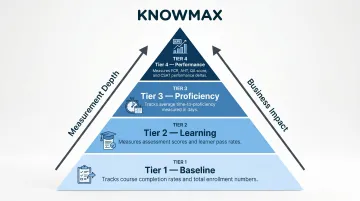
When L&D and operations review the same numbers, performance conversations shift from blame to diagnosis — and fixes happen faster.
Close the Knowledge-to-Performance Gap with Real-Time Support
The Forgetting Curve Under Pressure
Even well-designed training runs into a hard limit: agents forget most of what they learn. Ebbinghaus's foundational research, replicated in 2015, shows approximately 67% of learned material is lost within 24 hours without reinforcement. Under call pressure, it gets worse—systematic reviews found acute stress impairs memory retrieval in 16 of 18 experimental conditions.
Contact center agents face this daily. They train on dozens of processes, policies, and troubleshooting steps, then must recall precise details during fast-paced interactions while juggling multiple systems simultaneously.
Distinguish LMS from Performance Support
The LMS delivers structured learning before and between shifts: foundational knowledge, scenario practice, and skill building. Performance support tools handle something different—real-time assistance during live interactions. High-performing teams use both, and know when each applies:
- LMS role: Build foundational knowledge, establish competency baselines, deliver scenario-based practice
- Performance support role: Provide guided assistance during live calls, surface answers instantly, ensure correct application of learned procedures
Types of In-Call Support That Close the Gap
Effective real-time support includes:
- Interactive decision trees that guide agents step-by-step through complex scenarios, eliminating the need to memorise dozens of troubleshooting paths. ICMI research shows these tools make new employees as efficient as experienced agents by ensuring consistent resolution paths and directly improving FCR.
- Visual troubleshooting guides that break down technical procedures into annotated, step-by-step images—ideal for device setup, software installation, or hardware diagnostics.
- AI-powered search that retrieves the right answer from a knowledge base in seconds based on intent, not just keywords, reducing time spent hunting for information during calls.
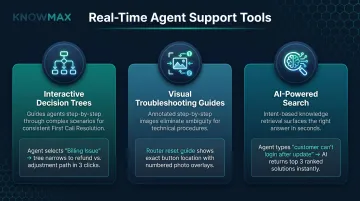
Knowmax combines all three of these capabilities in a single platform, built to sit alongside the LMS rather than replace it. The goal is straightforward: what agents learn in training should show up in how they handle calls.
Create a Continuous Improvement Loop
Integrating LMS data with knowledge management systems creates a powerful feedback mechanism:
- QA and performance data surface knowledge gaps (e.g., recurring errors on billing disputes)
- LMS delivers targeted refresher training on the identified topic
- Performance support tools reinforce correct behaviours in real time during calls
- Analytics confirm whether the intervention improved FCR or reduced errors
Teams that close this loop consistently tend to reduce repeat errors faster than those relying on scheduled training cycles alone—because they're responding to what's actually breaking down, not what they assume might be.
Keep Training Current with a Rapid Content Update Cadence
The Content Freshness Challenge
Contact centers face constant change: new product launches, pricing adjustments, regulatory updates, and revised escalation procedures. When agents work from outdated information, the result is direct CSAT damage, compliance risk, and increased call volume from incorrect resolutions.
Establish Event-Driven Content Review Triggers
High-performing teams don't rely solely on annual or quarterly reviews. They build defined triggers for immediate content updates:
- New product launches or updates trigger immediate review and revision of related training modules
- QA trend alerts — such as a sudden spike in errors on a specific process — prompt same-week content review
- Regulatory or compliance changes require mandatory content refresh and agent re-certification
- Threshold-based rules flag content for review when five or more agents repeat the same error within a week
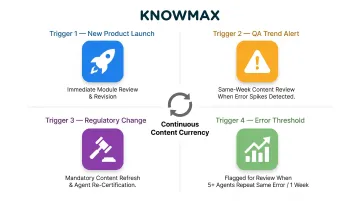
COPC best practices recommend content audits at minimum quarterly, but trigger-based workflows ensure critical updates happen immediately when needed.
Use LMS Version Control and Automatic Re-Enrollment
Triggers identify when content needs updating. Version control and auto-enrollment handle what happens next.
Modern LMS platforms track which agents completed the old version of a module and which completed the new one. Combined with automatic re-enrollment rules, this ensures all active agents receive updated training without manual assignment by training managers.
For example, if a billing policy changes, the system can automatically assign the updated module to all agents who completed the previous version within the last 90 days, ensuring floor-wide alignment within days rather than months.
Organisations with strong content governance and AI-assisted workflows report 10-15% gains in accuracy and 20-40% reduction in issue volume — returns that compound when update cycles are measured in days, not quarters.
Frequently Asked Questions
What makes a good learning management system?
An effective LMS combines ease of use, role-based learning paths, robust analytics, and integration capabilities with diverse content formats. For contact centers specifically, the ability to tie training outcomes directly to operational KPIs like FCR, AHT, and CSAT is critical—measuring success by business impact, not just course completions.
How do you measure LMS effectiveness in a contact center?
Effective measurement goes beyond completion rates to include time-to-proficiency, QA score changes, FCR improvements, and AHT reductions. The most actionable analysis pinpoints which modules correlate with performance gains, so teams can refine curriculum based on real outcomes.
What is the difference between LMS training and performance support for agents?
LMS delivers structured, pre-shift learning that builds foundational knowledge and competencies. Performance support tools—like decision trees, visual guides, and AI-powered knowledge bases—provide real-time, in-call assistance. Both are essential because agents cannot recall all training content under the pressure of live customer interactions.
How often should contact center agents receive refresher training?
Refresher training should be both event-driven (triggered by product updates, policy changes, or recurring QA failures) and periodically scheduled. Microlearning modules keep refreshers brief and actionable—monthly for high-change topics, quarterly for stable processes.
What LMS features matter most for contact center training teams?
Priority features include role-based learning paths, adaptive assessments that prevent underqualified progression, and cohort management for batch hiring. Robust reporting tied to performance metrics, CRM and QA platform integrations, and mobile accessibility for shift-based workforces round out the essentials.
How can an LMS help reduce agent ramp time in a contact center?
A well-structured LMS reduces ramp time by delivering role-specific onboarding paths, using assessments to catch knowledge gaps early, and automating progress tracking so managers can intervene before new hires go live. This approach cuts time-to-productivity by up to 40%.