Introduction
Contact center agents do drastically different work — new hires taking their first calls, product specialists handling escalations, team leads coaching peers, compliance officers managing regulatory risk. Yet most training programs treat them as interchangeable. Every agent sits through the same modules, regardless of role or tenure.
Most contact centers talk about personalized training, but few have operationalized it in ways that move metrics — First Contact Resolution (FCR), Average Handle Time (AHT), or time-to-productivity. According to industry research, only 42.8% of contact centers formally measure training results, and just 27% have a framework to measure learning strategy success.
This article examines the practical advantages of a role-based LMS for contact center and CX teams, focusing on measurable business outcomes rather than theoretical benefits.
TL;DR
- A role-based LMS assigns training by agent role and skill level, cutting time wasted on irrelevant content
- Core payoff: faster ramp-up within the typical 8–12 month proficiency window, stronger role-level performance, and tighter compliance
- Generic training programs inflate onboarding costs and leave centres with real compliance gaps
- Full ROI depends on maintained learning paths, role-level outcome tracking, and live knowledge integration
What Is a Role-Based LMS?
A role-based LMS is a learning management system configured to deliver different training paths, course content, and completion requirements based on a user's assigned role—such as new hire agent, product specialist, team lead, or compliance officer.
In contact center environments, this typically means:
- Onboarding tracks tailored to frontline agents by queue or product line
- Advanced certification paths for tenured specialists handling escalations or technical issues
- Leadership modules for supervisors focused on coaching and quality management
- Compliance refreshers targeted to function-specific regulatory requirements
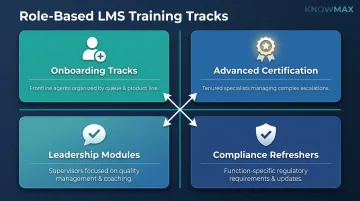
Each of these paths connects the right training asset to the right person at the right stage of their workflow. The result: agents spend less time wading through irrelevant content and more time absorbing what actually applies to their role.
Key Advantages of a Role-Based LMS for Contact Centers
Contact center managers measure what matters: time-to-productivity, quality scores, error rates, and compliance adherence. Each advantage below connects directly to those numbers.
Advantage 1: Shorter Onboarding Time and Faster Agent Productivity
New agents reach productive performance faster when their training path is scoped to their specific role, queue, and product line. Enrollment rules automatically assign only the courses tied to the agent's role at system provisioning — no wasted time navigating content that won't apply for months.
Time-to-proficiency is one of the largest hidden costs in contact center operations. New agents operate at just 53% efficiency in their first month compared to month 12 and require 8 to 12 months to reach full productivity. Every unproductive day costs approximately $204 in lost output; each replacement hire runs an estimated $10,000 to $20,000.
Shortened onboarding also reduces supervisor coaching hours and cuts error rates in the first 30–60 days. The impact is measurable: a Fortune 100 financial services firm using structured, role-specific training achieved proficiency in 60 days versus the expected 180 — three times faster than the industry baseline.
KPIs impacted:
- Time-to-proficiency (days from hire to target performance)
- Onboarding completion rate
- New-hire quality scores in weeks 1–4
- Escalation rate among agents in first 90 days
This advantage is most pronounced during high-volume hiring periods (seasonal ramps, new market launches), in BPO environments with continuous agent intake, and across organizations managing multiple product lines where generic onboarding creates knowledge gaps.
Advantage 2: Targeted Skill Development That Directly Improves CX Metrics
Centers with differentiated agent tiers — frontline, specialist, team lead, quality analyst — see the sharpest gains here, as do organizations undergoing product diversification or those where performance variation across roles is widest.
Advantage 3: Consistent and Auditable Compliance and Product Knowledge Delivery
This is especially critical in heavily regulated industries (banking, insurance, government, healthcare), contact centers managing frequent product or policy updates, and organizations with multiple business lines where compliance requirements differ by function.
What Happens When Role-Based LMS Is Missing or Ignored
Contact centers that rely on generic, undifferentiated training programs face real operational consequences:
- New hires are overloaded with content covering scenarios they won't encounter for months — causing cognitive overload, lower retention, and slower time-to-proficiency. Cognitive Load Theory establishes that working memory holds only 5 to 9 chunks at a time; a 2023 study confirms that overload increases anxiety and avoidance behavior.
- Tenured specialists disengage when required to complete the same refreshers as new agents — floor time that could go toward meaningful upskilling is lost.
- Compliance tracking loses precision. Completion records confirm that training happened, not that the right agents completed the right modules for their role.
- Targeted retraining becomes a blunt instrument. When a product update or policy change affects one team, operations pulls everyone off calls for a mass retraining session.
Left unaddressed, these gaps compound. Supervisor load increases, performance spreads unevenly across the floor, and the training library grows larger while becoming less useful to the people who need it most. Research consistently shows more than 50% of contact center agents quit within the first 90 days — and ineffective onboarding is a primary driver. Role-based LMS directly targets each of these failure points.
How to Get the Most Value from a Role-Based LMS
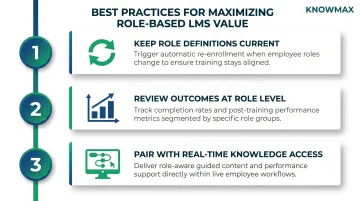
Role-based LMS delivers full value only when three operational practices are in place:
1. Keep role definitions current as organizational structures evolve. Agent role changes should trigger automatic re-enrollment or path updates. As new queues, products, or specializations emerge, training paths need to reflect those shifts — not lag behind them.
2. Review training outcomes at the role level, not just overall completion. Track which roles complete training on time, which are falling behind, and which show measurable performance improvement post-training. That data tells you what to adjust — and for whom.
3. Pair role-based LMS with real-time knowledge access at the agent desktop. Training builds the foundation, but agents also need role-specific guided resolutions and decision trees during live customer interactions. A knowledge management platform like Knowmax bridges that gap — delivering role-aware guided content and decision trees directly within the agent's workflow, so what agents learn in training is accessible when it actually counts.
Role-based LMS works best when it's treated as a living system. New compliance requirements, product launches, or organizational changes should trigger structured path updates — not periodic content overhauls.
Conclusion
The value of a role-based LMS in contact centers lies in precision—the ability to control which training reaches which agent, at which point in their tenure, with full visibility into outcomes by role.
These advantages compound over time and reinforce each other when the system is applied with discipline:
- Shorter ramp periods lower the cost of each new hire
- Targeted upskilling closes performance gaps by function
- Reliable compliance delivery reduces operational risk across the floor
Implemented well, role-based LMS functions as an operational discipline, not just a platform feature. The organizations that extract the most value treat role definition, content curation, and outcome review as ongoing responsibilities—not one-time setup tasks.
Frequently Asked Questions
What are the four types of learning management systems?
The four main types are cloud-based (SaaS), on-premise, open-source, and custom-built. Cloud-based LMS is most common in enterprise and contact center environments due to ease of deployment and scalability. 64% of LMS deployments are cloud-based versus 36% on-premises.
What is a role-based LMS and how is it different from a standard LMS?
A role-based LMS assigns specific training paths based on a user's role—unlike a standard LMS where all users access a common course library. This makes training delivery more targeted, relevant, and efficient for organizations with multiple agent types.
How does a role-based LMS reduce agent onboarding time in contact centers?
New hires train only on courses relevant to their specific role and queue. This cuts time spent on irrelevant content and gets agents to productive performance faster than generic onboarding programs. Structured role-based onboarding can reduce time-to-proficiency by up to 40%.
What agent roles should typically be defined in a contact center LMS?
Common role categories include new hire/frontline agent, product or queue specialist, team lead/supervisor, quality analyst, and compliance officer. Role definitions should map to actual performance responsibilities, not just job titles.
Which CX metrics improve when contact centers implement role-based LMS?
The most directly impacted metrics are FCR, AHT, CSAT, compliance completion rates, and new hire quality scores, especially when training paths are actively maintained and reviewed at the role level.
How often should role-based LMS training paths be updated?
Training paths should be reviewed whenever roles change, new products or policies launch, or performance data shows a persistent gap in a specific role. At minimum, a structured review every quarter is recommended for high-volume contact center environments.