Introduction
CX and contact center leaders face a growing challenge: AI tools are multiplying rapidly, but the terminology is muddled.
"AI assistant" and "virtual agent" are used interchangeably when they actually serve different functions across different parts of the customer service stack. That confusion has real consequences — choosing the wrong tool creates gaps in automation coverage, misaligned agent support, or poor customer experiences.
The stakes are high. 85% of customer service leaders will explore or pilot a customer-facing conversational generative AI solution in 2025, according to Gartner. This article breaks down exactly what separates the two — definitions, use cases, and how to decide which one belongs where in your support stack.
TLDR
- AI assistants respond to prompts—they help users find information when asked
- Virtual agents autonomously handle complete customer interactions without human involvement
- Choosing between them comes down to how much autonomy your support workflow requires
- AI assistants work best for internal agent support; virtual agents are built for customer-facing self-service
- The right choice depends on where in the support journey you need automation
AI Assistant vs Virtual Agent: At a Glance
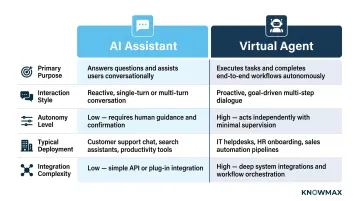
Here's a quick side-by-side comparison across five key dimensions:
| Dimension | AI Assistant | Virtual Agent |
|---|---|---|
| Primary Purpose | Information retrieval, task guidance | Complete workflow automation |
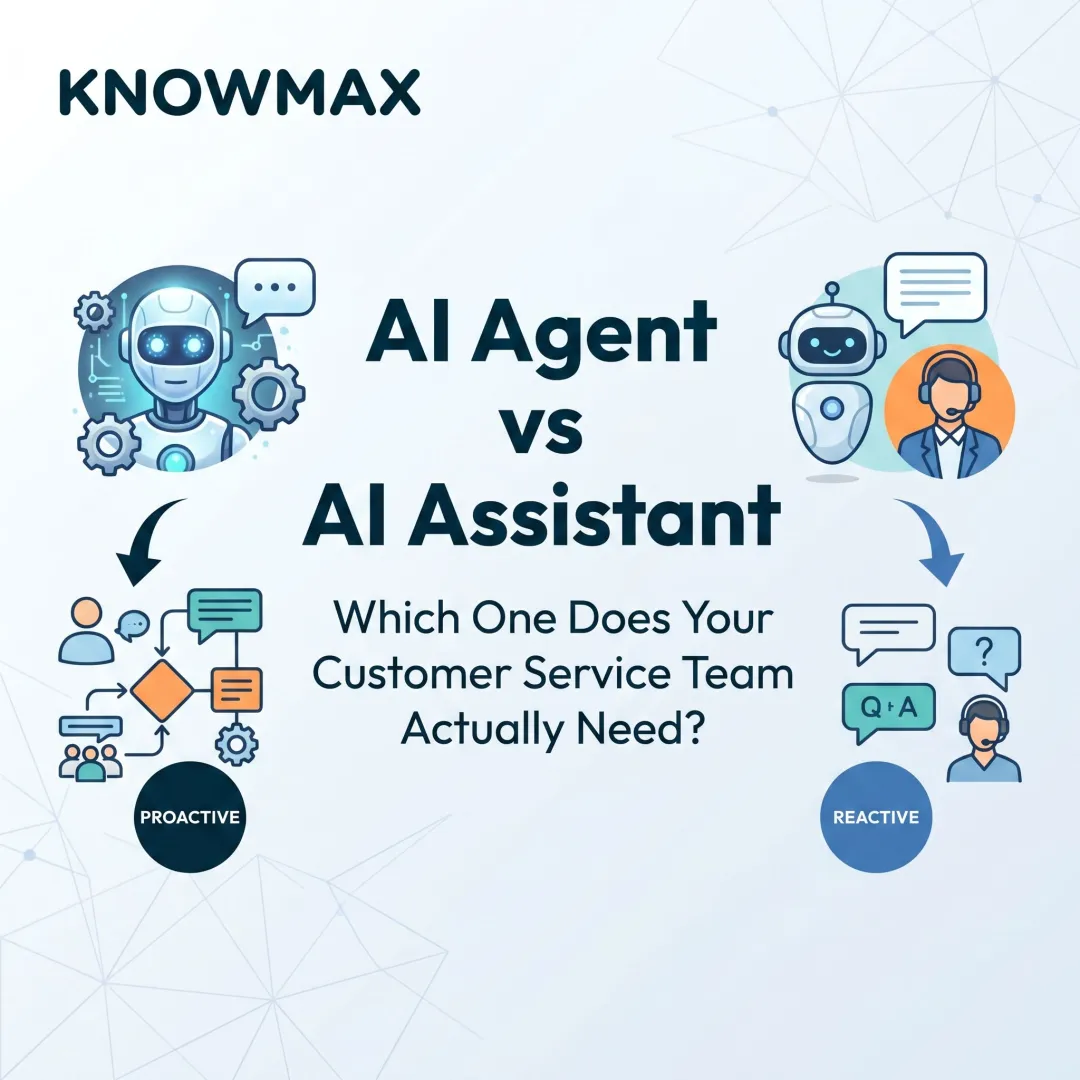
| Interaction Style | Reactive—waits for user prompts | Proactive—guides full interactions |
| Autonomy Level | Low—requires continuous user input | High—operates independently |
| Typical Deployment | Internal agent support, knowledge retrieval | Customer-facing self-service |
| Integration Complexity | Minimal—connects to calendars, search tools | Deep—integrates with CRM, ticketing, knowledge bases |
What is an AI Assistant?
An AI assistant is a software application powered by natural language processing (NLP) and large language models (LLMs) that responds to user queries with relevant information, suggestions, or task execution. By design, it is reactive: it waits for a prompt before acting, and its scope is broad rather than domain-specific. Examples include Siri, Alexa, Google Assistant, and enterprise tools like Microsoft Copilot.
Technology Foundation
AI assistants rely on foundational language models that interpret natural language input and generate contextually relevant outputs. Unlike early chatbots built on rigid, rule-based scripts, modern AI assistants understand intent through ML and LLMs — though they still operate within a prompt-response loop, not independently.
Gartner characterizes AI assistants as tools that "simplify tasks but depend on human input and do not operate independently." They are the precursor to more autonomous agentic AI, representing Stage 1 of Gartner's five-stage agentic evolution model (a maturity framework that tracks AI from reactive assistance to fully autonomous operation).
Core Capabilities
These capabilities translate directly to productivity gains in enterprise environments:
- Information retrieval based on natural language queries
- Maintains conversational context within a single session
- Executes basic tasks such as scheduling, reminders, or document search
- Summarises content, case history, or policy documents on demand
One firm limitation: AI assistants do not retain memory across sessions and cannot act without explicit user instruction.
Use Cases of AI Assistants
In contact centres, AI assistants function primarily as agent-assist tools: helping human agents retrieve answers quickly, surface relevant knowledge articles, suggest next-best actions, or summarise case history. The result is lower handle time and stronger first-call resolution rates.
The productivity impact is well-documented. According to McKinsey research, applying generative AI to customer care could increase productivity by 30–45% of current function costs. In a study of 5,000 customer service agents, GenAI increased issue resolution by 14% per hour and cut time spent per issue by 9%.
Other enterprise use cases include:
- HR self-service portals where employees ask policy questions
- Internal IT helpdesks for finding documentation
- Sales support for retrieving product information
Across every scenario, the pattern holds: a human initiates, and the assistant responds. That dependency on user input is precisely what distinguishes AI assistants from virtual agents — which are built to act on their own.
What is a Virtual Agent?
A virtual agent is a purpose-built AI system designed to autonomously manage complete customer service interactions within a specific domain (billing, technical support, account management). Unlike AI assistants, virtual agents don't just respond to a single query — they navigate multi-step workflows, access backend systems, and resolve issues end-to-end with minimal human intervention.
Technical Architecture
Virtual agents combine NLP/NLU with decision trees, intent classification, entity extraction, and integration with business systems (CRM, knowledge bases, ticketing platforms). This gives them the ability to authenticate users, retrieve account data, process requests, and escalate appropriately, all within a single interaction flow.
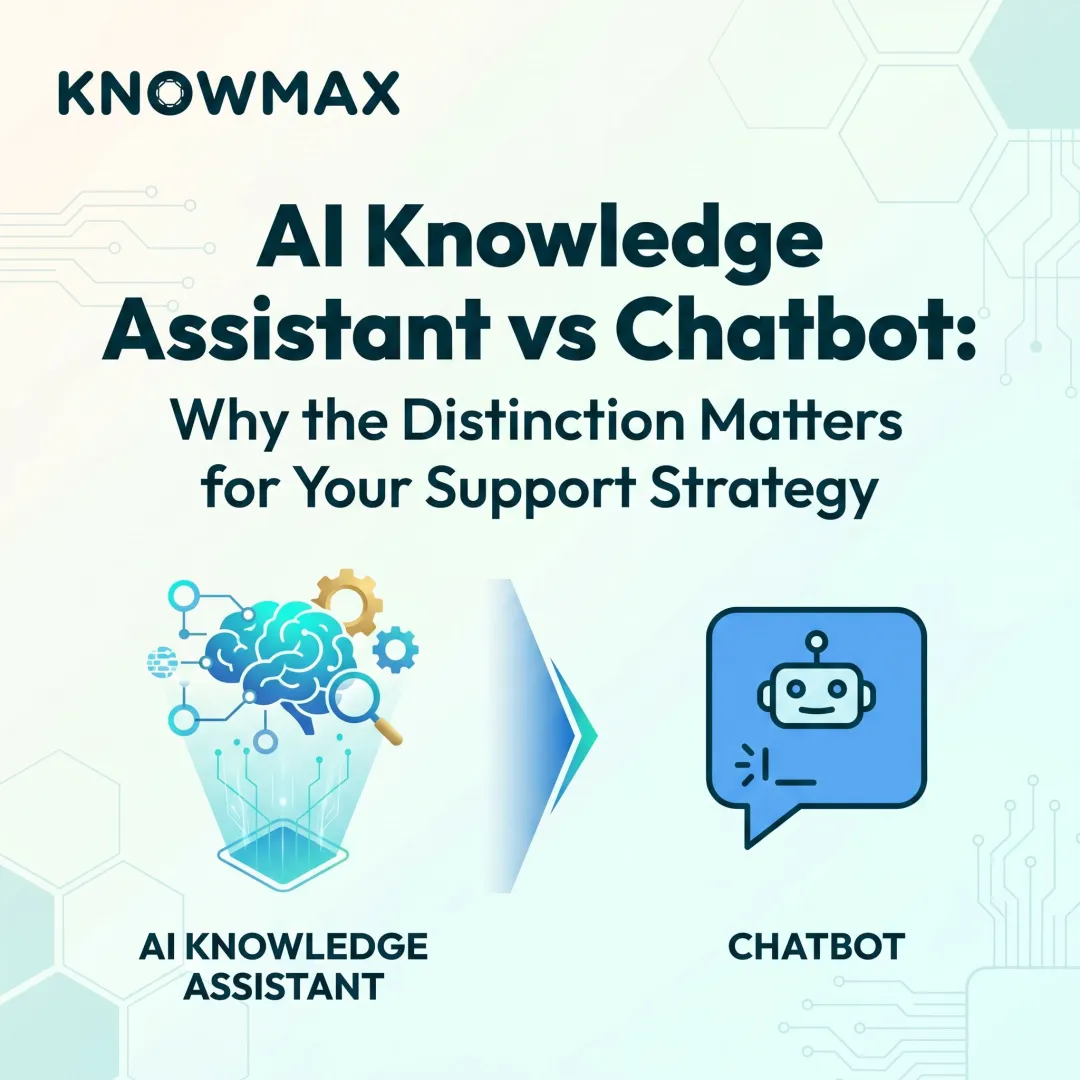
What distinguishes a virtual agent from a simple chatbot? According to NICE, a chatbot relies on keyword matching and menus without AI, limited to "only as good as it is programmed to be." A virtual agent is "infused with artificial intelligence," uses NLP to understand normal language, handles complex transactions (opening insurance claims, activating credit cards), and uses machine learning to become "smarter with use."
Gartner predicts that by 2028, 70% of customers will begin their service journey through Virtual Customer Assistants, highlighting the growing reliance on these autonomous systems.
Continuous Learning
Virtual agents improve over time by analyzing interaction data, failed resolutions, and escalation patterns. This makes them progressively more accurate for the specific domain they are deployed in, unlike general-purpose AI assistants that learn through vendor model updates rather than domain-specific feedback loops.
For example, Bank of America's Erica has received over 50,000 updates to its performance and natural language understanding since its 2018 launch. That kind of continuous iteration is what separates a mature deployed virtual agent from a static system.
Use Cases of Virtual Agents
Virtual agents are most impactful in customer-facing self-service for high-volume, repetitive inquiry types:
- Telecom: Troubleshooting connectivity issues, appointment booking
- Banking: Account balance, transaction disputes
- E-commerce: Order tracking, returns processing
- Insurance: Policy queries, claims initiation
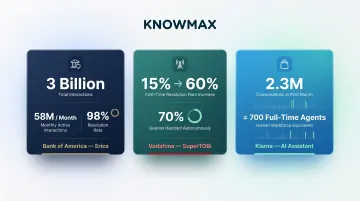
The numbers behind some of the most widely deployed virtual agents make the case clearly:
- Bank of America's Erica has handled over 3 billion client interactions since launch, averaging 58 million interactions per month, with 98% of clients getting the answers they need
- Vodafone's SuperTOBi increased first-time resolution from 15% to 60% and successfully handles approximately 70% of customer queries
- Klarna's AI assistant handled 2.3 million conversations (two-thirds of all customer service chats) in its first month, doing the work of 700 full-time agents
The quality of a virtual agent's responses depends entirely on the knowledge it is built on. Accurate, current knowledge bases are what make the difference between an agent that resolves issues and one that frustrates customers. This is where platforms like Knowmax come in — providing the knowledge infrastructure (decision trees, guided resolution flows) that virtual agents draw on to handle complex queries accurately.
AI Assistant vs Virtual Agent: Key Differences Explained
Autonomy and Initiative
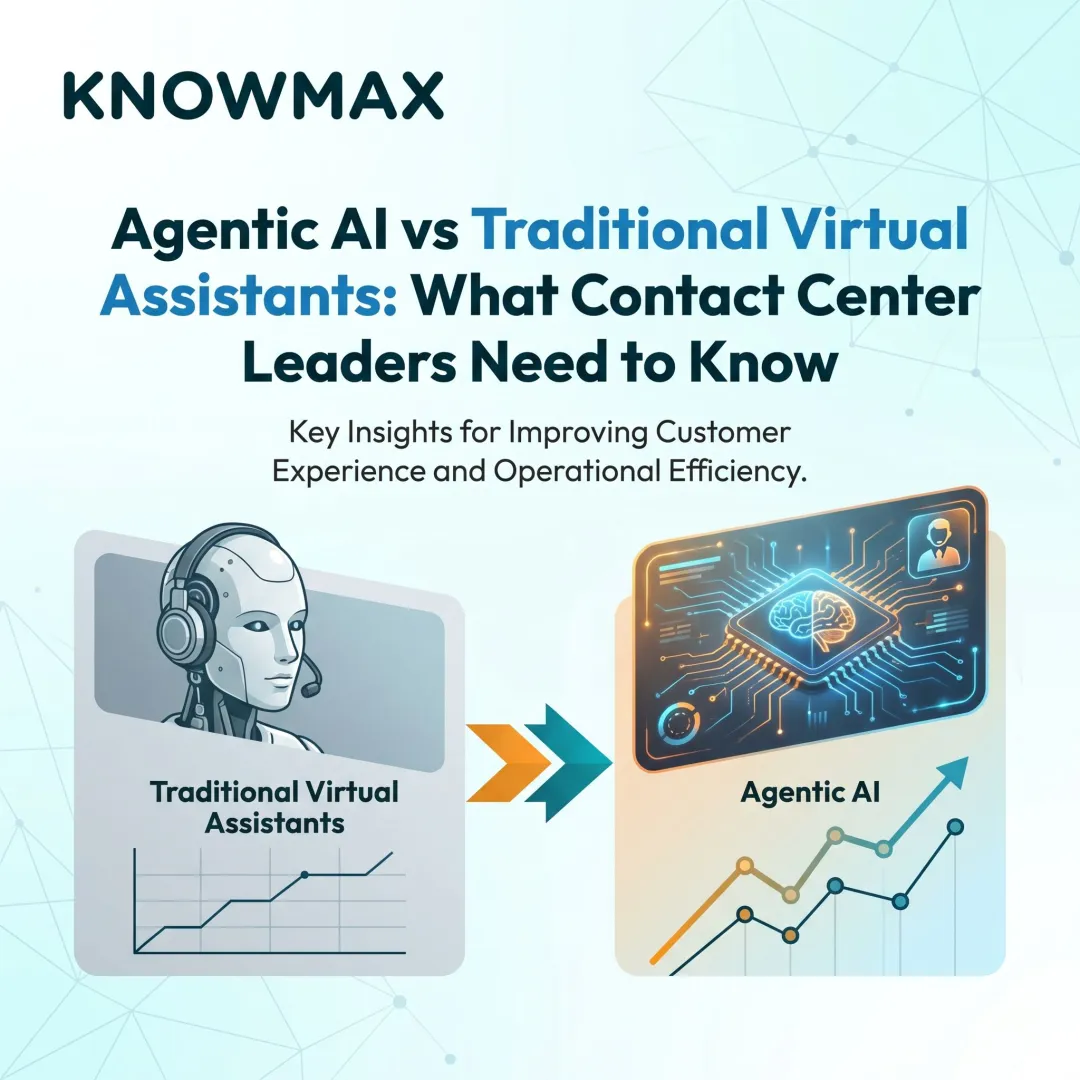
The most fundamental difference: AI assistants wait for instructions—every action is triggered by a user prompt. Virtual agents, once deployed, can guide and complete entire interaction journeys without being prompted at every step.
Example scenario (billing dispute):
- AI assistant: Helps an agent look up the account details, retrieve past billing history, and suggest knowledge articles
- Virtual agent: Handles the full dispute process with the customer directly—authenticates the user, retrieves the billing data, identifies the issue, processes the adjustment, and confirms resolution
Scope and Specialization
AI assistants are general-purpose—they can help with a wide variety of tasks but at a surface level. Virtual agents are narrow and deep—built for specific domains with specialised knowledge, workflows, and integrations that make them highly effective within those boundaries.
The trade-off is straightforward:
- Breadth needed? An AI assistant handles varied topics across your operation
- Depth needed? A virtual agent reliably resolves specific, recurring customer issues
Integration Requirements and Depth
Virtual agents require deep integration with backend business systems—CRM, billing platforms, ticketing tools, knowledge management systems—to function effectively. AI assistants can often operate with minimal integration, connecting to calendars, search tools, or document repositories.
According to Gartner, over 40% of agentic AI projects will be canceled by the end of 2027, noting: "Integrating agents into legacy systems can be technically complex, often disrupting workflows and requiring costly modifications."
This means deployment complexity and IT investment are significantly higher for virtual agents than for AI assistants.
Learning and Adaptation
AI assistants are updated through vendor model releases rather than learning from your specific deployment data. Virtual agents can be trained and refined on domain-specific data (conversation logs, escalation patterns, resolution outcomes), growing more accurate for your context over time.
In high-volume contact centres, that compounding improvement translates directly into higher first-contact resolution rates and lower handling times.
Human Escalation and Collaboration
Both tools should be designed to escalate to human agents when needed, but the escalation triggers differ.
- Virtual agents: Handle end-to-end resolution and only escalate on true complexity or emotional distress
- AI assistants: Augment the human agent throughout the interaction, providing real-time support
This shapes where each fits in the support architecture—virtual agents on the front line, AI assistants behind the scenes supporting human agents.
Which One Does Your Contact Center Need?
The right choice depends on your primary goal:
Deploy a virtual agent if:
- Your goal is reducing inbound contact volume and deflecting repetitive queries to self-service
- You have high-volume, predictable query types (account inquiries, order status, basic troubleshooting)
- You can invest in deep system integration and knowledge infrastructure
- You want autonomous customer-facing automation
Deploy an AI assistant if:
- Your goal is reducing average handle time and improving agent accuracy during live interactions
- Queries are complex, variable, or emotionally sensitive
- You want to enhance agent performance without replacing them
- You need a lower-risk proving ground with minimal integration complexity
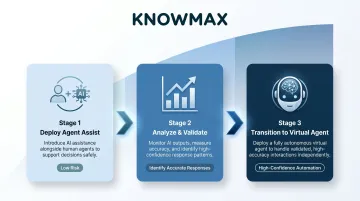
CX Today outlines a staged maturity framework for organizations building toward full automation:
- Deploy Agent Assist first as a low-risk proving ground with human-in-the-loop oversight
- Use Agent Assist data to identify which responses agents consistently rate as accurate
- Transition validated, repetitive tasks to autonomous Virtual Agents once confidence is established
Mature contact centers often need both—deployed at different layers of the support stack. Virtual agents handle front-line self-service; AI assistants support human agents managing complex escalations.
Regardless of which tool you deploy, underlying knowledge quality determines performance outcomes. Both virtual agents and AI assistants are only as reliable as the information behind them. Knowmax addresses this directly — its knowledge management platform supplies both tools with structured content, decision trees, and guided resolution flows that keep automated responses consistent as your operation scales.
Conclusion
AI assistants and virtual agents aren't competing tools — they address different points in the same service chain. One handles customers directly through self-service; the other supports agents working live interactions. Most contact centers eventually need both.
As AI capabilities advance, the two will increasingly overlap in function. What won't change is this: neither tool performs well without accurate, well-structured knowledge underneath it. Before deploying or expanding either, audit what your knowledge base actually contains, how current it is, and whether it maps to the workflows your agents and customers encounter daily. That groundwork determines whether AI adds real value or just adds noise.
Frequently Asked Questions
What is the difference between an AI agent and a virtual assistant?
AI agents are autonomous, goal-driven systems that act without continuous prompting and can complete multi-step tasks independently. Virtual assistants (AI assistants) are reactive tools that respond to user commands—the core distinction is autonomy and scope of action.
Can a virtual agent replace a human customer service agent?
Virtual agents can autonomously resolve high-volume, predictable queries, reducing contact volume (up to 70% in some deployments). They are not a full replacement for human agents in complex, emotionally sensitive, or highly variable situations.
What is the difference between a chatbot and a virtual agent?
Rule-based chatbots are scripted and limited to predefined responses. Virtual agents are NLP/ML-powered, able to handle dynamic conversations, access backend systems, and complete multi-step workflows autonomously. Unlike chatbots, they improve with each interaction through machine learning.
Is Siri an AI assistant or a virtual agent?
Siri is a general-purpose AI assistant—reactive, broad in scope, and designed for individual user convenience rather than autonomous completion of domain-specific business workflows.
Which is better for customer service: an AI assistant or a virtual agent?
It depends on the use case. Virtual agents are better for customer-facing self-service and deflection of high-volume queries. AI assistants are better for supporting human agents during live interactions with complex or variable customer issues.
How does knowledge management affect virtual agent and AI assistant performance?
Both tools rely on the quality of their knowledge source—structured, accurate knowledge bases and decision trees directly determine how reliably either tool can answer questions or guide customers through resolutions. A virtual agent built on outdated or fragmented content will misroute customers regardless of how advanced its underlying model is.