Introduction
Contact center leaders are under mounting pressure to deploy AI — but vendor pitches blur critical distinctions. Terms like "virtual assistant," "chatbot," and "agentic AI" are used interchangeably, creating confusion about what actually changes operationally when you move from one to the other.
Executive pressure to implement AI surged from 75% in mid-2024 to 91% by late 2025, cutting adoption timelines from years to quarters. That urgency creates risk.
Vendors are capitalizing on it through "agent-washing" — labeling rule-based products as "agentic" when they lack any autonomous reasoning capability.
What follows is a practical breakdown of what each technology actually does in a contact center context, where each genuinely fits, and what the real implications are for First Contact Resolution (FCR), Average Handle Time (AHT), and Customer Satisfaction (CSAT).
TL;DR
- Traditional virtual assistants handle one task at a time, responding to prompts — suited for FAQs and structured self-service
- Agentic AI pursues goals autonomously, running multi-step workflows across systems with minimal human direction
- The core difference is control: who decides what happens next — the human, or the AI
- Most contact centers will layer both: virtual assistants at the interaction layer, agentic AI orchestrating backend workflows
- Both depend on accurate, structured knowledge to perform reliably
Agentic AI vs Traditional Virtual Assistants: Quick Comparison
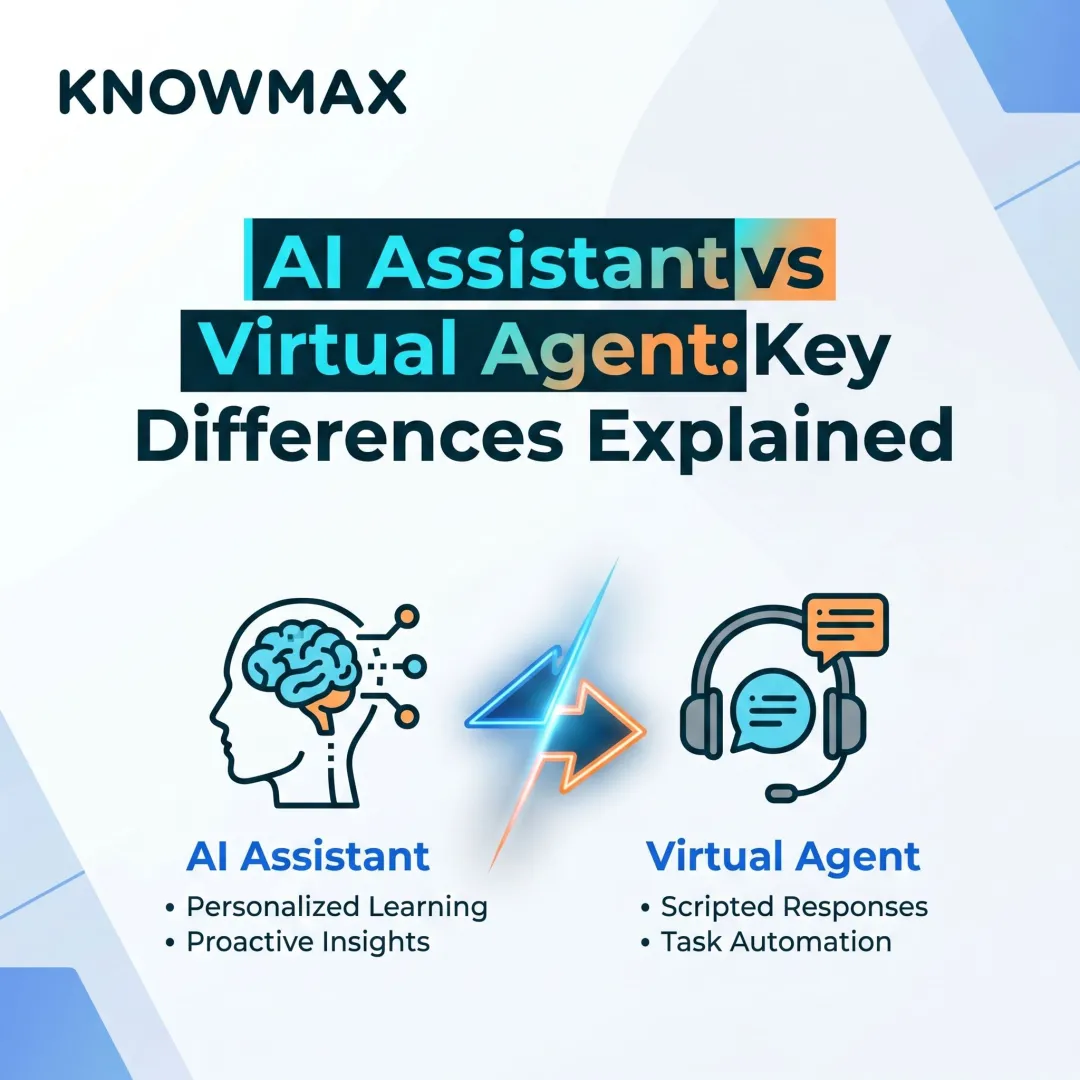
The differences between agentic AI and traditional virtual assistants go well beyond features — they reflect fundamentally different operating philosophies. Here's how they compare across the dimensions that matter most in contact center environments.
| Dimension | Traditional Virtual Assistants | Agentic AI |
|---|---|---|
| Operating Mode | Reactive — acts only when prompted, one interaction at a time | Proactive — pursues goals autonomously, initiating multi-step actions |
| Memory & Context | Session-only — context resets after each interaction | Persistent — retains context across sessions, enabling multi-day workflows |
| Task Complexity | Single-turn, well-defined tasks — FAQs, routing, data collection | Multi-step, cross-system tasks — case resolution spanning CRM, billing, ticketing |
| Human Oversight | High — humans review every output before action proceeds | Set at goal level — humans define objectives; AI executes independently |
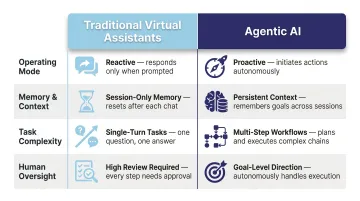
The gap in human oversight is where contact center leaders tend to pause. Agentic AI requires trust in the system's decision-making — which makes the quality and structure of the underlying knowledge infrastructure critical to getting it right.
What Are Traditional Virtual Assistants in Contact Centers?
Traditional virtual assistants in contact centers are rule-based or NLP-powered systems that handle structured, repetitive customer interactions. This includes chatbots, IVR bots, and first-line FAQ agents. Even modern LLM-enhanced bots remain reactive tools — they can't independently plan or act across systems.
Use Cases in Contact Centers
Traditional virtual assistants excel at specific, bounded tasks:
- Answering account balance queries and order status updates
- Guiding customers through basic troubleshooting using scripted flows
- Collecting information before handoff to live agents
- Routing calls based on intent classification
The operational value is real: these tools deflect high-volume contacts, reduce agent workload on repetitive queries, and deliver consistent responses for structured issues.
That value hits a hard ceiling, though. Gartner research surveying 5,728 customers found only 14% of service issues fully resolve in self-service. Even for "very simple" issues, only 36% resolve without human intervention.
When a customer's issue requires pulling data from multiple systems, adapting to unexpected input, or completing tasks that span more than one step, traditional virtual assistants stall — and escalate. That's the gap agentic AI is designed to close.
What Is Agentic AI in Contact Centers?
Agentic AI in contact centers receives a goal — such as "resolve this customer's billing dispute" — and independently plans the steps, accesses relevant systems, executes actions, and self-corrects if something goes wrong. That's a different category entirely from a smarter chatbot.
Key Capabilities That Matter for CX
- Persistent memory and context: Retains case history across interactions so customers never repeat themselves — reducing repeat contact rates and improving CSAT.
- Autonomous tool use: Queries CRM records, triggers billing adjustments, escalates tickets, or updates account data based on its own reasoning, without a human directing each specific action.
- Multi-step workflow execution: A single intent like "I was charged twice" triggers a full sequence — verify charge, cross-reference history, initiate refund, send confirmation — without agent involvement.
- Self-correction: When it hits an unexpected result mid-workflow (say, an unresponsive refund system), it re-routes or escalates rather than failing silently. Scripted bots break without warning; agentic systems adapt.
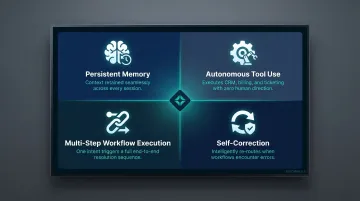
These capabilities translate into concrete deployment patterns across contact center operations.
Contact Center Use Cases
Common agentic AI applications include:
- End-to-end complaint resolution spanning multiple backend systems
- Post-call follow-up and automated case closure
- Proactive outreach when account anomalies are detected
- After-call work automation — summarization, tagging, CRM updates
- Agent assist surfacing next-best-action recommendations in real time
Salesforce's Agentforce deployment handles 32,000 conversations weekly with an 83% resolution rate and a 50% reduction in human escalations. Those numbers reflect what production-grade agentic AI looks like when it's working.
Key Differences That Matter to Contact Center Leaders
Reactive vs. Proactive: Who Initiates Action?
Traditional virtual assistants require customers to initiate every interaction. Agentic AI can initiate contact proactively — detecting a service disruption and reaching out to affected customers before they call. This shifts the contact center's role from reactive resolution to proactive service.
Task Scope: Single Interaction vs. End-to-End Resolution
Traditional virtual assistants handle one step at a time, depending on human agents to connect the dots. Agentic AI owns the full resolution journey.
This matters for First Contact Resolution. Industry-average FCR sits at 69%, with repeat calls consuming approximately 23% of contact center operating budgets. Even modest FCR improvements from agentic AI yield outsized cost savings.
Governance and Oversight Requirements
Traditional virtual assistants are safe for regulated environments by design — humans review every output before action proceeds. Agentic AI requires upfront governance work:
- Define what the system can do autonomously
- Establish escalation thresholds
- Build audit trails
- Set failure recovery protocols
This isn't a reason to avoid agentic AI — it's a prerequisite for responsible deployment. Gartner projects AI governance platform spending will reach $492 million in 2026, surpassing $1 billion by 2030 as fragmented regulations extend to 75% of the world's economies.
Impact on Contact Center KPIs
Average Handle Time (AHT): Agentic AI reduces AHT for complex queries by eliminating wait-and-escalate cycles. Documented deployments show 33% AHT reduction (3.5 minutes saved per call).
First Contact Resolution (FCR): Agentic AI improves FCR by resolving multi-step issues in a single interaction, compared to the 14% self-service resolution baseline.
Agent Utilization: Traditional VAs remove simple queries from agent queues. Agentic AI goes further — eliminating entire resolution workflows that previously required human handling. After-call work automation reduces ACW by 40-70%.
CSAT: Both can improve satisfaction when deployed correctly, but for different reasons — traditional VAs through faster deflection, agentic AI through complete resolution.
Cost and Implementation Reality
Traditional virtual assistants have low setup cost and immediate per-interaction ROI, but limited scalability. Agentic AI requires higher upfront investment in integration, workflow design, and governance.
One counterintuitive caution: Gartner predicts GenAI cost per resolution will exceed $3 by 2030, potentially surpassing offshore human agent costs. Full automation, Gartner warns, will be "prohibitively expensive for most organisations."
The practical implication: agentic AI delivers the strongest ROI on high-volume, multi-step workflows — not as a blanket replacement for every interaction type.
Which Is Right for Your Contact Center?
This isn't a binary choice between old and new. It's a question of where each technology fits in your architecture over the next 12-24 months.
Use a Decision Framework
Use traditional virtual assistants when:
- Tasks are structured and single-step
- Every output needs human review
- You're early in AI adoption and building internal trust
- Compliance rules require human sign-off at each step
Use agentic AI when:
- Workflows span multiple systems
- Volume of repetitive multi-step interactions is high
- Contact handling time is constrained by cross-system coordination delays
- Your team has governance infrastructure to define escalation paths
The Hybrid Model: Where Most Contact Centers Will Land
The strongest contact center AI architecture layers both: traditional virtual assistants at the customer-facing interaction layer for high-volume simple queries, and agentic AI orchestrating backend resolution workflows for complex cases.
Example: A customer chats with a virtual assistant that handles the FAQ. Meanwhile, agentic AI updates the ticket in the background, checks the billing record, and prepares the agent with a full case summary before escalation.
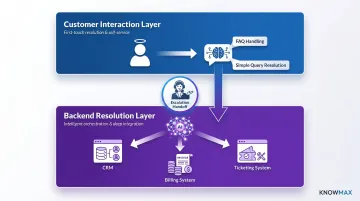
Gartner states that "AI and human expertise must work in tandem," with more than 80% of organisations planning to expand — not reduce — human agent responsibilities.
The Knowledge Foundation That Makes Both Work
Neither traditional virtual assistants nor agentic AI can deliver accurate, consistent resolutions without a structured, reliable knowledge base underneath them.
If knowledge is fragmented across wikis, PDFs, and tribal expertise, virtual assistants return inconsistent answers and agentic AI executes the wrong workflows. Research confirms that AI capability depends entirely on the quality of knowledge it accesses — making a curated, trusted knowledge base a prerequisite, not a nice-to-have.
Knowmax's AI-powered knowledge management platform addresses this directly. It provides structured decision trees, guided resolution flows, and intent-aware search that both virtual assistants and agentic AI draw from to resolve customer issues accurately.
Knowmax connects with contact center platforms including Genesys, Salesforce, Zendesk, Freshchat, and Talkdesk — acting as the centralized knowledge layer across assisted and automated CX channels. Customers report measurable outcomes after deployment:
- Reduced Average Handle Time (AHT)
- Improved First Contact Resolution (FCR) rates
- Higher CSAT scores
Ready to build the knowledge foundation your AI needs? Explore how Knowmax can power reliable AI-driven CX across your contact center.
Frequently Asked Questions
How is agentic AI different from traditional virtual assistants?
Traditional virtual assistants react to prompts and complete one task at a time under human direction. Agentic AI pursues goals autonomously, executing multi-step workflows across systems without requiring human input at each step.
Can traditional virtual assistants and agentic AI work together in a contact center?
Yes. The most effective architecture uses both: virtual assistants handle high-volume, structured customer interactions at the surface, while agentic AI orchestrates complex resolution workflows in the background.
What contact center tasks are best suited for agentic AI?
Agentic AI excels at end-to-end complaint resolution, after-call work automation, proactive customer outreach, multi-system case coordination, and real-time agent assist with next-best-action recommendations.
How does knowledge management impact the performance of agentic AI in contact centers?
Agentic AI is only as accurate as the knowledge it draws from. Fragmented or outdated knowledge leads to incorrect autonomous actions, making a structured AI-powered knowledge base a prerequisite before deployment.
Is agentic AI ready for enterprise contact center deployment?
Agentic AI is in active enterprise deployment, but it requires strong governance infrastructure before going live in customer-facing workflows: defined escalation thresholds, audit trails, and failure recovery protocols.
What risks should contact center leaders consider before deploying agentic AI?
Key risks include propagating failure — one undetected error affects all downstream steps — compliance gaps in regulated industries, and the governance investment needed to keep autonomous actions within defined boundaries.