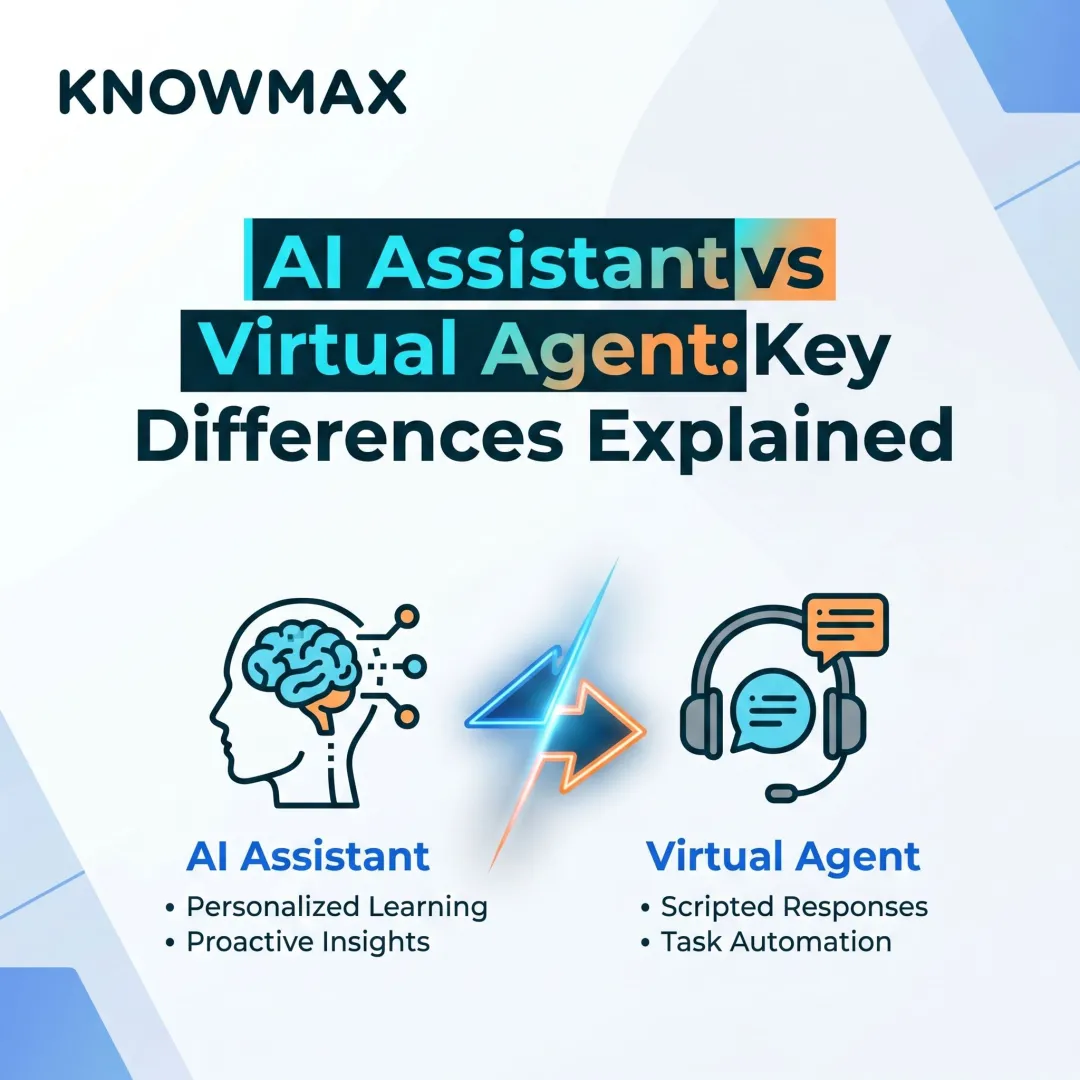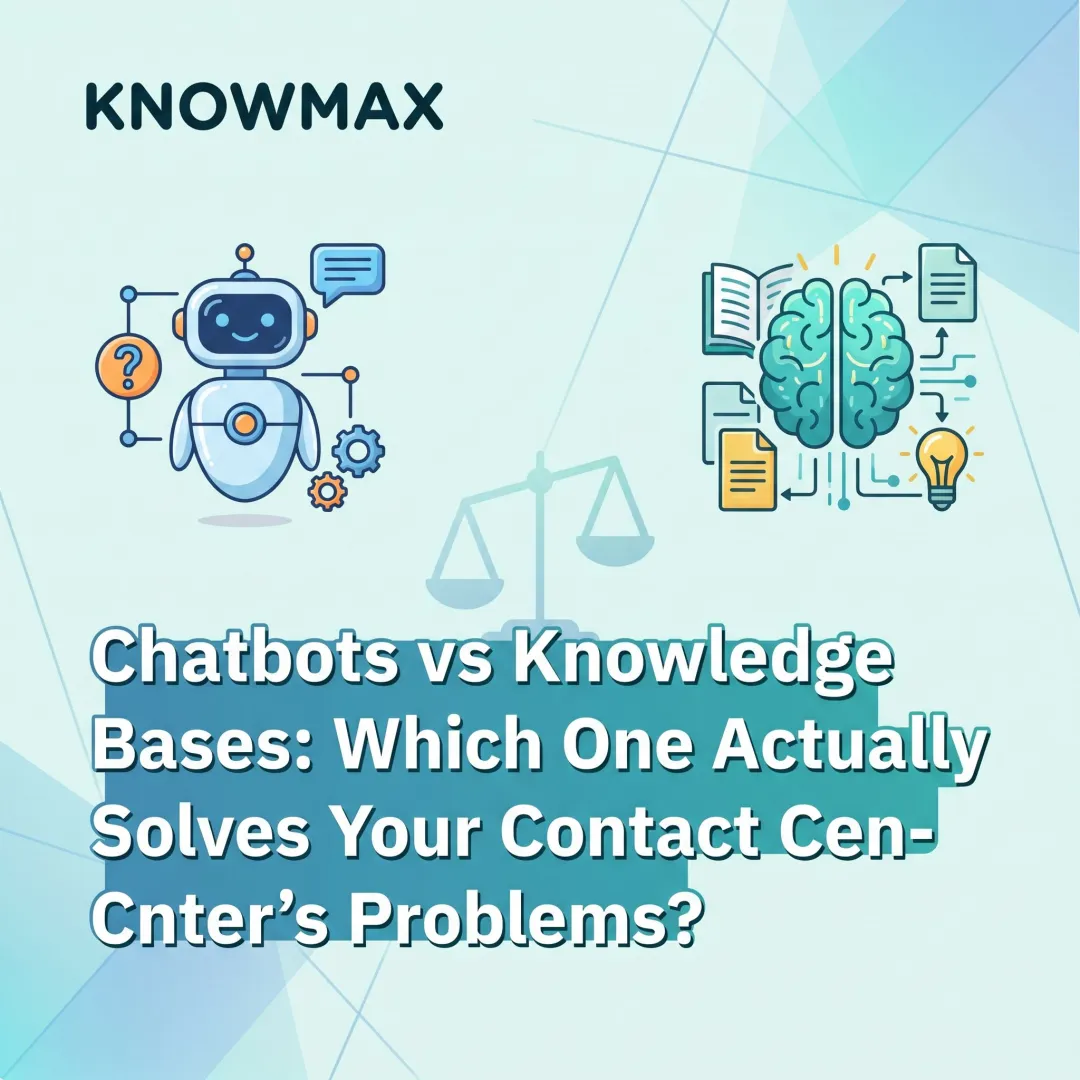
The terminology compounds the problem. Vendors use "chatbot," "AI assistant," and "knowledge AI" interchangeably, leading to misaligned investments and underwhelming support outcomes. Only 14% of customer service issues are fully resolved in self-service channels, according to Gartner's 2024 survey of 5,728 customers—even for issues customers describe as "very simple."
This article clarifies the distinction between chatbots and AI knowledge assistants, helping support leaders choose the right tool for measurable business outcomes: improved FCR, reduced AHT, and scalable resolution quality.
TL;DR
- A chatbot follows pre-programmed scripts and decision trees, handling predictable, low-complexity queries efficiently
- AI knowledge assistants understand intent, pull answers from a structured knowledge base, and guide both customers and agents through complex resolutions
- The distinction directly affects FCR rates, AHT, and agent enablement—not just chatbot deflection numbers
- Deploying the wrong tool erodes CX quality and creates a resolution gap
What is a Chatbot?
A chatbot is a rule-based or NLP-lite program that responds to user inputs through pre-scripted flows, keyword matching, or decision trees. Even AI-powered chatbots operate within a fixed inventory of responses—they cannot reason outside their configured paths or adapt to queries that fall outside predefined categories.
For support teams, this rigidity creates compounding problems:
- Fails when customers rephrase questions, add context mid-conversation, or ask follow-ups
- Only 38% of consumers report chatbots escalate to a human when needed, even though 81% expect this functionality
- 72% of consumers will not reuse a firm's chatbot after a single negative experience
Use Cases of a Chatbot
Chatbots genuinely perform well in specific, narrow support scenarios:
High-volume, repetitive self-service tasks:
- Order status lookups
- Password resets
- Store hours or location queries
- Routing to the correct department
Regulated industries with strict brand voice control:
- Financial services compliance scripts
- Healthcare eligibility pre-screenings
- Insurance claims intake forms
Nearly 8 in 10 consumers say AI bots are helpful for simple issues, and 51% prefer interacting with bots over humans when they want immediate service. The key qualifier: simple issues.
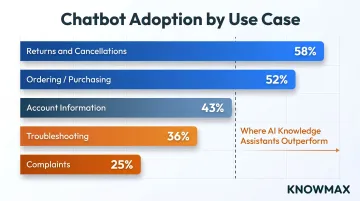
Gartner data shows chatbot adoption is strongest for returns and cancellations (58%), ordering/purchasing (52%), and account information (43%). Adoption drops sharply for troubleshooting (36%) and complaints (25%) — precisely where AI knowledge assistants begin to outperform them.
What is an AI Knowledge Assistant?
An AI knowledge assistant combines natural language understanding (NLU) with a curated, structured knowledge base to understand user intent—not just keywords—and deliver accurate, contextual answers in real time.
The critical distinction from a generic AI chatbot: the knowledge layer. The assistant is only as good as the organized knowledge behind it.
How AI knowledge assistants differ:
- Serve both customers on self-service channels and agents during live calls (agent-assist mode), reducing lookup time and keeping answers consistent across touchpoints
- Handle follow-up questions and adapt responses based on prior exchanges within the same session
- Walk users through complex resolutions step-by-step using interactive decision trees
- Pull from centrally managed knowledge rather than static scripts, so updates propagate instantly across all channels
Platforms like Knowmax function as AI knowledge assistants by combining intent-based search, AI authoring tools, interactive decision trees, visual device guides, and omnichannel deployment. This transforms a knowledge base into an active resolution engine rather than a passive document repository.
Use Cases of an AI Knowledge Assistant
AI knowledge assistants make the biggest difference when depth and accuracy determine whether an issue actually gets resolved:
Complex product troubleshooting:
- Device configuration and network connectivity issues (telecom)
- Multi-step technical support requiring visual guides
- Software integration and API troubleshooting
Policy and compliance queries:
- Insurance claims guidance and eligibility checks
- Banking product comparisons and regulatory disclosures
- Healthcare procedure authorization and billing inquiries
Agent-assist scenarios:
- Real-time guidance during live calls to reduce agent search time
- Step-by-step compliance workflows for regulated interactions
- New agent onboarding and ramp-time acceleration
83% of contact center professionals identify knowledge management as their primary agent-facing challenge, according to a CCW Digital survey. When agents lack reliable knowledge access, handle time climbs and errors multiply.
That ROI gap is widest in telecom, banking, insurance, and healthcare—the sectors where a wrong answer carries real consequences for compliance, cost, or customer trust.
AI Knowledge Assistant vs Chatbot: Side-by-Side Comparison
| Dimension | Chatbot | AI Knowledge Assistant |
|---|---|---|
| Underlying Technology | Rule-based logic or keyword matching; some use NLP for intent detection but remain script-bound | NLU + structured knowledge base; understands intent and retrieves dynamic answers |
| Knowledge Source | Static scripts or pre-programmed responses; updates require manual reconfiguration | Centrally managed knowledge base; updates propagate instantly across channels |
| Interaction Style | Single-turn or scripted multi-turn flows; limited ability to handle follow-up questions | Multi-turn conversations with context retention; adapts based on prior exchanges |
| Context Retention | Minimal; resets after each interaction or loses context mid-conversation | Maintains session context across a query journey |
| Agent-Assist Capability | Typically customer-facing only; not designed for agent workflows | Serves both self-service and agent-assist modes simultaneously |
| Best-Fit Query Type | Simple, repetitive, predictable queries (order status, password resets) | Complex troubleshooting, policy inquiries, multi-step resolutions |
| Maintenance/Update Model | Requires manual script updates; versioning challenges create stale responses | Knowledge base updates flow automatically; governance workflows ensure accuracy |
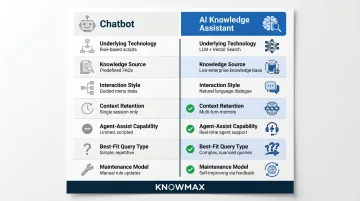
A chatbot optimizes for speed on defined paths. An AI knowledge assistant optimizes for accuracy and resolution depth across support scenarios that don't follow a script.
Both present as a chat window. The difference is in the processing architecture — how a query is interpreted, where the answer comes from, and whether context carries forward.
Why This Distinction Matters for Your Support Strategy
Deploying a chatbot where an AI knowledge assistant is needed creates a "resolution gap"—queries escalate more often, agents spend more time searching for answers, and CSAT drops.
The AHT Impact
Agents spend only 46% of their time with customers; the rest is consumed by administrative tasks and searching for answers. When agents toggle between knowledge tabs, consult colleagues, or re-read policy documents, handle time climbs.
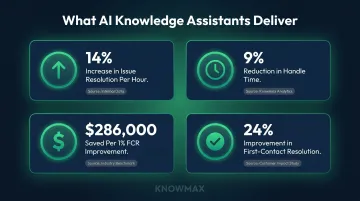
An AI knowledge assistant surfaces the right answer in the flow of work. GenAI-enabled agents achieved a 14% increase in issue resolution per hour and a 9% reduction in handle time, according to McKinsey.
The FCR Problem
Chatbots can deflect volume but cannot reliably resolve complex queries on first contact. The 2024 aggregated FCR average across all industries was 69%, with rates ranging from 43% to 88%. Only 5% of call centers achieve the 80% world-class standard.
An AI knowledge assistant—especially in agent-assist mode—lifts FCR by ensuring agents give accurate answers the first time. Every 1% improvement in FCR translates to $286,000 in annual savings for a typical midsize call center—and a 1.4-point gain in interactional NPS.
Knowledge management implementations have shown approximately 24% improvement in first-contact resolution and 30% reduction in repeat calls, according to eGain.
The Consistency and Compliance Risk
Chatbots return scripted answers that can go stale. AI knowledge assistants pull from a centrally managed knowledge base, ensuring every agent and channel delivers the same current, accurate answer.
In regulated industries, outdated responses aren't just a quality problem—they're a liability. Key frameworks that govern agent responses include:
- CFPB — financial services disclosures and complaint handling
- HIPAA — patient data handling in healthcare interactions
- PCI DSS — payment card data in retail and banking support
Agent misinformation under these frameworks can trigger regulatory penalties and lasting reputational damage.
61% of customer service leaders report a backlog of knowledge articles that need editing, and more than one-third have no formal process for revising outdated articles. This undermines any conversational AI deployment.
The Onboarding and Ramp-Time Benefit
New agents equipped with an AI knowledge assistant reach proficiency faster. The tool compensates for experience gaps by surfacing guided workflows and decision trees at the point of need—so agents don't have to rely on memory or supervisor escalation.
Average time to proficiency is 65 days, costing approximately $7,800 per agent. AI-powered knowledge tools are delivering 20-30% reductions in agent time to proficiency, according to McKinsey. Some knowledge management implementations have shown 80% reduction in training time—for example, wireless service providers reduced agent training from two months to one week.
Which Should You Use? Guidance for Support Leaders
The answer depends on your resolution depth requirements, product complexity, and channel strategy.
Use a chatbot if:
- Your primary need is handling high-volume, simple, predictable queries at low cost
- Strict brand voice control and compliance-approved scripts are non-negotiable
- Tier-0 deflection for repetitive tasks (order status, password resets, routing) is the goal
Use an AI knowledge assistant if:
- Your support involves complex products, multi-policy environments, or technical troubleshooting
- Agent enablement and real-time guidance are priorities
- Consistent omnichannel accuracy is non-negotiable
- You need to serve both self-service and agent-assist channels from a single knowledge source
The Hybrid Model
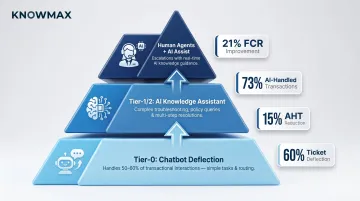
Contact centers that run both tools in tandem get the best of each: chatbots handle tier-0 deflection, while an AI knowledge assistant powers tier-1 and tier-2 resolution for customers plus real-time guidance for agents.
The case for layering is data-backed. McKinsey research shows that 50–60% of customer interactions remain transactional, making them strong candidates for chatbot deflection at tier-0. The remaining 40–50% require the kind of knowledge depth that only a purpose-built assistant can provide.
Gartner's guidance aligns: use a GenAI chatbot as a "single digital concierge," but "dedicate resources to building an AI-optimized knowledge base" to make that concierge effective.
Those outcomes translate directly in practice. A leading telecom company using Knowmax achieved a 21% improvement in FCR and handled 73% of transactions via AI chatbots while reducing AHT. A second organization reported a 15% reduction in AHT and 60% ticket deflection to self-service channels by pairing chatbot deflection with knowledge-powered resolution workflows.
Three Key Evaluation Criteria
When assessing tools, prioritize:
- CRM and telephony fit: Confirm compatibility with your existing stack — Salesforce, Zendesk, Genesys, Talkdesk — before evaluating anything else.
- Dual-channel reach: The tool should serve both customer-facing self-service and agent-assist from a single, unified knowledge base.
- Governance depth: Look for version control, approval workflows, and content scheduling — not just a place to store articles.
See how Knowmax helps support teams deliver faster, more consistent resolutions.
Conclusion
Chatbots and AI knowledge assistants solve different problems. Treating them as interchangeable is where most support strategies go wrong.
Teams that conflate the two tend to underinvest in knowledge infrastructure while overestimating what a chatbot alone can deliver. Only 14% of customer issues resolve fully through self-service, yet 85% of customer service leaders plan to explore conversational GenAI in 2025.
Without a strong knowledge foundation underneath, those GenAI deployments will underperform — regardless of the technology budget behind them.
The leaders seeing real gains in FCR and AHT aren't just choosing better tools. They're building the knowledge infrastructure that makes those tools worth deploying in the first place.
Frequently Asked Questions
Is an AI assistant the same as a chatbot?
No. While the terms are often used interchangeably, chatbots rely on scripted flows and keyword matching, while AI assistants use NLP/NLU and a structured knowledge layer to understand intent and return contextual answers—a meaningful gap in resolution quality.
Which AI assistant is more accurate?
Accuracy depends on the quality of the underlying knowledge base. An AI assistant grounded in a well-maintained, structured knowledge base will consistently outperform one that pulls from generic or poorly organized content.
What is the best AI knowledge base?
The best AI knowledge base for support combines structured content (decision trees, SOPs, FAQs), intent-based search, and regular governance workflows—and integrates seamlessly with the channels agents and customers already use. Knowmax, for example, is built specifically for this: it combines structured content formats, intent-based retrieval, and omnichannel deployment across agent desktop, self-service, and chat—making it a strong fit for contact center and enterprise support teams.
Can a chatbot be upgraded into an AI knowledge assistant?
Chatbots can be enhanced with NLP and knowledge retrieval, but a true upgrade requires connecting to a governed knowledge base and enabling context retention and multi-turn resolution. In practice, that means adopting a purpose-built knowledge management platform—not patching an existing chatbot.
What support metrics improve with an AI knowledge assistant?
The most commonly improved metrics include First Call Resolution (FCR), Average Handle Time (AHT), agent onboarding time, and CSAT—because the assistant reduces agent search friction, ensures answer consistency, and enables faster guided resolution.