Introduction
Telecom contact centers face a persistent paradox: despite heavy investment in support infrastructure, churn rates remain stubbornly high and call queues continue to overflow. The problem isn't insufficient capacity—it's that support is fundamentally reactive, not predictive. Customers experience issues, frustration builds, and by the time they reach an agent (if they bother calling at all), the damage is often done.
Approximately 1 in 7 mobile users globally changed providers in the past 12 months. More troubling: 25 out of 26 dissatisfied customers never complain—they simply leave. For a carrier with 30 million subscribers, each percentage point of churn costs approximately $198 million annually.
Leading telecom providers are now deploying proactive AI that intervenes before customers contact the center. These systems monitor network performance, billing data, and behavioral signals to identify at-risk customers, resolve issues silently, and trigger outreach that resolves friction before it becomes a cancellation.
TLDR
- Reactive support structurally drives churn — waiting, repeat calls, and unresolved issues accelerate cancellations
- Proactive AI monitors network, billing, and behavioral signals to intervene before customers contact the center
- Proactive call deflection and churn prevention are the same action, making this one of telecom's highest-ROI investments
- Key use cases: outage notification, billing anomaly alerts, churn risk outreach, and guided technical resolution
- Success requires robust knowledge management—agents must deliver on the promise proactive engagement makes
Why Reactive Telecom Support Accelerates Churn
Traditional telecom contact centers are built to respond to problems, not prevent them. This creates a costly lag: between when an issue starts (signal degradation, a billing error, a confusing renewal notice) and when it gets resolved, customers make decisions. Many don't call—they simply leave.
The reactive model fails most visibly when customers contact support for the second or third time about the same issue. Research shows that approximately 40% of customers who don't get their issue resolved on the first call defect to another company within that year. In telecom specifically, 51% of churning customers cited having to call more than once as their reason for leaving.
The Silent Churner Problem
The majority of at-risk telecom customers never appear in your contact center metrics. They experience friction, give up, and switch providers without logging a complaint. 56% of telecom churners left "passively"—through disengagement or hearing about better deals—rather than after a single bad experience. These silent churners are invisible to reactive support systems.
That invisibility has a direct operational cost. When silent churn drives up reactive inquiry volume, contact centers face a compounding spiral:
When overwhelmed with inbound calls:
- Hold times increase
- Agent attention decreases
- Resolution quality drops
This happens when customers most need reassurance, creating a negative feedback loop where volume and churn reinforce each other.
Reducing churn and reducing call volume aren't separate goals. Both require shifting the intervention point earlier — acting before a customer notices a problem, not after they've already decided to leave.
What Proactive AI Actually Means in a Telecom Contact Center
Many telecom operators confuse reactive AI—chatbots and IVRs that respond to inbound contacts—with proactive AI. Proactive AI is a different capability entirely: it monitors signals, scores risk, and acts before a customer ever picks up the phone.
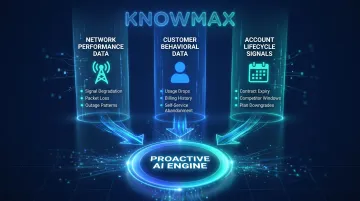
Three Core Inputs
Proactive AI operates by connecting data streams in real time:
- Network performance data — signal degradation, packet loss, outage patterns
- Customer behavioral data — usage drops, billing inquiry history, self-service abandonment
- Account lifecycle signals — contract expiry proximity, competitor promotion windows, recent plan downgrades
Outage response is the visible part. The harder problem—and the bigger opportunity—is predicting churn before the customer has made up their mind.
Proactive AI tracks behavioral signals that indicate a subscriber is drifting toward cancellation:
- Usage frequency dropping week-over-week
- Complaint volume rising without resolution
- Missed payments or billing disputes
- Upsell offers ignored across multiple cycles
- Self-service sessions abandoned mid-flow
AI scores and prioritizes these signals to create a "churn risk queue" for targeted intervention. One carrier's AI churn model identified at-risk subscribers 30 days before cancellation—but their human retention team could only reach 22% of flagged customers before they churned.
That gap between identification and action is where most telecom operators lose ground. Proactive AI doesn't solve for scale with mass outbound campaigns—it targets individual customers based on their specific signals, at the moment intervention is most likely to work.
How Proactive AI Reduces Both Call Volume and Churn at Once
When AI detects a problem and resolves it (or notifies the customer proactively), it simultaneously prevents the inbound call that would have been triggered and addresses the dissatisfaction that could have driven churn. The same intervention achieves both outcomes.
Scenario: A customer's data speeds degrade before they notice. AI detects it, sends a proactive message with a status update and estimated resolution. The customer never calls and doesn't add the incident to their mental "reasons to leave" list.
The Call Volume Math
Proactive notifications during outages and service disruptions eliminate entire categories of inbound contact. At one carrier, 71% of 4.8 million annual contacts were Tier-1 inquiries—billing questions, data usage checks, plan comparisons, password resets. These status-check calls are precisely what proactive AI eliminates.
Before deploying proactive AI, this same carrier experienced a 340% spike in inbound call volume within the first 90 minutes of a network event. Hold times exceeded 45 minutes and customer satisfaction dropped to 2.1 out of 5 during outages.
The Churn Math
Proactive outreach to at-risk customers—especially when it shows the provider is monitoring their experience and acting on their behalf—drives measurable retention gains. McKinsey research shows that a comprehensive, analytics-driven approach can reduce telecom churn by as much as 15%.
The carrier referenced above put that potential to work. Through AI-driven retention outreach, it achieved:
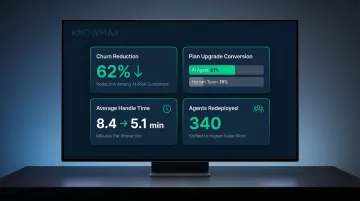
- 62% reduction in subscriber churn among at-risk customers
- 61% conversion rate on plan upgrades via AI agent, versus 19% for the human retention team
The Agent-Efficiency Multiplier
When proactive AI handles routine reactive volume, agents shift to the high-stakes interactions where human judgment and negotiation are actually required. The operational impact at the same carrier was concrete:
- Average handle time for escalated contacts dropped from 8.4 to 5.1 minutes, driven by AI-generated context summaries delivered before each call
- 340 agents were redeployed from Tier-1 volume to higher-value work: enterprise account management, fraud investigation, complex billing disputes, and retention negotiation
The Compound Effect
Proactive AI doesn't plateau. As it learns from outcomes—which interventions prevented churn, which notifications cut callbacks, which resolution paths stopped repeat contacts—its targeting sharpens. Contact centers that deploy it early tend to see compounding gains: lower call volume creates capacity for better escalation handling, which improves satisfaction scores, which reduces the at-risk population the AI needs to reach in the first place.
Proactive AI in Action: Key Use Cases for Telecom Contact Centers
Outage and Service Disruption Management
Network outages generate the single highest-volume inbound event in telecom. Proactive AI detects degradation before customers notice, sends targeted notifications to affected customers, and arms agents with precise status data.
Impact: During its first major outage post-deployment, one carrier reduced inbound call volume by 67% compared to the equivalent prior-year event. This saved $2.1 million in a single regional outage.
Billing Anomaly Detection and Preemptive Clarification
AI monitoring of billing data flags unexpected charges, unusual usage spikes, or promotional expirations before the bill arrives—then triggers a proactive explanation or alert. This eliminates a major driver of "bill shock" calls and the associated churn risk.
The scale of the problem is hard to ignore:
- Billing-related issues account for 46% of all telecom complaints with Canadian providers—a five-year high
- Price sensitivity and billing errors combined drive approximately 40% of total telecom churn
Churn Risk Outreach and Proactive Retention
AI identifies customers approaching contract renewal, with declining usage, or showing known pre-churn behavioral patterns—then triggers either a personalized retention offer or a proactive agent-assisted call.
Critical distinction: This isn't a generic retention campaign. The key is individual-level triggering based on live signals, not batch segmentation. One carrier's AI-triggered approach converted 61% of at-risk subscribers, compared to 19% for traditional human-led campaigns.
Technical Issue Resolution Before the Call
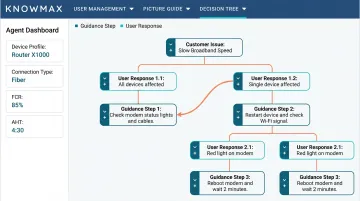
Proactive retention addresses intent to leave—but many customers churn simply because a technical problem went unresolved too long. AI-driven remote diagnostics close that gap by detecting device or connectivity issues and either resolving them silently (network-side fixes, automatic resets) or pushing guided troubleshooting to the customer's app or preferred channel before they ever place a call.
Knowmax's ready repository of 18,000+ telecom and broadband device profiles enables device-specific guided resolution across the full range of customer hardware, including smartphones and IoT equipment. Whether delivered by an agent or through self-service, the resolution is accurate and immediate.
The Missing Layer: Why Knowledge Management Makes Proactive AI Work
Proactive AI creates more complex, higher-stakes agent interactions, not fewer. When AI filters out routine calls and escalates only difficult cases—or when a proactive outreach call reaches a customer with a nuanced complaint—the agent on the other end must have instant, precise knowledge to deliver on the promise proactive engagement has made.
An agent fumbling for answers after a proactive "we're here to help" message causes more damage than no outreach at all.
Knowledge Management Requirements
Agents and digital channels need real-time access to structured, searchable, decision-tree-guided knowledge covering:
- The full range of telecom products and plans
- Device configurations and troubleshooting pathways
- Billing policies and promotional terms
- Network status and technical specifications
A platform like Knowmax serves as the execution layer that turns proactive intent into actual resolution. Its guided decision trees, visual troubleshooting guides, and 18,000+ device repository give agents the depth they need when escalated calls arrive.
In practice: when a customer follows up on a proactive outage notification, the agent navigates device-specific troubleshooting flows in real time using decision trees that auto-traverse based on CRM data — no manual searching required.
Consistency as a Compliance and Trust Issue
When proactive AI notifies a customer about an issue and that customer then calls or chats to follow up, every agent and digital channel must give the same answer. Inconsistent information after a proactive promise is one of the fastest ways to lose the customer you were trying to retain.
Knowmax enforces this consistency through a channel-agnostic knowledge layer that connects with CRM, chatbot, mobile app, and agent desktop systems. A single, centralized knowledge base updates in real time — so whether a customer follows up by phone, chat, or self-service portal, they get the same accurate answer.
A leading Indian telecom operator achieved a 21% improvement in first contact resolution accuracy after deploying Knowmax's knowledge platform. Another provider in the Middle East handled 73% of transactions via AI chatbots backed by structured knowledge, significantly reducing agent workload.
How to Start Building a Proactive AI Strategy in Telecom
Start with the Data Foundation
Proactive AI is only as good as the signal quality feeding it. Audit which data streams you can connect: network monitoring, CRM, billing, and self-service logs. Then prioritize integrations that give AI visibility into the signals most correlated with inbound volume and churn in your specific context.
Recommendation: Start with two or three high-signal data sources, not a boil-the-ocean approach. Network performance data and billing anomalies typically deliver the fastest ROI.
Sequence Deployment by Impact and Risk
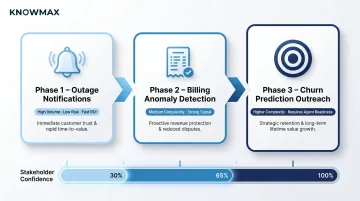
Begin with proactive outage notifications (high volume, low risk, fast ROI) before moving to churn prediction outreach (higher complexity, requires agent readiness). This sequencing:
- Builds stakeholder confidence
- Lets the AI learn on lower-stakes interactions
- Gives agents time to develop the skills for proactive conversations
McKinsey recommends deploying AI across the entire "issue management journey": network anomaly detection first, then CX monitoring, then proactive intervention.
Measure the Right Outcomes from Day One
Track:
- Inbound call deflection rate — how many calls did proactive intervention prevent?
- Repeat contact rate — are customers calling back about the same issue?
- Churn rate in proactively-contacted segment vs. control group
- Agent handle time on escalated interactions
- First contact resolution for proactive vs. reactive interactions
These metrics prove the dual ROI (call volume + churn) and justify continued investment. Avoid measuring only deflection, since churn impact is where the largest financial return sits. To put the stakes in perspective: each 1% improvement in first call resolution yields approximately $286,000 in annual savings for a 500-agent call center.
Frequently Asked Questions
What is proactive AI in a telecom contact center?
Proactive AI refers to systems that monitor network, billing, and behavioral data to identify and resolve issues—or initiate customer outreach—before the customer contacts the center. This contrasts with reactive AI (chatbots, IVR) that only responds to inbound contacts.
How does proactive AI reduce inbound call volume in telecom?
Proactive AI detects root causes of calls (outages, billing confusion, technical issues) before customers notice them, then resolves or notifies customers proactively. This eliminates entire categories of inbound contacts, especially status-check and repeat calls. One carrier saw a 67% drop in outage-related calls after deploying proactive notifications.
What signals does AI use to predict churn in telecom?
AI analyzes usage decline, increased complaint history, contract expiry proximity, billing anomalies, reduced self-service engagement, lack of response to upsell offers, and missed payments. Advanced models identify at-risk subscribers 30 days before cancellation, well ahead of human-triggered reviews.
How is proactive AI different from chatbots or IVR systems?
Chatbots and IVR are reactive: they only engage when a customer initiates contact. Proactive AI acts on detected signals, often resolving issues before the customer ever reaches out. In practice, both work best together — proactive AI reduces contact volume while chatbots handle what still comes in.
What metrics should telecom contact centers track to measure proactive AI ROI?
Key metrics include call deflection rate, repeat contact rate, churn rate in proactively-contacted vs. control segments, first contact resolution rate, and CSAT scores. Prioritize churn impact above all — that's where the largest financial return sits.
Does proactive AI replace human agents in telecom contact centers?
No. Proactive AI shifts agents away from routine reactive calls toward higher-stakes retention and resolution conversations, increasing their impact rather than eliminating their role. It requires better agent knowledge and skills, not fewer agents overall.