Introduction
Pressure to deploy AI in customer service is at an all-time high — and so is the risk of getting it wrong. 91% of customer service and support leaders report executive pressure to implement AI in 2026, driven by goals around customer satisfaction, operational efficiency, and self-service success.
Most deployments, however, underperform. The root cause isn't the AI itself — it's the absence of structured, verified knowledge to reason from. AI systems hallucinate at rates as high as 79% in some tests, and without a reliable knowledge foundation, even sophisticated models produce wrong answers and inconsistent responses.
Knowledge-based AI agents fix this by grounding every response in verified, structured information. This post breaks down exactly how they work — and why they consistently outperform conventional AI tools in accuracy, consistency, and customer satisfaction.
TL;DR
- Knowledge-based AI agents pair a structured knowledge base (facts, rules, policies) with an inference engine that reasons through queries to deliver accurate, relevant responses
- Unlike rule-based bots, they interpret intent, handle novel queries, and adapt as the knowledge base evolves
- Every response follows four steps: perceive the query, retrieve relevant facts, reason to an answer, then act — deliver or escalate
- These agents directly improve First Call Resolution rates, reduce Average Handle Time, and ensure consistent answers across all support channels
- Output quality is only as good as the knowledge base behind it — structure and accuracy matter
What Is a Knowledge-Based AI Agent?
A knowledge-based AI agent is an AI system that stores structured information — facts, rules, procedures, and relationships — in a knowledge base (KB), and applies an inference engine to reason through that knowledge and produce decisions or responses. According to UC Berkeley's CS188 curriculum, a knowledge-based agent "maintains a knowledge base, which is a collection of logical sentences" encoding facts told to the agent and observations it has made. It reasons about what to do based on explicit information rather than learned associations.
This distinguishes knowledge-based agents from general-purpose LLMs that generate responses through pattern matching without grounding in a verified, organization-specific knowledge base.
What Knowledge-Based Agents Are NOT
- Rule-based bots follow hard-coded if-then scripts with no reasoning capability. They break down the moment a query falls outside predefined paths.
- Pure ML models learn from data but cannot explain their reasoning or update with new policies without retraining.
Knowledge-based agents combine structured knowledge with intelligent reasoning — they can adapt to new information, explain their outputs, and update without a full model retrain.
Two Core Components
The Knowledge Base is a repository of facts, policies, procedures, and relationships — designed to be consistent and extensible. This is where verified information lives.
The Inference Engine applies logical methods (deduction, induction) to draw conclusions from the KB and determine the appropriate response. IEEE describes it as "the driver program that traverses the Knowledge Base in response to observations and answers from the external environment".
Why This Matters for Customer Service
In support environments where accuracy is non-negotiable, wrong product information or incorrect policy details directly erode customer trust and compliance standing. Knowledge-based agents are built to be explainable: they can trace exactly why they gave a particular answer, making audits and corrections straightforward.
That traceability becomes critical under regulatory scrutiny. The EU AI Act classifies most customer-facing chatbots as "limited risk," requiring that users be informed they're interacting with AI. High-risk systems face stricter demands — detailed technical documentation, human oversight, and active risk management. Non-compliance carries penalties up to €35 million or 7% of global turnover.
How Knowledge-Based AI Agents Work
A knowledge-based agent operates through a repeatable four-stage process that transforms a raw customer query into a grounded, reasoned response.
Perception: Receiving and Interpreting the Query
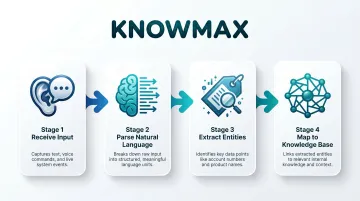
The agent first perceives the incoming input — whether a typed message, voice query, or system event — and converts it into a structured representation the system can process.
This stage goes beyond keywords. The agent identifies intent — what the customer is actually asking, in what context, and with what urgency. From there, it:
- Parses natural language for meaning
- Extracts entities like account numbers and product names
- Maps the query to relevant concepts in the knowledge base
Knowledge Retrieval: Finding What's Relevant
The agent queries the knowledge base to surface relevant facts, rules, and procedures that apply to the customer's query.
Modern implementations use semantic search with vector embeddings rather than exact keyword matching. Semantic search analyzes meaning and intent, creating numerical representations of documents in high-dimensional space where semantically similar content is positioned close together. This enables the agent to find conceptually related knowledge even when the customer's phrasing differs from how the KB is structured.
Retrieval accuracy comes down to how well the KB is organized, structured, and kept current.
Reasoning: Deriving the Right Answer
The inference engine takes retrieved knowledge and applies logical reasoning to determine the most accurate and contextually appropriate response.
Two inference methods handle most real-world scenarios:
| Method | How It Works | Best For |
|---|---|---|
| Forward chaining | Starts from known facts and applies rules until a goal is reached | Policy automation, process control |
| Backward chaining | Starts from a target conclusion and works backward to verify supporting facts | Diagnostics, root-cause debugging |
The practical impact: a contact center agent handling a billing dispute gets a response derived from verified policy rules — not a probable guess based on pattern similarity.
Action: Delivering the Response or Escalating
The agent acts on its reasoning: delivering a response to the customer or agent, triggering a guided resolution step, surfacing a relevant troubleshooting procedure, or escalating to a human agent with full context intact.
The agent can also provide source attribution — explaining which policy or procedure it drew from — which supports transparency and compliance.
How Knowledge-Based AI Agents Improve Customer Service
Answer Accuracy and First Call Resolution
Knowledge-based agents ground every response in verified, policy-aligned content — not probabilistic language generation. The result: consistent answers that resolve issues correctly the first time, without the customer needing to call back.
75% of customer enquiries can now be resolved by AI tools without human intervention, according to Gartner. The case studies back this up:
- Solo Brands deployed a generative AI chatbot that resolves 75% of customer interactions, up from a 40% resolution rate
- Salesforce Agentforce autonomously resolved 70% of chat engagements for 1-800Accountant during tax season, reasoning across internal data, company guidebooks, and IRS.gov
Reduction in Average Handle Time
When agents are assisted by a knowledge-based AI that surfaces the right resolution steps instantly, handle time drops significantly.
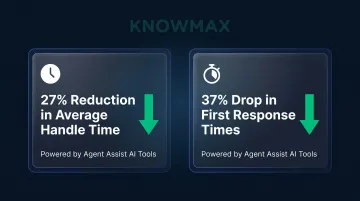
Organisations introducing agent assist tools report a 27% reduction in average handle time. Service teams that automate see a 37% average drop in first response times.
This impact is most acute during new agent onboarding, where knowledge access gaps are the hardest to close quickly.
Channel Consistency
Drawing from a single, centralised knowledge source, these agents deliver the same answer across chat, email, voice, and self-service portals. Conflicting information between channels — one of the fastest ways to erode customer trust — stops being a problem.
90% of customers expect their interactions to be consistent across all channels. Yet only 29% say they receive it. Academic research shows that consistency between online and offline experiences leads to significantly higher customer satisfaction than inconsistency.
Reduction in Agent Error
Human agents under pressure frequently give incorrect or outdated information. A knowledge-based agent acting as an assist layer surfaces the right answer in real time, catching potential errors before they reach the customer.
Contact centres deploying AI report 40-75% error reductions. This is especially critical in industries where compliance with regulatory information is legally required.
Improvement in Self-Service Containment
Knowledge-based agents powering self-service bots can handle a broader range of customer queries without human escalation. Their responses are grounded and accurate enough to be trusted for resolution — not just information lookup.
The numbers show why containment matters:
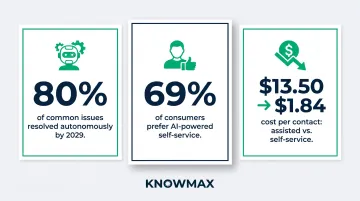
- 80% of common customer service issues are predicted to be resolved autonomously by agentic AI by 2029 (Gartner)
- 69% of consumers prefer AI-powered self-service for quick issue resolution
- Cost per contact drops from $13.50 (assisted) to $1.84 (self-service)
Customer Service Use Cases for Knowledge-Based AI Agents
Agent Assist for Live Support
Knowledge-based agents function as a real-time co-pilot for human agents. As a customer describes their issue, the agent surfaces the right knowledge articles, decision trees, or step-by-step resolution guides from the KB — reducing the time agents spend searching and the likelihood they give incorrect guidance.
This is one of the most impactful use cases in contact centres today. Organisations introducing agent assist report 27% AHT reduction and 60% of organisations report ROI within 12 months of AI deployment.
Conversational Self-Service Bots
Knowledge-based agents power self-service chatbots and virtual assistants that go beyond scripted FAQ responses. They interpret complex, multi-turn queries, reason through the KB to find relevant answers, and guide customers through resolution steps — handling billing disputes, troubleshooting, and policy explanations without human involvement.
Adoption is accelerating fast. 52% of contact centres have already invested in Conversational AI, with 44% more planning to follow — and 92% of businesses report that chatbots sped up issue resolution.
Omnichannel Support Consistency
Deploying a single knowledge-based agent across multiple support channels ensures customers receive identical, accurate information regardless of how or where they contact the business. Channels typically covered include:
- Chat, email, and voice
- IVR and web self-service portals
- WhatsApp and mobile messaging
This consistency is especially important for enterprises operating across regions with different product lines or regulatory requirements.
New Agent Onboarding and Training
Knowledge-based agents cut onboarding time by giving new agents immediate, guided access to the same depth of knowledge experienced agents build over months. Instead of memorising procedures, new hires query the system in real time and follow guided resolution paths.
The results are measurable: organisations using AI knowledge tools for agent training report a 30-50% reduction in ramp-up time. Given that the highest attrition risk falls within the first 90 days, faster onboarding directly protects retention — and most organisations see that value within 4-8 weeks of implementation.
Why Knowledge Quality Determines Agent Performance
A knowledge-based AI agent is only as accurate and reliable as the knowledge base it draws from. If the KB contains outdated policies, contradictory information, or poorly structured content, the agent will surface and reason from that flawed knowledge — producing wrong answers with apparent confidence.
This is the most commonly overlooked failure point in enterprise AI deployments.
What Knowledge Quality Means
Knowledge quality means structured content that is consistently formatted, regularly reviewed, version-controlled, and organised in a way that supports semantic retrieval.
This contrasts sharply with unstructured knowledge scattered across wikis, email threads, and disconnected documents — which knowledge-based agents cannot reliably draw from.
61% of customer service leaders report a backlog of articles to edit in their knowledge library. More than one-third have no formal process for revising outdated articles.
Failure Modes of Poor Knowledge Quality
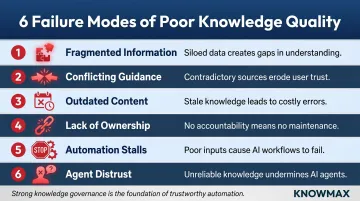
Research by USU identifies six failure modes:
- Fragmented information causes AI to combine signals from multiple documents incorrectly when content isn't unified
- Conflicting guidance leaves AI generating responses that accurately reflect neither source article
- Outdated content gets recommended to thousands of customers if not removed or archived promptly
- Lack of ownership means knowledge gaps spread faster once AI begins distributing them at scale
- Automation stalls after initial pilots when the underlying knowledge foundation is weak
- Agents lose trust in AI suggestions and revert to manual verification, keeping handling times high
AI does not create knowledge — it only retrieves and distributes existing information. AI cannot determine which version of a document is authoritative or which policy overrides another without governance. A single outdated article can influence thousands of AI conversations in hours.
Knowmax: The Knowledge Management Foundation
Fixing these failure modes requires more than clean content — it requires a knowledge management layer with built-in governance. Knowmax provides exactly that, ensuring knowledge-based AI agents always draw from accurate, structured, and current information.
Knowmax provides:
- AI-powered authoring tools — rephrase, summarise, and auto-translate content across 25+ languages without manual reformatting
- Interactive decision trees for guided resolution that ensure agents and AI systems follow compliant, accurate workflows
- Omnichannel knowledge delivery — embedding structured knowledge directly into CRM, telephony, and messaging platforms including Salesforce, Zendesk, Genesys, Freshchat, and Talkdesk
- Semantic search that understands customer intent, not just keywords
- Version control, approval workflows, and scheduled archiving to maintain knowledge quality at scale
- Source attribution so agents and customers can see which policy or article a response was drawn from
Trusted by Vodafone, Airtel, CIMB, Tata, Walmart, and Concentrix, Knowmax is SOC 2, GDPR, ISO 27001, and HIPAA certified — making it a fit for regulated industries including banking, insurance, telecom, and healthcare.
Frequently Asked Questions
What is a knowledge-based agent in AI?
A knowledge-based agent is an AI system that stores facts, rules, and relationships in a structured knowledge base and uses an inference engine to reason through that knowledge to answer queries or take actions — rather than responding through pattern matching or statistical generation alone.
What is the difference between knowledge-based and rule-based agents?
Rule-based agents follow fixed if-then logic with no flexibility. Knowledge-based agents apply logical inference to a dynamic knowledge base, so they can handle novel queries, incorporate new information, and explain their responses.
What is the difference between a knowledge base and an agent?
A knowledge base is the repository of structured facts, policies, and rules; an agent is the active system that queries that knowledge base, applies reasoning, and takes actions. The agent cannot function intelligently without a well-structured knowledge base to draw from.
What is a knowledge base in AI?
A knowledge base in AI is a structured repository that stores domain-specific facts, rules, and relationships in a format that AI systems can query and reason over — distinct from raw data stores or document archives that are not optimized for logical retrieval.
What are the types of agents in AI?
Main types include simple reflex agents, model-based agents, goal-based agents, utility-based agents, and knowledge-based agents. Knowledge-based agents are distinguished by their explicit use of a structured knowledge base and logical inference engine.
What is an example of a knowledge-based agent in AI?
A virtual support agent that queries a product policy knowledge base to answer a billing dispute, reasons through the relevant refund policy rules, and delivers a policy-grounded resolution — rather than generating a plausible-sounding but potentially incorrect response.