Introduction
Contact center agents operate in a relentless environment: toggling between CRM screens, SharePoint folders, outdated wikis, and tribal knowledge stored in colleagues' heads—all while a customer waits on hold. This isn't a minor inconvenience. It's a structural drag that shows up in every metric that matters: rising Average Handle Time (AHT), missed First Call Resolution (FCR) targets, repeat contacts, and frustrated agents who spend more time searching than solving.
The term "knowledge management" often floats around boardrooms in abstract terms. In a contact center, its absence is anything but theoretical. 81% of agents at companies without AI tools report feeling overwhelmed by information during calls, and agents spend 1.8 hours every day just searching for answers.
Every second wasted searching compounds into higher costs, lower satisfaction scores, and escalations that a better-informed agent could have resolved in one call.
This piece breaks down what a knowledge management platform actually is in a contact center context — what it does, why it matters, and what contact centers measurably gain when they implement one.
TL;DR
- A knowledge management platform centralizes and delivers the right information to agents and customers at the right moment
- Directly reduces AHT, improves FCR, and ensures consistency across agents and channels
- New agents onboard faster, escalations drop, and quality becomes less dependent on tenure
- Without one, contact centers face scattered knowledge, inconsistent resolutions, and rising operational costs
- The platform performs as well as the processes built around it — maintenance, integration, and regular review are non-negotiable
What Is a Knowledge Management Platform?
A knowledge management platform is software that captures, organizes, and delivers institutional knowledge—SOPs, troubleshooting guides, FAQs, product information—so the right person can access the right answer without delay. It is not a file repository or a static intranet. It is an active delivery system.
In a contact center, the platform sits between the agent and the information they need, whether during a live call, a chat interaction, or a self-service query. The value is not in storing knowledge. It is in reducing the time and friction between a customer's question and a correct, consistent answer.
In practice, this means:
- Agents get contextually relevant content the moment they search
- Policy updates push across every support channel in real time
- New hires access structured guidance from day one, not after weeks of shadowing
That combination—speed, consistency, and structured access—is what separates contact centers that resolve issues on the first contact from those that don't.
Key Advantages of a Knowledge Management Platform for Contact Centers
The advantages below are grounded in contact center operations. Each one maps to a metric that managers already track. The goal is not to describe theoretical benefits, but to explain what concretely changes when a platform is in place.
Three advantages stand out consistently across operations of every size.
Advantage 1: Faster Agent Responses and Reduced Average Handle Time
Agents spend significant time during every interaction searching for answers—across multiple tabs, SharePoint folders, outdated wikis, or asking a colleague. A knowledge management platform consolidates this and surfaces contextually relevant information in seconds, without the agent leaving their workflow.
What changes in practice:
- AI-powered search understands intent, not just keywords — if an agent types "refund policy for damaged items," the correct procedure surfaces even when the article title uses different wording
- Interactive decision trees guide agents step-by-step through resolution paths, eliminating ambiguity
- Structured content formats replace dense PDFs with scannable, actionable guidance
Knowmax's intent-based search and guided decision trees exemplify this approach, delivering precise answers that reduce the per-interaction search burden.
The business case:
Industry research shows agents spend 1.8 hours every day searching for information—nearly 20% of the workweek. Every second saved per interaction multiplies across thousands of calls per day. A leading online food delivery app using Knowmax achieved a 15% reduction in AHT within a short period, and a fintech startup reported AHT reductions of 35 seconds per interaction.
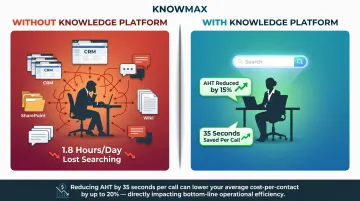
Lower AHT means more interactions handled per agent-hour, directly reducing cost-per-contact. With typical contact costs ranging from $8 to $80 depending on complexity and industry, even modest AHT improvements generate measurable savings.
KPIs impacted:
- Average Handle Time (AHT)
- First Call Resolution (FCR)
- Cost-per-contact
- Agent idle time
Best fit scenarios:
- High-volume contact centers handling thousands of daily interactions
- Complex product or service portfolios with frequent policy updates
- Environments where agents handle a broad range of query types in a single shift
Advantage 2: Consistent Resolution Quality Across Agents and Channels
In most contact centers, resolution quality is uneven. It depends on how long an agent has been there, which team lead trained them, or which version of a guide they happen to have saved. A knowledge management platform eliminates this variability by ensuring every agent accesses the same verified, current information every time.
What changes in practice:
Centralized content governance means updates are made once and reflected everywhere instantly. If a return policy changes at 9 a.m., every agent—across voice, chat, email, and self-service—has the new policy by 9:01 a.m. Guided resolution flows ensure agents follow the same path regardless of tenure, channel, or shift. Omnichannel delivery ensures the same knowledge reaches the agent whether they're on a call, responding to a chat, or supporting a self-service bot.
The business case:
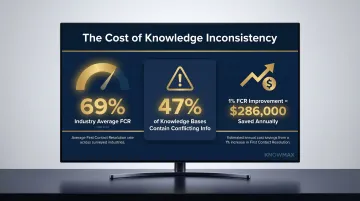
Inconsistency erodes customer trust and generates repeat contacts. According to SQM Group's 2024 benchmark data, the industry average FCR is just 69%, meaning nearly one-third of contacts require a follow-up. Every 1% improvement in FCR increases interactional NPS by 1.4 points and saves a typical midsize call center $286,000 annually.
47% of customer service knowledge bases contain conflicting information and 31% of agent escalations trace back to outdated or missing content. The cost of that inconsistency is measurable.
In regulated industries like banking, insurance, and healthcare, the stakes go beyond quality scores. Inconsistent agent guidance becomes a compliance liability. Major financial institutions face regulatory fines exceeding $4 billion annually, with information fragmentation identified as a root cause.
KPIs impacted:
- Quality assurance (QA) scores
- Repeat contact rate
- Escalation rate
- Customer satisfaction (CSAT)
- Compliance adherence
Best fit scenarios:
- Large teams with high agent turnover
- Omnichannel contact centers managing voice, chat, email, and self-service simultaneously
- Organizations operating across multiple geographies or languages
- Regulated industries where inconsistent guidance creates compliance risk
Advantage 3: Shorter Onboarding Cycles and Lower Training Costs
Contact centers face among the highest employee turnover rates of any industry. Agent turnover runs 30-45% annually across the industry, with first-year attrition reaching 69-73% and average tenure just 14-15 months. This means training is not a one-time cost — it is a recurring operational burden.
A knowledge management platform compresses ramp time by giving new agents an always-available, structured reference they can rely on from day one.
What changes in practice:
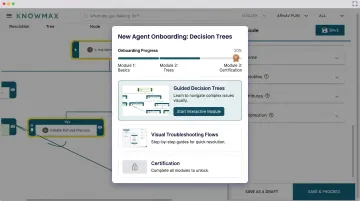
Instead of shadowing senior agents for weeks or sitting through classroom sessions, new agents access role-specific guided flows, visual troubleshooting guides, and searchable SOPs on demand. Knowmax's LMS brings this together with:
- Interactive visual guides and decision trees available from day one
- Gamified learning elements with sequentially unlocked courses
- Instant scoring and auto-issued certificates upon completion
- Real-time content updates so new agents always learn from current policies
The business case:
Replacing a single agent costs $10,000-$20,000 in total, with a 90-day average ramp to full productivity. For a 100-agent center with 31% turnover, the annual cost including lost productivity exceeds $700,000.
Knowledge management platforms with structured content and guided resolutions have been shown to reduce training time by 30-60%. This compresses ramp time and lowers per-agent onboarding cost. Agents who feel equipped from early on report less frustration — and are less likely to leave, breaking part of the turnover cycle.
KPIs impacted:
- Time-to-proficiency
- Training cost per agent
- Onboarding duration
- Early-tenure quality scores
- Agent retention rate
Best fit scenarios:
- BPOs managing multiple client programs
- Contact centers with seasonal ramp-ups
- Organizations with above-average annual attrition
- Teams launching new products or services requiring fast knowledge transfer
What Happens When a Knowledge Management Platform Is Missing
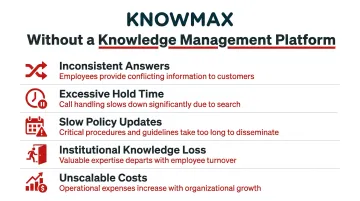
Without a knowledge management platform, contact centers operate in a state of managed chaos. Agents rely on personal notes, colleague interruptions, or outdated SharePoint documents. This isn't a minor inconvenience—it is a structural drag on performance that compounds daily.
Specific consequences contact centers face without a platform:
- The same query gets different answers on different calls — conflicting knowledge bases drive repeat contacts, escalations, and CSAT degradation
- Agents put customers on hold to search or consult colleagues, consuming 20-30% of handle time before a resolution is even attempted
- Every policy or product change triggers emergency retraining; without centralized governance, updates can take days or weeks to reach every agent
- When experienced agents leave — and with average tenure at 14-15 months and first-year attrition above 70%, they leave often — their institutional knowledge disappears with them
- Headcount growth brings proportional cost increases instead of efficiency gains, making scale operationally punishing rather than profitable
How to Get the Most Value from a Knowledge Management Platform
A knowledge management platform pays off more over time—but only when treated as a live operational system, not a one-time implementation. Three conditions determine whether a platform actually performs.
Apply It Consistently
A platform must be embedded in the agent's daily workflow—integrated into the CRM, ticketing system, or telephony platform so agents use it by default, not as an optional extra. Salesforce's 2024 State of Service report shows a 22-point gap in screen-toggling rates between high-performing (36%) and underperforming (58%) organizations. Integration eliminates this friction.
Knowmax integrates with Salesforce, Zendesk, Freshworks, Genesys, and Talkdesk, delivering knowledge directly within the agent's primary workspace—so the platform fits the workflow rather than adding to it.
Review Outcomes Regularly
Track how the platform is affecting AHT, FCR, QA scores, and onboarding duration on a recurring basis. Identify content gaps through search analytics—what agents are searching for but not finding is as revealing as what they are finding.
Leading organizations conduct quarterly content audits and establish cross-functional governance councils—Operations, Training, Quality, and Knowledge Management—to review metrics and approve updates. Usage trends, feedback ratings, and aging reports are what should set content priorities, not guesswork.
Keep Content Current Through Active Governance
Update content when products change, retire outdated articles, and close knowledge gaps identified through agent feedback and analytics. Knowledge decay is a silent liability. Stale content actively misleads agents; it is not a neutral gap, it is a wrong answer delivered with confidence.
Gartner reports that 58% of customer service leaders plan to upskill agents as knowledge management specialists to review and curate AI-generated content. That means the curation role is shifting from administrators to agents themselves—which only works if the platform is built to support structured review workflows, not just open editing.
Conclusion
A knowledge management platform's value in a contact center is not theoretical. It shows up in AHT, FCR, CSAT, onboarding speed, and the quality consistency that customers notice even when they cannot name it.
When agents spend nearly 20% of their workweek searching for information and 81% report feeling overwhelmed, the operational case for centralized, intelligent knowledge delivery becomes undeniable.
The advantages compound over time. A single percentage point improvement in FCR saves a midsize contact center $286,000 annually. Reducing onboarding time by 30–50% translates to hundreds of thousands saved in a high-turnover environment. Those numbers grow with every agent hired, every ticket resolved, and every inconsistency caught before it reaches the customer.
A knowledge management platform should be treated as an ongoing operational practice—actively maintained and continuously improved—not a box to check during a technology rollout. The contact centers that get this right stop reacting to knowledge gaps and start preventing them—and that shift is where the real competitive distance gets built.
Frequently Asked Questions
What is a knowledge management platform?
A knowledge management platform is a centralized software system that captures, organizes, and delivers institutional knowledge (SOPs, FAQs, guides) so agents and customers can access accurate, up-to-date information quickly across any channel or interaction.
What is the main purpose of KMS?
A KMS exists to put accurate answers in front of agents and customers without delay. It removes dependence on individual memory or informal knowledge-sharing, speeding up decisions and improving resolution consistency across the team.
What are the key features of a knowledge management system?
Essential features include AI-powered search, guided decision trees, version-controlled content, omnichannel delivery, content analytics, and integration with CRM and ticketing systems—all designed to put accurate answers in front of agents with minimal effort.
How does a knowledge management platform reduce Average Handle Time in contact centers?
AI-powered search and guided resolution flows surface the right answer before the agent even finishes typing the query. Less time hunting for information means faster resolutions—and across thousands of daily interactions, that directly cuts Average Handle Time.
What is the difference between a knowledge base and a knowledge management platform?
A knowledge base is a repository of stored articles and FAQs, while a knowledge management platform is an active system that governs how knowledge is created, maintained, delivered, and measured—making the information not just available but actionable.
How does a knowledge management platform support agent onboarding in contact centers?
It gives new agents on-demand access to structured resolution guides, visual troubleshooting flows, and searchable SOPs from day one, reducing dependence on shadowing or classroom training and accelerating time-to-proficiency.