Introduction
Picture this: Your agent toggles between six different screens, hunting for an answer while a frustrated customer waits on hold. Meanwhile, your shiny new chatbot loops through the same three options before deflecting the query back to the queue — unresolved. Sound familiar?
58% of agents at underperforming organisations toggle between multiple screens to find information they need. On the customer side, nearly 40% of chatbot interactions are negative, and 75% of consumers agree chatbots can't handle complex questions.
Both chatbots and knowledge bases are sold as silver bullets for contact centre inefficiency. They solve fundamentally different problems. Deploying only one — or choosing the wrong fit — leaves you with deflection that doesn't resolve, or accuracy that never scales.
TLDR
- A chatbot automates customer-facing conversations; a knowledge base is a structured repository that helps agents and customers find accurate answers fast
- Chatbots reduce inbound volume, knowledge bases reduce handle time and errors — they operate at different layers
- Neither alone fully solves contact center problems; the best deployments combine both, with the knowledge base powering the bot
- Your starting point should be your biggest pain point: deflecting volume, improving resolution quality, or enabling agents faster
Chatbots vs Knowledge Bases: Quick Comparison
| Dimension | Chatbots | Knowledge Bases |
|---|---|---|
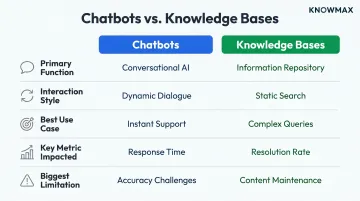
| Primary Function | Automates customer-facing conversations using AI, NLP, or rules | Centralised repository of structured content: SOPs, FAQs, guides, decision trees |
| Interaction Style | Conversational, proactive, guided dialogue | Search-based or agent-assisted retrieval |
| Best Contact Center Use Case | High-volume, repetitive transactional queries; 24/7 deflection | Complex queries requiring nuanced judgment; agent enablement during live calls |
| Key Metric Impacted | Reduces inbound volume, cost per contact | Reduces AHT, improves FCR, agent consistency |
| Biggest Limitation | Struggles with complex, multi-step issues; loops without resolution frustrate customers | Requires agents or customers to initiate search — won't deflect volume independently |
Note: These tools work best together. The sections below explain why pairing a chatbot with a knowledge base — where the KB acts as the intelligence layer — produces better deflection rates, lower AHT, and more consistent resolutions than either tool alone.
What Is a Chatbot in a Contact Centre?
A contact centre chatbot is a software layer that automates customer-facing conversations using predefined rules, natural language processing (NLP), or generative AI. It sits on digital channels like websites, WhatsApp, IVR systems, and messaging apps, acting as the first line of response before a human agent gets involved.
Three Common Types:
- Rule-based chatbots: Follow scripted decision trees, ideal for straightforward transactional queries like order status or balance checks
- NLP-driven chatbots: Understand natural language intent, handling variations in phrasing and context
- Generative AI-powered chatbots: Pull from a knowledge source to craft dynamic responses — but their quality depends entirely on the knowledge they access
Core Benefits for Contact Centres
Chatbots deliver measurable value when deployed for the right use cases:
- Handle high-volume, repetitive queries at scale: order tracking, account lookups, password resets, FAQs
- Stay available around the clock: AI chatbots now handle 75.3% of all incoming live chats, with 44.8% resolved without human involvement
- Free agents for complex work by deflecting routine queries from live queues
- Cut cost per contact: chatbot interactions run approximately $0.50–$0.70 versus roughly $6 for a human agent
Use Cases of Chatbots in Contact Centres
These benefits translate directly into specific scenarios where chatbots earn their place in the workflow.
Where chatbots deliver the most value:
- Triage and route first contacts: capture intent, then direct complex queries to the right agent queue
- Handle transactional self-service: balance checks, appointment booking, bill pay, tracking updates
- Cover after-hours gaps when live agents aren't available
That said, chatbots have real limits — and deploying them without understanding those limits is where most contact centres run into trouble.
Critical limitations:
- Break down on complexity: multi-step troubleshooting, nuanced policy questions, and emotionally charged issues exceed most bots' capabilities
- 50% of consumers feel frustrated by chatbot interactions, and 30% abandon purchases after one negative experience
- Only as accurate as their knowledge source — without a reliable, maintained knowledge base behind them, bots become a liability rather than an asset
What Is a Knowledge Base in a Contact Centre?
A contact centre knowledge base is a structured, searchable repository — SOPs, product details, troubleshooting guides, policies, FAQs — that agents access in real time to resolve customer issues accurately and consistently.
Unlike a simple FAQ page, a contact centre KB delivers guided, step-by-step resolution workflows built for complex queries.
Two Deployment Modes
- Agent-facing KB: An internal tool that surfaces the right answer during live interactions — reducing handle time and errors. Knowmax delivers AI-powered search, interactive decision trees, and visual troubleshooting guides built for contact centre workflows.
- Customer-facing KB: A self-service portal that deflects tickets by letting customers find answers on their own terms, across web, mobile, and chat channels.
Core Benefits Tied to Contact Centre KPIs
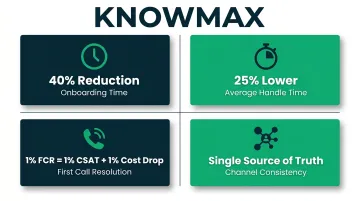
- Faster agent onboarding: Knowmax has reduced onboarding time by 40% by centralising training materials and workflows
- Reduced Average Handle Time: Implementing the right knowledge management system can lower call handle time by 25%
- Improved First Call Resolution: For every 1% improvement in FCR, customer satisfaction improves by 1% and operating costs drop by 1%
- Consistent responses across channels: Inconsistent answers across touchpoints are a top driver of customer frustration — a centralised knowledge base enforces a single source of truth across every channel
Where chatbots fall short on nuanced or sensitive queries, a knowledge base keeps agents in control — improving resolution quality, not just deflection volume.
Use Cases of Knowledge Bases in Contact Centres
Where a KB creates the most impact:
- Guides agents through live calls with step-by-step resolution flows — no screen-toggling required
- Accelerates new agent onboarding through structured learning paths and embedded SOPs
- Supports complex escalations: policy lookups, multi-product troubleshooting, compliance-sensitive workflows
- Enables self-service for customers who prefer finding answers independently
Content Governance Advantage
Unlike chatbots, a knowledge base can be updated centrally, and changes propagate instantly across all channels. This is critical for fast-changing products, policies, or regulated industries like banking, telecom, and healthcare where a single outdated policy answer can trigger a compliance breach.
Chatbots vs Knowledge Bases: Which One Actually Solves Your Contact Centre's Problems?
Frame your decision around pain points, not feature lists.
Start With Your Biggest Problem
High inbound volume and repetitive queries at scale?
A chatbot is the right lead investment. Deploy it on high-traffic channels (web, WhatsApp, SMS) to deflect transactional queries and reduce queue pressure. Industries like telecom and e-commerce see the highest ROI here.
Long handle times, agent inconsistency, or high error rates on complex queries?
A knowledge base is the more impactful fix. It equips agents with accurate, step-by-step guidance during live interactions, improving FCR and reducing AHT without sacrificing resolution quality.
The "False Choice" Trap
Many contact centres deploy a chatbot expecting it to solve all CX problems, then find that unresolved escalations flood the queue. Why? The chatbot had no reliable knowledge source to draw from.
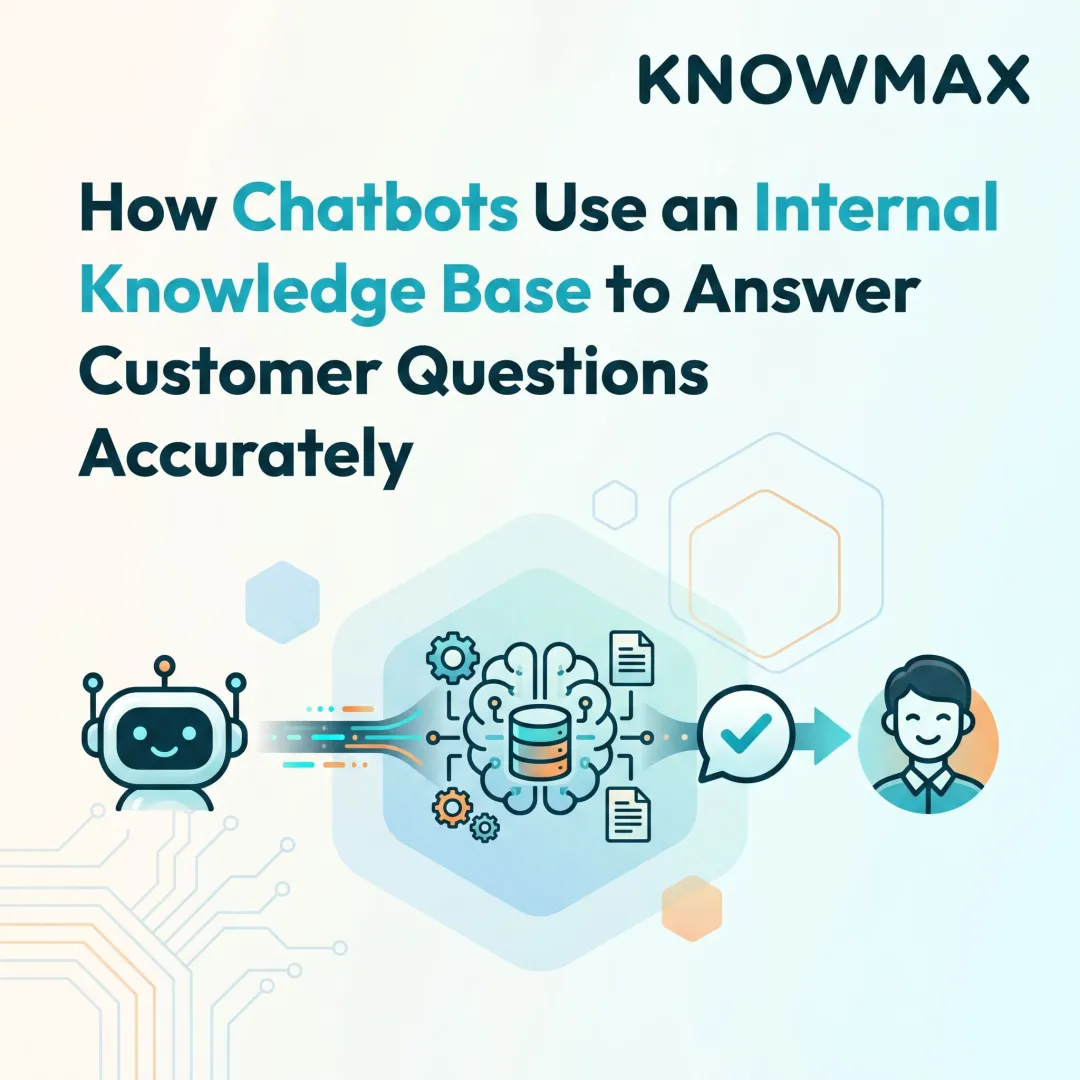
A knowledge base resolves this by serving as the single source of truth that both agents and chatbots depend on. When your bot pulls answers from a well-maintained KB, accuracy improves, hallucination drops — and your maintenance burden shrinks considerably.
Situational Decision Guide
Choose chatbots first if:
- High after-hours volume with mostly transactional queries
- Limited agent bandwidth and need immediate deflection
- Queries are repetitive and don't require judgment
Choose a knowledge base first if:
- Long AHT driven by agents searching for answers
- Inconsistent responses across teams or channels
- High escalation rates on complex, regulated, or multi-step queries
- New agents take too long to reach productivity
Deploy both if:
You want deflection AND resolution quality. The KB powers the chatbot's responses, reducing escalation rates and ensuring agents have context when handoffs occur.

The Integration Advantage
A chatbot connected to a well-maintained knowledge base is more accurate and easier to maintain than a standalone bot. The KB acts as the intelligence layer — keeping information current, reducing errors, and extending the bot's usefulness beyond simple transactional queries.
Real-world example:
Vodafone Germany's TOBi chatbot, powered by IBM Watson and integrated with a structured knowledge layer on the Genesys platform, grew its AI resolution rate from 16% at launch to 44% of all enquiries — with over 230 customer intents programmed.
The bot now handles 100% of initial messaging conversations across WhatsApp, Apple Business Chat, and SMS. That integration reduced escalations, improved CSAT, and earned Vodafone Germany the #1 ranking among all Vodafone contact centres worldwide. The knowledge layer is what made the difference between a bot that deflects and one that actually resolves.
Conclusion
There's no winner in the chatbots vs knowledge bases debate — because they're not rivals. They're two layers of the same resolution infrastructure. The chatbot handles the front door, deflecting volume and automating transactional queries. The knowledge base ensures what happens inside is accurate, fast, and consistent.
The goal isn't to deploy more technology. It's to reduce handle time, improve first call resolution, and give agents the tools they need to get it right. That outcome requires both a smart automation layer and a reliable knowledge foundation working in tandem.
Start by identifying your primary pain point: volume, resolution quality, or agent enablement. Then build around it. High-performing contact centers don't choose between chatbots and knowledge bases — they treat the knowledge base as the foundation and automation as the delivery mechanism on top of it.
Frequently Asked Questions
What is the difference between chatbots and knowledge bases?
Chatbots automate customer-facing conversations using AI or rules, while knowledge bases store structured information for agents or customers to retrieve. Chatbots typically depend on a knowledge base to deliver accurate answers — so in practice, the two tools work together rather than in opposition.
What are the advantages of chatbots compared to static FAQs or knowledge bases?
Chatbots provide conversational, real-time interaction rather than requiring users to search. They guide customers through dialogue, making them more effective for transactional, high-volume queries where waiting or searching creates unnecessary friction.
What is the difference between AI and a knowledge base?
AI is a technology layer (NLP, machine learning) that powers smarter search and conversation. A knowledge base is a content repository. Modern AI-powered knowledge bases combine both to deliver intent-based search and guided resolution.
What are the four types of chatbots?
The four main types are:
- Rule-based: Follow scripted flows and predefined decision paths
- NLP-based: Understand natural language to interpret varied customer inputs
- AI/generative: Dynamically generate responses from a connected knowledge source
- Hybrid: Combine rules and AI for flexibility across different use cases
Do contact centers need both a chatbot and a knowledge base?
Most high-performing contact centers use both. The chatbot handles volume deflection and automation, while the knowledge base improves resolution quality for agents and powers the chatbot's accuracy, reducing escalations and improving CSAT.