Introduction
Contact center managers face a performance paradox: agents complete weeks of training, pass certifications, and test well in simulations — yet struggle the moment they're on a live call. They freeze during complex billing disputes, put customers on hold while hunting for SOPs, and escalate issues they should handle independently. Training gave them knowledge, but the live environment exposes a gap: they lack the real-time support needed to apply what they learned under pressure.
This gap is measurable. 60% of agents report their training provides "no value" on the job, and the industry average time to full productivity remains stuck at 90 days — even though formal training typically lasts just 2-3 weeks.
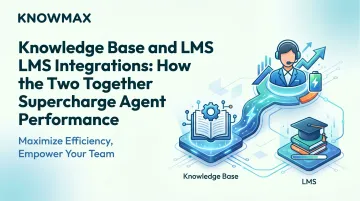
What bridges that gap isn't more training or better knowledge tools in isolation — it's connecting the two. A Learning Management System (LMS) builds foundational competency; a Knowledge Base (KB) delivers real-time performance support. Together, they create a continuous learning loop that moves agents from training to confident, independent call handling faster, with fewer errors and better customer outcomes.
TL;DR
- LMS delivers structured training before agents go live; KB provides real-time guidance during live interactions
- Together, LMS and KB close the gap between training and live performance — cutting ramp time and reducing in-call hesitation
- Combined, they directly improve AHT, FCR, and CSAT — the metrics contact centre leaders track most closely
- Without integration, agents hit a post-training void — and that void shows up in escalations, errors, and rising handle times
What Is KB+LMS Integration, and Why Does It Matter for Contact Centers?
Each tool solves a different problem — and has a clear boundary where it stops helping:
| Tool | Primary Role | Where It Falls Short |
|---|---|---|
| LMS | Delivers, tracks, and certifies agent training (product knowledge, compliance, soft skills, process orientation) | Stops being relevant the moment training ends |
| Knowledge Base | Real-time repository of SOPs, decision trees, troubleshooting flows, and FAQs agents access during live interactions | Only useful if it mirrors what agents actually learned |
For contact centers, platforms like Knowmax extend the KB further — delivering AI-powered search and guided decision trees directly within the agent's desktop workflow, so the right answer surfaces in seconds, not after a manual search.
Integration closes that gap. Training content in the LMS links directly to the same resources agents use on the floor — so the billing dispute module an agent studies during onboarding embeds the exact decision tree they'll follow on a live call.
Completing training doesn't just mean passing a quiz. It means being ready to perform, because the study materials and the live-use tools are the same.
Key Advantages of KB+LMS Integration for Agent Performance
Each advantage below corresponds to a measurable performance problem contact centers track daily — not abstract benefits, but direct solutions to operational challenges.
Advantage 1: Faster Agent Ramp-Up and Shorter Time-to-Competency
When LMS training modules link directly to KB articles agents will use on the job, new hires build context and confidence simultaneously. They don't just learn what to do — they practice navigating the exact resources they'll rely on during live calls.
During onboarding, an LMS module on handling billing disputes can embed links to the actual KB decision tree agents will follow on the job. Completing training means being ready to perform, not just ready to be tested.
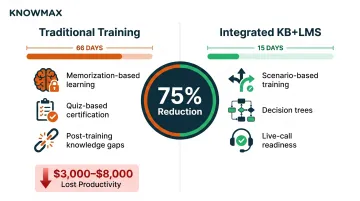
The traditional ramp-up problem is the gap between knowing and doing. Agent errors account for 38% of all First Call Resolution failures, and most occur in the first 60-90 days. Extended ramp-up carries measurable cost: lost productivity during ramp costs $3,000-$8,000 per agent, supervisor time adds another $1,000-$3,000, and customer service disruption costs an additional $1,000-$3,000. Each week of delay compounds.
Integrated KB+LMS compresses this window. One contact center reduced time-to-proficiency by 75% — from 66 days to just 15 days for call-handling readiness — by switching from memorization-based training to scenario-based training with decision-tree documentation embedded in both the LMS and live KB.
KPIs impacted:
- Time-to-competency
- Onboarding cost per agent
- Early-tenure error rate
- Supervisor escalation rate during first 90 days
When this advantage matters most: High-volume hiring periods, BPO environments with rapid agent turnover, and enterprises launching new products that require fast re-skilling across large agent populations.
Advantage 2: Real-Time Knowledge Support That Reduces Handle Time and Errors
LMS training gives agents foundational knowledge, but it cannot anticipate every edge case on a live call. A KB integrated into the agent desktop gives them instant access to the right answer, without putting the customer on hold or pulling in a supervisor.
When an agent trained on a product via the LMS encounters a complex issue mid-call, an AI-powered KB surfaces the exact resolution guide, policy update, or troubleshooting flow relevant to that query in seconds.
The cost of hold time and misdirected transfers is significant. Global average AHT is 6 minutes 10 seconds, but in financial services, hold times alone average 2-3 minutes per interaction. Contact centers can lower AHT by 25% with the right knowledge management system, with documented reductions reaching 67% in some implementations.
For every 1% improvement in FCR, contact centers see a 1% improvement in CSAT and $286,000 in annual savings for a midsize center. Integration ensures agents have both the training context (LMS) and the real-time guidance (KB) needed to resolve issues on the first contact without escalation — and without conflicting information undermining their confidence.
KPIs impacted:
- Average Handle Time (AHT)
- First Call Resolution (FCR)
- Escalation rate
- Agent error rate
- CSAT score
When this advantage matters most: Complex product environments with frequent policy changes, high-stakes interactions (banking, insurance, healthcare), and contact centers handling high query volumes where even small AHT reductions produce significant cost savings at scale.
Advantage 3: Consistent Knowledge Delivery Across a Distributed Agent Workforce
In large or multi-site contact centers, knowledge inconsistency is a silent quality killer. Different agents give different answers, outdated KB articles contradict recent LMS updates, and managers cannot guarantee what any given agent knows at any moment. Integration enforces a single source of truth.
When LMS course content and KB articles are governed from the same knowledge structure, any product update or policy change can be pushed to both the training layer and the live-use layer simultaneously. Every agent, everywhere, operates from current information.
Knowmax supports this through synchronized updates: when a policy changes in the KB, linked LMS training content reflects the change automatically, and vice versa.
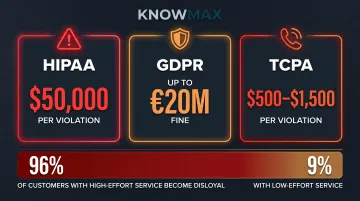
Inconsistency in agent responses leads directly to customer distrust. Forrester identified lack of knowledgeability and inconsistency across touchpoints as the biggest customer service hurdles. Gartner found that 96% of customers who experience high-effort service become disloyal, compared to only 9% with low-effort experiences.
In regulated industries, delivering outdated information is also a legal risk. HIPAA penalties reach $50,000 per violation, GDPR fines can reach €20 million, and TCPA violations run $500-$1,500 each.
KPIs impacted:
- Quality assurance (QA) scores
- Compliance adherence rate
- Customer effort score
- Repeat contact rate
- CSAT consistency across sites
When this advantage matters most: Multi-location or work-from-home agent environments, regulated industries, enterprises undergoing frequent product launches or policy updates, and BPOs managing multiple client programs simultaneously.
What Happens When Knowledge Base and LMS Operate in Silos
Agents complete LMS modules, pass certifications, and go live — only to find that the knowledge they need in real time is buried in a separate system, outdated, or simply absent. This post-training void forces guesswork, supervisor dependency, and inconsistent customer responses.
Direct operational consequences of siloed KB and LMS:
- AHT climbs as agents toggle between applications nearly 1,200 times per day, spending up to 15% of their time re-keying data across systems
- FCR suffers: the 69% industry average means roughly 30% of customers call back about the same issue, often because agents gave inconsistent answers
- Onboarding drags on when training content doesn't match what's actually used on the floor, pushing the ramp to proficiency well past 90 days
- QA scores drop as agents improvise answers for scenarios their training never covered
- Supervisors absorb escalations that agents should handle independently, cutting into coaching time
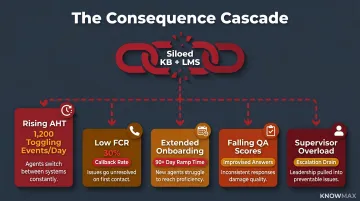
Every one of these problems compounds as headcount grows — making an integrated knowledge layer not a nice-to-have, but an operational necessity.
How to Get the Most Value from KB+LMS Integration
Integration works best when training content and KB content are developed in tandem — not as separate parallel projects. Every procedural task an LMS module covers should have a corresponding KB article agents can find with a single search.
Knowmax enables this natively: decision trees built in the KB can be embedded or referenced within LMS training modules, letting agents practice navigating real workflows during onboarding. AI-powered search then surfaces the exact troubleshooting flow, guide, or policy article needed during live calls.
Keep the KB Current — Not Just the LMS
Every policy change, product update, or process revision that goes into the LMS should trigger an update to the corresponding KB article. Stale content actively undermines agent trust — often creating more confusion than having no reference at all.
Knowmax supports this through built-in governance tools:
- Approve and schedule content updates with defined start/end dates
- Archive outdated articles so agents never encounter superseded information
- Set content expiry rules tied to product or policy revision cycles
Measure What Agents Actually Use
Governance keeps the KB accurate — analytics tell you whether it's working. Tracking usage patterns reveals gaps in both the LMS curriculum and KB content library.
Knowmax's analytics surface:
- Search success rates — which queries return useful results, and which dead-end
- Article resolution rates — whether agents find and apply content or abandon it
- Knowledge freshness scores correlated with AHT and FCR trends
These signals show precisely where training needs reinforcing and where KB content needs updating, closing the loop between learning and live performance.
Conclusion
KB+LMS integration is a commitment to keeping agent knowledge consistent from day one of training through every live customer interaction. What agents learn in the LMS should be immediately accessible in the knowledge base — and that alignment compounds in value over time.
When the two systems work together, contact centers see measurable gains across the board:
- Faster ramp-up: New agents reach proficiency without waiting for tribal knowledge to trickle down
- Real-time resolution support: Agents surface accurate answers mid-interaction, not after the call
- Consistent knowledge delivery: Every agent, on every channel, works from the same up-to-date source
The difference between high-performing contact centers and the rest often comes down to whether training and live knowledge operate as a continuous loop or as two disconnected systems. Treat this integration as an ongoing operational practice — audit content alignment regularly, update both systems in sync, and close the gap between what agents learn and what they actually use. That's where handle time drops, first-call resolution improves, and agent confidence becomes a competitive advantage.
Frequently Asked Questions
What are LMS integrations?
LMS integrations connect a Learning Management System with other platforms — such as CRMs, knowledge bases, HR systems, or communication tools — creating a unified ecosystem where data, content, and workflows are shared across systems rather than siloed.
What is the difference between LMS and knowledge base?
An LMS delivers structured, course-based training for foundational learning with tracking and certifications. A knowledge base is a real-time reference library agents use during live interactions to find answers and follow procedures. The two tools cover different stages of agent readiness — one builds knowledge, the other puts it to work.
What is LMS knowledge?
LMS knowledge refers to the structured, instructional content stored and delivered through a Learning Management System — including courses, modules, assessments, and certifications designed to build foundational understanding of processes, products, compliance, and skills.
Can a knowledge base replace an LMS for agent training?
No. A knowledge base provides on-demand reference content but does not deliver structured learning progression, track completion, or build foundational context the way an LMS does. The two tools serve complementary roles, and replacing one with the other leaves a gap in either training depth or real-time performance support.
How does integrating a knowledge base with an LMS reduce agent ramp-up time?
When LMS training modules link directly to the KB articles agents will use on live calls, new hires build familiarity with both the knowledge and the tools at the same time. This shortens the gap between completing training and independently handling customer interactions at full competency.
What metrics improve when a knowledge base and LMS are integrated for contact center agents?
Integration typically improves Average Handle Time (AHT), First Call Resolution (FCR), agent ramp-up time, QA scores, escalation rates, and CSAT. These gains come from giving agents both the training context and the real-time guidance needed to resolve issues accurately.