Introduction
Contact center collaboration failures rarely stem from team dysfunction. The symptoms are operational: agents scrambling mid-call to find an answer, supervisors fielding identical escalations shift after shift, training materials that contradict the policies QA audits against. The problem isn't the people — it's the knowledge infrastructure they're working with.
When different teams work from different versions of the truth, alignment breaks down. An agent references a training deck from last quarter while QA scores against a policy updated three weeks ago. A supervisor coaches to one standard while the knowledge base reflects another. The root cause is fragmented knowledge access — and it makes cross-team coordination structurally difficult.
This article explains how AI-powered knowledge search directly improves collaboration in contact centers by addressing the informational fragmentation that drives escalations, inconsistency, and misalignment. The advantages show up in metrics teams already own: FCR, AHT, escalation rate, quality scores, and onboarding ramp time.
TL;DR
- AI-powered knowledge search gives agents, supervisors, QA, and trainers access to the same accurate information when they need it
- Intent-based search surfaces correct answers even when agents phrase queries differently than article titles
- Unified knowledge access reduces escalations, shortens handle time, and aligns training with QA expectations
- Without it, teams fall back on Slack messages, tribal knowledge, and supervisor interruptions that don't scale
- Measurable gains show up in AHT, FCR, escalation rate, onboarding speed, and quality scores
What Is AI-Powered Knowledge Search?
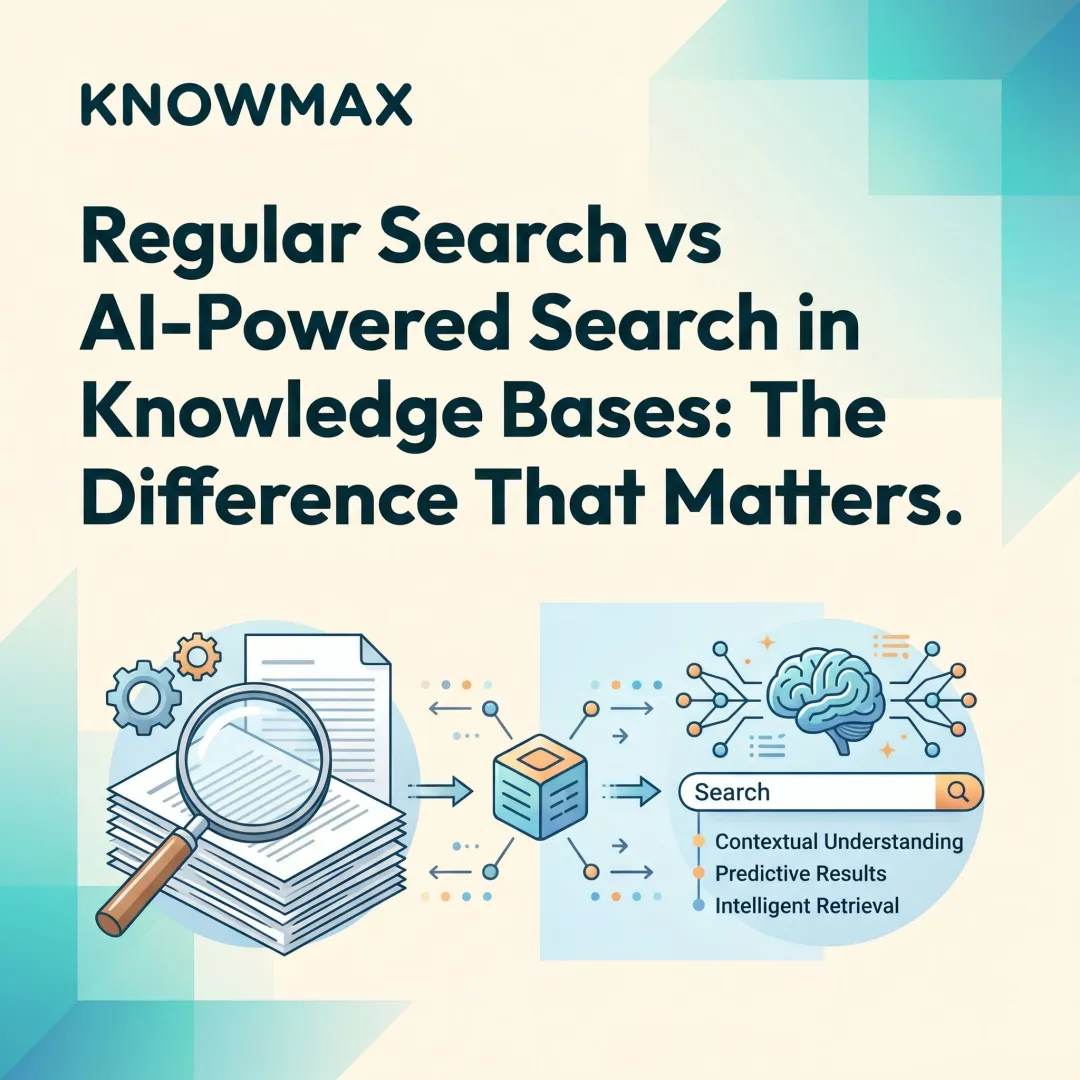
AI-powered knowledge search uses natural language processing to understand what a user is looking for — not just which words they typed — and surfaces the most relevant answer from a centralised knowledge base.
In contact centres, this capability lives inside the agent desktop, CRM, or ticketing system. It serves every role across the operation:
- Agents use it during live customer interactions to find accurate answers fast
- QA teams reference it during call reviews to benchmark responses against approved content
- Trainers pull from it when building or updating curriculum
- Supervisors access it when handling escalations that require precise policy detail
That shared access is where the real value sits. AI-powered search creates infrastructure for alignment — every role works from the same version of the truth, regardless of channel, shift, or tenure. When knowledge is fragmented across SharePoint sites, outdated training decks, and informal Slack threads, collaboration becomes guesswork. AI search centralises that knowledge and makes it accessible through intent, not institutional memory.
Key Advantages of AI-Powered Knowledge Search for Contact Center Team Collaboration
The advantages below map directly to operational outcomes contact center leaders already measure. Each connects to KPIs teams are responsible for.
Advantage 1: A Single Shared Knowledge Layer Eliminates Silo-Driven Inconsistency
Most contact centers store knowledge across multiple locations: a SharePoint site agents consult, a QA scorecard referencing different policies, training materials updated quarterly but never synced with live documentation. AI-powered knowledge search operates from one centralized, maintained repository. Every team pulls from the same source.
AI search indexes that central knowledge base and serves it across roles. Agents query it during calls. Trainers reference it when building modules. QA audits against it when reviewing interactions. Alignment is built into the system.
Why it matters for the bottom line:
Silo-driven inconsistency is among the most expensive contact center problems. Agents spend 15-20% of handle time searching for information when they lack structured knowledge access — losing 30-60 seconds per ticket switching tabs, totaling over an hour of wasted productivity daily at typical volumes. The numbers behind unified knowledge access are hard to ignore:
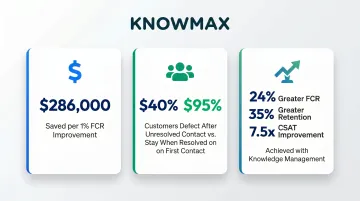
- Every 1% improvement in FCR saves $286,000 annually for a midsize call center
- 40% of customers defect after an unresolved first contact; 95% stay when it's resolved
- Contact centers with knowledge management systems achieve 24% greater FCR, 35% greater customer retention, and 7.5x greater year-over-year CSAT improvement versus those without
When QA, training, and frontline agents operate from the same knowledge layer, compliance violations drop, rework decreases, and the cost of inconsistency — repeat contacts, escalations, callbacks — falls.
KPIs impacted:
- First Contact Resolution (FCR)
- Quality/compliance scores
- Escalation rate
- Callback rate
- Cross-shift answer consistency
When this matters most:
- Large agent populations across multiple queues or geographies
- Organizations undergoing product, policy, or regulatory changes
- BPOs managing knowledge for multiple clients simultaneously
Advantage 2: Intent-Based Search Reduces Escalations and Supervisor Dependency
Traditional keyword search requires agents to guess the exact phrase an article was filed under. AI-powered search interprets intent: an agent typing "customer says device won't turn on after update" retrieves the relevant troubleshooting guide even if the article is titled "Post-Firmware Restart Protocol."
During a live interaction, agents type conversational queries and receive ranked, relevant results in seconds — without pausing the call or pulling a supervisor off the floor. Supervisors stop functioning as a real-time answer service and can focus on coaching, queue management, and genuine escalations.
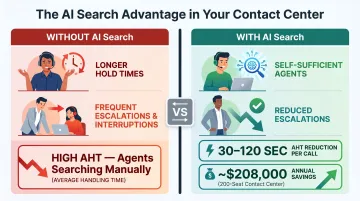
Supervisor dependency is a collaboration bottleneck at scale. When agents cannot self-serve from the knowledge base, they interrupt supervisors, creating a cascade that slows the entire floor. The downstream customer impact is measurable: 46% of customer calls are put on hold, often because agents need to consult supervisors or search other systems. Held calls see FCR drop 16% and CSAT drop 13%.
AI-powered search breaks this cycle by making agents self-sufficient. Well-structured knowledge bases reduce AHT by 30-120 seconds per call. For a 200-seat center handling 400 calls daily, a 60-second AHT reduction saves approximately $208,000 annually. That's before accounting for supervisor hours reclaimed.
KPIs impacted:
- Average Handle Time (AHT)
- Escalation rate
- Supervisor utilization rate
- Hold time
- Agent self-sufficiency
When this matters most:
- High-volume contact centers with large agent-to-supervisor ratios
- Complex, multi-step troubleshooting environments (telecom, banking, healthcare)
- Environments with high agent turnover where new agents lean heavily on supervisors
Advantage 3: Shared Knowledge Visibility Aligns QA, Training, and Operations in Real Time
Quality and training teams typically operate on a lag: QA audits interactions after the fact, training updates curricula quarterly, operations runs the floor daily. AI-powered knowledge search closes this loop by giving all three functions visibility into the same knowledge layer.
AI search platforms with usage analytics show which queries returned no results, which articles were searched but not used, and which topics generate the highest search volume. QA teams can identify exactly where agents go off-script — and whether the right content was ever available to them. Training teams prioritize curriculum based on search behavior, not assumptions.
Platforms like Knowmax combine intent-based search with analytics and content authoring tools, enabling QA, training, and operations to act on the same data. QA audits shift from after-the-fact scoring to real-time knowledge gap identification.
Without a shared knowledge layer, QA scores drop, training produces content that misses the mark, and operations chases symptoms without finding the cause. Organizational errors account for 49% of FCR failures, with agent knowledge gaps responsible for 38% of those. Most quality failures are knowledge infrastructure problems, not skill deficiencies. AI search analytics make those gaps visible before they compound.
KPIs impacted:
- Quality scores
- Training effectiveness (time-to-proficiency for new agents)
- Knowledge base accuracy rate
- Agent onboarding ramp time
When this matters most:
- Organizations undergoing rapid product or policy change
- Contact centers experiencing high QA failure rates where root cause is unclear
- Enterprises where training, QA, and operations are managed by different teams with limited coordination
What Happens When AI-Powered Knowledge Search Is Missing or Ignored
Without AI-powered knowledge search, contact centers face predictable, compounding consequences:
Inconsistent answers: Agents in different teams or shifts give conflicting responses because each relies on a different source — an old training doc, a Slack message from last month, memory.
Escalation overload: Supervisors become the default knowledge resource for agents who cannot find answers, creating a bottleneck that limits coaching capacity and inflates costs.
QA-training misalignment: QA scores agents against standards that training never communicated — or that the knowledge base doesn't reflect. The result: unfair scoring, agent frustration, and recurring quality failures that never get fixed at the source.
Slow onboarding and high error rates: New agents without institutional knowledge cannot compensate through search, resulting in longer ramp times, more mistakes, and higher supervisory load during the first 30-90 days. Typical ramp time is 4-8 weeks, but AI-powered knowledge bases reduce training time by 30-50%.
These consequences compound quickly. Inconsistency drives escalations, which consume the supervisor time that should go toward coaching. Less coaching means more agent errors, which generate QA failures that training can't resolve — because no one tracked where the gaps originated.
Annual agent turnover averages 40-45%, with first-year attrition at 69-73% and replacement costs reaching $46,000 per agent. High-AHT environments see turnover rates 15-20% higher. Inadequate knowledge access raises AHT, which raises stress, which drives attrition. Fixing the knowledge infrastructure breaks that cycle before it compounds further.
How to Get the Most Value from AI-Powered Knowledge Search
AI-powered knowledge search delivers compounding value only when the underlying knowledge base is maintained as a living asset. Outdated or conflicting content will be surfaced just as efficiently as accurate content. Governance isn't optional.
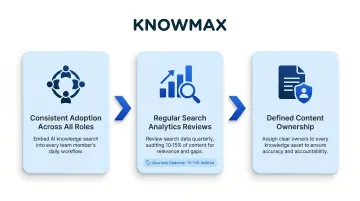
Three conditions maximise impact:
- Consistent adoption across all roles: Agents, QA, training, and supervisors must use the same system — not parallel workarounds. Fragmented tools fragment the knowledge layer.
- Regular search analytics reviews: Identify content gaps and trigger updates on a fixed schedule. COPC recommends quarterly cross-functional council reviews and minimum quarterly content audits, covering 10-15% of the knowledge base each quarter.
- Defined content ownership: Assign responsibility so articles don't decay between review cycles. AI authoring tools — such as those in Knowmax — speed up content creation and updates, including automated translation into 25+ languages.
Outcomes must be reviewed against the KPIs that matter — AHT, FCR, escalation rate, quality scores — on a defined cadence. When FCR stagnates despite high search usage, the problem is likely stale content. When search usage itself is low, the problem is adoption. Knowing the difference determines which team acts next.
Conclusion
Informational fragmentation is what keeps contact center teams working at cross-purposes — agents, supervisors, QA, and training all chasing the same goals through disconnected knowledge sources. AI-powered knowledge search closes that gap by giving every function a shared, reliable source of truth.
The advantages — consistent knowledge access, reduced escalation dependency, and aligned quality and training feedback loops — grow steadily as the knowledge base matures and search analytics surface gaps that teams act on.
Treated as ongoing operational infrastructure rather than a one-time deployment, AI-powered knowledge search delivers compounding returns. The contact centers that see the sharpest long-term gains are the ones that keep their knowledge current, review search data regularly, and let those insights drive how teams work together.
Frequently Asked Questions
What are the benefits of AI-powered knowledge search?
AI-powered knowledge search reduces time-to-answer, improves response accuracy, and ensures all team members — regardless of role or experience — access the same current information. This directly impacts resolution rates and customer satisfaction by eliminating the knowledge gaps that drive repeat contacts and escalations.
What is the main advantage of using an AI-powered knowledge management system?
The primary advantage is intent understanding: the system surfaces relevant answers based on what the user means, not just exact words used. This makes knowledge accessible across diverse teams and eliminates the failure points of keyword-dependent search, where agents must guess the precise phrase an article was filed under.
How do AI-powered tools enhance team collaboration?
AI-powered tools create a shared information layer that all team roles can access in real time, reducing reliance on informal coordination like Slack messages or supervisor interruptions. This aligns how agents, QA teams, and trainers interpret and apply the same knowledge, eliminating version-control problems.
How does AI knowledge search reduce Average Handle Time in contact centers?
AI knowledge search surfaces the right answer in seconds during a live interaction, eliminating hold time and transfer delays that inflate AHT. Organizations report 30-120 second reductions per call — savings that compound quickly at scale across thousands of daily interactions.
What makes AI knowledge search different from a traditional contact center knowledge base?
Traditional knowledge bases require agents to match exact keywords. AI search interprets natural language queries and understands context, meaning agents can ask in their own words and still retrieve the most relevant content. This reduces failed searches and frustration.
How does AI-powered knowledge search help with agent onboarding in contact centers?
New agents can self-serve through AI search rather than relying on supervisors or memorizing every policy. This shortens ramp time, reduces early-tenure errors, and cuts supervisory overhead — organizations report 30-50% reductions in training time.