Introduction
Picture this: A customer calls in frustrated about a billing error. The agent, eager to help, puts them on hold. What happens next is all too familiar — toggling between three disconnected systems, scanning outdated PDF manuals, scrolling through a cluttered SharePoint folder, and settling on an answer that might be current.
Five minutes later, the customer gets a response that turns out to be wrong. The agent didn't fail. The knowledge system did.
This isn't an edge case — it's the daily reality for over 80% of contact centres that admit their knowledge bases aren't as accurate as they should be. Meanwhile, 73% of contact centre leaders report that agents waste too much time searching for knowledge, and 39% of consumers rank information accuracy as the single most important factor when contacting a business.
That's the problem agentic AI is built to solve. Unlike traditional AI tools that wait for agents to ask questions, agentic AI reasons, anticipates, and acts autonomously — understanding context, synthesising information from multiple sources, and delivering the right answer before the agent has to go looking for it.
For contact centres drowning in fragmented systems and stale content, this isn't a feature upgrade. It's a structural rethink of how knowledge reaches the frontline.
TLDR
- Agentic AI reasons about context and intent, proactively surfacing relevant knowledge without agents needing to search
- Fragmented systems and outdated content force agents to spend more time searching than resolving customer issues
- Agent assist platforms reduce Average Handle Time by 27.2% and improve CSAT by up to 20.5%
- Success depends on clean knowledge foundations, clear governance, and keeping humans in the validation loop
- Platforms like Knowmax deliver guided workflows, answers drawn from multiple sources, and consistent knowledge across every channel
Traditional Knowledge Management in Contact Centers: Where It Breaks Down
The Fragmentation Problem
Most contact centers operate knowledge systems that resemble archaeological sites: layers of disconnected tools accumulated over years. Agents rely on a patchwork of SharePoint folders, legacy knowledge bases, Confluence wikis, email chains, and undocumented "tribal knowledge" passed down from senior reps.
Critical information lives in silos — product specs in one system, troubleshooting steps in another, pricing policies in a third, and compliance guidelines somewhere else entirely.
The operational cost is staggering. During live interactions, agents toggle between multiple screens, hunting for answers while customers wait. 61% of contact center leaders cite system complexity as a major source of agent effort. The result? Longer handle times, inconsistent responses, and frustrated customers who get different answers depending on which channel they use.
The Content Currency Crisis
Even when knowledge exists, it's often wrong. Only 19.1% of contact centers report fully accurate, up-to-date knowledge bases, according to a 2021 survey of 224 contact center professionals. Over 80% acknowledge their content isn't as accurate as it should be.
The root cause is structural: most contact centers lack dedicated knowledge management roles. Updates depend on ad hoc contributions from supervisors juggling operational fires. Content decays faster than teams can refresh it.
The vicious cycle starts when agents encounter one bad article. They stop trusting the system, create personal workarounds, and knowledge quality deteriorates further from disuse.
Agents lose faith in AI tools after just one or two incorrect responses. When they can't rely on the knowledge base, they waste time double-checking suspected outdated content — driving Average Handle Time even higher.
The AHT and Onboarding Tax
Knowledge fragmentation inflates operational costs:
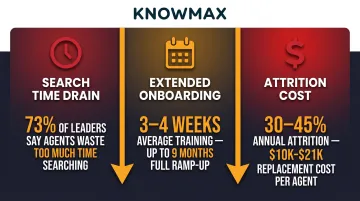
- Search time drain: 73% of contact center leaders say agents waste too much time looking up knowledge instead of resolving issues
- Extended onboarding: New agents require 3-4 weeks of training on average, with service ramp-up taking 30 days to 9 months depending on complexity
- High attrition amplifies the problem: Contact centers face 30-45% annual attrition—nearly triple other industries—at replacement costs of $10,000-$21,000 per agent
Poor knowledge management extends the already-long ramp-up period, compounding those losses at every turn. This is precisely the gap that agentic AI is now built to close.
What Is Agentic AI in the Context of Knowledge Management?
Beyond Search: The Core Distinction
Agentic AI represents a fundamental architectural shift from passive retrieval to autonomous reasoning. Gartner defines agentic AI as systems that act autonomously to complete tasks, not just generate text or summarize information. Unlike traditional keyword search—which returns whatever matches the query—or even first-generation chatbots that respond to prompts, agentic AI perceives context, reasons about intent, plans multi-step actions, and executes with minimal human input.
The practical difference:
- Traditional search returns 47 articles ranked by keyword match when an agent types "billing dispute"
- Agentic AI reads the live CRM transcript, identifies the customer as a premium subscriber with a duplicate charge, checks payment history, and surfaces the specific escalation workflow with pre-filled account details
Forrester's Dual Identity Framework frames this clearly: agentic AI must be managed simultaneously as a Skill (cognitive capability) and a Product (enterprise asset requiring governance and lifecycle management). The technology doesn't just assist—it adapts, coordinates with other systems, and often acts without direct human initiation.
Agentic RAG: Dynamic Knowledge Retrieval
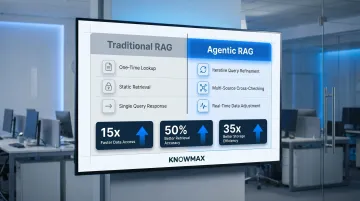
Traditional Retrieval-Augmented Generation (RAG) operates as a quick lookup—query the knowledge base, retrieve information, generate a response. Agentic RAG works differently: the AI agent actively controls retrieval, embedding it as a step within its reasoning process rather than treating it as a one-time lookup.
Specifically, the agent can:
- Adjust retrieval strategies based on real-time data updates
- Iteratively refine queries until achieving the best response
- Check relevancy across multiple sources before surfacing an answer
- Determine whether retrieved content is current and sufficient—or whether additional sources are needed
NVIDIA benchmarks show agentic RAG delivers 15x faster data access, 50% better accuracy in retrieval, and 35x better storage efficiency compared to traditional approaches. That translates directly to fewer outdated articles surfaced to agents, fewer escalations triggered by incomplete answers, and faster resolution on first contact.
How Agentic AI Transforms Contact Center Knowledge Management
Real-Time, Intent-Aware Knowledge Delivery
The shift from pull to push defines modern agentic knowledge management. Instead of agents searching for answers, the system listens to or reads the context of the interaction—via CRM data, live conversation transcripts, or intent signals—and proactively surfaces the most relevant article, decision tree, or troubleshooting guide.
How it works in practice:
- Agent opens a ticket flagged "password reset"
- Agentic AI reads the ticket type, customer tier, and recent interaction history
- Before the agent types a single search term, the system displays the password reset workflow with account-specific details pre-populated
Platforms like Knowmax integrate directly into agent desktops, eliminating screen-toggling. Using AI-powered intent recognition, the system identifies keywords and search context as soon as a ticket is raised, presenting a prioritised list of solutions without manual search.
This matters: 65% of agents want real-time AI hints, and among those already using AI, 95% report faster, more competent query resolution.
Guided Resolution Through Intelligent Decision Trees
Traditional decision trees follow fixed branching logic—rigid "if this, then that" structures that don't adapt to nuance. Agentic AI-powered decision trees dynamically navigate based on customer responses in real time.
Example:
- Customer reports "internet not working"
- Traditional tree: Click through 12 pre-set questions regardless of context
- Agentic tree: Checks CRM, sees recent service outage in customer's area, skips irrelevant troubleshooting steps, and immediately routes to the outage-specific resolution path
Knowmax's AI-powered decision trees use auto-traverse functionality to progress workflows automatically based on customer inputs, while keeping human intervention available at any point. Key capabilities include:
- Integrates CRM data to customise each step based on customer context
- Attaches visual guides or videos to specific nodes
- Links guidance steps directly to customer responses for faster resolution
This reduces agent errors and ensures consistent outcomes across the team.
Autonomous Knowledge Maintenance and Curation
Agentic AI addresses the content currency problem by monitoring knowledge quality without waiting for manual review cycles. The system analyses:
- Agent feedback signals (thumbs up/down, article edits)
- Resolution outcomes (Did the article lead to case closure or escalation?)
- Content usage patterns (Which articles are never accessed? Which generate repeat contacts?)
Based on these signals, agentic systems can flag outdated or conflicting articles, trigger review workflows, or in advanced implementations, auto-update content with accuracy verification.
Knowmax automates the operational side of knowledge maintenance through:
- Content tagging, duplicate detection, and broken-link identification
- Surfacing zero-result searches and unused articles for prioritised review
- Automated expiry alerts that notify stakeholders before content goes stale
The result: content teams spend less time on audits and more time on high-impact updates.
Multi-Source Knowledge Synthesis
Agentic AI pulls from multiple repositories simultaneously, delivering a single accurate answer instead of making agents cross-reference CRM notes, product manuals, compliance docs, and previous case resolutions separately.
Case Study: Salesforce Agentforce Contact Center, launched in March 2026, unifies voice, digital channels, CRM data, and AI agents in a single system. Every interaction pulls from the same source of truth—incorporating insights from voice conversations, chats, past purchases, and marketing activity. Checkmarx, an early adopter, achieved 41% faster case closures using the platform.
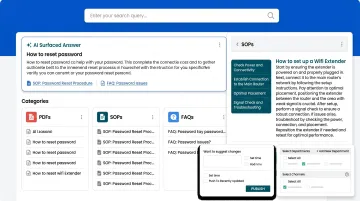
Knowmax operates on the same principle — a single source of truth that centralises PDFs, SOPs, FAQs, and other formats in one system. Its AI-powered search retrieves the right information instantly across integrated repositories, so agents stay on one screen throughout the interaction.
Omnichannel Knowledge Consistency
Customers expect the same accurate answer whether they call, chat, email, or visit a self-service portal. Agentic knowledge management ensures this by maintaining a unified knowledge layer that all channels draw from simultaneously.
How it prevents version conflicts:
- Policy update happens once in the central knowledge base
- Change propagates instantly to agent desktop, chatbot scripts, help centre articles, and IVR prompts
- No channel-specific knowledge silos—everyone works from the same source
Knowmax supports API integrations across apps, websites, chatbots, and social media, ensuring consistent answers regardless of channel. The platform allows instant updates to policies or announcements across all touchpoints, maintaining real-time consistency in knowledge delivery.
Measurable Impact: What Contact Centers Gain with Agentic AI-Powered KM
Reduced Average Handle Time
Eliminating mid-call knowledge searches directly compresses AHT. When agents receive contextually relevant answers in real time—without manual lookup—conversations move faster.
Industry data: Agent assist platforms reduce AHT by 27.2% on average across 641 companies studied by Metrigy in 2023. This represents the single highest-ROI AI investment for operational efficiency in contact centers.
For organizations using platforms like Knowmax, the impact is equally significant. A Fortune 500 retailer achieved a 13% AHT reduction by replacing cluttered SOPs with visual guides and integrating knowledge directly into their CRM.
Improved First Call Resolution
When agents have the right answer the first time, callbacks drop. The connection between knowledge quality and FCR is direct: better knowledge tools enable agents to resolve more issues on first contact.
Baseline context: The average FCR rate across the industry is approximately 70%, according to SQM Group benchmarks. Organizations using AI-driven knowledge management with established governance see 10-15% gains in accuracy and 20-40% reduction in issue volume.
Knowmax's guided decision trees and real-time agent assist capabilities directly support higher FCR by ensuring agents follow structured resolution paths with accurate, current information.
Faster Agent Onboarding
New agents no longer need to memorize hundreds of SOPs or flag down senior colleagues mid-call. Agentic AI delivers real-time guidance during every interaction, compressing the path to proficiency.
Organizations can reduce new agent onboarding time by 50% or more through real-time AI hints and knowledge. Personalized coaching delivered via AI is nearly 3x more effective than one-size-fits-all training programs.
Knowmax customers have reported a 40% reduction in time to proficiency using the platform's integrated LMS — structured learning journeys, interactive lessons, and operational knowledge that updates automatically when policies change.
Higher Customer Satisfaction
Faster, more accurate, and more consistent resolutions directly drive CSAT improvements. Use of AI in CX initiatives increases customer ratings by 20.5% on average, with top-performing organisations seeing gains of 45.8%.
39% of consumers rank information accuracy as the most important attribute when contacting a business — ahead of politeness (13%). Getting the answer right matters more than getting it warmly.
Knowmax serves clients including Vodafone, Airtel, CIMB, and Concentrix across telecom, banking, and eCommerce — giving agents accurate, current knowledge across every channel, every interaction.
Challenges and Considerations When Implementing Agentic AI for KM
Knowledge Readiness as the Foundation
Agentic AI is only as effective as the knowledge it operates on. Deploying agentic AI on top of unstructured, inconsistent, or incomplete content will bottleneck performance, and potentially amplify bad information at scale.
The numbers: 95% of AI pilots fail to deliver on promises, primarily due to poor knowledge governance. Most self-service AI systems struggle with containment rates below 30% because of inadequate knowledge foundations. Organisations that implement proper governance, by contrast, see containment rates of 40%+ and sustained ROI.
What knowledge readiness requires:
- Audit existing content for accuracy, completeness, and relevance
- Structure and tag knowledge assets systematically (categories, metadata, intent mapping)
- Eliminate duplicates, conflicting information, and outdated articles
- Establish quarterly review cycles as the minimum governance cadence
Platforms like Knowmax support this through structured onboarding that includes content audits, taxonomy mapping, AI-powered migration engines, and quality assurance checks.
Governance, Accuracy, and Trust
In contact centers, an AI confidently delivering the wrong answer is worse than no answer. A single incorrect response can trigger legal liability—as one major airline discovered when its chatbot promised a non-existent refund, forcing the company to honour the mistake.
The trust gap: 65% of agents want real-time AI hints, yet trust collapses after just one or two incorrect responses. Early accuracy isn't a nice-to-have — it determines whether agents use the system at all.
Required governance mechanisms:
- Confidence thresholds: Display only high-confidence recommendations; flag low-confidence responses for human review
- Human-in-the-loop validation: Agents retain final decision authority; AI suggests, humans approve
- Escalation protocols: Clear paths for complex or sensitive queries that exceed AI's scope
- Content approval workflows: Maker-checker processes to review content before publication
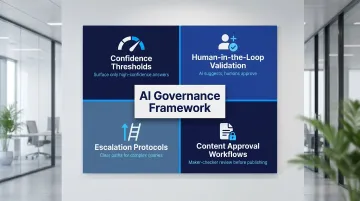
Knowmax supports these requirements through role-based access control, content approval workflows, and authorization features that restrict publishing rights to verified roles — reducing the risk of unreviewed content reaching agents or customers.
Change Management and Agent Adoption
Governance controls set the guardrails — but adoption depends on people. Agents need to trust how the agentic system works, and leadership must invest in training, transparent communication, and demonstrating early wins before resistance takes hold.
The adoption data:
- 89% of AI-using agents feel their organisation prioritises technology that supports them, versus only 57% of agents not using AI
- 91% of agents receiving AI-optimised coaching report job satisfaction, versus 57% without
The implication: resistance isn't to AI itself but to unreliable AI. Establishing accuracy thresholds, monitoring performance rigorously, and maintaining human-in-the-loop validation aren't optional—they're essential for sustained adoption.
Frequently Asked Questions
What is the difference between agentic AI and traditional AI in contact center knowledge management?
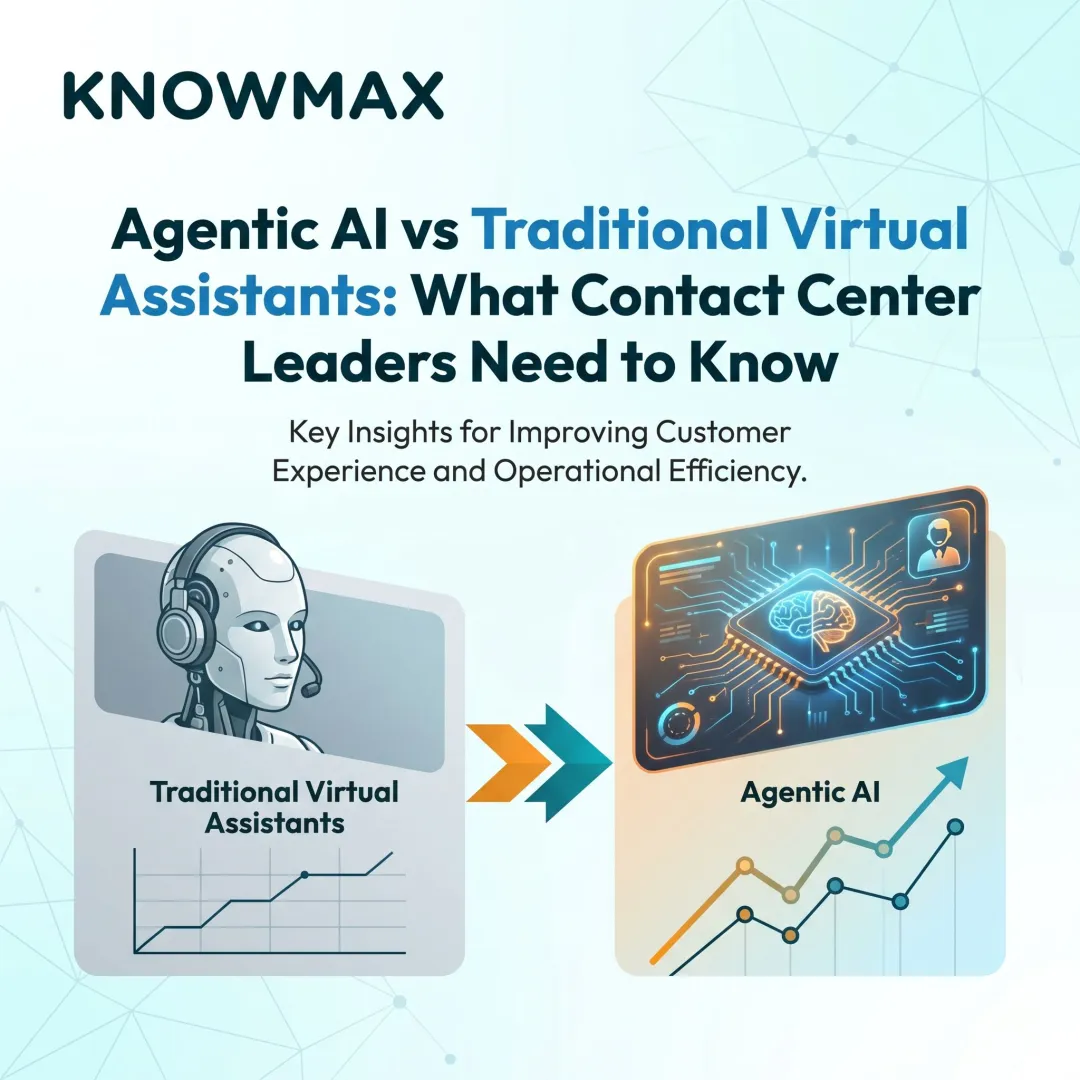
Traditional AI retrieves information based on keyword matches—it responds to explicit agent queries. Agentic AI reasons about context and intent, proactively delivering relevant knowledge and executing multi-step actions without agents needing to prompt it.
How does agentic AI help reduce Average Handle Time in contact centers?
By surfacing the right knowledge in real time—without agents needing to manually search across disconnected systems—agentic AI eliminates lookup delays and guides agents through faster, more accurate resolutions. Industry data shows agent assist platforms reduce AHT by 27.2% on average.
Can agentic AI keep a contact center knowledge base automatically updated?
Yes. Agentic AI monitors resolution outcomes, agent feedback, and content usage patterns to flag stale or conflicting articles. It can trigger update workflows or review processes, reducing the burden on manual content management teams while maintaining knowledge accuracy.
What role does human oversight play when using agentic AI for knowledge management?
Agents keep final decision-making authority; the AI handles retrieval, synthesis, and step-by-step guidance. Escalation protocols and confidence thresholds maintain accuracy on complex or sensitive queries, supporting both trust and compliance.
How does agentic AI deliver consistent knowledge across omnichannel contact center environments?
Agentic knowledge management platforms maintain a single, unified knowledge layer that all channels—voice, chat, email, self-service—draw from simultaneously. This eliminates version conflicts and channel-specific inconsistencies, so customers get the same accurate answer no matter how they reach out.
What should contact centers evaluate when choosing an agentic AI knowledge management platform?
Prioritize intent-aware search, CRM and telephony integrations, content governance features (approval workflows, version control), and omnichannel delivery. Also look for proven AHT and FCR outcomes, human-in-the-loop validation, and structured onboarding to assess knowledge readiness before go-live.