Introduction
A customer is on the line. The question is specific — account setup failed midway, error code unknown — and the agent's silence stretches past three seconds. That pause, multiplied across dozens of daily interactions, isn't just uncomfortable. According to McKinsey research, knowledge workers spend roughly 20% of their workweek searching for internal information. In contact centres, where agents juggle an average of 4.3 different systems per interaction, that percentage translates directly into abandoned calls, plummeting CSAT scores, and burned-out teams.
An AI knowledge assistant changes the equation. Rather than forcing agents to hunt across tabs, wikis, or colleagues' desks, it surfaces the right answer from the organisation's collective intelligence without breaking the flow of conversation.
For support teams fielding high-volume, omnichannel interactions, this shift from manual retrieval to ambient delivery means shorter handle times, fewer escalations, and agents who can actually focus on the customer in front of them.
This article examines why traditional knowledge sharing collapses under support-specific pressures, how AI assistants change real-time knowledge delivery, and what measurable impact organisations are seeing across AHT, FCR, and agent ramp-up time.
TL;DR
- Support teams need answers in seconds, not minutes — traditional knowledge systems weren't built for that speed
- AI assistants deliver contextually relevant, intent-aware answers directly into agent workflows during live interactions
- Core capabilities — semantic search, guided decision trees, automated content upkeep, and omnichannel delivery — all draw from a single source of truth
- Measured results include a 27.2% reduction in AHT and a 31.1% improvement in CSAT, with teams also reporting faster onboarding and fewer errors
- Adoption works best when phased — audit your knowledge gaps first, pilot with one team, and scale only after feedback loops confirm what's working
Why Knowledge Sharing Breaks Down in Support Teams
Unlike departments where research happens between tasks, support agents must retrieve knowledge inside a live interaction. Speed and accessibility aren't background concerns — they're direct performance variables.
The "Ask a Senior Agent" Trap
When institutional knowledge lives in people's heads rather than accessible systems:
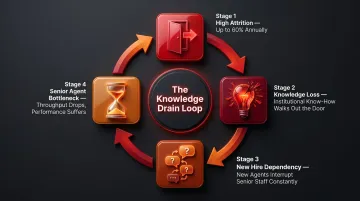
- New agents interrupt experienced ones repeatedly
- Senior agents become bottlenecks, unable to focus on complex escalations
- Response quality varies by who answers, not what the policy says
- Team throughput drops as knowledge-seeking ripples across shifts
Contact centres face turnover rates up to 60% annually, with large centres averaging approximately 45% attrition. That means institutional knowledge walks out the door, and new hires are repeatedly learning from scratch — which taxes trainers, erodes consistency, and keeps the interruption cycle running.
The Multi-System Maze
Product updates live in email threads. Policy changes sit in wikis. CRM notes contain workarounds. Shared drives hold outdated troubleshooting guides. Agents searching for answers must check multiple repositories — often while a customer waits on hold.
Gartner's 2024 survey of 5,728 customers found that 43% of self-service failures occurred because customers couldn't find relevant content. Agents inherit those same gaps when customers escalate — and because departments rarely sync their documentation, answers can differ by shift, channel, or region.
The Omnichannel Consistency Gap
When agents across voice, chat, email, and self-service portals draw from different knowledge sources — or interpret policies differently — customers receive conflicting answers. Research cited by Parloa found a stark perception gap:
- 90%+ of executives believe customers experience their brand consistently
- Only 36% of consumers agree
That disconnect damages trust and inflates repeat contact rates.
The Compressed Window for Informal Learning
ContactBabel data shows agent idle time between calls has dropped from 14% to 8% since 2010. That compression eliminates the informal knowledge-sharing time that previously existed — quick questions between calls, shadowing during quiet periods. Modern contact centres operate at capacity, leaving no buffer for peer learning.
How AI Assistants Rewire Knowledge Sharing for Support Teams
Real-Time, Intent-Aware Knowledge Surfacing
AI assistants connected to a centralised knowledge base don't wait for agents to search. They surface relevant content based on conversation context — understanding intent rather than matching keywords. The right answer arrives at the moment it's needed, not after the agent has hunted across tabs.
Knowmax's AI-powered search detects keywords as soon as a ticket is raised, then presents a list of potential solutions directly to the agent's screen in real time. This removes friction from the knowledge-sharing chain: instead of escalating to a supervisor or asking a colleague, the AI assistant acts as a real-time intermediary between the organisation's collective knowledge and the agent's workflow.
Guided Decision Trees Reduce Cognitive Load
Rather than presenting agents with a wall of documentation, AI-assisted decision trees walk agents through branching resolution paths step by step. This:
- Reduces cognitive load during complex troubleshooting
- Cuts errors by ensuring every agent follows the same vetted process
- Maintains consistency regardless of tenure or experience
Knowmax's interactive decision trees auto-traverse based on customer input, dynamically progressing to the next step while allowing agents to pause or override when needed. Each node can include images, videos, or external resource links — helping agents explain solutions more effectively.
The system auto-copies and tags resolutions in the CRM, eliminating post-call documentation time entirely.
Democratising Expertise Across the Team
When a seasoned agent's knowledge is captured in structured decision trees and articles, every new hire has access to the same resolution intelligence. The expert no longer needs to be in the room — their judgement is already embedded in the workflow. This simultaneously addresses two persistent contact centre problems: knowledge hoarding and attrition-driven knowledge loss.
Concentrix, for example, handled over 3.7 million chatbot transactions and improved knowledge access for more than 120 agents after integrating Knowmax. Key outcomes included:
- Agents resolving queries independently without escalating to senior staff
- Structured knowledge reducing live-interaction dependency on experienced team members
Continuous Learning Loops
AI assistants improve with use. Flagged gaps, agent feedback, and interaction patterns feed back into the knowledge base, so the system gets smarter over time — a sharp contrast to static wikis that decay the moment they stop being actively maintained.
Knowmax's two-way feedback management system allows agents to provide real-time feedback on the knowledge they access. This feedback is reviewed by content authors and incorporated into knowledge base updates, ensuring the repository evolves in response to real-world use cases.
Key Capabilities That Make Knowledge Sharing Effortless
Semantic Search That Understands Agent Intent
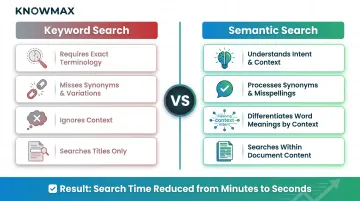
Keyword-based search requires the agent to know the right terminology. If they search "connection dropped" but the article is titled "intermittent service interruption," the answer won't surface.
Semantic search understands what the agent is trying to find even when phrasing varies. It:
- Differentiates word meanings by context (e.g., "Paris" as location vs. name)
- Processes synonyms and term variations
- Handles misspellings
- Searches within document content, not just titles
Enterprise Knowledge notes that semantic search is superior for chatbots, virtual assistants, and customer service applications where users ask questions in natural language. Knowmax's AI-powered search uses elastic search technology to locate information within documents, ensuring agents can access the exact section containing the answer, reducing search time from minutes to seconds.
AI-Assisted Content Creation and Maintenance
AI author tools help knowledge managers keep content accurate and current at scale. Capabilities include:
- Condenses lengthy articles into digestible summaries automatically
- Adjusts tone, trims length, or elaborates on points with a single click
- Translates content into 25+ languages with high accuracy
Knowmax's Max AI provides these features directly within the platform UI, enabling knowledge managers to maintain a multilingual, up-to-date knowledge base without requiring a large editorial team.
Omnichannel Knowledge Delivery
AI assistants serve consistent knowledge across voice, chat, email, and self-service touchpoints from a single source of truth. The answer a customer gets on chat matches what they'd get on a call — eliminating the inconsistency that erodes trust.
Knowmax centralises all enterprise knowledge into one repository. Content is authored once and automatically updated across every channel, eliminating the need for separate channel-specific repositories and ensuring any update is instantly reflected everywhere.
The Real Impact on Support Team Performance
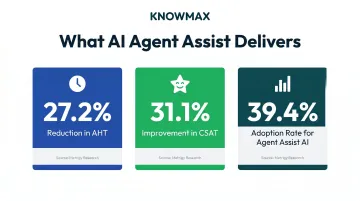
Metrigy's Customer Experience Optimisation 2023-24 study of 641 companies found that agent assist reduces AHT by 27.2% — the most widely adopted AI use case at 39.4% adoption. Separately, Metrigy's AI for Business Success 2025-26 study of 1,104 companies shows 71.9% of companies using agent assist report a 31.1% improvement in CSAT/PSAT.
Faster Agent Ramp-Up
McKinsey reports that standard agent training lasts 4 to 8 weeks, and new agents operate at only 50-60% productivity during their first three active months. When knowledge is accessible through an AI assistant rather than stored in colleagues' heads, new agents reach competency faster.
Knowmax's integrated Learning Management System (LMS) connects training content directly to the live knowledge base. Policy and process updates automatically reflect in training materials, so new hires access the same institutional knowledge as experienced agents from day one.
The downstream effect on operations is measurable:
- Reduces time-to-proficiency by up to 40%
- Shortens onboarding programs and lowers training costs
- Delivers more consistent performance across agent cohorts
Organisational Resilience
Faster ramp-up also changes how organisations handle attrition. When knowledge is captured, structured, and accessible through AI, the team no longer depends on specific individuals — turnover stops being a knowledge crisis, and continuity holds even as headcount changes.
McKinsey estimates that replacing a single contact centre agent costs $10,000-$21,000 including recruiting, upfront training, and lost productivity during ramp-up. AI-powered knowledge tools reduce this burden by ensuring institutional knowledge persists beyond individual departures.
Documented Customer Outcomes
- Vodafone: Reduced AHT and lifted CSAT scores across voice, chat, and email channels through consistent, structured knowledge delivery
- Leading telecom company: Reported a 21% improvement in FCR after implementing Knowmax's interactive decision trees
- Leading online food delivery app: Achieved a 15% reduction in AHT by streamlining agent workflows with instant knowledge access
How to Integrate AI Assistants into Your Support Workflow
Start with a Knowledge Audit
Before deployment, identify:
- Where current knowledge lives (wikis, email threads, CRM notes, shared drives)
- What's missing, outdated, or duplicated
- What questions agents ask most frequently
This audit creates the foundation the AI assistant needs to be useful and surfaces content gaps that should be addressed regardless of the technology decision. Gartner recommends a diagnostic-first approach: determine whether the pain point is a content gap, a quality issue, or an adoption issue before investing in AI tools.
That diagnostic logic shapes how Knowmax approaches onboarding. Content audits identify relevant content types and surface structural gaps, while AI-powered analytics track search trends and failed searches to pinpoint where content needs improvement.
Recommend a Phased Rollout
Begin with a single team, channel, or question category (e.g., top 20 most common queries). Measure deflection rates and agent satisfaction, then expand. This approach:
- Builds internal confidence before broad deployment
- Surfaces integration issues early
- Generates feedback data needed to improve the system
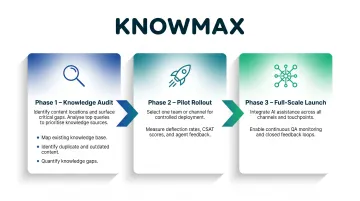
Knowmax's typical deployment process includes content migration, integration setup, a pilot rollout in a select area, and then full-scale launch with continuous quality assurance and training support.
Embed Within Existing Tools
An AI knowledge assistant that agents must leave their CRM or helpdesk to access will face adoption resistance. The technology needs to surface where work actually happens — inside the platforms agents already use.
Knowmax integrates with Salesforce, Zendesk, Freshdesk, Genesys, Talkdesk, Exotel, and Freshchat. Knowledge surfaces automatically within the CRM UI, so agents never open a separate tab. In Salesforce, Knowmax acts as a co-pilot — agents search and share knowledge without breaking their workflow.
Gartner predicts that by 2025, 100% of generative AI virtual assistant projects lacking integration with modern knowledge management systems will fail to meet their CX and cost-reduction goals. Without the right knowledge foundation, even well-funded AI deployments stall.
Frequently Asked Questions
What is an AI knowledge assistant?
An AI knowledge assistant uses natural language processing and machine learning to surface relevant information from an organisation's knowledge base in response to real-time queries. In support contexts, it delivers answers to agents during live customer interactions without requiring manual search.
How do you integrate an AI assistant into a support team?
Audit existing knowledge content, choose a platform that integrates with current tools (CRM, helpdesk, telephony), start with a focused use case, and build feedback loops to maintain content quality over time.
What actually happens when an AI assistant responds to a query?
Three core processes run in sequence: understanding what the user is asking (intent recognition), retrieving the most relevant content from connected knowledge repositories, and generating a clear, contextually appropriate response. In support settings, the assistant also routes complex issues to human agents when needed.
How do AI assistants reduce agent handling time in contact centres?
AI assistants surface the right resolution steps, policy details, or troubleshooting guides instantly. This removes the dead time between a customer's question and the agent's answer, directly cutting average handling time without requiring any manual search.
Can AI assistants replace human agents in support teams?
AI assistants are designed to augment, not replace, human agents. They handle the knowledge retrieval and guidance layer so agents can focus on empathy, judgment, and complex problem-solving, which remain distinctly human strengths in customer interactions.
How does AI help with knowledge management for new agent onboarding?
New hires get immediate access to the same institutional knowledge as experienced agents, reducing reliance on shadowing or peer interruptions. This accelerates time-to-competency and ensures consistent responses from day one.