Introduction: The ROI Case Contact Center Leaders Are Expected to Make
When a contact center leader walks into a budget meeting to justify an agent assist platform, the conversation rarely stays on features. It moves immediately to numbers. Executives want to know what it costs, what it saves, and how quickly the investment pays back — before a single agent logs in.
CFOs and operations executives want hard numbers: projected cost savings, efficiency gains, and a realistic payback timeline. Yet most contact centers lack a repeatable framework for making that case.
They rely on vendor claims, industry averages, or best-guess estimates. None of those hold up under finance team scrutiny.
This guide gives contact center leaders a concrete framework: the five metrics that drive the strongest ROI case, a step-by-step calculation process tailored to your environment, and the hidden value categories — agent retention, compliance risk reduction — that standard models routinely leave out.
TLDR
- Agent assist platforms drive ROI across five levers: AHT reduction, FCR improvement, faster onboarding, fewer errors/escalations, and higher CSAT
- Accurate ROI measurement needs pre-deployment baselines, attribution discipline, and tracking across cost savings and revenue protection
- Long-term value includes lower agent turnover, compliance consistency, and absorbing volume growth without proportional headcount increases
- Platform depth — AI search, decision trees, and CRM integrations — determines whether ROI is actually realized
Why Contact Centers Struggle to Quantify Agent Assist ROI Before They Deploy
The Attribution Challenge
Contact centers operate in complex, multi-tool environments. Agents toggle between CRM systems, knowledge bases, ticketing platforms, telephony software, and workflow tools—often five or more applications per interaction. When AHT drops by 20 seconds or CSAT climbs by three points, isolating which tool drove the improvement becomes nearly impossible.
This attribution problem stalls evaluations. Organizations want guaranteed ROI before committing budget, but ROI is only measurable after deployment on real interactions. According to recent industry commentary, fragmented data, legacy systems, and high agent turnover all complicate before-after comparisons — creating a measurement gap that makes executives hesitant to approve purchases.
The result: pilots fail to prove value conclusively, evaluations drag for months, and organizations fall back on vendor claims that finance teams can't verify.
Efficiency vs. Effectiveness ROI
Contact center leaders must present two distinct ROI arguments to win executive approval:
Efficiency ROI targets direct cost reduction:
- Lower AHT translates to fewer labor hours per resolved interaction
- Improved FCR cuts repeat contact handling costs
- Faster agent onboarding reduces training spend
Effectiveness ROI targets better outcomes at the same or lower cost:
- Higher CSAT protects revenue through customer retention
- Fewer errors reduce compliance exposure
- Consistent knowledge delivery strengthens brand trust
CFOs respond more readily to efficiency arguments (direct cost savings), but effectiveness arguments (revenue protection) carry equal weight when framed correctly. The strongest business cases present both.
Setting Clean Baselines Is Non-Negotiable
Without pre-deployment baselines, ROI claims become anecdotal. Leaders must capture interaction-level data before go-live: AHT by issue category, FCR by agent tenure cohort, escalation rates by channel and issue type, and CSAT by customer segment. Category-level baselines allow you to demonstrate ROI in the specific areas the platform was expected to impact, not just aggregate averages that mask category-level gains.
The Key ROI Metrics Contact Center Leaders Must Track
Organizations should select 2-3 primary KPIs based on their biggest current pain points. The five metrics below represent the most consistently measurable, executive-ready indicators of agent assist value.
Reduced Average Handle Time (AHT)
AHT is typically the first and most significant ROI lever. When agents have instant access to relevant knowledge, they spend less time searching and can guide customers to resolution faster.
Industry evidence:
- Microsoft Copilot for Service reduced AHT by 12% in 2023 deployments
- A telecom BPO case study showed 20% AHT reduction within two months of agent assist deployment
- Knowmax customers have documented a 15% AHT reduction in high-volume food delivery environments
Calculating the cost impact: Even a 20-second reduction per interaction compounds quickly. Consider a 200-agent contact center handling 50,000 calls monthly:
- 20 seconds saved × 50,000 calls = 1,000,000 seconds (16,667 minutes or 278 hours)
- At $25/hour fully loaded labor cost: 278 hours × $25 = $6,950 monthly savings
- Annualized: $83,400 in direct labor cost savings
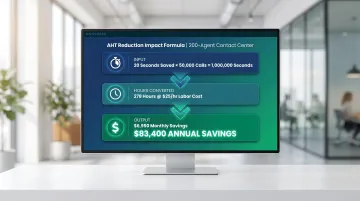
This calculation assumes modest improvement and doesn't account for additional capacity created—agents can handle more volume in the same shift, reducing overflow and outsourcing costs.
Improved First Call Resolution (FCR)
FCR is the single most important efficiency metric in a contact center. Each call that requires a follow-up or callback doubles the cost of that interaction.
Industry benchmarks from SQM Group's 2024 research show that the average FCR across industries is just 69%, with only 5% of centers achieving world-class performance at 80% or above. FCR varies significantly by inquiry type: technical support averages 60%, while general inquiries reach 73%.
Economic impact: Each 1% improvement in FCR is associated with approximately $286,000 in annual savings for a typical mid-size center, according to SQM's research. That figure compounds further on the revenue side: 95% of customers continue to do business when FCR is achieved, making resolution quality a direct driver of retention.
Agent assist platforms improve FCR by surfacing complete, accurate resolutions rather than partial answers. Knowmax's interactive decision trees and AI-powered search guide agents to the correct resolution the first time, reducing the likelihood of incomplete answers that drive repeat contacts. One telecom customer achieved a 21% improvement in FCR accuracy after deploying Knowmax's guided workflows.
Agent Onboarding and Time-to-Proficiency
New agent ramp time is an underappreciated cost center. Organizations pay full salary during a period where agents handle lower volume at lower quality — and most training programs run 3-4 weeks before agents hit the floor.
At a fully loaded onboarding cost of $7,000–$15,000 per agent, contact centers with high turnover absorb this expense multiple times a year.
Agent assist platforms shorten the gap between hire date and full productivity. Guided workflows, decision trees, and in-context knowledge delivery allow newer agents to perform at near-senior levels without needing to internalize every process and policy upfront.
Documented improvements:
- The telecom BPO case showed 50% faster onboarding using agent assist and decision trees
- Knowmax customers have reported a 40% reduction in onboarding time
- Industry research suggests up to 65% reduction in ramp time is achievable with real-time guidance platforms
New agents contribute productive capacity weeks earlier, turning what was a cost drag into a faster return on every hire.
CSAT, NPS, and Customer Retention Impact
Improved agent confidence and accuracy translate directly to higher CSAT and NPS scores — both of which carry measurable revenue implications through retention and reduced churn.
SQM Group's 2024 research found that each 1% FCR improvement correlates with a +1.4 NPS point gain. Track pre- and post-deployment scores alongside AHT and FCR to build a complete, correlated picture for leadership.
The financial stakes are significant. U.S. companies risked losing an estimated $846 billion in 2024 due to churn and poor customer experience, according to the XM Institute. When FCR is achieved, 95% of customers continue to do business—demonstrating the direct link between resolution quality and revenue retention.
Error Rate and Escalation Reduction
Errors create downstream costs: escalations, complaints, regulatory risk, and repeat contacts. Agent assist platforms with structured knowledge and compliance prompts measurably reduce these incidents.
SQM Group research shows that Overall Contact Resolution (OCR) runs 11% lower than FCR on average, highlighting hidden repeat-contact load and unresolved issues that drive up operational costs.
Cost multipliers for escalated contacts vary by industry, but the pattern is consistent: every escalation requires supervisor time, extended handle time, and often compensation or goodwill gestures. Structured knowledge platforms that guide agents through compliance steps and reduce judgment errors eliminate many of these costly interactions before they occur.
How to Build the ROI Business Case for Agent Assist: A Step-by-Step Framework
This practical, executive-ready method works whether you're securing initial budget approval or justifying a renewal.
Step 1 – Establish Honest Baselines Before You Deploy
Baselines must be captured at the interaction level, not just as averages. Track:
- AHT by issue category and channel
- FCR by agent tenure cohort
- Escalation rates by issue type
- CSAT by customer segment
Category-level baselines allow you to demonstrate ROI in the specific areas the platform was expected to impact, not just aggregate improvements that could be explained by other factors.
Step 2 – Define the ROI Formula You'll Use
Use the standard ROI formula:
ROI = (Net Benefit / Cost of Investment) × 100
In a contact center context, Net Benefit includes:
- Cost savings from AHT reduction
- Cost avoidance from FCR improvement
- Value of onboarding acceleration
- Revenue protected through retention improvement
Minus:
- Platform licensing cost
- Implementation cost
- Ongoing maintenance
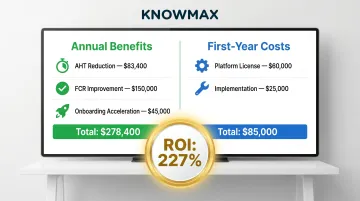
Simplified example calculation (200-agent center, 50,000 calls/month):
Benefits:
- AHT reduction (20 sec/call): $83,400/year
- FCR improvement (3% gain): $150,000/year
- Onboarding acceleration (30% faster ramp): $45,000/year
- Total Annual Benefit: $278,400
Costs:
- Platform license: $60,000/year
- Implementation: $25,000 (one-time)
- Total First-Year Cost: $85,000
ROI = ($278,400 - $85,000) / $85,000 × 100 = 227% first-year ROI
Step 3 – Separate Direct Savings from Revenue Protection
Once you have the numbers from Step 2, separate them cleanly — CFOs scrutinize cost savings differently than revenue protection, and mixing the two weakens both arguments.
Present them as distinct line items:
- Labor cost reduction from lower AHT and reduced outsourcing/overflow
- Churn reduction tied to measurable CSAT or escalation rate improvements
- Customer lifetime value gains from retention improvements in high-value segments
Step 4 – Build a 12-Month and 36-Month View
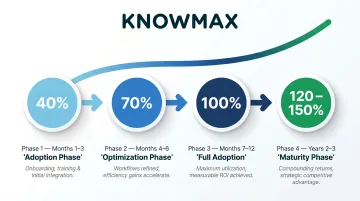
With your cost and benefit categories defined, the next step is projecting how returns accumulate over time. Agent assist ROI typically looks modest at 3 months — the platform is being configured, adoption is building — but compounds significantly by months 6–12 as agents embed the tool into their daily workflows.
Present phased ROI projections:
- Months 1-3: 40% of projected benefit (adoption phase)
- Months 4-6: 70% of projected benefit (optimization phase)
- Months 7-12: 100% of projected benefit (full adoption)
- Years 2-3: 120-150% as the knowledge base matures and new issue categories are added
Step 5 – Set a Review Cadence and KPI Dashboard
ROI claims made at budget approval must be tracked and reported. Otherwise, the investment becomes vulnerable at renewal.
Create a monthly KPI dashboard tracking:
- AHT by category
- FCR by agent cohort
- CSAT trends
- Escalation rates
- Agent ramp time
Conduct formal 90-day and 6-month reviews against baseline to validate ROI claims and identify optimization opportunities.
The Hidden ROI: What the Hard Numbers Don't Immediately Show
The metrics-based ROI case covers the measurable layer, but agent assist platforms generate substantial value that doesn't appear in traditional ROI calculations.
Agent Retention and Reduced Turnover Costs
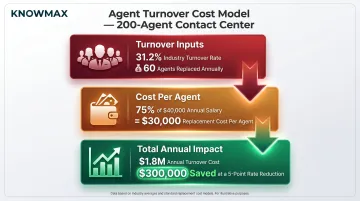
Contact center agent turnover reached 31.2% annually in 2024, according to Metrigy research. The primary driver is job-related stress—specifically, the anxiety of not knowing the right answer under customer pressure.
Agent assist reduces this cognitive load, improving agent confidence and job satisfaction. Industry sources estimate the cost of replacing a contact center agent at 50-60% of annual salary in direct hiring costs, and 90-200% including productivity loss and ramp, according to SHRM-cited figures.
For a 200-agent center with 30% annual turnover:
- 60 agents replaced annually
- At $40,000 average salary and 75% replacement cost: 60 × $30,000 = $1.8M annual turnover cost
- If agent assist reduces turnover by just 5 percentage points (from 30% to 25%): $300,000 annual savings
Compliance and Quality Consistency at Scale
In regulated industries—telecom, banking, insurance, healthcare—the cost of a compliance failure can be orders of magnitude larger than the cost of the platform. HIPAA violations carry tiered penalties ranging from thousands to millions of dollars per incident. Financial services firms face similar exposure under CFPB and FCA regulations.
Agent assist platforms that enforce structured response flows reduce this exposure directly. Knowmax's decision trees include built-in compliance checkpoints and prompts, ensuring agents complete mandatory disclosure steps in regulated workflows—turning a liability risk into a process control.
Scalability Without Proportional Headcount
Agent assist platforms let contact centers absorb volume growth without hiring proportionally.
When agents handle calls faster and resolve more on the first contact, existing headcount effectively gains capacity. Gartner's 2026 survey found that 85% of service leaders are expanding agent responsibilities as AI efficiency grows, indicating capacity redeployment rather than 1:1 staff reductions.
Frame this as an alternative to hiring: what would the labor cost of handling 20% more volume be without the platform?
Knowledge Consistency Across Channels and Agent Tenure
That capacity gain only holds if the answers agents deliver are consistent. Inconsistent responses—where customers get different information depending on who they reach—drive repeat contacts, erode trust, and quietly inflate handle time across the board.
Agent assist platforms that serve a single, updated knowledge source eliminate this variability. Key downstream benefits include:
- Fewer repeat contacts caused by conflicting information
- Less senior agent time spent correcting junior agent errors
- Faster ramp for new hires who follow the same guided flows from day one
How to Maximize Agent Assist ROI: The Platform Features That Matter Most
Not all agent assist platforms generate the same ROI. The depth of features, quality of knowledge delivery, and integration capabilities determine whether ROI is theoretical or realized.
AI-Powered Search and Intent Recognition
The single biggest agent productivity killer is time spent searching for the right answer across disconnected systems. Agent assist platforms with AI-powered search that understands intent rather than matching keywords dramatically reduce this search time.
Knowmax's AI search surfaces content based on what the agent or customer actually means — not just what they typed. This matters most in complex scenarios where keyword search falls short:
- Troubleshooting multi-step technical issues
- Navigating policy exceptions or edge cases
- Handling processes that require several resolution stages
Guided Decision Trees and Structured Resolution Flows
Fast search solves the "find it" problem. Structured resolution flows solve the "use it correctly" problem. For contact centers handling complex, multi-step resolutions — troubleshooting, claims, onboarding — unstructured knowledge bases leave too much to agent judgment and create inconsistency.
Decision trees guide agents step by step to the right resolution and ensure compliance at each stage. This feature is particularly important for high-turnover environments where new agents must perform at senior levels quickly.
Knowmax's decision trees support nested logic, multimedia embedding, and dynamic updates. They auto-traverse steps using API integrations, pulling relevant customer data from CRM systems to deliver personalized resolutions.
The result: agents in their first weeks on the floor can handle the same complexity as seasoned team members — without escalation or guesswork.
Integration Depth with CRM and Telephony Platforms
Agent assist delivers maximum ROI when it operates inside the agent's existing workflow — not as a separate tab they must context-switch to.
Deep integrations with CRM systems (Salesforce, Zendesk, Freshworks) and CCaaS platforms (Genesys, Talkdesk) surface relevant knowledge automatically based on live interaction context — no tab-switching required.
Knowmax connects directly to these platforms so knowledge appears where agents already work:
- Salesforce: Decision trees and articles appear inside Service Cloud without leaving the interface
- Genesys: Real-time knowledge surfaces during calls based on conversation context
- Freshworks/Zendesk: Ticket context automatically triggers relevant resolution flows
This keeps agents focused on solving customer problems rather than hunting for answers across systems.
Frequently Asked Questions
What are the capabilities of agent assist platforms?
Agent assist platforms provide real-time knowledge surfacing, guided resolution workflows, automated response suggestions, and compliance prompts—all integrated directly into the agent's existing CRM or telephony system for immediate access during calls.
What are the 4 pillars of AI agents?
The four pillars are perception (understanding context and input), reasoning (interpreting and prioritizing), action (executing a response or workflow step), and learning (improving over time through feedback). Agent assist platforms apply all four to surface relevant knowledge and guide agents to accurate resolutions in real time.
How long does it take to see ROI from an agent assist platform?
Initial ROI indicators—AHT reduction and FCR improvement—typically become measurable within 60–90 days of full deployment. Compounding benefits like onboarding acceleration and agent retention improvements become visible at the 6–12 month mark as adoption matures.
How does an agent assist platform reduce average handle time?
AHT reduction happens through two mechanisms: eliminating search time (agents find answers instantly rather than navigating multiple systems) and reducing decision uncertainty (guided flows eliminate back-and-forth with customers or supervisors). Together, these cut the time to resolution on every interaction.
What metrics should contact center leaders track to measure agent assist ROI?
Track five core metrics: Average Handle Time, First Call Resolution rate, agent onboarding ramp time, CSAT/NPS scores, and error/escalation rates. Capture each at baseline before deployment—before/after comparison is what makes the ROI case to finance.
What is the difference between an agent assist platform and a knowledge base?
A knowledge base is a static repository agents must actively search, while an agent assist platform is an active, in-workflow system that surfaces the right information at the right moment based on conversation context—so agents don't have to know where to look.