Utilities face mounting operational pain from legacy payment channels. Billing inquiries alone drive 7-10% of total call center volume, costing utilities with 2 million customers as much as $20-40 million annually. Manual reconciliation errors compound the burden, while customer expectations now mirror the seamless experiences set by banking apps and e-commerce checkouts.
This article covers what self-service payment platforms are, the channels and features that matter, the business impact they deliver, and how to evaluate solutions that meet today's digital-first demands.
TLDR — Key Takeaways:
- Self-service platforms let customers pay bills, enroll in autopay, and manage accounts without agent intervention
- Essential channels: online portals, mobile apps, IVR, payment kiosks, and QR/payment links
- Core features: multiple payment methods, real-time posting, CIS integration, autopay, and PCI-compliant security
- Digital self-service cuts delinquency by 20-35%, deflects 25-40% of calls, and saves $12 per transaction
- Embedding knowledge management within payment flows resolves billing questions mid-journey and prevents escalations
What Is a Self-Service Payment Platform for Utility Billing?
A self-service payment platform is a secure digital system that enables utility customers to pay bills, view account balances, manage payment preferences, and access billing history independently — without contacting a customer service representative.
These platforms serve electric, water and sewer, natural gas, telecommunications/ISP, and multi-commodity municipal utilities. Each utility type brings unique billing models — metered usage, tiered rates, variable monthly amounts — that the platform must handle without requiring custom code for every scenario.
The operational gap this creates becomes clear when you compare it to legacy payment methods:
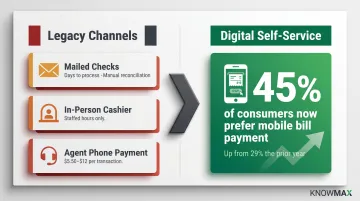
- Mailed checks take days to process and require manual reconciliation
- In-person cashier payments demand staffed counters during business hours
- Agent-handled phone payments cost utilities between $5.50 and $12 per transaction
According to InvoiceCloud's 2026 State of Online Payments Report, 45% of U.S. consumers now prefer mobile bill payment — up from 29% the prior year, the largest single-year jump in six years of tracking. Utilities that don't meet this shift risk declining satisfaction scores and rising support costs.
Types of Self-Service Payment Channels Utilities Should Offer
Online Portal and Mobile Access
A web-based customer portal — accessible on desktop, tablet, and mobile — is the foundation of utility self-service. Customers use it to view current and past bills, make one-time payments, and manage saved payment methods.
Mobile optimization is non-negotiable. J.D. Power's 2025 U.S. Utility Digital Experience Study found that mobile app satisfaction scores 41 points higher than desktop on a 1,000-point scale, yet 28% of the largest U.S. utilities still do not offer a mobile app.
That gap has real consequences. With 68% of consumers having used a mobile device to pay a bill in the past year — and lower-income customers leading adoption at 72% — utilities without a mobile-optimized experience are actively excluding their most payment-vulnerable customers.
Autopay and Recurring Billing Enrollment
Recurring payment setup is the single highest-value feature for utilities, delivering predictable on-time collections and reducing delinquency. A strong autopay module should allow customers to:
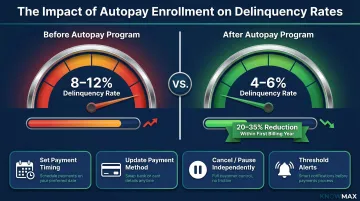
- Set payment timing preferences (due date, pre-due date)
- Update payment methods without calling support
- Cancel or pause autopay independently
- Receive threshold alerts before large withdrawals
Utilities with autopay programs and automated reminders report delinquency rate reductions of 20-35% within the first billing year, moving from 8-12% delinquency rates to 4-6%.
IVR (Interactive Voice Response) and Pay-by-Phone
Voice-based payment remains critical for older adults, customers with limited internet access, and those managing accounts on behalf of others. 10% of the 55+ population prefer paying bills via an automated phone system — a segment utilities cannot afford to ignore.
A well-integrated IVR handles secure card entry without agent involvement, directly reducing call-center staffing costs. The gap, however, is significant: McKinsey found only a handful of utilities offer self-service for bill-inquiry calls in their IVR, while a typical telco resolves 60-70% of billing calls through self-service. Closing that gap is one of the fastest cost-reduction moves available to utility operations teams.
Payment Kiosks for In-Person Self-Service
Physical kiosk stations deployed in utility offices, lobbies, or outdoor/drive-through locations serve walk-in customers who prefer or require in-person payment. Key advantages include:
- Real-time payment posting
- Support for cash, card, and check
- Elimination of service-counter queues
- 24/7 availability when deployed outdoors
For utilities serving 5.6 million unbanked households where 66.2% rely entirely on cash, kiosks provide essential access to digital payment infrastructure without requiring a bank account.
Payment Links, QR Codes, and SMS/Email Payments
Kiosks handle in-person needs, but most customers still pay remotely — and not always through a portal. For customers responding to an overdue reminder or making a one-time payment, a direct link sent by email or SMS (or a QR code printed on a paper bill) removes the friction of logging in or retrieving forgotten credentials entirely.
Pay-by-text adoption grew 5x year-over-year according to InvoiceCloud's 2026 report, and one utility saw a 43% reduction in live agent payments after adopting personalized, secure payment links.
Must-Have Features of a Utility Self-Service Payment Platform
Multiple Payment Method Support
Utility customers span diverse demographics, from digitally native users to unbanked or underbanked households. A platform must accept:
- Credit and debit cards
- ACH/bank transfers
- Digital wallets (Apple Pay, Google Pay)
- Cash at kiosks
According to the FDIC's 2023 National Survey, 4.2% of U.S. households (approximately 5.6 million) are unbanked and 14.2% (approximately 19.0 million) are underbanked. Among unbanked households, 66.2% rely entirely on cash. Supporting multiple methods is not a feature — it's a requirement for equitable access.
InvoiceCloud data shows debit cards now used by 44% of respondents (up from 35% in 2022), while 17.17 billion consumer-initiated bill payments were made via ACH in 2025, confirming ACH remains the backbone of recurring utility payments.
Real-Time Payment Posting and Instant Confirmation
Real-time posting is critical. Customers need immediate confirmation that their payment was received to avoid service disruption anxiety — something legacy systems couldn't deliver, with payments taking 24-48 hours to reflect and driving unnecessary agent calls.
18% of digital bill payers cite "payments taking too long to process" as a top pain point. McKinsey found that utilities improving IVR containment through real-time balance and payment confirmation achieved 5-20% better containment rates and 10-30% total call-center cost reduction within 3-6 months.
CIS (Customer Information System) Integration and Full Account Management
A self-service platform must integrate with the utility's existing CIS so customers can access live account data:
- Current balance
- Billing history
- Rate plan details
- Consumption data
Without this integration, customers still need to call for basic account information, defeating the purpose of self-service. J.D. Power found that only 16% of utilities deliver a "valuable user experience", with overall utility digital experience satisfaction scoring 611 on a 1,000-point scale — significantly below wealth management (738) and P&C insurance (698).
Autopay Controls, Payment Arrangements, and Payment Plan Management
Beyond simple autopay enrollment, a mature platform allows customers to:
- Set up installment plans for overdue balances
- Modify payment dates
- Receive threshold alerts
- Manage financial hardship programs
All without agent intervention. This feature is especially important for customer financial hardship programs, where self-service reduces the stigma and friction of arranging payment plans.
Security and Compliance (PCI DSS, Encryption, Tokenization)
A utility payment platform handles sensitive financial data at scale, making PCI DSS compliance, end-to-end encryption, and payment tokenization non-negotiable.
Platforms should also align with data privacy regulations relevant to their operating regions (such as GDPR and CCPA). Utilities should look for vendors with verified certifications:
- SOC 2 — AICPA framework evaluating security, availability, processing integrity, confidentiality, and privacy
- ISO 27001 — International standard for information security management systems
- PCI DSS — Mandatory for all entities that process, store, or transmit cardholder data
When a knowledge management layer sits alongside the payment platform — handling FAQs, guided troubleshooting, and account support content — it should carry the same compliance rigor. Knowmax, for instance, holds SOC 2, ISO 27001, GDPR, and HIPAA certifications, ensuring customer data remains protected across the full self-service environment, not just the payment transaction itself.
How Self-Service Payment Platforms Drive Business Impact
Higher On-Time Collections and Reduced Delinquency
When payment is easy — available 24/7 across multiple channels with no friction in the flow — customers pay more consistently and on time. Autopay enrollment drives the biggest share of that improvement.
Utilities with CIS-integrated self-service portals and automated reminders report delinquency rate reductions of 20-35% within the first billing year, moving from 8-12% delinquency to 4-6%.
Lower Operational Costs Through Reduced Manual Processing
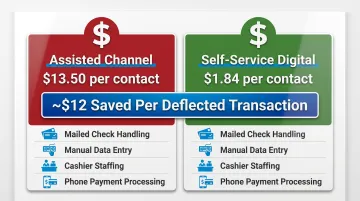
Digital payments auto-reconcile in most modern platforms, removing a significant administrative workload. Cost savings come from:
- Eliminating mailed check handling
- Reducing manual data entry
- Cutting in-person cashier staffing
- Minimizing phone payment processing
Gartner benchmarks show the median cost per contact is $1.84 for self-service versus $13.50 for assisted channels — meaning every call deflected to self-service saves approximately $12.
Reduced Call Center Volume Tied to Billing
A well-designed self-service portal reduces inbound calls for balance inquiries, payment confirmations, and autopay setup — the highest-volume, lowest-complexity call types in utility contact centers.
McKinsey data shows billing-related calls account for 25-35% of total inbound volume at some utilities. Utilities that transformed IVR systems achieved 10-30% total call-center cost reduction within 3-6 months. One utility achieved a 50% reduction in "start services" calls via visual IVR.
That volume shift frees agents for complex interactions — service disputes, account changes, and escalations that actually require human judgment.
Real-Time Data Visibility for Smarter Operations
Beyond cost reduction, self-service platforms generate granular operational data that most utilities aren't fully using:
- Payment method mix
- Channel preferences
- Failure rates
- Autopay adoption by customer segment
Utilities can use this data to optimize billing strategy, prioritize outreach, and forecast cash flow more accurately.
Beyond the Transaction: The Role of Knowledge Management in Utility Self-Service
The Knowledge Gap in Self-Service Payment Journeys
Even with a well-built payment portal, customers frequently encounter questions mid-journey:
- "Why did my bill spike this month?"
- "What happens if I miss autopay?"
- "How do I dispute a charge?"
The payment platform cannot answer these questions. Without an accessible knowledge layer, customers abandon self-service and call an agent, negating cost-saving gains.
How AI-Powered Knowledge Management Closes This Gap
Embedding or linking a knowledge base — featuring decision trees, guided billing FAQs, and visual troubleshooting content — directly within the self-service experience helps customers resolve billing questions without escalating.
Knowmax enables utilities to deliver consistent, guided resolutions across web portals, chatbots, and mobile apps. Key features include:
- Guided decision trees that walk customers through dispute resolution, rate change explanations, and payment plan options
- AI-powered search that retrieves contextually relevant answers by understanding intent, not just matching keywords
- Visual guides covering billing statements, payment methods, and account adjustments
- Multilingual content support across 25+ languages for diverse customer bases
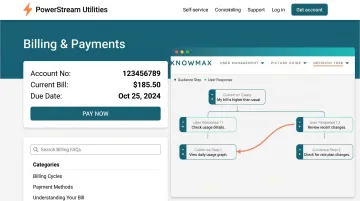
Content is authored once on a centralized platform and automatically updated across every channel — embedded web portals, chatbots, mobile apps, and IVR systems — so customers always see accurate information regardless of where they engage.
The Agent-Side Benefit When Self-Service Escalates
For billing queries too complex for self-service, agents need instant access to accurate, up-to-date billing knowledge.
Knowmax reduces agent handle time on billing calls by surfacing guided resolution paths. Documented outcomes include:
- 15% reduction in average handle time (AHT) through guided workflows
- 21% improvement in first-call resolution (FCR) across telecom deployments
- 40% reduction in agent errors through structured SOPs and real-time content updates
By equipping agents with decision trees and a centralized knowledge base, utilities ensure faster resolutions and consistent responses across all interactions.
How to Choose the Right Self-Service Payment Platform for Your Utility
Evaluate Integration Depth with Existing Systems
The platform must integrate with the utility's CIS, billing software, and CRM without requiring extensive custom development. Poor integration creates data silos, reconciliation failures, and inconsistent customer account views.
Ask vendors for specific CIS integration references during vendor evaluation. Verify they have deployed successfully with your CIS platform in live production environments — not just controlled sandbox tests.
Assess Channel Coverage, Scalability, and Compliance Posture
A single platform should support online, mobile, IVR, kiosk, and payment link channels — not a patchwork of disconnected tools. Scalability should be validated against the utility's projected customer growth and peak-period transaction volumes.
Verify compliance certifications (PCI DSS, SOC 2, relevant regional data privacy standards) directly — request copies of current audit reports rather than accepting vendor assurances at face value.
Look for Automation Capabilities and Meaningful Reporting
Beyond compliance, the right platform reduces manual workload through built-in automation across the full payment cycle:
- Payment reminders and dunning retry logic
- Payment confirmation notifications to customers
- Automated reconciliation with billing records
- Failed payment recovery workflows
- Scheduled reporting and audit trail generation
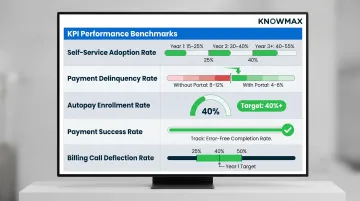
Its reporting should surface actionable metrics. Track these five KPIs to measure self-service payment performance:
| KPI | Benchmark |
|---|---|
| Self-Service Adoption Rate | Year 1: 15-25%; Year 2: 30-40%; Year 3+: 40-55% |
| Payment Delinquency Rate | Without CIS portal: 8-12%; With CIS portal: 4-6% |
| Autopay Enrollment Rate | Target: 40%+ (U.S. average across all bill types: 41%) |
| Payment Success Rate | Track percentage of attempted self-service payments that complete without errors |
| Billing Call Deflection Rate | Target: 25-40% within first year |
Frequently Asked Questions
What apps can I use to pay utility bills?
Most utility providers offer their own self-service portal or mobile app for bill payment — check your provider's website or app store for their branded app. General bill-pay apps and bank mobile apps also support utility payments via ACH transfer.
What is a self-service payment platform for utility billing?
It's a digital system enabling customers to pay utility bills, enroll in autopay, view billing history, and manage payment preferences without agent assistance — available through web portals, mobile apps, IVR, kiosks, or payment links.
How do self-service payment platforms reduce operating costs for utilities?
Digital self-service eliminates manual check processing, reduces cashier staffing, and lowers inbound call volume for routine payment inquiries. Digital channels cost approximately $1.84 per contact versus $13.50 for assisted methods — a $12 savings per transaction.
What payment methods should a utility self-service platform support?
Credit/debit cards, ACH bank transfers, digital wallets (Apple Pay, Google Pay), and cash at kiosks. Supporting multiple methods is critical because 4.2% of U.S. households are unbanked and 14.2% are underbanked, with two-thirds of unbanked households relying entirely on cash.
How can utilities reduce billing-related support calls even after deploying a self-service payment platform?
Billing questions about usage spikes, payment arrangements, or autopay errors still drive calls even when a portal exists. Embedding FAQs, guided decision trees, and chatbot support directly within the portal helps customers resolve these questions without calling an agent.
What security standards should a utility self-service payment platform meet?
PCI DSS compliance, end-to-end payment data encryption, and tokenization are baseline requirements. Broader certifications like SOC 2 and ISO 27001 indicate a vendor's overall data security posture and commitment to protecting sensitive customer information.