Introduction
Contact centers are under pressure from multiple directions at once. Interaction volumes are projected to grow 16% from 2024 forward, driven by digital commerce expansion and rising customer expectations — while 87% of contact centers are actively hiring, yet only 54% of agents stay longer than two years.
The cost side is just as stark. The mean cost per inbound call has reached $6.91, and average speed of answer has stretched to 79 seconds — up from 31 seconds in 2012. More volume, fewer stable agents, and rising per-interaction costs: the operational math doesn't work without structural intervention.
While self-service is often discussed as a customer experience trend, its real impact shows up in measurable contact center outcomes: deflected calls that never enter the queue, reduced average handle time, improved first-contact resolution rates, and stabilized headcount despite growing customer bases. For contact centers managing thousands of daily interactions across telecom, banking, insurance, and e-commerce sectors, self-service software has shifted from nice-to-have to structural necessity.
That's what this article addresses — what customer self-service software actually does, why it matters operationally, and what contact centers risk by delaying investment in it.
TLDR
- Self-service software lets customers resolve issues independently through digital tools, eliminating the need for live agent interaction
- Cuts cost per contact from $13.50 (assisted) to $1.84 (self-service) — deflecting up to 40% of routine queries
- Delivers answers instantly 24/7, improving CSAT and cutting customer effort across all channels
- Frees agents from repetitive queries to focus on complex, high-value interactions
- Consistent, well-maintained knowledge across channels prevents contradictory answers and repeat contacts
What Is Customer Self-Service Software?
Customer self-service software is a category of digital tools that allows customers to independently find information, troubleshoot issues, or complete transactions without agent involvement. In a contact center context, this means providing answers before a query becomes a live contact.
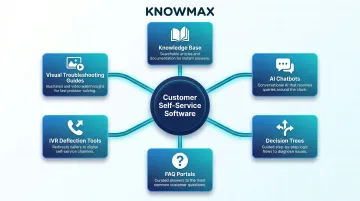
The primary forms it takes include:
- Searchable knowledge bases — repositories of articles, FAQs, and documentation customers can browse on their own
- AI-powered chatbots — conversational interfaces that parse natural language queries and return structured answers instantly
- Interactive decision trees — guided workflows that walk customers through troubleshooting step by step
- FAQ portals — organized collections of common questions with verified, consistently maintained answers
- IVR deflection tools — telephony systems that surface self-service options before routing callers to a live queue
- Visual troubleshooting guides — image or video instructions for device setup, account management, and common technical issues
Each format targets a specific gap: reducing the volume of routine contacts that reach live agents. Platforms like Knowmax combine these formats — knowledge articles, decision trees, picture guides, and chatbot integration — deployed across websites, mobile apps, and agent desktops from a single content repository.
The result is a tiered support model where customers resolve common issues independently, and agents handle the complex, high-stakes interactions where human judgment actually changes the outcome.
Key Advantages of Customer Self-Service Software for Contact Centers
The three advantages below reflect operational outcomes that contact center leaders track daily: cost, efficiency, quality, and customer experience. They're not abstract aspirations.
Advantage 1: Deflects High-Volume Routine Contacts, Reducing Operational Cost
A significant portion of inbound contacts are repetitive, low-complexity queries. McKinsey analysis across 30+ organizations found 50-60% of interactions remain transactional or simple — billing questions, account status checks, password resets, order tracking. Self-service tools can resolve these without agent involvement.
How contact deflection works:
Self-service software intercepts contacts before they reach the queue by providing accurate, always-available answers through knowledge bases, chatbots, and portals. This is called contact deflection.
When a customer searches a knowledge base at 2 AM and finds the answer, or an AI chatbot resolves a billing question in 90 seconds, that's one fewer contact in the morning queue.
Why the cost impact is real:
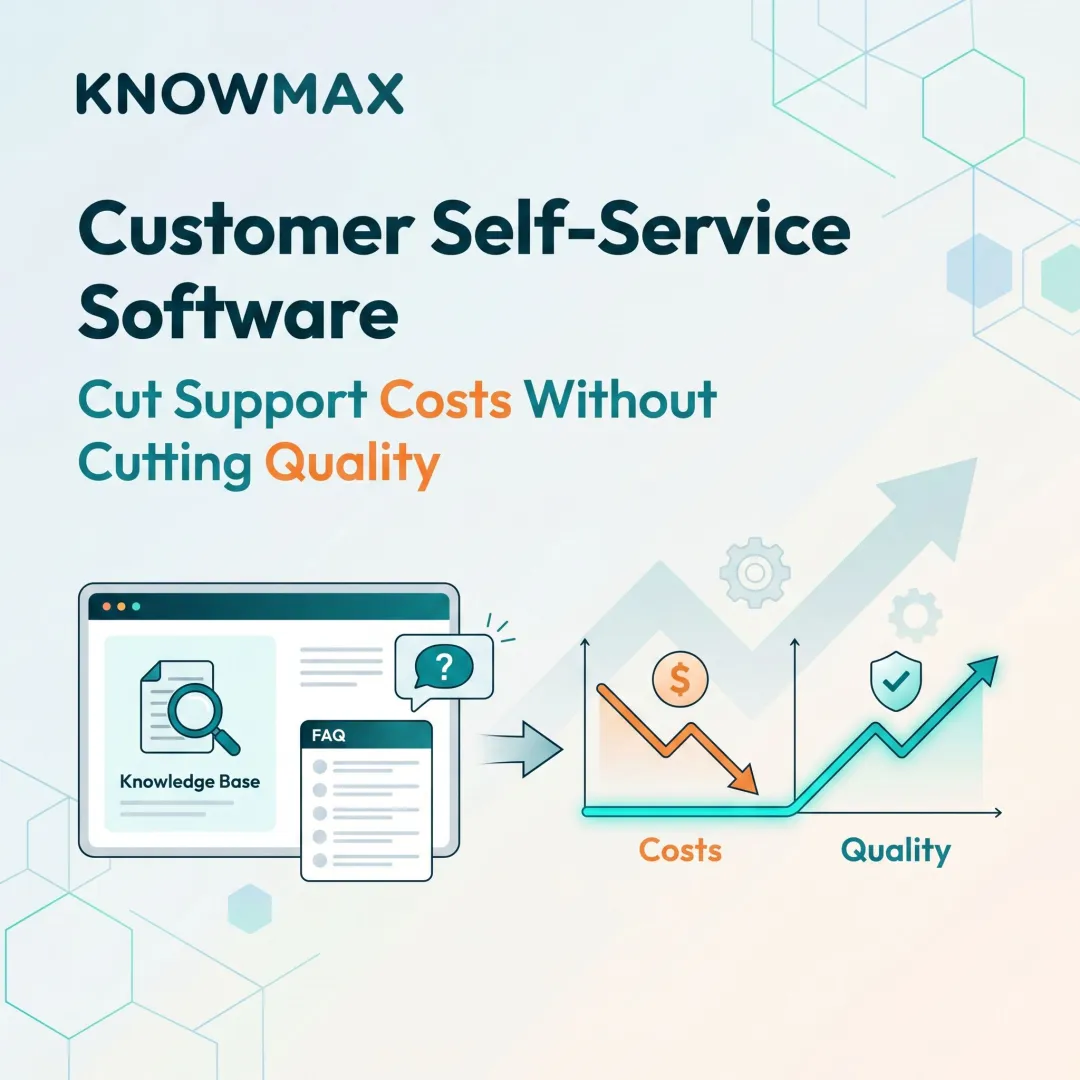
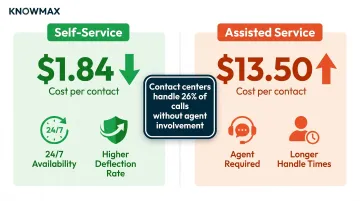
- Self-service interactions cost $1.84 on average, compared to $13.50 for assisted channels. Every deflected contact represents direct cost savings
- Deflection allows contact centers to absorb volume growth without proportional headcount increases. As the customer base scales, self-service scales with it
- Reduced queue pressure improves speed of answer and average wait time for remaining live contacts that genuinely need agents
- Contact centers offering telephony self-service handle an average of 26% of calls without agent involvement (median 15%)
KPIs impacted:
Cost per contact, total contact volume, inbound call volume, average speed of answer, agent utilization rate.
When it matters most:
During peak periods — seasonal spikes, product launches, service outages — inbound demand surges faster than staffing can respond. Self-service absorbs the overflow without degrading service quality. A leading energy company reduced billing call volume by 20% using an AI voice assistant — proof that targeted deployment against specific query types moves the needle quickly.
Advantage 2: Improves Customer Satisfaction by Eliminating Wait Times and Friction
Self-service gives customers immediate, on-demand answers. No hold queues, no callback windows, no business-hours constraints. The experience is frictionless when the content is accurate and easy to navigate.
How this works:
A customer searching a knowledge base at 11 PM or interacting with an AI chatbot gets an answer in seconds rather than waiting for the contact center to open. This eliminates the frustration of waiting and the effort of repeating context to a live agent.
Why satisfaction outcomes follow:
- 81% of customers attempt to resolve issues themselves before contacting support, according to research by Dixon et al. published in Harvard Business Review. When self-service works well, it aligns with customer preference
- 94% of customers with low-effort interactions intend to repurchase, compared to just 4% of those experiencing high-effort interactions. Reducing customer effort directly drives satisfaction and retention
- 24/7 availability addresses a structural gap in traditional contact center coverage — support no longer stops at close of business
Success depends on execution quality. Only 14% of customer service issues are fully resolved in self-service — a reminder that deployment alone doesn't equal resolution. When self-service fails, customers escalate to live channels with more frustration than if they'd called first.
KPIs impacted:
Customer Satisfaction Score (CSAT), Net Promoter Score (NPS), Customer Effort Score (CES), first contact resolution rate (when self-service is counted as a resolution channel).
Where the gains are clearest:
For customers with straightforward, information-based needs — billing queries, FAQs, account lookups — waiting for an agent creates disproportionate frustration relative to the simplicity of the query. In these scenarios, self-service doesn't just reduce cost; it delivers a genuinely better experience.
Advantage 3: Frees Agents to Handle Complex Issues and Increases Productivity
When self-service handles routine queries, agents are no longer spending the majority of their day answering the same five questions repeatedly. They can focus on interactions that require judgment, empathy, troubleshooting, and problem solving.
How this shift happens:
Reducing low-complexity contacts changes the nature of agent work: from reactive, repetitive answering to higher-value, relationship-driven support. Platforms like Knowmax extend this by ensuring that when customers do escalate to agents, those agents have access to the same accurate, structured knowledge through integrated decision trees, visual guides, and contextual search.
This eliminates inconsistency between self-service and assisted-service answers — a common failure point when the two channels operate in silos.
Why this matters for both performance and retention:
- Agent time is one of the highest costs in a contact center. Reducing time spent on low-value contacts directly improves cost efficiency per interaction
- Mean annual agent attrition is 31% (median 24%), with repetitive work cited as a top reason for turnover. Agents who handle more complex, meaningful queries report higher job satisfaction
- 85% of service leaders are expanding human agent responsibilities as simpler tasks move to self-service, recognizing that agent value increases when routine queries are deflected
When agents spend less time on password resets and order tracking, they have real capacity for complex troubleshooting, retention conversations, and cross-functional issue resolution — the interactions that are genuinely hard to automate.
KPIs impacted:
Average Handle Time (AHT), First Call Resolution (FCR), agent occupancy rate, employee satisfaction/NPS, escalation rate.
Where the productivity gains are largest:
In large-scale contact centers with high volumes of repetitive L1 contacts — telecom, banking, e-commerce, insurance — where the routine-to-complex ratio is heavily skewed toward routine. In these environments, even modest deflection rates translate to significant agent capacity gains.
What Happens When Self-Service Is Missing or Ignored in Contact Centers
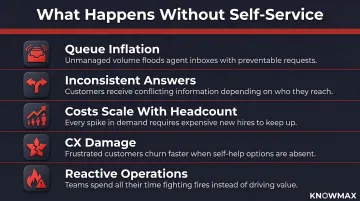
Without self-service infrastructure, contact centers face compounding operational consequences:
- Queue inflation: Queries that could be self-served — order status, billing, account updates — hit the inbound queue instead. Agents stretch thin, and average handle time climbs as they toggle between systems to find answers.
- Inconsistent answers: Without a centralized knowledge repository, customers get different responses depending on which agent they reach. Repeat contacts rise; confidence in support quality drops.
- Costs that scale with headcount: Every increase in customer volume demands more agents, more infrastructure, more training. There's no operational leverage — just a constant hiring cycle.
- Measurable CX damage: 75% of customers hang up after 8 or more minutes on hold, and 28% abandon a brand after a single bad experience. Long wait times and after-hours gaps in coverage are among the top drivers of poor CSAT and churn.
- Reactive operations during volume spikes: Without self-service as a buffer, contact centers scramble to staff up when demand surges — extending hold times and degrading service quality rather than absorbing the load.
The risk compounds at scale. The self-service abandonment rate rose from 13% in 2013 to 32% in 2023 — a sign that customers want self-service to work, but are walking away when it doesn't.
Contact centers that delay investment don't just absorb higher costs. They lose customers to competitors whose self-service actually delivers.
How to Get the Most Value from Customer Self-Service Software
Self-service software delivers its full operational value only when the knowledge powering it is accurate, consistent, and regularly maintained. Outdated content creates failed self-service attempts that result in customer frustration and an agent contact anyway — often with higher customer effort than if they'd reached an agent initially.
Maintain Knowledge Quality
Only 14% of issues are fully resolved in self-service, with 45% of users saying the company "didn't understand what they were trying to do". This highlights a critical need for better content relevance, query-matching, and knowledge base coverage. Effective platforms include content governance features:
- Scheduling and expiry management to remove outdated information
- Authorization workflows requiring review before publication
- Real-time updates that sync changes across all channels instantly
Integrate with Existing Infrastructure
Knowledge quality alone isn't enough if escalation breaks the experience. Self-service tools that connect with CRM platforms, telephony systems, and ticketing tools mean that when customers escalate to live support, agents already have full context on what was already attempted.
Knowmax's integrations with Genesys, Salesforce, Zendesk, Freshworks, and Talkdesk allow agents to see customer self-service history and pick up conversations without forcing customers to repeat themselves. This directly reduces handle time and improves FCR.
Measure and Optimize Continuously
Use analytics from the self-service platform to identify knowledge gaps:
- Zero-result searches indicate missing content
- Abandoned sessions show where customers give up
- Most-accessed content reveals what information customers need most frequently
Self-service is not a one-time deployment. It requires a content governance process, regular audits, and ongoing optimization based on actual customer behavior. Contact centers that audit and update their self-service content on a regular cycle consistently outperform those that deploy once and disengage.
Conclusion
For contact centers operating under pressure to reduce costs, improve CSAT, and scale without proportional headcount growth, customer self-service software is not a nice-to-have. It is a structural necessity. The operational advantages — contact deflection, friction reduction, agent productivity — compound over time when backed by a well-maintained, integrated knowledge foundation.
The contact centers seeing the strongest results are those that treat self-service as an ongoing operational practice, not a one-time technology purchase. They continuously refine content, monitor analytics for gaps, integrate across channels, and ensure consistency between what customers see in self-service and what agents access on their desktops.
As customer expectations for instant, 24/7 support continue to rise and agent attrition remains high, self-service software becomes the operational mechanism that lets contact centers absorb volume, control costs, and raise the quality of every customer interaction — without scaling headcount in lockstep.
Frequently Asked Questions
What is self-service in software?
Self-service in software refers to tools that allow users or customers to independently access information, complete tasks, or resolve issues without needing direct assistance from a support agent or representative.
What is the purpose of providing self-service options to customers?
The core purpose is to give customers immediate access to answers and resolutions. This reduces wait times, lowers operational costs, and removes unnecessary friction from the support experience.
What are examples of customer service software?
Common examples include knowledge base platforms, AI-powered chatbots, interactive decision trees, IVR systems, and FAQ portals. Some enterprise platforms, like Knowmax, combine several of these into a single omnichannel solution.
What are the key features to look for in customer self-service software for a contact center?
Look for AI-powered search, integration with CRM and telephony platforms, content analytics to identify gaps, multi-channel delivery (web, app, chatbot), and easy content management to keep knowledge current.
How does customer self-service software reduce contact center costs?
Routine, low-complexity queries deflected to self-service channels mean fewer live agent interactions. This lowers cost per contact, reduces agent workload, and removes pressure to scale headcount alongside volume growth.
What is the difference between self-service and assisted service in a contact center?
Self-service allows customers to resolve issues independently through digital tools, while assisted service involves a live agent. High-performing contact centers use both: self-service handles high-volume routine queries, while agents focus on complex, high-value interactions.