Introduction
Only 14% of customer service issues are fully resolved in self-service, despite 73% of customers attempting it at some point in their journey. This gap between usage and resolution represents an operational crisis for support leaders facing rising agent headcount, stretched budgets, and mounting pressure to reduce cost-per-contact.
57% of inbound calls come from customers who first attempted self-service on the company website but couldn't find what they needed. That failure carries a real price: each escalated contact costs approximately 7 times more than a resolved self-service session.
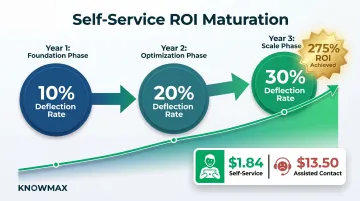
Median costs bear this out — $13.50 per assisted interaction versus $1.84 for self-service. At scale, that delta is a budget line item that compounds fast.
The real cost driver isn't licensing. It's the selection criteria ignored during procurement, the implementation shortcuts taken at launch, and the governance gaps that let content go stale. This article covers each of those decisions — and what separates self-service that deflects volume from self-service that just adds another channel to manage.
TL;DR
- Self-service costs grow through ticket volume, underused tools, and content that fails to deflect queries
- Key cost drivers: content quality, format mismatch, and missing analytics on what actually deflects tickets
- Reducing costs starts before deployment by choosing the right knowledge format and defining deflection metrics upfront
- Keeping content fresh and tracking containment rates prevents failed self-service from escalating to agents
- Adoption, agent workflow integration, and escalation design determine whether self-service cuts costs or creates friction
How Support Costs Build Up Around Customer Self-Service Software
Support costs don't spike suddenly. They accumulate as ticket volume grows, agents spend increasing time on repetitive Tier-1 queries, and self-service investments fail to deflect those queries effectively.
Customers attempt self-service, can't find what they need, and escalate to agents — already frustrated before the conversation starts. Research shows that 43% of self-service failures occur because customers cannot find content relevant to their issue.
Self-service software introduces a secondary cost layer that rarely appears in operational budgets:
- Stale knowledge bases with outdated information create failed attempts
- Abandoned portals that customers don't know exist or can't navigate
- Chatbots trained on incorrect content escalate to agents with context already lost
- Failed sessions that re-enter the ticket queue with elevated customer effort
Each of these failure points shows up elsewhere: in rising Average Handle Time (AHT), declining First Call Resolution (FCR), and dropping Customer Satisfaction (CSAT) scores. They're symptoms of self-service infrastructure that was deployed but never governed.
The Forrester Total Economic Impact study found that organizations achieving 275% ROI over three years did so by progressively maturing deflection rates from 10% in Year 1 to 30% by Year 3. Self-service outcomes require continuous management — not just a one-time deployment.
Key Cost Drivers for Customer Self-Service Software
The primary cost driver is not the tool itself but the volume of resolvable queries that continue to reach agents because self-service content is hard to find, incomplete, or formatted incorrectly.
Content Quality and Findability
When customers search for help and find nothing relevant, the interaction fails before it starts. Gartner's research reveals that in 43% of failure cases, customers couldn't locate content matching their specific issue. An additional 45% said the company didn't understand what they were trying to do.
The root cause is content governance, not search algorithms. Articles written in technical jargon, answers buried six clicks deep, and search results that ignore user intent all contribute to failed sessions that escalate at significantly higher cost.
Tool Selection Misalignment
Choosing a generic knowledge base for environments that need guided troubleshooting creates predictable failure patterns. A telecom company deploying static FAQ articles for complex device issues will see customers abandon self-service and call agents instead.
Format has to match query complexity:
- Informational queries ("What are your business hours?") — static FAQ articles work fine
- Conditional or multi-step issues ("Why isn't my internet working?") — require interactive decision trees that guide customers through diagnostic steps
Platforms like Knowmax address this by offering both static knowledge articles and AI-powered interactive decision trees specifically designed for format-to-complexity matching—enabling organizations to deploy the right content type for each query category.
Governance Absence
Without analytics tracking search queries, failed sessions, and deflection rates, teams have no signal for which content is causing self-service to fail. Costs continue to accumulate unnoticed.
Organizations that measure containment rates consistently outperform those that don't. Visibility is the mechanism: knowing which 20% of issue types drive 80% of inquiry volume lets teams prioritize content creation where it delivers the fastest return.
Customer Adoption Gaps
Governance fixes the content. Adoption determines whether customers use it. Even well-built self-service tools generate no return if customers aren't directed to them at the moment of need. A buried help center versus an in-product widget creates friction that determines whether customers attempt self-service at all.
Recent research found that when agents positively promote self-service, customers are twice as likely to adopt it for future issues. Yet 60% of agents fail to mention self-service options, and 12% make explicitly negative remarks about them.
Cost-Reduction Strategies for Customer Self-Service Software
Cost reduction through self-service breaks down into three distinct levers: the decisions made before and during deployment, the ongoing management of the system once it's live, and the surrounding conditions that determine whether customers actually use it.
Strategies That Reduce Costs by Changing Decisions
These strategies focus on making better choices before or at deployment—decisions that determine whether self-service can realistically deflect tickets at scale.
Match Knowledge Format to Issue Complexity
Simple FAQ articles work for basic informational queries. Guided decision trees and interactive troubleshooting flows reduce escalations for multi-step or conditional issues.
Choosing the wrong format for a query type is one of the most common reasons customers abandon self-service and call an agent instead. Knowmax supports both static knowledge articles and AI-powered interactive decision trees, so organizations can match the right format to the right use case—from basic account questions to multi-step device troubleshooting in telecom or compliance workflows in banking.
Define Deflection Success Metrics Before Implementation
Without clear targets, self-service programs often run for months before anyone notices the deflection rate isn't moving. Set containment rate targets, ticket deflection volume goals, and CSAT benchmarks before go-live—not after.
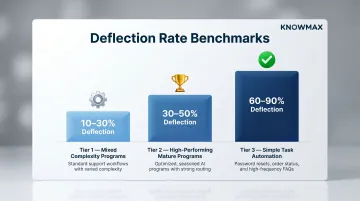
Typical benchmarks:
- Overall deflection: 10–30% of potential contacts for mixed complexity
- High-performing programs: 30–50% for mature content on top inquiries
- Simple tasks: 60–90% deflection (password resets, order status)
Programs that don't track containment from launch tend to discover gaps only after agent volume spikes—by which point the cost has already accumulated.
Scope Content Investment to Highest-Volume, Lowest-Complexity Categories First
Industry research consistently points to a Pareto distribution: approximately 20% of issue types cause 80% of inquiry volume. Building quality content for those categories before expanding coverage generates faster ROI.
A telecom provider might prioritize:
- Password reset and account access
- Bill payment and invoice questions
- Basic device setup for top 5 devices
Rather than attempting comprehensive coverage across hundreds of topics.
Evaluate Total Cost of Ownership, Not Just Licensing
Deployment complexity, content migration effort, training time, and integration requirements with existing CRM and ticketing platforms all affect the real cost of a self-service platform.
Knowmax's deployment process includes AI-powered content migration engines that have delivered up to $60,000 in migration cost savings for Fortune 500 customers, alongside native integrations with Salesforce, Zendesk, Genesys, Freshdesk, and other platforms to minimize integration effort.
Strategies That Reduce Costs by Changing How Self-Service Is Managed
These strategies reduce cost by improving control, accuracy, and visibility once the self-service system is active—ongoing management determines whether initial deflection rates hold or erode.
Track Containment Rates, Not Just Ticket Volume
An organization can see ticket counts plateau while self-service failure rates rise unchecked—if agents are absorbing failed attempts informally, the volume simply moves channels rather than disappearing. Measure what percentage of self-service sessions reach resolution without escalation within 3–7 days, and treat this as a primary operational metric.
Knowmax's analytics capabilities track search queries, session outcomes, deflection rates, and containment rates through dedicated reporting dashboards—surfacing which content is driving success and which is causing escalations.
Use AI-Assisted Authoring to Prevent Knowledge Decay
Outdated articles and incorrect troubleshooting steps cause most self-service failures. Using AI tools to flag content that hasn't been updated after product or policy changes maintains accuracy without manual audits across hundreds of articles.
Knowmax's AI author suite automates rephrasing, summarization, and multi-language content updates across 15+ languages, reducing the maintenance burden while ensuring content remains current.
Mine Search Analytics for Knowledge Gaps
What customers search for and fail to find is direct evidence of where self-service is costing money. Organizations should use this data to prioritize content creation.
Unresolved searches correlate directly with agent escalation rates. Platforms that surface failed search queries enable teams to close gaps systematically rather than reactively.
Align Self-Service Content Updates with Agent Feedback Loops
Agents are the first to see patterns in what self-service cannot resolve. Creating a structured process for agents to flag content gaps closes the loop between support operations and knowledge management.
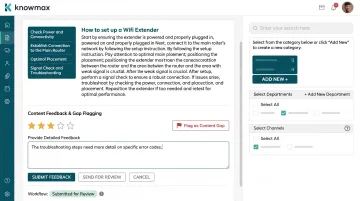
Knowmax includes mechanisms for agents to flag content gaps or inaccuracies directly from the agent desktop, feeding this feedback into the authoring workflow through content rating and review systems.
Strategies That Reduce Costs by Changing the Context Around Self-Service
These strategies address the surrounding conditions that determine whether self-service tools are actually used and whether escalations are handled efficiently.
Embed Self-Service at the Point of Need
Customers are most likely to use self-service when it's surfaced contextually—within the product, on a relevant page, or at the start of a support interaction—rather than requiring them to navigate to a separate portal.
Industry data shows in-app contextual help typically outperforms standalone portals by 5–15 percentage points in deflection rate.
Case examples:
- Cisco Consumer Products increased self-service resolution from 30% to 84% by guiding customers to the best channel based on issue type
- EarthLink reduced calls by 8% by initiating chat with customers who spent more than 90 seconds in the knowledge center
Knowmax supports in-product widget deployment through Chrome extension widgets and CRM integrations, allowing knowledge to be surfaced within existing workflows rather than requiring navigation to standalone portals.
Design Escalation Paths That Carry Self-Service Context Forward
When self-service fails, agents should receive information about what the customer already tried. This eliminates repetitive questions, reduces AHT on escalated interactions, and makes escalations faster and less costly.
Research shows 56% of customers report having to re-explain their issue when contacting support, and each repeat contact doubles perceived effort. The operational cost is equally significant: agents waste time re-diagnosing issues customers already attempted to resolve.
Organizations using knowledge platforms that pass self-service session context to agents see measurable AHT reductions. One fintech startup achieved a 35-second reduction in AHT after deploying decision tree capabilities that provided agents with full interaction history.
Drive Customer Adoption Through Onboarding and In-Journey Prompts
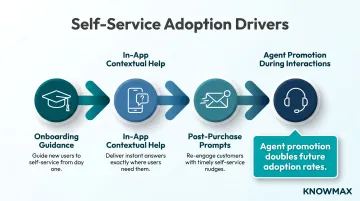
A self-service infrastructure that customers don't know how to use generates no cost reduction. Embedding self-service guidance into onboarding flows, post-purchase communications, and common trigger points increases utilization without requiring customers to seek it out.
Gartner found that when agents mention and positively promote self-service during interactions, customers are twice as likely to adopt self-service for their next issue. Availability alone isn't enough. Active promotion—by agents, in-app, and post-interaction—is what converts occasional users into habitual ones.
Integrate Self-Service Analytics with CRM and Ticketing Data
Connecting what happens in self-service channels with the full support record creates a feedback loop that identifies whether cost savings are real or displaced. Without this integration, deflection numbers can look strong while repeat contacts quietly absorb the cost elsewhere.
Knowmax integrates natively with Salesforce, Zendesk, Genesys, Freshdesk, Freshchat, Talkdesk, SAP, and other platforms, enabling unified visibility into customer journeys across assisted and self-service channels.
Conclusion
Customer self-service software succeeds when it removes human involvement from issues that don't need it — and fails when it removes human involvement from issues that do. The difference starts with knowing where your support costs actually come from: poor content formats, knowledge that goes stale, adoption gaps, or escalation paths that dead-end instead of connect.
Cost reduction through self-service doesn't happen at deployment — it happens in the months after. Organizations that manage content quality, deflection rates, and channel accessibility as ongoing responsibilities consistently lower cost-per-contact without the CSAT drop that poorly maintained self-service creates.
The teams that get this right focus on three things continuously:
- Content accuracy: outdated answers cost more than no answers
- Deflection measurement: knowing which issues resolved without agent contact, and which ones should have
- Escalation design: ensuring customers who need a human can reach one without friction
Self-service that reduces costs looks different from self-service that just shifts them. The distinction comes down to governance — what you put in place before launch, how you measure after it, and whether the system works with your agents or around them.
Frequently Asked Questions
What is self-service in customer support?
Customer self-service is the capability for customers to find answers, resolve issues, and complete support-related tasks independently through knowledge bases, AI chatbots, interactive guides, or portals—without requiring direct agent involvement.
How to encourage customers to use self-service?
Surface self-service at the point of need (in-product, in-journey), keep content accurate and easy to navigate, and educate customers during onboarding rather than waiting for them to discover the portal independently. Agent promotion during interactions doubles future adoption rates.
What are the key features to look for in customer self-service software?
Look for intent-based AI search, support for multiple content formats (articles, decision trees, visual guides), integration with existing CRM and ticketing platforms, and analytics that track deflection rates and knowledge gaps. These features determine whether the platform can realistically resolve issues at scale.
Does self-service software reduce customer satisfaction?
Poorly implemented self-service can hurt CSAT when content is outdated or hard to find. Well-governed self-service, however, consistently improves satisfaction through faster, always-available resolutions. Research shows 96% of customers with high-effort experiences become disloyal, compared to just 9% of those with low-effort ones—so content quality is what determines the outcome.
How do you measure the ROI of customer self-service software?
Focus on five core metrics:
- Ticket deflection rate and self-service containment rate
- Cost-per-contact reduction
- CSAT on self-served interactions
- AHT reduction on escalated tickets (where self-service context passed to the agent)
Organizations that track these systematically report 275% ROI over three years.
What are the 4 types of customers in customer service?
The four commonly referenced types are the angry customer, the impatient customer, the demanding customer, and the loyal customer. Effective self-service design addresses all four by offering quick-answer formats for low-patience users and detailed guided workflows for those who need step-by-step help.