Introduction
Most contact centres invest heavily in building a knowledge base — but the moment it goes live, many treat it as finished. This one-and-done mindset creates a ticking clock on accuracy. Every product update, policy change, and process revision that follows silently introduces new gaps, contradictions, and errors into what was once reliable documentation.
Only 14% of customer service issues fully resolve in self-service, according to Gartner's 2024 survey of 5,728 customers. The most common reason for failure: 43% of customers cannot find content relevant to their issue — a direct result of outdated or poorly maintained knowledge bases.
When agents rely on stale content, average handle time climbs, first contact resolution drops, and inconsistent experiences follow.
This guide covers how to prevent that decay:
- The four core stages of the knowledge lifecycle
- Warning signs that your KB is becoming outdated
- Best practices for ongoing maintenance
- A practical review schedule to keep content accurate as your business changes
TLDR
- Knowledge bases decay naturally — product changes, policy updates, and regulatory shifts erode accuracy without active lifecycle management
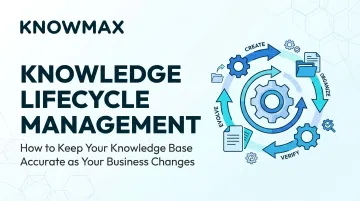
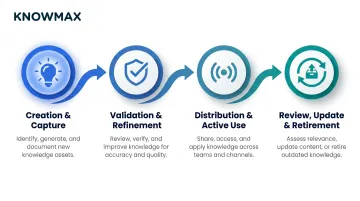
- The knowledge lifecycle has four stages: creation and capture, validation and refinement, distribution and active use, and review and retirement
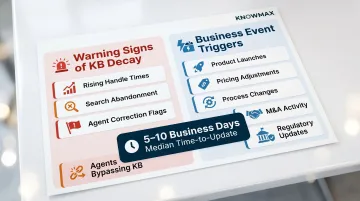
- Warning signs include rising handle times, agents bypassing documented content, and increasing error flags from frontline teams
- Effective maintenance requires assigned content ownership, event-triggered reviews, and scheduled content reviews
Why Knowledge Base Accuracy Deteriorates Over Time
KB decay isn't a failure of the system — it's a predictable operational reality. Business changes drive it: product updates, pricing adjustments, policy revisions, regulatory shifts, and workforce transitions render existing articles inaccurate. Every new feature launch, retired SKU, or revised compliance rule widens the gap between what's documented and what's actually true.
Those gaps have real consequences. One outdated procedure can cascade into incorrect agent guidance, repeat contacts, and escalating complaints. Knowledge workers spend nearly 20% of their workweek searching for internal information, according to McKinsey Global Institute — and when that information is wrong, the time spent becomes pure waste. Agent confidence erodes, resolution rates drop, and support costs rise.
The root cause is structural. Most teams treat knowledge creation as the finish line — no one owns ongoing accuracy, and no process flags articles when business conditions shift. Content ages invisibly until a customer complaint or agent escalation forces the issue.
This is the problem the knowledge lifecycle framework is built to solve: establishing continuous stewardship so content stays accurate before it causes damage, not after.
The 4 Stages of the Knowledge Lifecycle in a Knowledge Base
The knowledge lifecycle is a structured approach that treats KB content as a living asset moving through defined stages, each requiring distinct actions and clear ownership.
Creation and Capture
New knowledge enters the KB from multiple sources: SME input, agent-submitted insights, product documentation, compliance mandates, and customer feedback. Without a structured intake process, this content arrives inconsistently, in varying formats, and with no quality threshold — which creates low-trust content that agents ignore.
Knowmax supports structured intake through:
- DIY and no-code tools that enable SMEs and agents to create decision trees, articles, and visual guides without technical expertise
- Content categorization that organizes submissions so agents can find answers without hunting through unrelated content
- Bulk upload capabilities that simplify migration of product documentation
- API integrations that capture customer feedback and agent submissions automatically from CRMs and helpdesks
Structured intake means content arrives consistently formatted and ready for validation — not dumped into a queue for someone to sort out later.
Validation and Refinement
Every article requires peer review and SME sign-off before it goes live. Validation isn't a one-time gate, either. A pricing article that cleared review six months ago may now be wrong after a product update — so the process must re-trigger whenever business conditions shift.
Knowmax provides authorization workflows that support this:
- Maker-checker approval processes where team leaders and CX managers review content before publishing
- Suggestion and correction mechanisms that enable reviewers to flag errors and recommend changes
- Version control to ensure that all users see the most current, approved content
Without this gate, unvalidated content reaches agents — and once agents stop trusting the KB, they stop using it.
Distribution and Active Use
Knowledge reaches agents and customers through omnichannel delivery: embedded in CRM workflows, surfaced via AI-powered search, and accessed through self-service portals. Active use is where knowledge value is realized, and it's also where gaps, inconsistencies, and outdated content first become visible through usage patterns.
Knowmax delivers knowledge through:
- CRM-embedded widgets in Salesforce, Zendesk, Freshdesk, and Genesys that eliminate context-switching for agents
- AI-powered search that surfaces contextually relevant articles based on intent, not just keywords
- Self-service portals embedded in websites and mobile apps
- Chatbot integrations that power conversational AI with structured, validated answers
- Omnichannel support across voice, chat, email, social media, IVR, and field operations
Accurate content accelerates resolutions at this stage. Outdated content shows up just as fast — as agent confusion, repeat contacts, and customer escalations.
Review, Update, and Retirement
This is the most neglected stage. Every article should carry an assigned owner, a review-by date, and clear retirement criteria. Retiring outdated content matters as much as creating new content. A cluttered KB with conflicting articles damages agent trust and degrades search accuracy.
Knowmax supports this stage through:
- Assigned content ownership tied to SMEs or product specialists responsible for accuracy
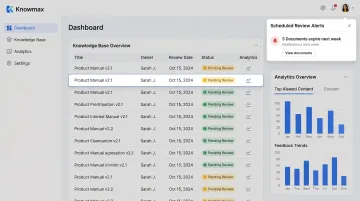
- Scheduled reviews with automated expiry alerts and rolling review cycles
- Content scheduling and archiving that allows articles to be published for specific time periods and archived when no longer relevant
- Analytics tracking that identifies stale content, knowledge gaps, and orphaned articles
Most KBs don't fail at creation. They fail here, when no one is accountable for what happens to content after it's published.
Warning Signs Your Knowledge Base Is Becoming Outdated
KB content rarely fails loudly — decay surfaces gradually through operational signals and user behavior. Identifying these signals early prevents compounding damage.
Performance and Usage Signals
Rising average handle time and increasing repeat contacts on specific issue types are early indicators that agents cannot find or trust KB content. Organizations adopting Knowledge-Centered Service (KCS) report 25-50% improvement in resolution times within the first 3-9 months — the inverse holds when KB content decays.
Track search abandonment rate: when agents perform searches but don't click any result, it signals that available content isn't relevant or trusted. This metric is a leading indicator of KB staleness.
Content Quality Indicators
Two behavioral red flags signal credibility breakdown:
- Agent-submitted correction requests or "flag as incorrect" submissions increase
- Agents bypass the KB entirely to ask colleagues, signaling that informal knowledge is more trusted than documented content
When 60% of customer service agents fail to promote self-service options, the underlying cause is often agent distrust of KB accuracy.
Business Event Triggers That Go Unaddressed
Predictable change events should automatically prompt KB review:
- Product or service launches
- Pricing adjustments
- Process changes
- M&A activity
- Regulatory updates
Most organizations lack a formal change-event-to-KB-update workflow, meaning these events silently create inaccuracies until a customer or agent surfaces the problem. Median time-to-update for routine knowledge article changes is 5-10 business days, according to practitioner benchmarks. Agents access incorrect content throughout that window.
Customer Experience Impact
KB staleness drives measurable CX decline:
- CSAT drops on specific issue categories
- Rising escalation rates on topics that should be self-serviceable
- Complaint themes that repeat across interactions
When these signals cluster around the same issue types, structural content gaps are almost always the cause.
Visible Structural Decay
Content-level warning signs that lifecycle governance has lapsed:
- Articles with no review date or ownership attribution
- Duplicate entries with conflicting instructions
- Orphaned content no longer linked from navigation
- Broken references to products or processes that no longer exist
These are concrete, auditable signals. Regular content reviews surface them before they create operational problems.
Best Practices for Keeping Your Knowledge Base Accurate
Assign Named Content Ownership
Every article should have a designated owner — typically an SME, team lead, or product specialist — responsible for accuracy. Tie ownership accountability to performance reviews or content audit completion metrics, not voluntary responsibility. Knowmax recommends a ratio of 200 users to 1 knowledge creator for optimal management.
Build a Change Management Workflow into KB Operations
Establish a formal trigger system that links internal change events to automatic KB review tasks assigned to the relevant content owner. This prevents silent KB decay more reliably than any other operational practice.
Knowmax supports this through:
- API integrations that connect change management tools to the KB platform
- Notification systems that alert content owners when related product or policy changes occur
- Approval workflows that gate updates before publication
Embed this workflow into existing change management or project handoff processes — when a product update is approved, the corresponding KB review task should be assigned automatically.
Create Structured Feedback Loops from Frontline Teams
Build accessible, low-friction channels for agents and customers to flag incorrect, outdated, or missing content. Route these flags into a regular triage process with clear SLAs for review and resolution. Knowmax enables this through two-way feedback management systems that link agent feedback to the learning management system for continuous improvement.
Apply Content Expiry Dates and Rolling Review Schedules
Set automatic expiry flags on time-sensitive content:
- Promotional procedures
- Seasonal policies
- Regulatory deadlines
Apply rolling review schedules (e.g., every 90 days) for evergreen content. Expiry dates make the review obligation visible and prevent content from aging invisibly. Knowmax supports content scheduling with defined start and end dates, ensuring that outdated information is automatically archived.
Leverage AI-Powered Tools to Reduce Maintenance Overhead
Scheduling and expiry rules handle the when — but at enterprise scale, the sheer volume of content awaiting review can still overwhelm manual teams. AI tooling addresses the how.
91% of customer service leaders are under executive pressure to implement AI, and **58% plan to upskill agents as knowledge management specialists** to review and curate AI-generated content.
Knowmax's Max AI author tools reduce manual effort by:
- Rephrasing content for clarity and tone consistency
- Summarizing lengthy articles into scannable FAQs
- Auto-translating updates across 25+ languages
- Generating assessments from existing articles for agent training
At high content volumes, these tools shift the bottleneck from creation to curation — a more manageable problem for lean KB teams.
Knowledge Base Maintenance: A Practical Review Cadence
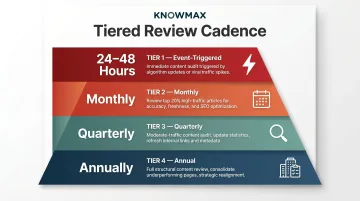
Not all KB content ages at the same rate. A troubleshooting guide for a stable legacy product needs far less frequent review than a pricing article for an actively changing service. Match review frequency to content volatility and business risk.
Tiered Review Cadence Framework
Immediate / Event-Triggered Any article linked to a product launch, policy change, pricing update, or regulatory shift should be reviewed within 24-48 hours of the change going live. Assign this review as part of the change rollout process, not as a separate afterthought.
Monthly Review the top 20% of articles by access volume or agent search frequency. High-traffic content carries the highest risk when inaccurate — small errors in frequently used articles create disproportionate impact.
Quarterly Conduct a broader audit of moderate-traffic articles:
- Check for ownership assignment
- Verify review date currency
- Confirm factual relevance
- Retire or archive articles that no longer reflect current products, processes, or policies
Annual Perform a structural review of the entire KB:
- Reassess taxonomy and categorization
- Identify content gaps relative to current product and service scope
- Archive low-value content
- Verify that search and navigation still align with how agents and customers look for information
The goal is deliberate prioritization — spend review effort where content failure carries real consequences, and set calendar triggers so nothing drifts past its useful life unnoticed.
Conclusion
Knowledge lifecycle management is an ongoing operational discipline, not a one-time project. A KB is only as valuable as its accuracy, and accuracy requires clear ownership and a review process that keeps pace with how your business actually changes.
Businesses that treat their knowledge base as a living asset — one that evolves alongside products, policies, and teams — see their support operations improve over time, not erode. The ones that don't will feel it in their metrics first — and in their customer relationships soon after. Start with ownership. The rest follows.
Frequently Asked Questions
What is the knowledge management life cycle?
The knowledge management lifecycle is the end-to-end process of creating, capturing, validating, distributing, and eventually retiring knowledge within an organization to ensure it remains accurate, accessible, and useful over time.
What are the 5 steps of knowledge management?
The most widely cited five steps are knowledge creation, capture and organization, validation, distribution and application, and evaluation or retirement. Different frameworks name these steps differently, but the sequence holds across most models.
What are the 5 pillars of knowledge management?
The five foundational pillars are:
- People — contributors and end users
- Process — defined workflows for creation and review
- Technology — tools and platforms that host and surface knowledge
- Content — the knowledge itself
- Culture — the organizational mindset that values sharing and accuracy
What are the 4 KM models?
Four well-known KM models are Nonaka and Takeuchi's SECI model, the Meyer and Zack model, the Wiig model, and the Probst Building Block model.
How often should a knowledge base be reviewed and updated?
Review frequency should match content volatility: event-triggered reviews for content tied to business changes, monthly reviews for high-traffic articles, and quarterly or annual audits for the broader KB structure.
How do you know when a knowledge base article is outdated?
Key signals include no assigned review date or owner, agents asking colleagues instead of consulting the KB, rising handle times on specific topics, or user-submitted flags indicating incorrect information.