Introduction
Customer service operations face relentless pressure: query volumes climb year over year, customer expectations for instant and accurate answers intensify, and the cost of slow or inconsistent support compounds. 88% of customers expect faster response times than they did a year ago, and 63% are willing to switch to a competitor after just one bad experience—a 9% year-over-year increase in churn sensitivity. When every interaction carries this much weight, smarter, knowledge-driven AI has become operationally critical.
Most AI conversations in customer service stay surface-level—chatbots, automation, deflection rates. What gets less attention is the knowledge layer underneath: the structured context, rules, and reasoning that determine whether AI actually resolves issues or just routes them. That gap matters. Here, we break down what knowledge-based AI does in practice, where operations break down without it, and how to get measurable value from it.
TL;DR
- Knowledge-based AI combines structured facts and rules with an inference engine, making it distinct from generic AI that relies purely on pattern matching
- It surfaces the right answer at the right moment, eliminating manual searches and guesswork for agents and bots
- Consistency across agents, channels, and interactions ensures every customer receives the same quality of response
- Fragmented knowledge raises error rates, extends handle times, and drives avoidable escalations
- Maintained consistently, it compounds in value: better FCR, shorter onboarding, and higher CSAT scores
What Is Knowledge-Based AI?
Knowledge-based AI is an AI system that stores domain knowledge—facts, policies, procedures, and rules—in a structured repository and uses an inference mechanism to apply that knowledge to answer questions or guide decisions. Unlike large language models or probabilistic AI that rely solely on training data, knowledge-based AI delivers responses grounded in verifiable, up-to-date information.
In customer service, that distinction matters. Knowledge-based AI powers:
- The responses agents see during live calls
- The suggestions chatbots surface in self-service channels
- The guided workflows that walk support teams through complex issue resolution
The goal isn't to build a smarter system for its own sake — it's to ensure every support interaction draws on the most accurate and contextually relevant information available.
Key Advantages of Knowledge-Based AI in Customer Service
The advantages below are grounded in operational outcomes that CX and contact center teams actively track. Each advantage maps to a metric, a process improvement, or a risk reduction that decision-makers can measure.
Advantage 1: Faster Resolution Through Intent-Aware Knowledge Retrieval
Knowledge-based AI doesn't just match keywords—it understands the intent behind a query and retrieves the most relevant procedural or factual knowledge from the repository, reducing the time agents or bots spend searching.
In practice:
When a customer reports an issue, the AI cross-references the query against structured knowledge (troubleshooting guides, product FAQs, policy documents) and surfaces a guided resolution path. Platforms like Knowmax use decision trees and AI-powered search to enable agents to reach the right answer in seconds rather than minutes.
The system's natural language understanding engine analyzes context and semantics—for example, interpreting "How do I get a refund for a damaged product?" as a request for a specific refund scenario, not a generic policy lookup.
What the data shows:
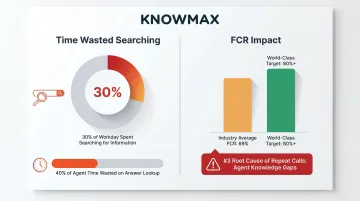
Knowledge workers spend approximately 30% of the workday searching for information, with 60% of the time finding the right information proving difficult. In contact centers specifically, 40% of an agent's time is wasted searching for answers. Reducing search and retrieval time directly compresses Average Handle Time (AHT).
Faster knowledge access also drives First Call Resolution (FCR). The industry FCR average sits at 69%, with only 5% of call centers achieving world-class FCR of 80% or higher. When agents receive accurate, complete answers on the first attempt, escalations and repeat contacts decrease—agent lacked knowledge or resources ranks as the #3 root cause of repeat calls.
KPIs impacted:
- Average Handle Time (AHT)
- First Call Resolution (FCR)
- Average Speed of Answer (ASA)
- Agent idle time
Where it matters most:
High-volume contact centers, industries with complex product portfolios (telecom, banking, insurance), and teams with frequent agent turnover benefit most. A leading telecom company reported a 21% improvement in FCR after implementing Knowmax; a Fortune 500 retailer achieved a 13% reduction in handling time.
Advantage 2: Consistent Knowledge Delivery Across Agents and Channels
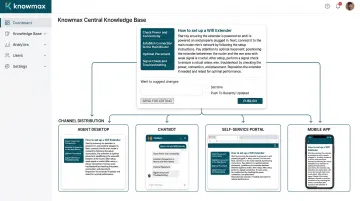
Knowledge-based AI enforces a single source of truth—every agent, chatbot, or self-service interface draws from the same structured knowledge base—eliminating the variation that emerges when agents rely on personal notes, outdated documents, or word-of-mouth guidance.
The operational impact:
Whether a customer contacts support via phone, chat, email, or self-service portal, the knowledge-based AI surfaces the same validated response, procedure, or policy. Knowmax's centralized repository connects directly to agent desktops, websites, chatbots, and mobile interfaces, with real-time updates reflected across all channels. This eliminates contradictory advice across touchpoints.
What the data shows:
85% of customers expect consistent interactions across departments, while 74% find it frustrating to tell their story over and over to different agents. Inconsistency drives repeat contacts and erodes trust faster than almost any other service failure.
In regulated industries (banking, healthcare, insurance), delivering inconsistent or incorrect information carries legal and reputational risk. 50% of customers will leave a brand after just one bad service experience—in banking, a single misstated policy response can trigger regulatory review.
KPIs impacted:
- Customer Satisfaction Score (CSAT)
- Customer Effort Score (CES)
- Repeat contact rate
- Compliance incident rate
Where it matters most:
Omnichannel operations, BPO environments managing multiple clients, and regulated industries see the highest impact. Knowmax's multi-tenant architecture enables BPOs like Concentrix to manage client-specific knowledge environments within a unified platform, with secure content segmentation and role-based access built in.
Advantage 3: Accelerated Agent Onboarding and Reduced Dependence on Tribal Knowledge
Knowledge-based AI externalizes expertise—instead of relying on experienced agents to informally pass knowledge to new hires, the system makes structured guidance immediately accessible to any agent, regardless of tenure.
How it changes onboarding:
New agents can access decision trees, visual troubleshooting guides, and policy walkthroughs from day one—shortening time to full productivity and reducing errors during the critical early employment period.
Knowmax's interactive decision tree software simplifies complex processes into guided workflows, while step-by-step visual guides combine images, annotations, and guided actions that can be converted into video walkthroughs.
The attrition math:
Contact center turnover rates have climbed to 31.2% annually, with some centers experiencing attrition rates up to 100%. The cost to replace a frontline employee ranges from $10,000 to $20,000, with total hiring, training, and ramp-up costs between $7,000 and $15,000 per agent.
42% of institutional knowledge is unique to the individual—when that person leaves, coworkers lose access to nearly half their expertise. When knowledge lives in a system rather than in people's heads, departing agents take far less with them.
Clients have reported a 40% reduction in time-to-proficiency using Knowmax's training and knowledge management features.
KPIs impacted:
- Time-to-proficiency for new agents
- Agent error rate
- Training cost per agent
- Knowledge retention after onboarding
Where it matters most:
High-attrition environments, rapid headcount scaling periods, and BPOs onboarding new client accounts where product knowledge ramp-up is time-sensitive see the highest impact.
What Happens When Knowledge-Based AI Is Absent
Without AI-driven knowledge management, contact centers run into the same operational problems — every time, at every scale:
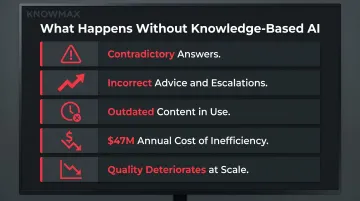
Agents working from different document versions, personal notes, or memory give contradictory answers — eroding trust and driving repeat contacts. Top root causes of repeat calls include agents lacking knowledge and customers' requests not being fully resolved.
Without guided resolution paths, agents rely on judgment calls — leading to incorrect advice, mishandled cases, and avoidable escalations. 69% of service employees report frustration with outdated or scattered knowledge.
Content updates happen after complaints surface, not before — so agents routinely work with outdated information during the gap. Without knowledge management, 90% of routine tasks remain manual and unautomated.
Inefficient knowledge sharing costs the average large business $47 million per year, with agents wasting 5.3 hours weekly waiting on information or rebuilding what already exists. Longer handle times, rework, and escalations stack up quickly from there.
Every new agent or channel added without centralized knowledge inherits the same fragmentation — quality doesn't hold as the operation grows, it deteriorates.
How to Get the Most Value from Knowledge-Based AI
Knowledge-based AI delivers compounding returns only when treated as an ongoing operational discipline rather than a one-time technology implementation. Three conditions determine whether the value is realized or lost.
Keep Knowledge Current
The system is only as good as the content inside it. Stale policies, outdated troubleshooting steps, or missing product updates cause agents to distrust the system and revert to ad-hoc methods.
Establish clear content governance with assigned owners and review cycles. Knowmax supports this with:
- Content owner assignment and accountability tracking
- Scheduled review cycles and expiry workflows
- Archiving and version history to maintain accuracy
Integrate into Existing Workflows
Knowledge should surface where agents already work—not in a separate tab they have to hunt down. Knowmax embeds directly into CRM, telephony, and ticketing systems like Salesforce, Zendesk, Genesys, and Freshworks via native connectors and APIs.
A Chrome extension extends this further, delivering instant knowledge access inside any browser-based platform without breaking the agent's focus.
Measure Outcomes and Act on Them
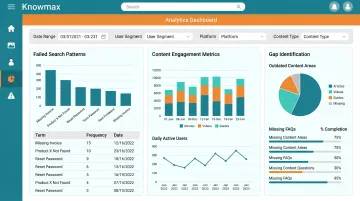
Track which articles are most accessed, which queries go unanswered, and where resolution times remain high. These signals reveal content gaps that feed directly back into creation—turning the system into one that improves with use.
Knowmax's micro-segmented analytics surface user engagement patterns, failed searches, and content gaps, giving operations teams clear direction on where to focus updates next.
Conclusion
Knowledge-based AI's value in customer service comes down to three compounding capabilities: faster and more accurate resolution, consistent knowledge delivery across every agent and channel, and a system that grows smarter as it is maintained and measured.
These gains are measurable. Improvements appear directly in AHT, FCR, CSAT, and agent ramp time — making knowledge-based AI one of the most impactful investments a customer service operation can make.
The organizations that see the greatest returns treat this as an ongoing discipline, not a one-time deployment. Keep your knowledge base current, track what the data tells you, and close gaps as they emerge. The advantage compounds — but only for those who keep building it.
Frequently Asked Questions
What is knowledge-based AI?
Knowledge-based AI is a form of AI that stores domain-specific facts, rules, and procedures in a structured knowledge base and uses an inference mechanism to reason over that knowledge. This produces reliable, explainable outputs rather than purely statistical predictions.
What is an example of knowledge-based AI?
A contact center agent assist tool that retrieves the correct troubleshooting steps for a reported device fault is one example. A chatbot following policy-based decision trees to resolve a billing dispute is another.
What are the 4 types of knowledge in AI?
The four types are:
- Declarative knowledge — facts and concepts the system knows
- Procedural knowledge — how to perform specific tasks
- Meta-knowledge — how the system reasons about its own knowledge
- Heuristic knowledge — experience-based rules of thumb used in expert systems
What is the knowledge base for AI?
In AI, a knowledge base is the structured repository where facts, rules, policies, and domain-specific information are stored. It functions as long-term memory for the system, enabling retrieval and reasoning rather than generating responses from scratch.
What is the difference between AI and knowledge base?
A knowledge base is the storage structure — it holds the facts, policies, and procedures. AI is the reasoning layer that queries and applies that knowledge. In customer service, the knowledge base provides the content; the AI determines what's relevant to a given situation and surfaces it in the right format.