Introduction
Customers expect instant, accurate answers—yet contact center agents spend 40% of their time searching for information rather than resolving issues. Fragmented knowledge bases, outdated wikis, and disconnected systems create a productivity crisis that drives longer handling times, inconsistent responses, and frustration on both ends of the line.
AI knowledge assistants go well beyond generic chatbots and scripted FAQs. These systems surface the right answer at the right moment — for a self-service customer or a live agent mid-call — using intent-based understanding rather than keyword matching. The result is structured guidance through decision trees, visual walkthroughs, and contextual recommendations that adapt to the situation.
This post covers the highest-impact use cases, the business results organizations are seeing, and what to look for when evaluating a solution.
TLDR
- AI knowledge assistants cut agent search time by 40%, directly reducing average handle time and error rates
- Effective AI-powered self-service can resolve 14% of all customer issues fully — top performers resolve significantly more
- Interactive troubleshooting flows reduce escalations and improve first-call resolution, especially in technical support
- Centralized knowledge management delivers consistent answers across voice, chat, email, and digital channels
- Organizations report up to 21% FCR improvement and 40–50% faster agent onboarding alongside stronger CSAT scores
What Is an AI Knowledge Assistant in Customer Service?
An AI knowledge assistant is a system that ingests, organizes, and intelligently delivers support content—from SOPs and product guides to troubleshooting flows—to agents and customers at the moment of need. Unlike basic keyword search, these systems use intent-based understanding to interpret what the user actually needs, not just what they typed.
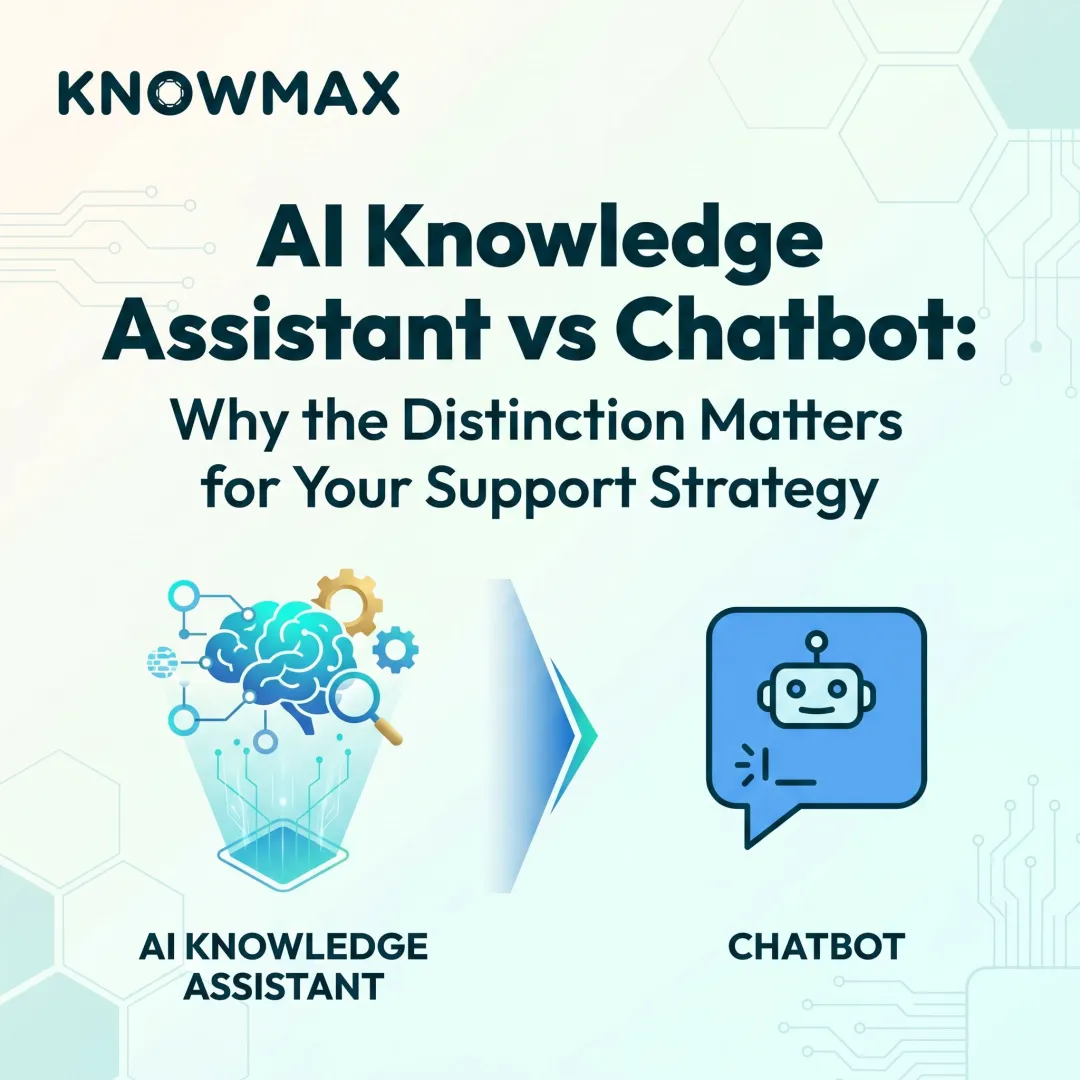
The distinction from traditional tools matters. Here's how they stack up:
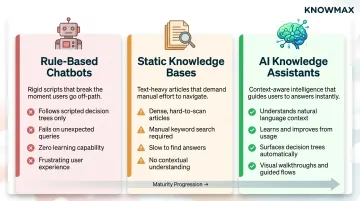
- Rule-based chatbots follow scripted paths and break the moment a query falls outside their defined flow
- Static knowledge bases surface text-heavy articles that agents must manually hunt through to find relevant information
- AI knowledge assistants understand context, learn from usage patterns, and surface structured guidance — step-by-step decision trees, visual walkthroughs — rather than generic documents
For CX leaders, this difference directly impacts resolution speed, response accuracy, and customer satisfaction. According to a Salesforce State of Service report, agents spend less than half their shift (46%) actually working with customers — the rest goes to admin tasks and knowledge-hunting. That gap makes knowledge delivery the bottleneck that determines how well the entire operation performs.
6 High-Impact Use Cases for AI Knowledge Assistants in Customer Service
Each use case below maps to a documented contact center pain point — with outcomes from real enterprise deployments, not hypothetical benchmarks. If you're evaluating where an AI knowledge assistant would move the needle fastest, start here.
Real-Time Agent Assist: Surfacing Answers During Live Interactions
As an agent handles a call or chat, the AI knowledge assistant listens to the query context and proactively surfaces the most relevant articles, policies, or step-by-step guides—without the agent needing to search manually. Agents stay in the conversation instead of switching between tabs and scanning stale documentation.
Measurable outcomes:
- Telstra's "Ask Telstra" deployment scaled to 8,000+ users processing 2 million+ queries, saving agents over one minute per call and reducing follow-up contact by 20%
- 84% of Telstra agents agreed the tool positively impacted customer interactions, validating both efficiency and satisfaction gains
- A telecom provider using AI Agent Assist achieved 20% AHT reduction in just two months
The pattern across deployments is consistent: faster resolution, fewer errors, and measurable AHT improvement within weeks — not quarters.
Self-Service Knowledge Delivery for Customer-Facing Portals
AI knowledge assistants power self-service portals and chatbots by delivering relevant, structured answers from a curated knowledge base rather than relying solely on a bot's conversational model. The AI matches customer intent to the most accurate, up-to-date content, ensuring consistency and accuracy.
The numbers reveal a serious gap: only 14% of customer service issues are fully resolved in self-service, yet 73% of customers attempt it first. Better knowledge delivery — not more chatbot training — is what closes that gap.
Documented success:
- Everlane achieved a 4x increase in live service deflections using AI-powered self-service, along with 25% time savings through workflow automation
- Amtrak's "Ask Julie" virtual assistant delivers an 8x return on chatbot investment, 32% increase in containment, and answers 5 million+ questions annually
When self-service fails, it's rarely the channel — it's the knowledge behind it. AI knowledge assistants fix the root cause by keeping content accurate and matched to actual customer intent.
Guided Troubleshooting with Interactive Decision Trees
AI knowledge assistants serve dynamic, branching decision trees that guide both agents and customers through structured troubleshooting flows. These workflows ask targeted diagnostic questions and narrow toward a resolution step-by-step, reducing dependence on product expertise.
Telecom is where this capability earns its keep — technical issues span complex diagnostic paths across hundreds of device configurations. Knowmax's library of 18,000+ device guides gives agents a pre-built starting point, dramatically narrowing the gap between a new hire and an experienced technician.
Industry context:
- Technical support FCR averages just 60%, the second-lowest category after complaints
- In telecom, AHT for technical troubleshooting runs 8-12 minutes, double the 4-6 minutes for billing inquiries
- A telecom company using interactive decision tree software reduced call escalations by 58% in 3 months and misdiagnoses by 72%
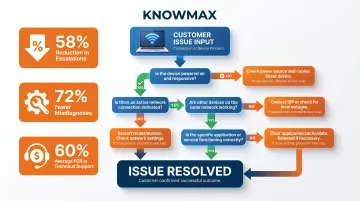
The 58% escalation reduction above isn't from hiring better agents — it's from giving every agent the same structured path to resolution.
Faster Agent Onboarding Through AI-Curated Knowledge
New agents typically struggle during ramp-up because institutional knowledge is buried in documents, legacy wikis, or the heads of senior staff. AI knowledge assistants create a searchable, structured learning environment that new agents can query naturally from day one.
The onboarding challenge:
- Average time to proficiency: 4-6 months for contact center agents
- Full replacement cost per departing agent: ₹8,00,000–₹16,00,000 ($10,000–$20,000)
- New agent cohorts run 20-30% higher AHT than experienced teams
AI-assisted onboarding outcomes:
- 50% faster agent onboarding in a telecom deployment, with up to 80% reduction in agent errors within two months
- 40% reduction in time-to-proficiency when using AI-powered knowledge management
For high-turnover contact centers, shaving two months off ramp-up time isn't just an efficiency win — it directly reduces the cost of attrition.
Omnichannel Knowledge Consistency Across Voice, Chat, and Email
When a chatbot says one thing and a phone agent says another, customers notice — and they don't forgive it easily. A centralized knowledge base, surfaced consistently across every channel, eliminates that disconnect.
The stakes are high:
- 65% of customers express frustration over inconsistent information across service channels
- Even with 95% satisfaction on individual steps, 1 in 4 customers (25%) will have a poor overall experience during a 6-step journey due to inconsistency compounding
- 42% of consumers stop shopping with a brand after just two bad experiences
Business value:
Consistency reduces escalations driven by conflicting information, improves CSAT, and simplifies compliance in regulated industries like banking and insurance where policy accuracy is non-negotiable. Companies using omnichannel integration tools report 9% lower cost per assisted contact.
Proactive Knowledge Gap Detection and Content Updates
AI knowledge assistants don't just deliver knowledge—they monitor for gaps. By tracking failed search queries, escalation patterns, and unresolved tickets, the system flags areas where knowledge is missing, outdated, or underperforming.
69% of service employees feel frustrated by outdated or scattered knowledge — and that frustration shows up in the numbers. Poor knowledge management is linked to a 32% drop in first-contact resolution likelihood and 50% customer churn after a single bad experience.
AI author tools address this directly — helping knowledge managers draft, rephrase, or auto-translate new content in 25+ languages without needing a large content team. The knowledge base stays current as products change, policies update, and new customer issues emerge.
The Real Results: Key Metrics That Move With AI Knowledge Assistants
Here's what the data actually shows — across AHT, FCR, compliance risk, customer satisfaction, and agent retention.
Average Handle Time (AHT)
AI-assisted knowledge retrieval reduces the time spent per interaction by eliminating manual searches and delivering structured answers like decision trees and guided SOPs.
Industry benchmarks and improvements:
- 2024 industry average AHT: 697 seconds (11.6 minutes), an 18% increase over the previous year
- Telstra agents save over 1 minute per call using AI knowledge assist
- 20% AHT reduction in two months with AI agent assist in telecom
- Service leaders expect a 20% average decrease in case resolution times from AI agents
First Call Resolution (FCR)
FCR improves when agents surface the right answer on the first attempt — no callbacks, no escalations, no repeat contacts eating into operational costs.
Industry performance and financial impact:
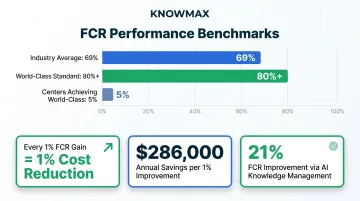
- Industry average FCR: 69%; world-class is 80%+, achieved by only 5% of centers
- Every 1% improvement in FCR reduces operating costs by 1%, worth $286,000 annually for a midsize call center
- A leading telecom company achieved a 21% improvement in FCR using AI knowledge management
- Cost per call resolution: $12.74 (factoring in repeat calls), with top FCR performers achieving 35% lower cost per resolution
Agent Error Rate and Compliance Risk
When agents can't find the right answer — or find the wrong one — the consequences go beyond a poor customer experience. In regulated industries like banking, insurance, and healthcare, knowledge failures become compliance failures.
Error sources and reduction:
- For non-FCR calls, 49% of errors are organization-caused (knowledge/process failures) vs. 38% agent-caused
- Major financial institutions face fines exceeding $4 billion annually from compliance failures
- Manual QA in financial call centers samples only 1-2% of calls, missing the vast majority of compliance risks
- AI Agent Assist achieved up to 80% reduction in agent errors within two months
Customer Satisfaction (CSAT) and Effort Score
Faster, more accurate resolutions mean fewer transfers and fewer "let me check on that" moments — and customers notice. CSAT scores track closely with how little effort customers have to expend.
The FCR-CSAT connection:
- Every 1% improvement in FCR yields 1% improvement in CSAT
- CSAT drops an average of 15% each time a customer must re-contact for the same issue
- When FCR is achieved, 95% of customers will continue doing business with the organization; without FCR, 19% express intent to defect
- Service innovators using advanced AI capabilities are 4.6x more likely to report excellent customer satisfaction
Employee Onboarding and Retention
Contact center turnover is expensive — and getting worse. AI knowledge tools shorten ramp-up time, which reduces the pressure new agents face and lowers the overall cost of churn.
Attrition economics:
- Contact center turnover: 31.2% annually in 2024, with some reports showing 34% turnover—double pre-COVID levels
- Replacement cost: $10,000-$20,000 per departing agent (fully loaded)
- Training cost alone averages $7,500 per agent
AI tools don't just lower onboarding costs — they change how agents experience the job itself.
Retention benefits:
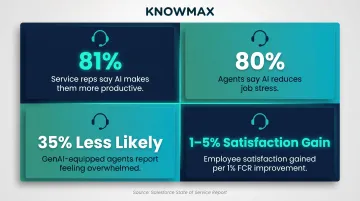
- Every 1% improvement in FCR yields 1-5% improvement in employee satisfaction
- Agents in GenAI-equipped contact centers are 35% less likely to report being overwhelmed by information during calls
- 81% of service reps say AI makes them more productive; 80% say it reduces stress
Industry-Specific Applications Worth Noting
While AI knowledge assistants benefit all customer-facing teams, certain industries see outsized returns due to high interaction volume, complex product sets, or strict compliance requirements.
Telecom and Broadband
Agents handle a massive variety of device configurations, plan changes, and technical issues. AI knowledge assistants with device-specific troubleshooting guides and visual walkthroughs measurably cut escalation rates and truck rolls.
The numbers reveal the scale of the problem:
- In 25 years of benchmarking, no telecommunications company has achieved the 80% world-class FCR standard
- Technical troubleshooting AHT: 8-12 minutes vs. 4-6 minutes for billing
- Technical support FCR: just 60%
AI knowledge platforms have moved those numbers. Vodafone saw consistent AHT reductions and improved CSAT across voice, chat, and email. STC achieved a 21% improvement in FCR. Ooredoo handled 3.7 million transactions via chatbots and extended knowledge access to 120+ agents.
Banking, Insurance, and Financial Services
In regulated industries, the accuracy and consistency of information agents provide is both a CX and a compliance requirement. AI knowledge assistants ensure agents always reference the latest approved policy language, reducing mis-selling risk and improving audit readiness.
The compliance stakes are high:
- Financial institutions face $4 billion+ in annual fines from compliance failures
- Manual QA samples only 1-2% of calls, creating massive blind spots
- Insurance AI implementation can reduce claim processing times and operational costs by 40% and improve CSAT by 20%
A global financial institution deployed an AI knowledge platform that reduced document retrieval times from hours to under 4 seconds, eliminating answer inconsistency flagged by internal audit as a material control gap.
eCommerce and Retail
High-volume, seasonal spikes in eCommerce demand knowledge tools that scale without requiring constant agent headcount increases. AI self-service portals and guided chatbots handling order status, returns, and FAQs consistently deflect a significant share of inbound contacts before they reach a live agent.
Context on the volume:
- WISMO ("Where Is My Order") queries make up 30-50% of all retail support contacts
- Retail AHT benchmark: 3-5 minutes for voice, sub-2 minutes for chat
Results from retailers using AI knowledge tools:
- Everlane: 4x increase in service deflections, 25% time savings during peak holiday seasons
- Walmart: 13% reduction in handling time using AI-powered flows and visual guides
- Amtrak: 32% increase in containment, 30% more revenue per booking
How to Choose the Right AI Knowledge Assistant for Your Team
Not every AI knowledge assistant delivers equal value in a contact center environment. The right platform needs to work inside your existing workflows, draw from well-structured content, and hold up as your team grows. Three criteria tend to separate effective platforms from expensive disappointments.
Integration Capability
The assistant must connect to existing CRM, telephony, and helpdesk platforms so agents get contextual answers without switching tabs or breaking their workflow. Knowmax, for example, integrates directly with Salesforce, Zendesk, Freshworks, Genesys, and Talkdesk — embedding knowledge into the tools agents already use, not alongside them.
Knowledge Structure and Content Quality
An AI assistant is only as good as the knowledge it draws from. Look for platforms that support multiple content formats:
- Decision trees for guided troubleshooting
- Visual guides for complex procedures
- SOPs for compliance and consistency
- FAQs for quick reference
- AI authoring tools for easy content creation and translation into 25+ languages
- Analytics on knowledge usage and gaps to identify content that needs updates
Scalability and Security for Enterprise Teams
For enterprise teams, the platform also needs to handle scale without compromise. That means multi-language delivery, omnichannel deployment, and role-based access controls. Compliance certifications — GDPR, SOC 2, ISO 27001, and HIPAA — matter most for organizations in regulated industries or those operating across multiple geographies.
Frequently Asked Questions
What are the use cases for customer service AI agent?
Primary use cases include real-time agent assist (surfacing answers during live interactions), self-service deflection (powering portals and chatbots), guided troubleshooting (interactive decision trees), automated ticket routing, sentiment analysis, and intelligent knowledge delivery. Each use case targets a specific operational bottleneck in customer support.
How does an AI knowledge assistant differ from a regular chatbot?
A chatbot handles conversation flow and dialogue management, while an AI knowledge assistant focuses on sourcing and delivering accurate, structured information from a curated knowledge base. It often powers the chatbot's responses or works alongside a live agent in parallel, ensuring answers stay accurate and up to date.
What metrics improve most when you deploy an AI knowledge assistant?
AHT, FCR, CSAT, agent onboarding time, and ticket deflection rate are the primary KPIs affected. Results strengthen further when teams actively maintain the knowledge base and use analytics to close content gaps before they affect customers.
Which industries benefit most from AI knowledge assistants in customer service?
Telecom, banking, insurance, and eCommerce see the highest returns due to high interaction volumes, complex product portfolios, and compliance requirements. However, any industry with a large frontline support team can achieve measurable gains in efficiency, accuracy, and customer satisfaction.
Can AI knowledge assistants integrate with existing CRM and contact center platforms?
Yes. Leading platforms are built for integration with CRMs, helpdesks, IVR systems, and messaging platforms. Seamless integration is a critical evaluation criterion — agents won't use a knowledge assistant that pulls them out of their workflow, and an unused tool delivers no ROI.
How long does it take to see ROI from an AI knowledge assistant?
Time-to-ROI depends on knowledge base quality at deployment and integration depth. Most organisations see measurable reductions in AHT and onboarding time within the first few months. CSAT gains follow as deflection rates improve and teams proactively close knowledge gaps.