Introduction
Support leaders face a relentless operational tension: ticket volumes climb 15–20% year-over-year, yet budgets rarely keep pace. Hiring more agents feels like the obvious fix, but it's expensive, slow, and ultimately unsustainable. The true cost per contact center agent — factoring in recruiting, training, and ramp-up — runs between $10,000 and $20,000, compounded by 31.2% annual turnover that forces teams to repeat the cycle endlessly.
Automation and AI get most of the attention, but neither works well without a structured knowledge base underneath. Without one, AI tools surface incomplete answers, agents lose minutes per call hunting for information, and new hires take months to reach full productivity.
This article covers three specific, measurable ways a knowledge base helps support teams handle more volume without adding headcount:
- Ticket deflection through self-service that resolves issues before they reach an agent
- Reduced handle time through instant, accurate answers at the agent desktop
- Compressed onboarding that cuts the time it takes new hires to operate independently
TL;DR
- A knowledge base deflects tickets by enabling customers to self-serve common answers—61% prefer this, yet only 9% of customers succeed finding answers without one
- It cuts Average Handle Time by giving agents instant, structured guidance—reducing errors and boosting First Call Resolution
- Onboarding compresses fast: codifying institutional knowledge cuts agent ramp-up time by up to 70%
- Without knowledge infrastructure, teams default to hiring — a costly, reactive fix that treats the symptom, not the cause
- ROI builds over time: organisations that actively maintain their knowledge base report lower cost-per-contact and higher CSAT alongside capacity gains
What Is a Knowledge Base in the Context of Support Scaling
A knowledge base is a centralized, searchable repository of answers, processes, and troubleshooting workflows. It acts as a single source of truth across all channels—serving customers, agents, and automated systems simultaneously.
That means self-service portals, agent desktops, and chatbots all draw from the same governed content instead of maintaining separate, often conflicting, information silos.
Unlike a static FAQ page, a knowledge base is operational infrastructure. It determines how consistently and quickly support can be delivered at any volume. When ticket volume doubles, a well-structured knowledge base enables teams to absorb that growth without proportionally doubling headcount. When it's fragmented or outdated, the only option left is hiring.
That scalability depends on where and how the knowledge base is deployed. A properly integrated system surfaces content across every channel that handles volume:
- Agent desktop — embedded in CRM tools like Salesforce and Zendesk so agents retrieve answers without leaving their workflow
- Customer-facing help centers — published for self-service, reducing inbound contacts before they're created
- Chatbots and IVR — integrated to power automated resolution on common queries
When each channel draws from the same source, consistency is built into the system—not enforced manually.
Key Advantages of a Knowledge Base for Scaling Support
The advantages below are tied to measurable operational outcomes—not abstract benefits. Each directly affects the metrics support leaders are accountable for: cost per contact, capacity utilisation, resolution quality, and speed.
Advantage 1: Deflects Ticket Volume Through Scalable Self-Service
A knowledge base enables customers to find answers independently, cutting the inbound contacts that require human intervention. When customers encounter an issue, a searchable knowledge base surfaces relevant articles, step-by-step guides, decision trees, and visual troubleshooting workflows. For common queries—password resets, billing questions, order status—customers resolve issues before a ticket is ever created.
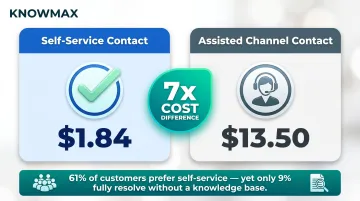
Ticket deflection is the most direct way to scale capacity without adding staff. Every resolved self-service interaction is a fully loaded agent cost that never materialises. Gartner's 2024 benchmark places the median cost per self-service contact at $1.84 vs. $13.50 for assisted channels—a 7x difference.
61% of customers prefer self-service for simple issues, yet only 9% fully resolve via self-service. That gap between preference and execution is what poor knowledge infrastructure costs you.
The effect compounds at scale. In retail eCommerce, "Where Is My Order" (WISMO) calls represent 30–50% of all support contacts. A knowledge base targeting the top 20% of high-frequency issues can eliminate a disproportionate share of that volume.
KPIs impacted:
- Inbound ticket volume
- Cost per contact
- Self-service containment rate
- Agent-to-ticket ratio
When this advantage matters most:
- Seasonal spikes (retail holiday periods, tax season for financial services)
- Product launches with predictable question patterns
- High-growth phases where hiring can't keep pace with demand
- Industries with repetitive query volume: eCommerce, telecom billing, banking account services
Advantage 2: Reduces Average Handle Time and Agent Error Rates
When agents have instant access to structured content—decision trees, step-by-step resolution guides, policy documents—they spend less time searching and more time resolving. Knowmax's interactive decision trees and AI-powered intent-based search deliver guided, contextual answers directly inside the agent's workflow, removing the need to toggle between systems.
A telecom agent troubleshooting a network issue, for instance, follows a decision tree that walks through diagnostic steps and auto-recommends the next action based on customer responses. The result: less guesswork, faster resolution, and consistent answers across every agent.
Why this matters for capacity:
Average Handle Time (AHT) is one of the highest-leverage metrics in contact centres. A 30–60 second reduction per interaction creates real capacity across thousands of daily contacts. Mizuho Bank achieved a 6% AHT reduction using NLP-based knowledge suggestion during live calls.
Reduced error rates directly improve First Call Resolution (FCR). 38% of FCR failures are caused by agent mistakes—errors driven by fragmented or inaccessible knowledge. SQM Group benchmarks show 1% FCR improvement equals $286,000 in annual savings for a midsize centre. When agents resolve issues correctly the first time, repeat contacts drop and effective capacity rises—without a single new hire.
KPIs impacted:
- Average Handle Time (AHT)
- First Call Resolution (FCR)
- Agent error rate
- Repeat contact rate
When this advantage matters most:
- Complex product or policy environments (telecom, insurance, banking) where agents must navigate multi-step workflows
- BPO and contact center settings with high agent turnover and variable skill levels
- Industries where regulatory accuracy is required—errors trigger compliance risk, not just customer dissatisfaction
Advantage 3: Shortens Agent Onboarding and Reduces Dependency on Institutional Knowledge
A well-maintained knowledge base codifies the information experienced agents hold in their heads, making it accessible to new hires from day one. Instead of relying on shadowing or senior agent availability, new agents follow guided resolutions, access structured troubleshooting workflows, and find policy details without interrupting colleagues.
Knowmax integrates a learning management system (LMS) directly with the knowledge base, so training content updates automatically when processes change. New agents access dynamic training hubs with quizzes, decision trees, and video tutorials—all governed by the same content approval workflows that ensure accuracy.
Why this changes the economics of growth:
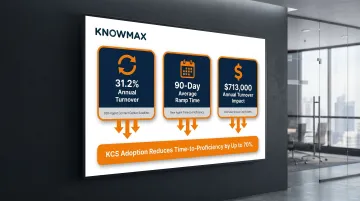
Onboarding costs are a hidden driver of headcount expense. Average time to full productivity is 90 days; best-in-class teams reach it in 45–60. Organisations adopting Knowledge-Centered Service (KCS) report 70% improved time-to-proficiency.
At 31.2% annual turnover, a 100-agent centre faces roughly $713,000 in annual turnover impact—combining replacement costs and lost productivity. Cutting onboarding time in half directly reduces that figure.
There's also a structural benefit: when knowledge lives in a centralised system rather than in individuals, losing a senior agent doesn't mean losing their expertise. New agents handle escalations and edge cases sooner because the institutional knowledge is documented and findable.
KPIs impacted:
- Time-to-proficiency for new agents
- Onboarding cost per agent
- Dependency on senior agent escalations
When this advantage matters most:
- High-growth teams hiring frequently
- BPOs managing large, rotating agent populations
- Regulated industries (healthcare, financial services) where accuracy during onboarding is a compliance requirement
What Happens When a Knowledge Base Is Missing or Ignored
When knowledge is fragmented, outdated, or inaccessible, support teams face predictable, compounding consequences:
Agents give inconsistent answers. Without a single source of truth, customers receive different information depending on who they contact. This erodes trust and increases repeat contacts—30% of customers call back regarding the same issue, often because the first agent provided incomplete or incorrect guidance.
Handle times stay high. 65% of agents say finding answers is their biggest challenge. Scattered knowledge forces agents to search multiple systems, ask colleagues, or escalate unnecessarily — all of which consume capacity without resolving anything faster.
60% of agents report that training provides no value — a figure that reflects what happens when new hires must piece together knowledge through observation rather than structured, accessible content. Onboarding drags on, ramp time extends, and mistakes compound before agents reach baseline competency.
Reactive hiring becomes the default response. Teams add headcount to compensate for a knowledge infrastructure gap rather than solving the root cause. This makes the problem more expensive over time: more agents mean more training overhead, more quality variance, and higher turnover impact.
The scale of this problem becomes concrete in real deployments. One UK telecom provider with 10,000 agents and 3.5 million monthly calls operated across 4 separate knowledge bases. The result: 19 million callback instances — customers repeatedly calling back because agents couldn't locate or confirm the right answer the first time.
How to Get the Most Value from a Knowledge Base
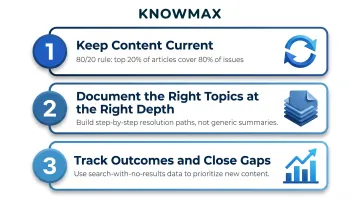
A knowledge base only delivers on its scaling potential when treated as a living operational asset, not a one-time documentation project. Three conditions determine success:
Keep content current. Articles must be reviewed and updated regularly so agents and customers can trust what they find. Outdated content erodes confidence and increases escalations. The 80/20 rule applies: the top 20% of most-viewed articles covers 80% of issues — prioritizing freshness for high-traffic content has disproportionate impact.
Document the right topics at the right depth. Start with your highest-volume query categories and build step-by-step resolution paths, not generic policy summaries. Knowmax supports AI-assisted content creation and auto-translation across 25+ languages — making it possible to build and maintain a full knowledge library without a large authoring team.
Track outcomes and close gaps. Search queries with no results, articles with low helpfulness ratings, and topics driving high escalation rates all signal where coverage is thin. Acting on these signals improves deflection rates and resolution quality over time. Analytics that surface "searches with no results," for example, help content managers prioritize new articles based on actual demand rather than guesswork.
These three conditions address the system — but human behavior matters too. 60% of agents fail to promote self-service options, yet when agents do endorse the knowledge base, customer adoption doubles for future issues. Teaching agents to recommend self-service as a first step — not an afterthought — turns each interaction into a deflection opportunity the next time around.
Conclusion
Scaling support without adding headcount is not primarily a technology problem—it is a knowledge infrastructure problem. A knowledge base addresses the root cause by reducing how many interactions require a human, how long each interaction takes, and how long it takes new agents to become effective.
The returns grow as the system matures. The more thoroughly it is built and consistently maintained, the stronger its impact across deflection, handle time, onboarding, and consistency. This trajectory aligns with where the industry is heading: Gartner predicts that self-service and live chat will surpass phone and email as the most valuable customer service technologies by 2027, and knowledge management systems are what make that shift operationally viable.
Support operations that invest in knowledge infrastructure now build a compounding advantage. Those that don't will keep solving a capacity problem by adding capacity—and hitting the same ceiling every time volume grows.
Frequently Asked Questions
How does a knowledge base reduce average handle time for agents?
When agents can instantly retrieve accurate answers, guided steps, or decision trees from a knowledge base, they spend less time searching mid-call. This directly cuts time per interaction and reduces errors that require follow-up contacts, improving both speed and quality.
Can a knowledge base replace the need for agent training entirely?
No, but it significantly reduces training duration and scope. New agents handle more scenarios independently sooner because structured guidance is available in the moment, not locked in prior memorization.
What types of queries can a knowledge base deflect without human involvement?
Knowledge bases are most effective at deflecting high-frequency, low-complexity queries—billing questions, product FAQs, troubleshooting steps, account processes, and policy lookups. These typically represent the majority of inbound contact volume.
How does a knowledge base support both agents and customers simultaneously?
A well-structured knowledge base serves both audiences from the same content layer: customers access it as a self-service portal, while agents use it as an in-call reference tool. This reduces inbound contact volume while improving resolution speed for contacts that reach agents.
What metrics should I track to measure the impact of a knowledge base on support costs?
Track self-service containment rate, inbound ticket volume, Average Handle Time (AHT), First Call Resolution (FCR) rate, cost per contact, and agent time-to-proficiency. Together these quantify both deflection and efficiency gains.
How is an AI-powered knowledge base different from a traditional FAQ page?
A traditional FAQ page is static and keyword-dependent. An AI-powered knowledge base understands user intent, surfaces contextually relevant content, guides users through multi-step resolution paths, and updates at scale without manual restructuring — keeping content accurate as products, policies, and processes change.