Introduction
CX automation platforms—chatbots, AI agents, IVR systems, and agent-assist tools—have become standard infrastructure in enterprise support operations. 88% of organizations now regularly use AI in at least one business function, with particularly strong adoption across telecom, banking, and eCommerce sectors. Gartner predicts 73% of customer service organizations will deploy agent assist solutions by end of 2025, marking a clear shift toward automation-first support models.
Deployment is widespread, but results are not. Only one-third of organizations have scaled AI at the enterprise level, and 32% report negative consequences from AI inaccuracy.
The gap between automation speed and support quality comes down to a structural problem: most CX automation deployments treat the knowledge base as a passive, searchable repository rather than a live intelligence layer. Agents still search manually, chatbots pull loose keyword matches, and the result is inconsistent, slow, or incomplete answers.
That gap sits precisely at the integration point between CX automation platforms and knowledge bases. This article explains how these two systems connect technically and operationally, and what "smarter support" concretely looks like when that integration is done well.
TL;DR
- CX automation–knowledge base integration enables real-time retrieval of structured knowledge based on conversation context, not just keywords
- Works through REST APIs, native connectors, or middleware to query the KB dynamically during live interactions
- A single KB instance powers chatbots, IVR, agent-assist tools, and self-service portals with consistent answers across every channel
- Delivers faster first-contact resolution, reduced agent error, lower handling time, and fewer repeat queries
- Integration quality directly determines whether CX automation enhances or undermines the support experience
What Is CX Automation–Knowledge Base Integration?
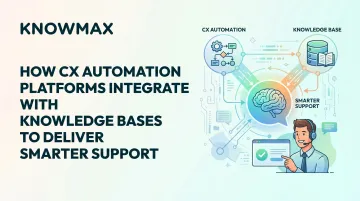
CX automation–knowledge base integration is the technical and operational connection between automation tools (AI chatbots, virtual agents, IVR systems, agent-assist widgets) and a knowledge base. It enables the automation layer to dynamically retrieve and surface the right information during an active customer interaction—without manual agent search.
This is not simply embedding a KB link in a chatbot flow or giving agents a browser tab to search. True integration means the CX platform reads the interaction context, forms an intelligent query, and retrieves structured, ranked knowledge in real time—with the KB functioning as the decision-support brain of the automation stack.
Why this integration exists:
Support teams face a structural gap between the speed and scale demands of automated CX and the depth of knowledge required to resolve queries accurately. 71% of support agents say fragmented knowledge directly slows ticket resolution, while Gartner pegs the average cost of a live support interaction at $8.01.
Without a tightly integrated KB, automation handles volume but not quality. Customers receive fast, inaccurate answers — and at scale, that's a harder problem to fix than slow ones.
Forrester's Wave Q1 2026 positions knowledge management as the "critical control mechanism" to prevent wrong answers from becoming a scaled problem. When CX platforms query a structured, maintained knowledge base in real time, they stop functioning as rigid scripts and start delivering accurate, context-aware responses at the speed customers expect.
How Does the Integration Work?
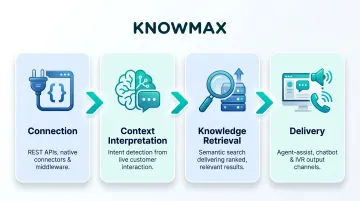
The integration operates through a defined sequence: connection, context interpretation, knowledge retrieval, and delivery. Each stage determines how accurately and quickly the right answer reaches the right person.
Connection Layer
CX platforms connect to knowledge bases via REST APIs, native integrations, or middleware (iPaaS) layers. Native integrations—pre-built connectors listed on Salesforce AppExchange, Zendesk Marketplace, Genesys AppFoundry, or Freshworks Marketplace—offer lower latency and easier maintenance than custom-built API connections. A well-optimized REST endpoint responds in under 20ms, making direct API connections the fastest option for most deployments.
Knowmax, for example, integrates natively with leading CRM, CCaaS, telephony, IVR, and messaging platforms including Salesforce, Zendesk, Genesys, Talkdesk, Freshworks, and Exotel. These pre-built connectors reduce setup time and synchronization lag.
Data flowing across the connection includes:
- Articles, FAQs, and step-by-step guides
- Decision tree nodes and guided workflow paths
- Visual troubleshooting guides
- Metadata tags, role segmentation, and structured content objects
Context Interpretation
The CX platform reads the interaction in progress—whether it is a live chat message, call transcript fragment, ticket subject line, or IVR menu selection—and converts it into a structured knowledge query. Modern platforms use intent detection rather than keyword matching, meaning the query is formed around what the customer is trying to achieve, not just the words they used.
This stage is critical. A weak intent-detection layer returns irrelevant articles even if the KB is excellent — the quality of the query directly determines the quality of the result.
Knowmax's AI-based intent detection picks up keywords as soon as a ticket is raised, searches the knowledge base, and surfaces pre-aligned solutions with a single click. Agents get the right answer without manually scanning long articles.
Knowledge Retrieval and Ranking
When the KB receives a query, it searches across its content—articles, guided flows, troubleshooting trees, FAQs—and returns a ranked set of results based on relevance, recency, and usage signals. AI-powered KB platforms use semantic search, understanding meaning and context rather than literal string matching. Semantic search is especially valuable when customers phrase questions in unexpected ways or combine multiple issues in one message.
How content structure affects retrieval quality:
Well-tagged, role-segmented, and regularly maintained KBs return better results than those with flat, unstructured articles. Decision trees and visual troubleshooting guides are especially effective here because they map directly to resolution paths, not just information.
Modern KB platforms use multi-signal ranking that combines semantic relevance, content recency, usage frequency, and agent feedback scores.
Delivery to Agent or Customer
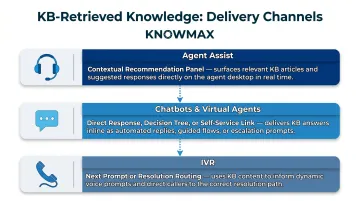
Retrieved knowledge is surfaced through different interfaces depending on the channel:
- Agent-assist: Appears as a contextual recommendation panel on the agent desktop—showing the most relevant article or guided workflow without the agent leaving the conversation screen
- Chatbots and virtual agents: Rendered as a direct response, a guided decision tree, or a self-service article link
- IVR: Informs the next prompt or routes the caller to the right resolution path
If the delivery requires the agent or customer to take multiple extra steps to access the knowledge, adoption drops and the integration loses its speed advantage. Knowmax's browser extension enables agents to access knowledge on any browser-based platform they are using, ensuring a frictionless experience.
What Smarter Support Looks Like in Practice
Real-Time Agent Assist
When a customer describes an issue, the agent's screen automatically surfaces the most relevant KB article, step-by-step resolution guide, or interactive decision tree—before the agent has typed a single search term. This reduces average handle time and agent error rate, especially for newer or less-experienced agents.
United Airlines achieved a 15% reduction in average handle time after deploying Cresta Agent Assist. J.P. Morgan Chase reduced AHT by 14% by streamlining access to trusted information via a centralised KM hub. In an 800-agent contact center, a 1-minute AHT reduction yields approximately $1.7M in annual savings.
Vodafone experienced consistent improvement in service delivery across voice, chat, and email channels after implementing Knowmax, contributing to reduced AHT and increased customer satisfaction.
Self-Service Deflection
Integrated chatbots use the KB to resolve a growing share of queries without human involvement—not through scripted flows but through dynamic content retrieval. A customer asking about a billing discrepancy gets the relevant process article and action steps in the chat window; one troubleshooting a device is walked through a visual guide.
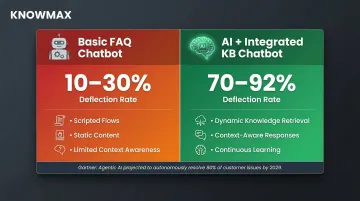
Basic FAQ-style chatbots deflect only 10-30% of inquiries, while advanced AI systems backed by integrated KBs achieve deflection rates of 70-92%. Gartner predicts agentic AI will autonomously resolve 80% of common customer service issues without human intervention by 2029, leading to a 30% reduction in operational costs.
Concentrix handled over 3.7 million transactions via chatbots powered by Knowmax, while also improving knowledge access for 120+ agents.
Consistent, Channel-Agnostic Answers
Because the same KB feeds the chatbot, IVR, agent-assist tool, and customer-facing portal, the answer to any given query is consistent regardless of how the customer contacts support. This eliminates the common problem of customers receiving different information depending on the channel they used.
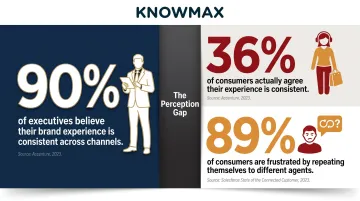
That gap is larger than most organisations realise:
- Over 90% of executives believe customers experience their brand as intended — yet only 36% of consumers feel interactions are consistent across channels
- 44% of bank customers report receiving inconsistent answers across different touchpoints
- 89% of consumers are frustrated by having to repeat themselves to multiple representatives
Consistency is especially high-stakes in regulated industries like banking or telecom, where incorrect information can lead to regulatory exposure. The CFPB imposed a $3.7 billion fine on Wells Fargo for systemic consumer-facing errors, and two-thirds of banking and fintech institutions encounter recurring calculation errors on a weekly or monthly basis.
The Continuous Improvement Loop
Interaction data from the CX platform flows back into the KB—surfacing which articles failed to resolve queries, which topics have no existing content, and which decision tree paths were abandoned. This makes the KB sharper over time and turns every interaction into a feedback signal.
Knowmax's platform closes this loop through:
- Micro-segmented analytics that track time spent on each decision tree node and flag abandoned paths
- Efficiency and resolution rate tracking that shows which content is actually resolving issues
- Agent and customer content ratings that give authors direct feedback on what needs refinement
The result: knowledge that gets more precise with every interaction, rather than drifting out of date.
Where CX–Knowledge Base Integration Delivers Maximum Value
High-Volume Contact Centers and BPOs
Environments where hundreds or thousands of agents handle diverse query types simultaneously benefit most from integration. The KB serves as a real-time training aid that reduces onboarding time, enforces answer consistency, and allows less-experienced agents to resolve complex queries correctly.
Standard agent competency takes 3-6 months; KM systems can save days or weeks of training. KM-assisted onboarding reduces agent ramp-up time by up to 50% in banking environments. Knowmax customers have reported a 40% reduction in employee onboarding time by providing a centralized knowledge hub and interactive training modules.
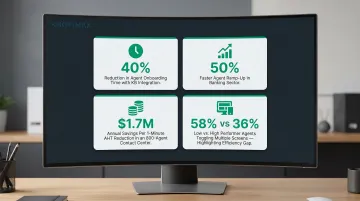
58% of agents at underperforming organizations must toggle between multiple screens to find information versus 36% at high performers. KB-integrated agent assist eliminates screen toggling and delivers contextual knowledge directly within the workflow.
Complexity-Heavy Industries
Sectors like banking, insurance, telecom, and healthcare involve queries with regulatory, technical, or procedural complexity where an incorrect answer has consequences beyond customer dissatisfaction. In these environments, structured KB content—including guided decision trees and visual troubleshooting paths—becomes essential because it constrains the resolution path to verified, compliant information.
Two-thirds of banking and fintech institutions encounter recurring loan calculation errors on a weekly or monthly basis, and 60% struggle to keep pace with regulatory changes. Nearly 25% of lenders take three months or longer to fully implement regulatory updates, exposing them to non-compliance for an entire quarter.
Knowmax is built for these environments, holding certifications across:
- SOC 2 and ISO 27001 for data security
- GDPR for privacy compliance
- HIPAA for health insurance use cases
The platform supports audit-ready content governance and decision trees for regulated workflows. Airtel improved first-call resolution rates by 21% using Knowmax's decision trees and visual guides.
Omnichannel Operations
Organizations that support customers across chat, voice, email, social, and self-service portals need a single knowledge source that can be accessed consistently from every channel. Integration ensures that the KB does not have to be maintained separately per channel, reducing content drift and ensuring that a customer who moves from self-service to a live agent gets continuity rather than contradiction.
Companies with strong omnichannel customer engagement strategies retain 89% of their customers and see 9.5% year-over-year revenue increase, compared to 3.4% for those without strong omnichannel strategies.
Knowmax's omnichannel deployment feeds a single KB instance to the agent desktop, self-service portal, chatbot, IVR, and mobile channels simultaneously. Any update made to the knowledge base is immediately reflected everywhere — no channel-by-channel maintenance required.
Conclusion
CX automation platforms are only as intelligent as the knowledge layer behind them. How deeply context is read, how accurately the system retrieves knowledge, and how cleanly it surfaces answers to agents or customers—these determine whether automation enhances support or just accelerates existing gaps.
Teams evaluating CX automation platforms should assess the depth and flexibility of their knowledge base integration, not just feature checklists. A platform with sophisticated AI but shallow KB connectivity will consistently underperform one with tighter, structured integration. The KB needs to function as the active intelligence layer of the CX stack—not a static reference document agents search manually.
Organizations that treat knowledge management as foundational infrastructure—not an afterthought—consistently capture more value from CX automation investments. The quality of that integration is what separates automation that amplifies support capacity from automation that simply moves existing failures faster.
Frequently Asked Questions
What is the purpose of a knowledge base in customer service?
A knowledge base serves as the centralized repository of verified information (articles, guides, troubleshooting flows) that both customers and agents access to resolve queries. In CX automation, it acts as the retrieval engine behind accurate, consistent responses at scale.
How do CX automation platforms connect to knowledge bases technically?
CX platforms connect via REST APIs, native platform integrations (pre-built connectors on CRM or CCaaS marketplaces), and middleware/iPaaS layers. Native integrations typically offer lower latency and easier maintenance than custom-built API connections, with well-optimized endpoints responding in under 20ms.
What is the difference between a knowledge base integration and a simple chatbot FAQ?
A scripted FAQ chatbot uses hardcoded question-answer pairs, while a KB-integrated chatbot dynamically queries a structured knowledge repository using intent detection. This returns contextually relevant results that can be updated centrally without rewriting the bot flow.
How does AI improve the connection between CX platforms and knowledge bases?
AI enables intent detection on the CX platform side rather than keyword matching, and powers semantic search and content ranking on the KB side. Together, they allow the right knowledge to be retrieved even when the customer's phrasing is vague or unconventional.
What metrics improve when CX automation is properly integrated with a knowledge base?
Metrics that typically improve include:
- First-contact resolution rate
- Average handle time
- Agent error rate
- Self-service deflection rate
- Customer satisfaction scores
The degree of improvement depends on KB content quality and integration depth.
What should organizations look for when evaluating a knowledge base for CX automation integration?
Key evaluation criteria include:
- Native connectors with your existing CX platforms
- Structured content formats (decision trees, visual guides — not just flat articles)
- Semantic search capability
- Role-based content segmentation
- Analytics that feed back into content improvement