Introduction
Most knowledge management platforms look impressively scalable during controlled vendor demos. The painful reality surfaces when user volumes surge from hundreds to thousands, content libraries balloon from thousands to tens of thousands of articles, or channel integrations multiply across voice, chat, email, and self-service portals. The demo environment bears little resemblance to production-scale operations.
According to McKinsey research, knowledge workers spend approximately 20% of their workweek searching for information — a figure that compounds quickly when your KM platform hits its limits. Agent costs represent 95% of total contact center costs, making any productivity loss from inadequate knowledge access costly at scale.
Scalability in enterprise KM isn't just about storage capacity. It directly affects agent productivity, First Call Resolution rates, Average Handling Time, and customer satisfaction. This post gives decision-makers a structured six-factor checklist to pressure-test any KM platform before committing — so you can assess real operational readiness, not just demo performance.
TL;DR
- Scalability means sustaining performance, accuracy, and governance as users, content, and geographic reach grow—without proportional cost increases
- Six dimensions matter most: volume capacity, integration flexibility, omnichannel delivery, governance, security compliance, and ROI analytics
- Unscalable platforms cause duplicated work, inconsistent agent guidance, and rising costs as organisations expand
- A structured checklist, not vendor demos alone, reveals long-term scalability fit
- Knowmax is built to scale across channels, geographies, and compliance requirements—without rebuilding your knowledge infrastructure
What Is Scalability in Enterprise Knowledge Management?
Scalability in knowledge management means the platform sustains search performance, content governance, and access consistency as your organisation grows—in users, content volume, channels, and geographic reach—without proportional increases in cost or manual effort.
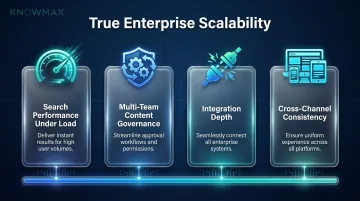
True enterprise scalability extends beyond surface-level metrics like storage capacity. It encompasses:
- Search performance under load – sub-second query response times whether serving 100 or 10,000 concurrent agents
- Multi-team content governance – approval workflows, version control, and audit trails that prevent knowledge decay across business units
- Integration depth – native connections to CRM, telephony, IVR, and messaging tools that eliminate agent screen-toggling
- Cross-channel consistency – the same knowledge base powers accurate answers across voice, chat, email, self-service portals, and AI bots
Enterprise-scale KM serves distinct stakeholders simultaneously: contact center agents needing instant answers, customers accessing self-service portals, AI bots requiring structured data, and supervisors monitoring content performance. Each group has different access needs and expectations, which means a platform that works for one can quietly fail another.
That complexity shows up in adoption data. Research from IDC found that only 45% of employees at large companies actively use their KM systems—yet fewer than 1% report receiving no benefit when they do. The implication for decision-makers: a platform can have the technical capacity to scale and still fail if it isn't built to serve every stakeholder group consistently.
Why Scalability Failures Are More Costly Than Decision-Makers Expect
Scalability failures compound rapidly. As agent headcount grows, knowledge gaps multiply — new hires rely on peer escalations rather than the system, subject matter experts become bottlenecks, and Average Handle Time climbs.
Research shows that 70% of employees spend at least one hour searching for a single piece of information, with 23% spending more than five hours. That search burden alone signals a platform struggling to keep pace.
When a KM platform can't deliver consistent, up-to-date answers across channels, agents provide conflicting resolutions. Industry benchmarks show the average First Call Resolution rate is 70%, and every 1% FCR improvement yields a 1% improvement in customer satisfaction. Poor knowledge access undermines both metrics.
The customer experience consequences are measurable. 72% of customers will switch to a competitor after a single bad experience, and U.S. businesses lose $168 billion annually to churn. When knowledge fails at scale, revenue follows.
These costs extend beyond the immediate service failure:
- Operational drag: SME bottlenecks and peer escalations inflate labour costs as teams grow
- Revenue exposure: FCR decline and churn compound across an expanding customer base
- Platform switching costs: Mid-growth migrations require content re-migration, integration rebuilds, and typically delay strategic initiatives by months
Catching scalability gaps before signing a contract is far less disruptive than discovering them at 500 agents. That's what the evaluation checklist in this guide is built to do.
The Decision-Maker's Scalability Evaluation Checklist
Apply this six-factor framework during vendor evaluation, proof-of-concept testing, and contract negotiation. Each factor maps to specific operational KPIs, not just feature comparisons.
User and Content Volume Capacity
The Core Question: Does the platform maintain search speed and content retrieval accuracy when article count scales from thousands to tens of thousands, and concurrent users increase from hundreds to thousands?
Performance degradation at volume is the first sign of an unscalable system. If search response times climb from sub-second to 3-5 seconds as your knowledge base grows, agent productivity suffers immediately. McKinsey research shows that strong KM systems can reduce time lost to information search by up to 35%, but only if search performance remains fast under load.
KPIs this factor protects:
- Agent query response time
- Knowledge retrieval success rate
- System uptime SLAs during peak contact volumes
What to test: Request load testing data showing query response times at 2x and 5x your current article volume and concurrent user count. Verify contractual SLA guarantees for sub-second search performance at your projected three-year scale.
System Integration and API Flexibility
The Core Question: Does the platform connect natively or via open APIs with your existing CRM, telephony, IVR, ticketing, and messaging tools?
Scalable KM must deliver knowledge within the agent's workflow, not in a separate tab. Contact center agents switch between applications 40+ times during a single call across 5-10 different tools. One major insurer saved $4 million annually by reducing application switching through unified desktop integration.
That switching cost compounds across teams. Knowledge workers toggle between applications over 1,200 times per day, costing roughly four hours of productive time per week — a direct drag on integration depth and adoption rates.

KPIs this factor protects:
- Time-to-resolution
- Agent handle time
- Tool-switching friction
What to verify: Check whether the vendor is listed on marketplaces of platforms you already use (Salesforce AppExchange, Zendesk Marketplace, Genesys AppFoundry). Confirm open APIs exist for custom integrations with proprietary systems.
Omnichannel Knowledge Delivery Consistency
The Core Question: Does a single knowledge base power consistent answers across voice, chat, email, self-service portals, and AI bots—without maintaining separate content repositories per channel?
Inconsistency is a governance failure, not just a UX problem. Research reveals that over 90% of executives believe CX is delivered as intended, yet only 36% of consumers feel their interactions are consistent across channels—a 54-percentage-point perception gap.
True scalability means content updated once flows instantly to all channels. 54% of businesses use more than five different tools for documentation and information sharing, creating silos that scalable KM platforms must consolidate.
KPIs this factor protects:
- Cross-channel CSAT scores
- Deflection rates from digital to assisted channels
- Escalation frequency
What to test: Verify that the platform uses a single content repository feeding all channels. Update one article during proof-of-concept and confirm it appears identically across agent desktop, self-service portal, and chatbot within seconds.
AI-Powered Search and Content Governance at Scale
The Core Question: As content volume grows, does the platform use intent-based AI search that returns contextually accurate results, and do governance tools prevent knowledge decay at scale?
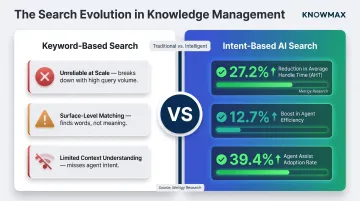
Keyword-based search becomes unreliable as knowledge bases expand. Research from Metrigy shows that Agent Assist software—the most widely adopted AI use case at 39.4% adoption—reduces Average Handle Time by 27.2% and boosts agent efficiency by 12.7%. Intent-based AI search delivers this advantage by understanding user queries, not just matching keywords.
Content governance automation prevents decay at scale. 48% of leaders believe critical knowledge "walks out the door" when employees leave. Gartner states that AI-powered taxonomy automation, knowledge capture, and curation are making conventional KM practices obsolete.
KPIs this factor protects:
- Agent first-contact accuracy
- Outdated-article incident rate
- Content maintenance overhead
What to evaluate: Assess whether the platform offers AI authoring tools (auto-translation, rephrasing, summarization) that reduce content scaling costs. Verify governance features include content expiry scheduling, audit trails, and version control.
Security, Compliance, and Role-Based Access Controls
The Core Question: Can the platform maintain GDPR, SOC 2, ISO 27001, or HIPAA compliance as you expand into new markets and business units?
Enterprise scalability includes geographic and regulatory expansion — and every new market adds compliance obligations. The average U.S. data breach costs $10.22 million, with healthcare breaches averaging $7.42 million.
53% of breaches involve customer PII, and 97% of AI-related security incidents occurred where access controls were lacking.
Role-based access controls must scale to support diverse user hierarchies across teams and regions. Without granular permissions, you risk compliance violations or restrict knowledge access so tightly that agents can't do their jobs.
KPIs this factor protects:
- Compliance audit pass rates
- Data breach incident rate
- Time-to-onboard new business units securely
What to verify: Confirm the platform holds SOC 2 Type II, ISO 27001, GDPR compliance, and HIPAA where applicable. Test how easily you can configure role-based access for new regions or business units during proof-of-concept.
Usage Analytics and ROI Measurement
The Core Question: Does the platform provide dashboards showing knowledge utilisation rates, top-searched queries, low-performing articles, and correlation between KM adoption and operational KPIs like AHT and FCR?
Decision-makers scaling a knowledge base need more than adoption metrics — they need to see where the system is working and where it isn't. Without visibility into content effectiveness and knowledge gaps, teams continue investing in content that agents never use and miss the gaps that drive escalations.
APQC's KM Measurement Framework, backed by 30+ years of benchmarking research, describes four phases of KM measurement maturity—progressing from activity metrics to business impact metrics.
KPIs this factor protects:
- Knowledge base ROI
- Content effectiveness score
- Decision-maker visibility into operational gaps
What to test: Request a demo of the analytics dashboard showing real usage data. Verify it surfaces actionable insights like failed search queries, low-engagement articles, and correlation between knowledge access and handle time reduction.
How Knowmax Supports Enterprise-Scale Knowledge Management
Knowmax is an AI-powered knowledge management platform built for enterprises operating across contact centers, digital channels, and multiple industries—from telecom and banking to healthcare and e-commerce. Clients including Vodafone, Airtel, Walmart, Concentrix, CIMB, and Tata rely on Knowmax for scalable KM delivery across global operations.
Scalability capabilities aligned with the checklist:
- Searches by intent, not just keywords, so agents surface the right answer faster
- Delivers knowledge across agent desktops, self-service portals, chatbots, mobile, voice/IVR, and social—from a single unified repository
- Integrates natively with Salesforce, Zendesk, Freshworks, Genesys, and Talkdesk via official marketplace listings
- Creates, rephrases, summarizes, and auto-translates content in 25+ languages using built-in AI authoring tools
- Guides agents through complex issues with interactive decision trees and visual troubleshooting workflows
- Enforces role-based access controls with compliance coverage across GDPR, SOC 2, ISO 27001, and HIPAA
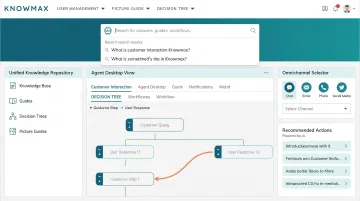
These capabilities map directly to the KPIs decision-makers are accountable for: lower Average Handling Time, reduced agent error, faster onboarding, and stronger First Call Resolution. The platform scales from 50 users to over 5,000, supporting deployments across North America, Europe, the Middle East, India, Southeast Asia, and Africa.
Conclusion
Scalability evaluation is ultimately a business risk decision. The six-factor checklist in this post gives decision-makers a structured way to move beyond vendor claims and pressure-test platforms against real operational growth scenarios.
The right KM platform delivers accurate, fast, and consistent knowledge as teams grow, channels multiply, and customer expectations rise — regardless of how many features the vendor demo showcases. Before signing, evaluate across all six dimensions:
- Volume capacity under realistic peak load conditions
- Integration flexibility with your existing CRM and CCaaS stack
- Omnichannel consistency across agent, self-service, and chatbot channels
- AI-driven governance and content accuracy controls
- Security and compliance coverage (SOC 2, GDPR, HIPAA, ISO 27001)
- ROI measurement tied to resolution speed and agent efficiency
Treat scalability as an ongoing assessment — build it into every contract renewal cycle, not just the initial procurement decision.
Frequently Asked Questions
What activity is necessary for successfully implementing a knowledge management system?
A thorough needs and gap assessment is foundational: mapping current knowledge workflows, identifying access bottlenecks, and aligning stakeholders before platform selection.
What does scalability mean in the context of a knowledge management platform?
KM scalability means the platform sustains search performance, content governance, and access consistency as user count, content volume, channels, and geographic reach grow—without proportional increases in cost or manual administration.
How do you measure whether a knowledge management system is scaling effectively?
Track knowledge retrieval success rate, agent handle time trends, First Call Resolution rate, content utilisation analytics, and system uptime under peak load.
What are signs that a current KM platform cannot scale with an enterprise?
Warning signs include degraded search performance as content grows, inability to integrate with new CRM or telephony tools, rising content maintenance overhead, and inconsistent answers across channels.
How does API integration affect the scalability of a knowledge management system?
Open APIs allow the KM platform to embed into agents' existing tools—CRM, telephony, chat—so knowledge delivery scales with workflow rather than requiring separate adoption. This directly drives utilisation rates and prevents tool-switching friction.
What security certifications should an enterprise KM platform have to support global scalability?
Platforms operating across geographies should hold SOC 2 Type II, ISO 27001, GDPR compliance, and HIPAA for healthcare operations. These certifications ensure security controls scale alongside user and data volume growth, meeting regulatory requirements in multiple regions.