?](https://file-host.link/website/knowmax-9pnv2t/assets/blog-images/27bb259c-6988-4469-8e32-470076f67a59/1778157874582029_23243bcc63a24f58bc0bd788e664a6d0/360.webp)
Introduction
AI productivity gains aren't distributed evenly across the business landscape. Industries where knowledge complexity runs deep and information access remains slow are seeing disproportionately large returns from AI knowledge bases — not just AI broadly, but knowledge systems specifically.
The mechanism is direct: AI knowledge bases cut the time agents spend searching for answers, reduce resolution errors, accelerate onboarding, and surface the right information without requiring agents to hunt for it. Workers lose roughly 1.8 to 2.5 hours daily searching for information, and in banking contact centers, agents spend 70% of their time toggling between as many as ten different legacy systems.
That search burden is the primary bottleneck in customer-facing operations — and it's exactly what AI knowledge bases are built to remove.
This article examines which industries are capturing the biggest productivity gains from AI knowledge bases, why certain sectors benefit more than others, and what specific metrics move when knowledge becomes instantly accessible.
TL;DR
- High knowledge complexity + large frontline teams = the sharpest AI knowledge base gains
- Telecom, Banking, Healthcare, Insurance, and eCommerce report the biggest drops in handle time, faster FCR, and quicker agent ramp-up
- Impact is highest where knowledge is fragmented, fast-changing, or compliance-heavy
- Key metrics include Average Handle Time (AHT), First Call Resolution (FCR), agent ramp-up time, and customer satisfaction scores
What Are AI Knowledge Bases and Why Do They Drive Productivity Differently?
An AI knowledge base is fundamentally different from a static FAQ repository. Instead of requiring agents to manually search through articles and interpret answers, AI knowledge bases use intent-driven search, guided resolution workflows, and contextual surfacing to deliver the right answer at the exact moment it's needed.
How They Work
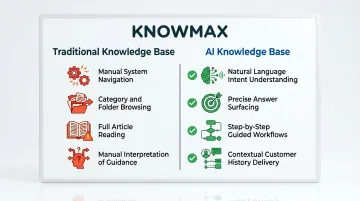
Traditional knowledge bases force agents to:
- Remember where information lives across multiple systems
- Navigate through categories and folders
- Read full articles to find relevant details
- Interpret how general guidance applies to specific customer scenarios
AI knowledge bases eliminate these steps by:
- Understanding natural language queries and customer intent
- Surfacing precise answers without requiring agents to know where to look
- Providing step-by-step guided workflows for complex resolution paths
- Delivering contextual information based on customer history and current interaction
The Productivity Difference
Generic AI adoption typically focuses on automation, eliminating repetitive tasks entirely. AI knowledge bases take a different approach: they accelerate decision-making and reduce errors for complex, judgment-dependent work that can't be fully automated.
This distinction matters because customer-facing roles across industries involve nuanced decisions, compliance requirements, and situational problem-solving. An AI knowledge base doesn't replace the agent — it makes the agent measurably more effective.
A 2024 industry analysis found that AI-powered knowledge platforms can reduce search time by up to 65% while cutting call volume by up to 40% through improved self-service. According to Gartner, agent enablement tools (including AI-generated summaries and real-time knowledge retrieval) save agents significant time without compromising accuracy.
Industries Seeing the Biggest Productivity Gains from AI Knowledge Bases
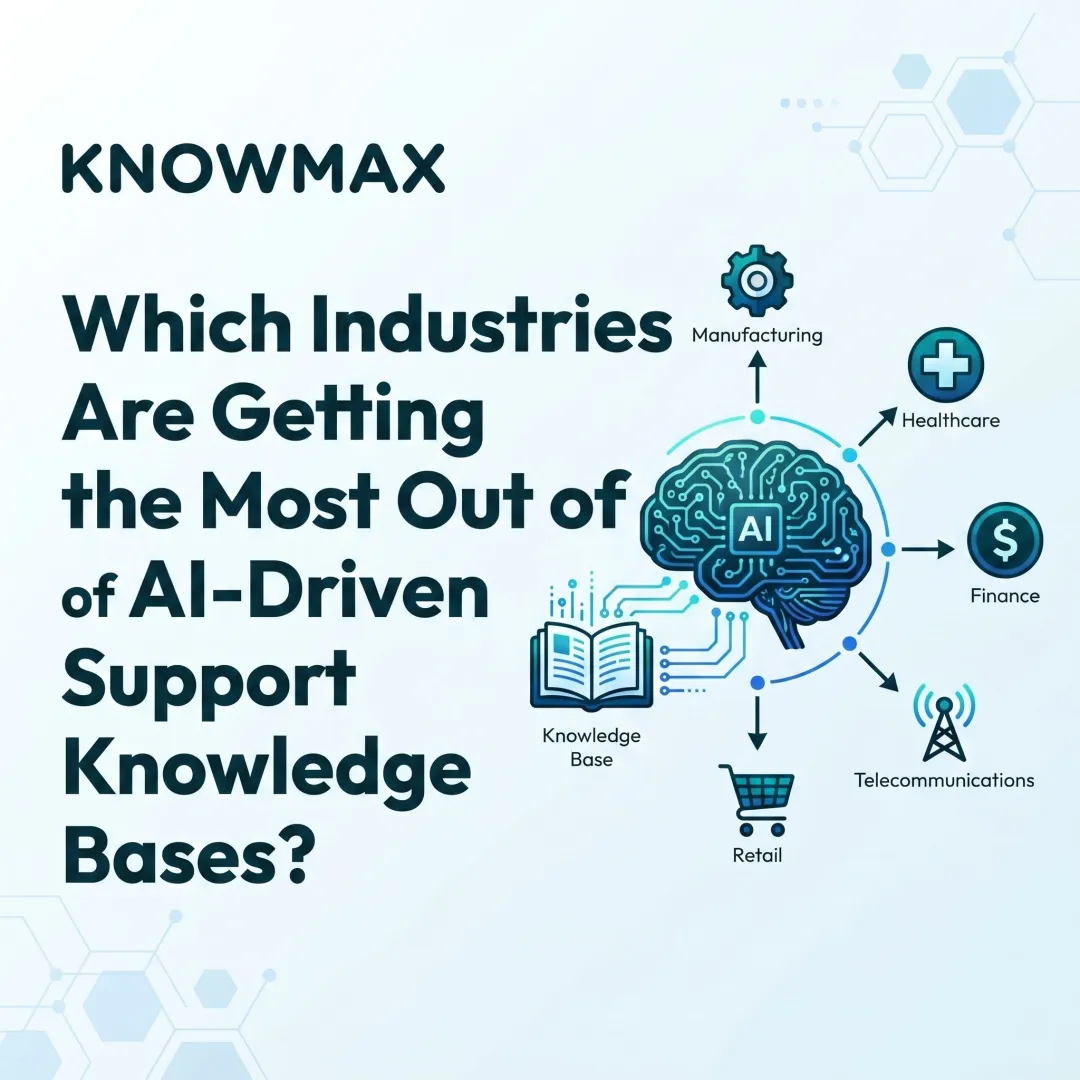
The industries listed below share three characteristics: massive volumes of customer interactions, deep and frequently changing product knowledge, and high costs associated with agent errors or slow resolution.
Telecom & Broadband
Telecom represents the highest-gain industry for AI knowledge bases. Agents navigate thousands of device configurations, service plans, network troubleshooting scenarios, and regulatory requirements. Knowledge fragmentation here is extreme, and providing the wrong answer creates immediate customer impact.
Why Telecom Sees Exceptional Gains:
The structural challenge is clear in the data. In 25 years of benchmarking, no telecom company has ever achieved the 80% "world-class" First Call Resolution standard. Telecom contact centers run the highest Average Handle Time among major industries — 8 to 10 minutes compared to a cross-industry average of roughly 6 minutes.
AI knowledge bases with structured device repositories and visual troubleshooting guides directly address this gap. For example, Knowmax's Ready Repository of 18,000+ devices provides telecom operators like Vodafone, Airtel, and Etisalat with comprehensive device-specific guides that agents can access instantly during live calls, eliminating manual searches through fragmented documentation.
Documented Productivity Improvements:
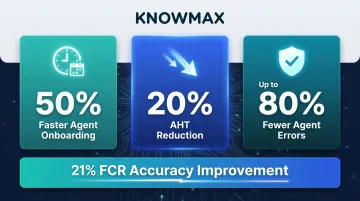
A leading telecom operator in India achieved a 21% improvement in FCR accuracy using Knowmax's AI-powered knowledge management tools. Vodafone reported measurable drops in AHT that contributed directly to enhanced customer satisfaction scores.
One ResultsCX case study documented 50% faster agent onboarding, 20% AHT reduction, and up to 80% reduction in agent errors within two months of deploying AI-driven agent assist for a major telecom provider.
The Agent Onboarding Advantage:
Telecom products change constantly — new devices launch, tariffs shift, roaming agreements update. Traditional onboarding requires 4 to 8 weeks. AI knowledge bases compress this timeline by surfacing role-specific, contextual guidance instead of requiring agents to memorize product catalogs.
Knowmax addresses this through integrated learning management that combines training content with live operational knowledge. When a policy or product changes, the update flows simultaneously into both the agent knowledge base and training materials — so new hires always work from current information, not last quarter's documentation.
Banking & Financial Services
Banking contact centers face a distinct knowledge challenge: agents must deliver accurate, compliance-aligned answers across loans, account types, regulations, and fraud protocols. Errors carry financial and legal consequences.
The Compliance Dimension:
AI knowledge bases in banking aren't just about speed — they're about regulatory accuracy. Structured decision trees ensure agents follow compliant pathways for sensitive conversations like credit disputes or fraud claims, reducing errors and supervisor escalation.
According to McKinsey's research on AI-powered banking, banks investing in agent copilots and real-time knowledge tools promise 30-45% cost reductions in contact centers. However, McKinsey warns that anticipated gains frequently "fail to materialize" when AI is layered onto unredesigned processes.
Documented Outcomes:
A US credit union with $10 billion in assets identified opportunities to cut 45% of contact center costs after implementing structured AI-knowledge integration. Within the first 100 days, it achieved a 15% reduction in AHT. Within six months, the organization realized a 10% cost reduction, making the project self-funding.
Effective AI integration in banking delivers:
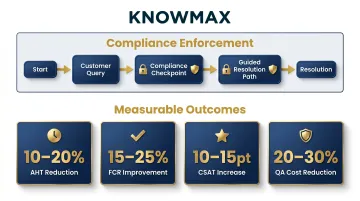
- 10-20% AHT reduction
- 15-25% FCR improvement
- 10-15 point increase in CSAT scores
- 20-30% reduction in QA costs through automated transcript monitoring
How Decision Trees Enforce Compliance:
Knowmax's decision trees convert complex SOPs and compliance scripts into interactive workflows where each step is pre-defined and interlinked with relevant content. Agents cannot skip critical compliance checkpoints, and real-time alerts flag regulatory disclosure requirements during live interactions. This approach ensures regulatory accuracy while maintaining resolution speed.
Healthcare
Healthcare presents a dual productivity opportunity: clinical staff need faster access to protocol documentation, and patient-facing support teams must resolve billing, insurance, and pre-authorization queries without repeated transfers.
The Compliance Context:
HIPAA and similar regulations mean healthcare knowledge must be accurate, version-controlled, and auditable.
Beyond accuracy, knowledge systems must enforce minimum necessary standards: agents should only see information required for their specific task, access controls must use unique user identities, and all training records must be stored for at least six years.
Productivity Impact:
Healthcare industry FCR averages between 55% and 65%. Best-in-class human contact centers reach 75%. AI-assisted voice agents regularly achieve 80-85% FCR, representing a potential 20-30 percentage point improvement through AI-assisted resolution.
Knowmax addresses healthcare-specific requirements through:
- HIPAA-compliant role-based access controls
- Version control and audit trails for all content updates
- Integration with Electronic Health Records (EHR) systems
- Real-time distribution of time-sensitive care updates across care teams
The platform's AI-powered search delivers instant answers from medical literature, clinical protocols, and internal knowledge bases — cutting the time clinical and support staff spend hunting for information before and during patient interactions.
eCommerce & Retail
eCommerce faces a unique seasonal surge challenge. Customer service volumes spike dramatically during peak periods, requiring rapid agent onboarding and consistent resolution quality across high volumes of order, return, and product queries.
The Seasonal Pressure:
Call volumes increase by 41% during Thanksgiving, Black Friday, and Cyber Monday. Meanwhile, 33% of new seasonal agents quit within their first 90 days when faced with heightened workloads. Traditional BPO onboarding takes 4-8 weeks — a timeline that doesn't fit when surge periods arrive in days.
AI knowledge bases enable faster agent ramp-up, maintain answer consistency across chat, email, and phone, and reduce ticket escalation when it matters most.
Documented Improvements:
Companies using AI-assisted knowledge tools during peak periods report a 20% increase in CSAT and 15% improvement in FCR rates. Knowmax's platform demonstrated these gains through AI-powered search that instantly surfaces contextually relevant articles and visual guides that simplify complex processes like returns and exchanges.
For eCommerce customers like Walmart, Zepto, and Majid Al Futtaim, Knowmax ensures resolution consistency by integrating directly with existing CRMs, allowing agents to access real-time customer data and knowledge without switching systems — critical during high-volume periods.
Insurance
Insurance is knowledge-intensive in a distinct way. Policy terms are complex, claims processes involve multiple steps, and agent misinformation can trigger regulatory or legal issues.
The Information Burden:
76% of insurance employees spend more than 30% of their workday searching for information. This search burden directly impacts resolution time and error rates.
Productivity Improvements:
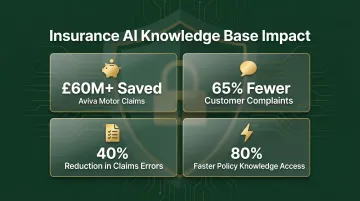
Aviva saved more than £60 million in 2024 by transforming its motor claims domain with AI. Key outcomes included:
- 65% reduction in customer complaints
- 30% improvement in routing accuracy for claims
- 23-day reduction in liability assessment time for complex claims
Across insurers using domain-level AI, McKinsey reports a 10-20% improvement in new-agent success rates and a 20-40% reduction in customer onboarding costs.
Knowmax's platform reduces costly claims and service errors by approximately 40% while accelerating policy and compliance knowledge access by around 80%. Interactive visual guides and guided workflows simplify first notice of loss, policy endorsements, and coverage explanations — turning what used to be multi-step lookups into single-screen resolutions.
What Makes an Industry Primed for the Biggest AI Knowledge Base Gains?
Three characteristics amplify productivity returns from AI knowledge bases:
1. High Knowledge Volume and Complexity
The more information agents must know, the more time they lose searching. Industries managing thousands of product SKUs, complex service configurations, or extensive regulatory requirements see the greatest reduction in search time when AI-powered retrieval replaces manual navigation.
2. Frequent Knowledge Change
Policy updates, product launches, regulatory shifts, and process changes make static documentation obsolete fast. Industries where knowledge changes weekly or monthly gain disproportionately because AI knowledge bases ensure agents always access current information without re-training delays.
3. Large Frontline Workforce with Direct Customer Impact
The more agents using the knowledge base, the greater the compounding productivity effect. A 20% AHT reduction across a 500-agent contact center delivers far more value than the same improvement in a 50-person team.
The Agent Turnover Multiplier
Industries with high agent turnover (common in Telecom, BPOs, and eCommerce) amplify gains even further. AI knowledge bases reduce re-onboarding time and cost because knowledge no longer walks out the door when agents do. New hires access the same expert-level guidance as tenured staff from day one.
The Omnichannel Advantage
Industries serving customers across voice, chat, email, and self-service channels face a compounding problem: inconsistent answers across channels drive repeat contacts and erode trust. An AI knowledge base that distributes the same content across every channel simultaneously eliminates that risk. Author content once, and agents handling calls, chats, and emails all work from identical, current information — no version drift, no channel-specific gaps.
Key Productivity Metrics That AI Knowledge Bases Move
AI knowledge bases move multiple metrics at once, creating compound gains rather than isolated improvements.
Primary Metrics
Average Handle Time (AHT): Drops when agents find answers faster without toggling between systems or placing customers on hold. AHT in banking drops 10-20% when knowledge becomes instantly accessible.
First Call Resolution (FCR): Improves when guided workflows eliminate wrong answers and ensure agents follow the correct resolution path the first time. Healthcare sees 20-30 percentage point FCR improvements with AI-assisted resolution.
Agent Ramp-Up Time: Shortens when new hires access contextual, role-specific knowledge instead of memorizing documentation. Telecom operators report 50% faster onboarding with AI knowledge platforms.
CSAT/NPS: Improves as a downstream effect of faster, more accurate resolution. Banking organizations report 10-15 point CSAT increases after implementing AI knowledge integration.
The Compound Effect
The most meaningful productivity signal is the compound effect across metrics. Every 1% improvement in FCR yields $286,000 in annual savings and a 1.4-point NPS increase for a typical midsize call center. When FCR is achieved, 95% of customers continue doing business with the organization.
Lower AHT means agents handle more contacts per shift. Higher FCR cuts repeat call volume. Together, these outcomes reduce staffing pressure without compromising service quality — a critical factor for any operation managing cost-per-contact.
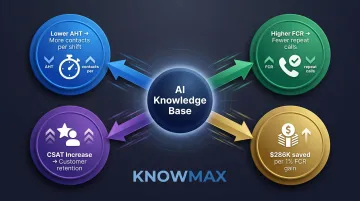
McKinsey's research confirms that effective AI-knowledge integration drives simultaneous improvements across all major metrics: AHT reduction, FCR improvement, CSAT increase, and QA cost reduction.
Conclusion
The industries capturing the biggest productivity gains from AI knowledge bases are those where knowledge is the bottleneck — not effort or headcount. In Telecom, Banking, Healthcare, Insurance, and eCommerce, resolving a single interaction correctly the first time has measurable financial and customer impact.
Evaluate your industry against these characteristics:
- Do agents navigate thousands of product configurations or complex regulatory requirements?
- Does your knowledge change frequently through policy updates or product launches?
- Do you manage a large frontline workforce across multiple channels?
- Is agent turnover creating repeated onboarding costs?
If you answered yes to two or more, AI knowledge bases represent a high-ROI productivity lever. The next step is finding a platform built for your industry's specific knowledge complexity — not a generic solution.
Knowmax serves organizations across Telecom, Banking, Healthcare, Insurance, eCommerce, and BPO operations with an AI-powered knowledge management platform that includes guided decision trees, visual troubleshooting guides, and AI-powered search across 25+ languages. Schedule a demo to see how these capabilities map to your operation's specific challenges.
Frequently Asked Questions
Which industries benefit most from AI?
Industries with complex, high-volume customer interactions — Telecom, Banking, Healthcare, Insurance, and eCommerce — benefit most when AI is applied specifically to knowledge access and guided resolution. The gains come from eliminating search time and resolution errors.
What is an AI knowledge base, and how does it differ from a regular knowledge base?
A regular knowledge base is a static repository requiring users to search and interpret content manually. An AI knowledge base uses intent-driven search and decision trees to surface the right answer at the right step — so agents spend less time hunting for information and more time resolving issues.
How do AI knowledge bases reduce Average Handle Time (AHT) in contact centers?
AHT drops when agents no longer navigate multiple systems or guess answers. AI knowledge bases surface the correct resolution path in real time, cutting search time and reducing the need for hold or escalation — banking sees 10-20% AHT reductions through this mechanism.
Can AI knowledge bases improve agent onboarding time?
By embedding contextual, role-specific knowledge directly into agent workflows, new hires handle complex queries sooner. In knowledge-intensive industries, this cuts ramp-up from weeks to days — telecom operators report 50% faster onboarding as a result.
What metrics should companies track to measure AI knowledge base productivity gains?
Track Average Handle Time (AHT), First Call Resolution (FCR), agent onboarding duration, escalation rate, repeat contact rate, and CSAT. Gains across multiple metrics simultaneously signal true productivity improvement, not isolated changes.
Which industry has the highest ROI from AI knowledge management systems?
Telecom and Banking consistently report the highest returns from AI knowledge management. Both sectors handle massive agent interaction volumes with complex product knowledge, where slow resolution or errors carry direct, measurable costs in regulated environments. ROI scales quickly once implementation matures.