Introduction
Support teams across industries share a common problem: fragmented knowledge. Outdated manuals, inconsistent agent guidance, and procedures buried across disconnected systems all extract a measurable cost.
According to research from 8x8, contact center agents spend roughly 90 seconds per call assembling context across four different platforms — plus 10 minutes of every hour on post-call documentation and busywork.
AI-driven support knowledge bases are built to close that gap — surfacing the right information to agents and customers at the moment it's needed. The ROI, though, isn't uniform. It varies considerably by industry depending on query complexity, regulatory pressure, and call volume. This article examines which industries extract the most measurable value and why – focusing on telecom, banking, eCommerce, healthcare, and insurance as the clear frontrunners.
TL;DR
- High query volume, complex products, or strict compliance make AI knowledge bases a strong ROI investment
- Telecom, banking, eCommerce, healthcare, and insurance lead in adoption and measurable outcomes like reduced AHT and improved FCR
- The real advantage isn't just speed – it's consistent answers across every agent and channel, directly impacting customer trust
- The biggest gains come when AI replaces reactive manual searches with proactive, context-driven guidance
What Is an AI-Driven Support Knowledge Base?
An AI-driven support knowledge base is a centralized, intelligent system that uses natural language processing, semantic search, and guided workflows to surface the right information to agents or customers at the point of need — without manual searching through outdated documents.
The difference from traditional systems is significant:
- Traditional knowledge bases rely on static pages, keyword search, and manual updates — with no sense of what an agent needs mid-conversation
- AI-driven platforms learn from usage patterns, auto-update content, and proactively push relevant articles based on what's being discussed in real time
That capability shift is what makes these platforms valuable across industries. Knowmax, for instance, structures knowledge into decision trees, visual guides, and AI-authored articles — powering both agent-assisted and self-service channels from a single system. It connects directly with CRMs like Salesforce and Zendesk, so agents get answers inside the tools they already use rather than switching between screens.
What Makes an Industry Ready to Benefit?
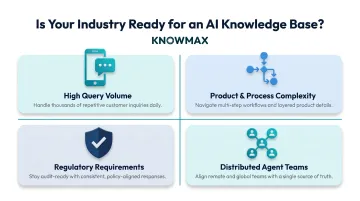
The core characteristics that make an industry a high-ROI fit for AI knowledge bases include:
- High inbound query volume – more interactions mean more opportunities to reduce handle time
- Product/process complexity – intricate workflows demand accuracy and consistency
- Regulatory requirements – compliance mandates create zero tolerance for errors
- Distributed agent teams – knowledge gaps across locations and shifts are costly
Industries with long average handle times, high agent onboarding costs, or significant compliance exposure see the fastest, most measurable returns. The economics make this concrete: every 1% improvement in First Call Resolution yields approximately $286,000 in annual savings for a typical midsize call center — and agent errors drive 38% of repeat calls, while organizational knowledge failures account for another 49%.
Those savings compound when knowledge is consistent across every channel. AI knowledge bases that surface the same answer on chat, voice, email, and social eliminate one of the most common sources of customer frustration: conflicting information depending on how someone reaches out.
Industries Getting the Most Out of AI-Driven Support Knowledge Bases
Telecom & Broadband
Telecom leads adoption because contact centers handle massive daily volumes of technical and billing queries across diverse product lines – mobile, broadband, enterprise. Agents must navigate device troubleshooting, plan changes, network issues, and regulatory disclosures with zero margin for inconsistency.
The specific impact:
AI knowledge bases with visual troubleshooting guides and decision trees reduce supervisory escalation, cut AHT on technical calls, and ensure every agent can handle complex device or connectivity queries from day one. Telecom currently achieves only 62% average FCR – 13 points below the 75% cross-industry average – leaving enormous improvement headroom.
Device-specific guidance is a critical differentiator. In telecom, one-size-fits-all knowledge fails — the resolution path for a Samsung differs entirely from an iPhone or a broadband router. Knowmax's ready repository of 18,000+ devices gives agents model-specific troubleshooting workflows instantly.
Agent onboarding advantage:
Telecom experiences notoriously high contact center attrition at 30-35% annually. AI knowledge bases with guided workflows dramatically reduce new hire ramp time, allowing agents to perform accurately from week one rather than month three. Knowmax's integrated Learning Management System has reduced time to proficiency by up to 40% in telecom deployments.
Omnichannel dimension:
Telecom customers now interact via app, WhatsApp, chat, IVR, and live agent. AI knowledge bases that maintain consistent guidance across all these surfaces prevent conflicting answers — one of the most common causes of repeat contacts. Only 14% of customer service issues are fully resolved through self-service currently, exposing a large gap between digital preference and actual resolution capability.
Banking & Financial Services
Banking is a top adopter because financial services agents must deliver accurate, compliant guidance without slowing down. A misquoted rate, an incorrectly processed claim, or a compliance gap can carry real legal and financial consequences — the stakes are higher here than in almost any other support environment.
Compliance-driven use case:
AI knowledge bases in banking serve as a real-time compliance guardrail – ensuring agents deliver only approved, up-to-date information on products like loans, credit cards, and investment accounts. Any policy change is reflected instantly across all agents, eliminating the lag that causes errors.
Global regulatory fines reached $6.6 billion in 2023 for AML, KYC, and sanctions violations – a 57% increase from 2022. The compliance risk mitigation alone builds a compelling business case for AI knowledge management.
FCR improvements:
Account inquiries, fraud disputes, loan status, and KYC requirements are among the highest-volume contact reasons. When agents have guided resolution paths instead of searching across siloed systems, FCR improves and escalation rates drop. Banking FCR targets typically range from 70-75%, with AHT benchmarks at 4-6 minutes.
Digital and self-service banking:
AI knowledge bases don't just empower agents — they power chatbots and self-service portals with consistent, compliant information. The gap between digital preference and digital resolution is significant:
- 76% of bank customers prefer digital channels (54% mobile, 22% online)
- Only 14% of service issues are fully resolved through self-service
- AI knowledge bridges this gap with accurate, contextual answers at every touchpoint
eCommerce & Retail
eCommerce experiences extreme seasonal volatility – peak sales and promotional events cause sudden spikes in support volume. Queries range from order status and returns to product compatibility and payment failures: diverse, high-volume, and time-sensitive.
Support volume increased 22% per agent during November 2025 peak season, with QA processes designed for 1,000 tickets per week scaling to 5,000. Brands that planned early saw CSAT improve 32%; late planners suffered high churn and burnout.
Agent empowerment:
In eCommerce, agents often support multiple brands or seller accounts simultaneously. AI knowledge bases that surface contextually relevant policies and resolution paths based on query type reduce average resolution time and errors, especially for new or part-time agents hired during peak periods.
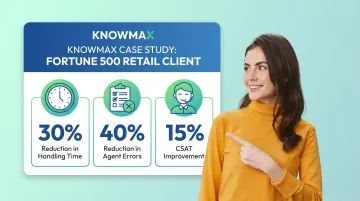
Knowmax helped a Fortune 500 retailer achieve a 13% reduction in handling time, 30% reduction in agent error, and 11% improvement in CSAT through AI-powered knowledge flows and seamless CRM integration.
Self-service dimension:
eCommerce customers strongly prefer self-service for routine queries. AI knowledge bases that power customer-facing help centers with intelligent search and dynamic FAQ content deflect a significant percentage of contacts, directly reducing operational costs. Knowmax has demonstrated 60% query deflection rates in customer engagements.
Peak-period consistency:
Knowledge consistency at scale is the differentiator between peak-season profit and peak-season churn. AI knowledge bases with real-time updates ensure that promotional terms, shipping policies, and return procedures remain accurate across all channels – even when policies change hourly during flash sales.
Healthcare
Patient support teams, hospital helpdesks, and health insurance contact centers deal with queries that require both speed and absolute accuracy. Incorrect information about coverage, appointments, medications, or claims can have serious consequences for patients.
The current state:
Healthcare contact centers achieve only 52% FCR – well below the 70-79% industry standard. Average handle time is 6.6 minutes, with average hold time of 4.4 minutes. For a 350-agent center, the cost per call averages $4.90, totaling approximately $128,625 per day.
Compliance and sensitivity:
Healthcare organizations operate under HIPAA regulations that require strict documentation and data handling. HIPAA penalties range from $145 to $2,190,294 per violation, with 21 settlements or civil monetary penalties in 2025 alone.
Knowmax's HIPAA certification enables healthcare organizations to maintain compliant, auditable knowledge bases with role-based access control — separating clinical guidance from administrative resolution paths so agents work only within their designated scope.
Agent support value:
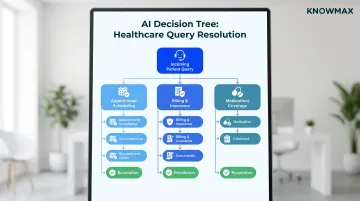
Healthcare contact center agents are often not clinically trained. AI-guided decision trees and scripted resolution paths allow them to handle a wide range of queries accurately without requiring deep clinical knowledge. This reduces dependency on specialized staff for common questions about appointment scheduling, billing, or insurance coverage.
Insurance
Insurance is one of the most knowledge-intensive support environments. Agents must navigate complex policy terms, claims procedures, premium calculations, and regulatory disclosures that vary by product type, region, and customer profile.
Claims handling impact:
When agents can surface the exact policy clause, the correct claims process, and the next-best action within seconds, call duration drops and customer confidence in the resolution increases. Claims-related calls achieve only 61% FCR versus 73% for general inquiries, with AHT of 7-10 minutes driven by verification and compliance processes.
47% of insurance inquiries occur outside business hours, making always-on AI knowledge especially valuable. Self-service portals powered by AI knowledge bases allow policyholders to access coverage details and claims filing guides 24/7, reducing the burden on contact centers.
Customer satisfaction:
J.D. Power's 2025 U.S. Auto Claims Satisfaction Study showed an overall score of 700 out of 1,000. For customers facing rate increases, that score dropped to 650 — a 104-point gap that tracks directly to how well agents explain policy changes. When agents communicate clearly and consistently, trust holds even in difficult conversations.
AI knowledge bases ensure agents consistently deliver compliant, accurate explanations of policy changes, claims processes, and premium adjustments – maintaining trust even during difficult conversations.
What These Industries Have in Common
The industries seeing the highest returns from AI-driven support knowledge bases share a common pattern: they recognize that faster answers alone are not enough. They need consistently correct answers at scale, across every agent and every channel.
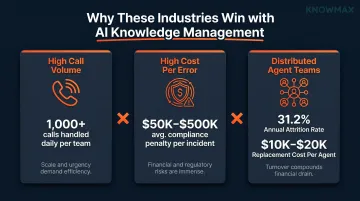
The structural advantage these industries share comes down to three compounding factors: high call volume × high cost per error × distributed agent teams. The numbers behind each factor show why:
- Agent attrition has climbed to 31.2% annually, with true replacement cost of $10,000-$20,000 per agent
- New agents require approximately 90 days to reach full productivity
- AI knowledge tools that cut ramp time by 20-30% directly reduce the $713,000 annual turnover cost in a 100-seat center
These industries also share regulatory or reputational risk that makes knowledge consistency non-negotiable. A wrong answer in banking triggers compliance exposure. In healthcare, it risks patient safety. In insurance, it creates claims disputes. That's why these organizations aren't treating AI knowledge management as an efficiency project — they're treating it as a risk control mechanism.
Conclusion
The industries extracting the most value from AI-driven support knowledge bases have recognized that the right AI knowledge management platform should be built with industry context in mind — supporting the specific workflows, compliance requirements, and content structures that each vertical demands, not a generic platform built for no industry in particular.
Each vertical covered in this guide has distinct requirements:
- Telecom — device-specific troubleshooting across 18,000+ models
- Banking — instant policy updates with full audit trails
- eCommerce — elastic scalability during peak seasons
- Healthcare — HIPAA-compliant, role-based content access
- Insurance — claims-specific decision trees with regional regulatory content
These aren't niche edge cases — they're the baseline expectations for enterprise contact centers operating at scale. Knowmax is built around this reality.
Its modular capabilities — decision trees, visual guides, AI-authored content, omnichannel deployment, and an integrated LMS — address the demands of each vertical while maintaining the consistency and compliance that regulated industries require. For contact centers measuring performance through FCR, AHT, and CSAT, that specificity is what separates a platform that fits from one that doesn't.
Frequently Asked Questions
Which industries benefit most from AI-driven service?
Telecom, banking, eCommerce, healthcare, and insurance lead in AI-driven service adoption because of high query volumes, product complexity, and strict compliance requirements. These conditions create environments where consistent, AI-guided knowledge delivery generates measurable ROI through reduced errors and faster resolutions.
What is an AI-driven support knowledge base?
An AI-driven support knowledge base is an intelligent, centralized system that uses NLP and semantic search to surface accurate, context-aware answers in real time. It replaces manual searching through static documents with proactive, intent-based knowledge delivery for both agents and customers.
How does an AI knowledge base reduce average handle time in contact centers?
AI knowledge bases proactively surface the right resolution path, decision tree, or policy clause based on query context — eliminating mid-call searching entirely. Agents respond without toggling screens or consulting supervisors, which closes queries faster.
Can AI knowledge bases help with agent training and onboarding?
AI knowledge bases with guided workflows and decision trees significantly reduce new hire ramp time. New agents handle complex queries accurately from day one, with guidance embedded directly in their workflow rather than stored in memory.
What features should an AI support knowledge base include?
Core features to look for:
- Intent-based AI search and semantic query understanding
- Interactive decision trees and visual troubleshooting guides
- Omnichannel delivery across agent desktop, self-service, and chatbot
- Role-based access, real-time content updates, and CRM/ticketing integrations