Introduction
Ecommerce support volumes are growing faster than teams can scale. 70% of service leaders expect case volumes to increase over the next year, yet service agents spend only 46% of their time actually helping customers — the rest is lost to admin tasks and searching for answers. Peak sale seasons, high return rates (19.3% of online sales will be returned in 2025), and customer expectations for immediate resolution are breaking traditional support models.
AI-powered knowledge management is the lever top retailers are pulling to close that gap. An AI knowledge management system centralises product information, return policies, troubleshooting steps, and workflows — then surfaces the right answer to the right person, exactly when they need it.
TLDR:
- Ecommerce support is uniquely hard to scale due to unpredictable volume spikes, constantly changing product catalogues, and fragmented knowledge across channels
- AI-powered KM platforms reduce agent handle time, improve first-contact resolution, and enable consistent omnichannel experiences
- Highest-impact use cases include agent assist, self-service deflection, peak season scaling, returns handling, and multilingual support delivery
The Ecommerce Support Problem: Scale, Speed, and Knowledge Gaps
Ecommerce support is uniquely difficult to scale. High ticket volumes spike unpredictably during flash sales, Black Friday, and holiday seasons. Product catalogues change constantly — new SKUs launch, pricing updates daily, and shipping policies vary by region. Returns and logistics queries require precise, up-to-date information that changes with promotions and inventory levels. Customers expect resolution in minutes, not hours.
The knowledge gap issue makes this harder to manage. Agents working across chat, email, phone, and social often pull from inconsistent, scattered information:
- Outdated SOPs buried in shared drives
- Product FAQs sitting in email threads
- Policies that differ by channel or market
- Troubleshooting guides agents can't find under pressure
When a retailer grows from 50 to 500 agents, or expands from one country to five, knowledge fragmentation multiplies. Seasonal staffing exposes how dependent support quality is on individual agent experience rather than institutional knowledge.
With 147 hours of training required for new agents, every gap in documented knowledge slows hiring cycles and raises the cost of scaling — which is exactly why more retailers are turning to structured knowledge management to replace tribal expertise with consistent, findable information.
What Knowledge Management Does for Ecommerce Support Teams
A knowledge management system in ecommerce support is the centralised structured layer that captures, organises, and delivers the right information — product details, return policies, troubleshooting steps, escalation workflows — to agents and customers at the moment of need. It's not a generic wiki or help centre; it's an operational system designed to drive measurable performance outcomes.
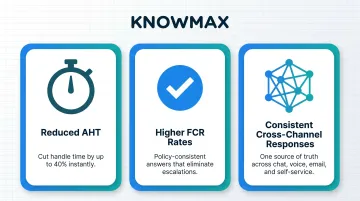
A well-implemented KM system delivers three core outcomes:
- Reduced AHT: AI-powered search surfaces the right article, decision tree, or workflow in seconds — agents stop hunting across multiple systems
- Higher FCR rates: Agents deliver precise, policy-consistent answers the first time, cutting escalations caused by incomplete information
- Consistent cross-channel responses: One source of truth means the same answer across chat, voice, email, and self-service — eliminating the "I was told something different" complaints that drive repeat contacts
That last point connects directly to self-service. A KM system powers customer-facing help centres and chatbots, deflecting high-volume, low-complexity queries before they reach an agent:
- Order tracking
- Return initiation
- Delivery windows
- Sizing questions
- Payment options
Only 14% of customer service issues are fully resolved in self-service, with 43% of failures attributed to customers being unable to find relevant content. The cost difference is significant: Gartner benchmarks median cost per contact at $1.84 for self-service versus $13.50 for assisted channels. Even modest improvements in self-service resolution rates yield substantial cost savings at ecommerce scale.
How AI Supercharges Knowledge Management in Ecommerce
Traditional KM systems fall short in ecommerce environments. Static FAQs become outdated within weeks. Keyword search fails when customers phrase questions conversationally ("where is my stuff" vs. "order tracking status"). Agents still dig through articles manually rather than getting step-by-step guidance. AI addresses each of these gaps directly.
Intent-Based Search
AI-powered search understands intent, not just keywords. A customer asking "where is my package" and "track my order" map to the same answer — no disambiguation needed.
Natural language processing handles vague queries and typos, returning precise answers in seconds. That alone reduces agent frustration and improves self-service deflection rates.
Guided Resolution Workflows
Interactive decision trees walk agents through complex, conditional scenarios:
- Return eligibility depends on product category, purchase date, and item condition
- Refund processing varies by payment method and return window
- Exchange workflows differ for damaged goods versus wrong-size orders
These workflows reduce agent error and eliminate the need to memorize policy edge cases — valuable for onboarding new or seasonal agents quickly.
AI-Assisted Content Authoring
Knowledge teams can create, update, rephrase, and auto-translate articles faster with AI authoring tools. Knowmax, for instance, lets teams summarize lengthy articles, adjust tone with one click, and translate content into 25+ languages — useful when product lines change seasonally and return policies shift frequently.
Multilingual capabilities matter for regional ecommerce players. Southeast Asia ecommerce GMV reached $159 billion in 2024, with a 1.4x increase in local-language searches since 2020. AI auto-translation allows content to be created once and deployed across markets, maintaining consistency without duplicating effort.
Integrated Knowledge Delivery
AI knowledge management connects directly to the broader support stack — CRM, ticketing, chatbots, and CCaaS platforms. Knowledge surfaces in context: inside the agent's CRM view, within a chatbot flow, or on a self-service portal.
Agents don't switch tabs or copy-paste answers. What they need appears where they're already working.
Key Use Cases Where AI-Powered KM Delivers the Most Impact
Agent Assist for Complex Queries
AI KM surfaces step-by-step resolution guides directly within the agent desktop for complex queries: damaged goods, multi-item returns, payment disputes. Decision-tree guided workflows break these scenarios into clear actions, reducing AHT and error rates. Newer agents reach competency faster because they're guided by the system, not relying on shadowing experienced staff.
Platforms like Knowmax integrate natively with Salesforce, Zendesk, and Genesys, delivering knowledge in real time without screen toggling. This is where decision trees have the highest leverage — conditional logic ensures agents follow the right path based on product type, purchase date, or customer tier.
Omnichannel Self-Service Deflection
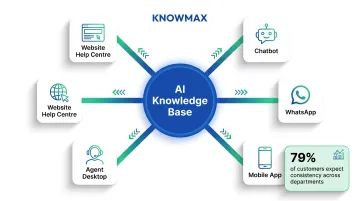
A single, centralised knowledge base powers self-service across the website help centre, chatbot, WhatsApp, and mobile app. Customers get consistent answers regardless of channel, reducing repeat contacts caused by conflicting information.
79% of customers expect consistency across departments, yet 56% have to repeat information to different representatives. AI KM eliminates this gap by ensuring every touchpoint pulls from a single source — cutting the repeat contacts that inflate handle times and frustrate customers.
Peak Season Support Scaling
AI KM enables retailers to scale support during high-volume periods — Black Friday, Diwali, Ramadan sales — without proportional headcount increases. 65% of organisations faced significant staffing challenges during peak season, despite pre-season planning.
With decision trees and AI search guiding every interaction, seasonal agents handle queries accurately from day one — rather than accumulating hours of classroom training before they're customer-ready.
Returns and Post-Purchase Support
Returns are one of the highest-contact-volume categories in ecommerce. An estimated 19.3% of online sales will be returned in 2025, with total retail returns projected at $849.9 billion. An AI-powered KM system ensures agents and self-service channels give accurate, policy-consistent answers on:
- Return eligibility
- Refund timelines
- Exchange processes
- Restocking fees
Decision trees codify return workflows so agents don't make discretionary errors. Customers get clear eligibility rules, reducing escalations and frustration.
Multilingual and Multi-Market Knowledge Delivery
Regional ecommerce players managing support across multiple languages face a unique challenge. Southeast Asia alone spans Indonesian, Thai, Vietnamese, Tagalog, Malay, and English — while Middle East operations typically require Arabic, English, and Urdu coverage simultaneously.
AI auto-translation and localisation within KM platforms allow content to be created once and deployed across markets. Knowmax supports 25+ languages, ensuring content remains accurate, policy-compliant, and culturally appropriate without duplicating content management effort. This is essential as consumers make 27-32 orders per year in Southeast Asia, increasing the volume of post-purchase support interactions requiring multilingual capability.
How Top Retailers Are Scaling Support with AI-Powered KM
The shift from reactive, agent-dependent support to proactive, knowledge-driven support is already underway at leading ecommerce and retail brands. Companies like Zepto, Currys, Walmart, and Majid Al Futtaim are implementing AI KM at scale, pursuing faster resolution, lower AHT, and consistent omnichannel CX.
High-growth quick commerce players like Zepto face extremely time-sensitive support queries. Product and pricing information changes daily, and the window for customer patience is short. AI KM platforms that surface accurate information to agents and chatbots in under a second keep that window from closing — a delayed or wrong answer erodes trust fast.
For omnichannel retailers like Currys and Walmart, the challenge is consistency across in-store, online, and contact centre channels. AI KM platforms that serve the same knowledge to all touchpoints eliminate the "I was told something different" problem that drives escalations and negative reviews. Walmart achieved a 13% reduction in handling time and a 30% reduction in agent error by integrating Knowmax into its CRM, ensuring agents had visual guides and AI-powered flows accessible mid-call.
What separates the retailers that scale successfully? They treat the knowledge base as a product — with defined ownership, governance, and content freshness SLAs. That means:
- Assigning knowledge owners accountable for article accuracy
- Setting SLAs for content review cycles (30, 60, or 90 days)
- Using AI tools that flag stale articles and surface suggested updates
- Running regular audits before major promotional or product cycles
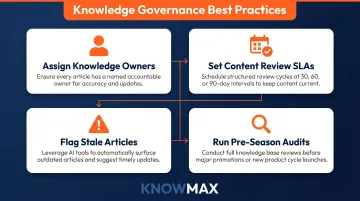
Without this governance layer, even strong AI search will surface outdated or conflicting answers — undoing the speed gains the platform was deployed to deliver.
What to Look for in an AI Knowledge Management Platform for Ecommerce
When evaluating an AI KM platform for ecommerce support, prioritise these core capabilities:
AI-powered search that understands intent, not just keywords. The platform should interpret natural language queries, handle typos, and map conversational phrases to the right answer.
Interactive decision trees for guided resolution. Complex scenarios like returns, refunds, and exchanges require conditional workflows that adapt based on product type, purchase date, or customer tier.
Content authoring tools with AI-assisted creation and auto-translation. Look for platforms that help teams create, rephrase, summarise, and translate content quickly — essential when product lines and policies change frequently.
Omnichannel delivery that surfaces the same knowledge base across agent desktop, chatbot, self-service portal, and mobile app — no duplication, no version drift.
Integration depth with the CRM, ticketing system, and chatbot infrastructure your team already uses. Native integrations — with platforms like Salesforce, Zendesk, Freshworks, and Genesys — surface knowledge in-context within existing agent workflows. A KM platform that forces agents to switch tabs or copy-paste answers creates friction that offsets any efficiency gains.
Governance and scalability features ensure the knowledge base stays accurate as the catalogue, policies, and team grow. Look for:
- Analytics on knowledge usage (what articles are searched most, what searches return no results)
- Content freshness indicators that flag stale articles
- Role-based publishing workflows so only approved content goes live
Without governance in place, even a well-built knowledge base degrades quickly — especially during peak seasons when content changes outpace review cycles.
Frequently Asked Questions
What is the relationship between e-commerce and knowledge management?
Knowledge management in ecommerce involves capturing, organising, and delivering product, policy, and process information to agents and customers. This directly improves support quality, reduces resolution times, and enables consistent experiences across channels.
What is a knowledge-based system in e-commerce?
A knowledge-based system in ecommerce is a centralised platform that stores and delivers structured information — such as FAQs, decision trees, and policy documents — to support agents and self-service tools. The goal is accurate, consistent resolution of customer queries across every channel.
What CMS is best for e-commerce?
A CMS manages storefront and product pages, while a Knowledge Management System handles support and agent-facing content. For customer support and contact centre use cases, a purpose-built KMS with AI capabilities is more appropriate than a generic CMS.
What are the key components or principles of e-commerce?
The key pillars are product discovery, transaction processing, fulfilment, and customer support. Knowledge management underpins the support pillar by ensuring agents and self-service channels have accurate, accessible information when customers need it most.
What are the 4 types of e-commerce?
The four types are B2C, B2B, C2C, and D2C. Customer support complexity and knowledge management requirements differ across each model — for example, B2C ecommerce typically handles the highest volume of post-purchase support queries.