Introduction
Picking the wrong Gen AI customer support platform doesn't just waste budget — it actively damages customer experience and erodes agent trust. The global Call Center AI market is projected to grow from $1.6 billion in 2022 to $4.1 billion by 2027 at a 21.3% compound annual growth rate. Investment is surging. Outcomes are not keeping pace.
The right platform affects metrics that matter: First Call Resolution rates, average handling time, agent productivity, compliance exposure, and long-term scalability. Get it wrong, and you risk joining the 39% of customer service chatbots that required rework due to hallucination-related failures.
The cost of hallucination failures alone reached an estimated $67.4 billion in global business losses in 2024 — yet 85% of customer service leaders are still exploring or piloting Gen AI solutions in 2025. The pressure to adopt is real. So is the pressure to get it right. This guide gives you the specific evaluation criteria to make a defensible decision before you sign.
TLDR
- Gen AI customer support platforms combine LLMs with knowledge bases to handle complex queries across channels
- Technology differs from rule-based chatbots through contextual understanding and open-ended conversation capabilities
- Evaluate knowledge management depth, hallucination controls, integration capabilities, compliance certifications, and total cost before buying
- Red flags: black-box AI with no explainability, missing human-in-the-loop escalation, vague implementation timelines
- Knowmax delivers structured, AI-ready knowledge across every channel, backed by SOC 2, GDPR, HIPAA, and ISO 27001 certifications
What Is a Gen AI Customer Support Platform?
A Gen AI customer support platform is a software solution that uses large language models (LLMs) and generative AI to understand customer intent, retrieve relevant knowledge, and generate or suggest contextually accurate responses across support channels. Unlike rules-based chatbots that answer only pre-programmed questions, Gen AI platforms interpret unstructured, nuanced queries and produce original responses grounded in company knowledge.
The difference is measurable. Klarna's Gen AI assistant achieved 2-minute average resolution times versus 11 minutes for human-led interactions, with a 25% drop in repeat inquiries. H&M's generative AI chatbot reduced response times by 70% compared to human agents. Those results, though, depend on more than a capable LLM.
Core Capabilities of a Gen AI Customer Support Platform
Three functional layers make these platforms work:
- The LLM or foundation model — interprets intent and generates language
- The knowledge layer — grounds responses in factual company information from knowledge bases, CRM systems, and documentation
- The delivery layer — routes responses across channels including chat, voice, email, and agent desktops
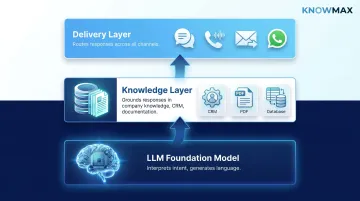
Without a reliable knowledge layer, even the most advanced LLM will hallucinate. 77% of teams cite data quality or availability as the biggest obstacle to efficient AI implementation. Your knowledge management infrastructure determines AI accuracy more than the model itself.
Key Use Cases Driving Adoption
The most impactful use cases buyers should understand:
- AI-powered self-service bots for FAQs and common queries
- Real-time agent assist with suggested responses and next-best-action recommendations
- Automated post-call summarization and ticket documentation
- Knowledge gap detection to identify where content is missing or outdated
- Multilingual support delivery across global customer bases
Each of these use cases points to the same performance gap. Gartner finds that only 14% of customer issues resolve through traditional self-service channels, yet McKinsey reports 40–50% reduction in customer service interactions from AI deployments. That spread — 14% resolution today versus 40–50% deflection with AI — is where the real business case lives.
Key Factors to Evaluate Before You Buy
Evaluating a Gen AI customer support platform requires connecting technical specifications to operational outcomes — not just comparing feature lists. The right factors to assess vary by industry complexity, compliance requirements, existing tech stack, and interaction volume.
Knowledge Management Foundation
The quality of the underlying knowledge layer is the single most determinative factor in Gen AI accuracy. If your knowledge base is outdated, unstructured, or siloed, the AI will generate unreliable responses regardless of LLM sophistication. This pattern appears repeatedly in enterprise POCs where platforms underperform because the LLM lacks access to proprietary product or policy documentation.
Before shortlisting any platform, verify:
- Does it include tools to create, maintain, and structure knowledge content?
- Does it support AI authoring capabilities like rephrase, summarize, and auto-translate?
- Can content be scheduled, reviewed, and archived automatically?
Knowmax addresses all three: its AI author tools rephrase content for clarity, summarize lengthy articles instantly, and auto-translate into 25+ global languages. Scheduled review workflows, article expiry dates, and automated alerts for outdated content keep knowledge current without manual overhead.
AI Accuracy and Hallucination Controls
Hallucination (where the AI generates plausible-sounding but factually incorrect responses) is a documented risk in all LLM-based systems. 82% of AI bugs in production stem from hallucinations and accuracy failures. For customer-facing deployments where accuracy affects brand reputation and compliance, buyers must verify how a platform constrains the AI to approved knowledge sources.
Look for these features:
- Retrieval-augmented generation (RAG) architecture : Forrester reports that RAG can deliver "near-perfect accuracy" when grounded in clean, structured enterprise data
- Source citation in responses : traces every answer back to a specific document
- Human-in-the-loop review workflows : approval gates before responses go live
- Accuracy scoring dashboards : real-time visibility into confidence levels and error rates
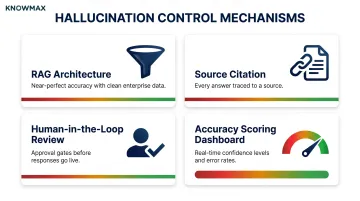
Ask vendors directly: "What happens when the AI doesn't know the answer?" Platforms without confidence-based escalation to human agents are a deployment risk.
Omnichannel Reach and Integration Depth
A Gen AI platform's value multiplies when it delivers consistent, knowledge-grounded responses across every customer touchpoint : chat, email, voice, WhatsApp, in-app. Omnichannel service boosts CSAT to 67%, compared to just 28% for multichannel approaches, according to Salesforce data. Yet 56% of customers have to repeat themselves due to disconnected support channels.
Integration depth matters more than breadth. Specifically:
- Does the platform offer pre-built, certified connectors to your CRM, telephony, IVR, and ticketing systems?
- Are these listed on vendor marketplaces like Salesforce AppExchange, Zendesk Marketplace, Genesys AppFoundry?
- Do integrations support bidirectional data flow and context continuity?
Shallow integrations requiring heavy custom development add months and tens of thousands in implementation costs. Knowmax maintains certified connectors on the marketplaces of Salesforce, Zendesk, Freshworks, Genesys, Talkdesk, and SAP , enabling deployment in days rather than quarters.
Security, Compliance, and Data Privacy
For contact centers in regulated industries (banking, healthcare, insurance, telecom) security certifications are non-negotiable. Verify whether the platform holds:
- SOC 2 Type II
- ISO 27001
- GDPR compliance
- HIPAA certification (for healthcare)
The EU AI Act Article 50 requires providers to inform users when they interact with an AI system. GDPR Article 22 gives data subjects the right not to be subject to solely automated decisions with legal effects. Compliance isn't optional : it's foundational.
When evaluating vendors, request documentation on:
- Shared-responsibility model and incident response procedures
- Data residency options and role-based access controls
- Audit logging capabilities and PII handling protocols
Knowmax holds GDPR, SOC 2, ISO 27001, and HIPAA certifications, covering enterprise security requirements across geographies.
Agent Assist vs. Full Automation Balance
Not all Gen AI platforms are designed for the same mode of deployment. Some optimise for full customer-facing automation (self-service bots), while others are built primarily to assist live agents in real time. Buyers must match the platform's design to their actual support model.
The platform should support:
- Guided resolution workflows like decision trees for complex scenarios
- Real-time suggested responses during live interactions
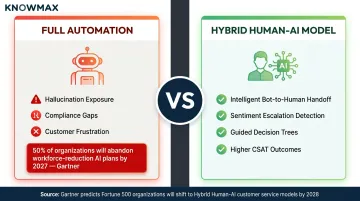
- Intelligent handoff from bot to human when confidence is low
- Sentiment-based escalation triggers
Gartner predicts 50% of organisations that expected to significantly reduce their customer service workforce will abandon these plans by 2027. None of the Fortune 500 will have fully eliminated human customer service by 2028. The data is consistent: hybrid human-AI models outperform full automation in both cost and customer satisfaction.
Scalability and Total Cost of Ownership
Upfront licensing cost is rarely the full picture. Account for:
- Onboarding and implementation fees ($25,000 to $150,000 is typical for enterprise deployments)
- Knowledge migration and content setup effort
- Ongoing model maintenance and retraining costs
- Agent training and change management
- Cost of re-configuring the platform as products and policies change
These ongoing costs add up faster than most buyers anticipate. Gartner projects that GenAI cost per resolution will exceed $3 by 2030, surpassing many offshore human agent rates as data centre costs and vendor pricing shift. "Full automation will be prohibitively expensive for most organisations," notes Patrick Quinlan, Senior Director Analyst at Gartner.
Ask vendors for reference customers in comparable industries. Assess whether the pricing model scales predictably with interaction volume growth.
Red Flags That Signal the Wrong Platform
Three warning signs should immediately disqualify a vendor from your shortlist:
Black-box AI with no explainability — If a vendor cannot explain why their platform generated a specific response, or if there's no mechanism to trace an answer back to a source document, that's unacceptable risk for customer-facing deployments. Ask vendors directly: "Can you show me a response audit trail?" If they can't demo it, assume it doesn't exist.
No structured human-in-the-loop escalation design — Platforms that route all queries to AI without well-defined escalation triggers (low confidence scores, sentiment detection, query complexity) will generate frustrated customers and compliance exposure. 95% of customer service leaders plan to retain human agents to strategically define AI's role, according to Gartner. Treat escalation logic as a primary evaluation criterion — not a configuration detail to sort out post-contract.
Vague implementation timelines and no onboarding framework — A vendor who cannot provide a clear deployment roadmap, a defined knowledge migration plan, and documented onboarding milestones signals immature enterprise readiness. Enterprise deployments with structured onboarding typically run 8–16 weeks — scope varies by knowledge base readiness and integration complexity, but any vendor unable to give you a range upfront is worth questioning.
How Knowmax Can Help
Knowmax is an AI-powered knowledge management platform built as the knowledge foundation that Gen AI customer support platforms depend on. Contact centers, BPOs, and enterprise CX teams use it to create, manage, and deliver accurate knowledge across every assisted and digital channel.
The result: fewer agent errors, shorter handling times, and measurable gains in First Call Resolution.
Key differentiators for buyers evaluating Gen AI platforms:
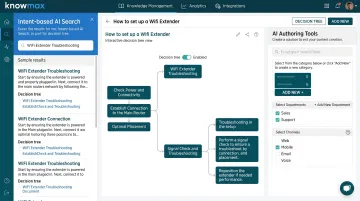
- Intent-based AI search that surfaces answers based on what users actually need, not just keyword matches
- Interactive decision trees that guide agents through complex issue resolution step by step
- AI authoring tools to create, rephrase, summarize, and auto-translate content across 25+ languages
- A ready device repository covering 18,000+ devices for Telecom and Broadband support teams
- Native integrations listed on the Salesforce, Zendesk, Freshworks, Genesys, Talkdesk, and SAP marketplaces
Knowmax is certified for GDPR, SOC 2, ISO 27001, and HIPAA — covering the compliance requirements most enterprise buyers in regulated industries encounter. Its track record spans Telecom, Banking, Insurance, eCommerce, and Healthcare, with global brands including Vodafone, Airtel, Walmart, CIMB, and Concentrix already on the platform.
Conclusion
The goal in buying a Gen AI customer support platform is not to choose the most heavily marketed tool. Choose the platform that aligns with your support model, your compliance requirements, your existing tech stack, and the quality of your underlying knowledge infrastructure.
Gen AI in customer service is not a one-time implementation. Re-evaluate your platform periodically as LLM capabilities evolve, customer expectations shift, and knowledge bases grow. Treat the buying decision as the start of an ongoing evaluation process, not a one-time milestone. The vendors who invest as seriously in knowledge management as they do in AI models are the ones most likely to deliver measurable, lasting results.
Frequently Asked Questions
What is GenAI for customer service?
Gen AI for customer service uses large language models to understand customer intent, retrieve relevant information, and generate contextually accurate responses across both automated self-service and live agent assistance channels. Unlike traditional automation, it handles open-ended, unstructured queries rather than only pre-programmed inputs.
What features should I look for in a Gen AI customer support platform?
Critical features include knowledge management and AI authoring tools, hallucination controls like RAG architecture and source grounding, omnichannel delivery capabilities, human-in-the-loop escalation design, pre-built CRM and telephony integrations, and enterprise security certifications such as SOC 2, ISO 27001, GDPR, and HIPAA.
How do Gen AI customer support platforms handle data security and compliance?
Reputable platforms hold certifications such as SOC 2, ISO 27001, GDPR, and HIPAA, and include role-based access controls, PII redaction, audit logging, and data residency options. Verify these certifications before shortlisting any vendor — this is non-negotiable in regulated industries like banking, healthcare, and insurance.
What is the difference between a Gen AI chatbot and a traditional rule-based chatbot?
Rule-based chatbots follow pre-programmed decision trees and can only answer questions they were explicitly trained on, while Gen AI chatbots use LLMs to interpret open-ended, unstructured queries and generate contextual responses grounded in connected knowledge sources. Gen AI adapts to conversational nuance; rule-based bots cannot.
How long does it take to implement a Gen AI customer support platform?
Implementation typically runs 8–16 weeks for enterprise deployments, depending on knowledge base readiness, integration complexity, and platform maturity. Ask vendors for a documented onboarding roadmap and reference timelines from comparable deployments.
What metrics should I track to measure ROI from a Gen AI customer support platform?
Primary KPIs include First Call Resolution (FCR) rate, Average Handling Time (AHT), self-service containment rate, CSAT scores, agent onboarding time, and cost per interaction. Baseline measurements should be taken before deployment to enable meaningful comparison and demonstrate ROI.