Introduction
In 2026, organizations face two fundamentally different paths for deploying AI in customer service: building and operating their own AI software stack, or outsourcing AI-augmented operations to a BPO partner. The choice shapes your control over customer data, your ability to adapt to product changes, your cost structure at scale, and whether you're building long-term AI capability or paying for someone else's.
This guide breaks down both models across the decisions that actually matter — data ownership, cost trajectory, speed of change, and where each approach fails.
91% of customer service leaders report executive pressure to implement AI in 2026, a sharp acceleration from prior years. At the same time, over 80% of organizations expect to reduce agent headcount through attrition or hiring pauses.
Choosing the wrong delivery model now means rebuilding under pressure later — a costly mistake when competitors are moving fast.
TL;DR
- AI software = platform your team owns and operates; AI BPO = managed service where a provider runs AI and human agents on your behalf
- AI software delivers lower per-resolution costs ($0.50–$1.50 vs $2.00–$3.00+ for BPO) and full data ownership
- AI BPO offers faster deployment and built-in human escalation without requiring internal AI operations staff
- The right choice hinges on your internal capabilities, volume scale, and whether AI is a core competency you want to own
AI Software vs AI BPO: Quick Comparison
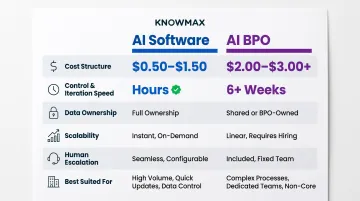
| Dimension | AI Software | AI BPO |
|---|---|---|
| Cost Structure | Per-seat or usage-based; $0.50–$1.50/resolution | Blended per-contact; $2.00–$3.00+/resolution |
| Control & Iteration Speed | Direct control; updates deployed in hours | Vendor-dependent; 6+ weeks for knowledge updates |
| Data Ownership | Full ownership; all logs and analytics in-house | Provider infrastructure; difficult to migrate |
| Scalability | Requires internal resources to scale knowledge | Provider manages scaling and seasonal spikes |
| Human Escalation | Requires separate staffing plan | Built into contract with seamless handoff |
| Best Suited For | High-volume operations (50,000+ resolutions/month); regulated industries with frequent product changes | Fast deployment needs; unpredictable volume; limited internal AI expertise |
What is AI Customer Service Software?
AI customer service software is a platform your team directly deploys, configures, and manages—including the AI agent itself, the knowledge base powering it, automated workflows, and performance analytics. These platforms resolve customer queries autonomously by drawing from structured knowledge and integrating with backend systems like CRM, order management, and ticketing platforms.
The defining operational advantage: your team controls the pace of improvement. When a policy changes or a new product launches, your knowledge manager updates the content and the AI reflects it within hours—no vendor delays, no sprint backlogs. Traditional BPO knowledge updates, by contrast, require 6+ weeks for human agent retraining, creating a compounding lag for companies in fast-moving industries.
The Knowledge Base Is Everything
Resolution rates rise or fall based on one variable above all others: knowledge base quality and structure. Generic AI tools without source-grounded knowledge stall at 50-65% resolution rates due to hallucinations. Best-in-class AI platforms using verified, structured knowledge bases achieve 85%+ resolution rates.
This is where AI-powered knowledge management platforms like Knowmax serve as critical infrastructure. They provide:
- Intent-driven search that matches customer meaning, not just keywords
- Decision trees that convert complex SOPs into step-by-step AI workflows
- Visual guides and FAQs agents and bots draw from for consistent, accurate answers
- Content updates that propagate across all channels the moment they're published
For example, BQE Software achieved 86% AI resolution rate handling 180,000+ support questions with zero hallucinations using source-grounded knowledge infrastructure.
Data Ownership: The Compounding Asset
That performance advantage compounds when your team owns the data behind it. All conversation logs, knowledge content, and analytics live in systems you control—which matters for two distinct reasons:
- Regulatory compliance: Fintech, telecom, and healthcare operations require full audit trails, data portability, and certifications like GDPR, HIPAA, and SOC 2. Knowmax maintains all four (SOC 2, GDPR, HIPAA, ISO 27001).
- Institutional learning: Every resolved conversation refines your AI. Over 90% of strategic insights from customer conversations are lost without proper capture infrastructure—organizations that own their data avoid that loss and can train increasingly specialised models on proprietary conversation history.
The Trade-Off: You Need AI Ops Capability
AI software requires someone on your team to own AI performance—typically a knowledge manager or CX ops lead who actively maintains content, monitors resolution rates, and iterates on workflows. Without that internal ownership, even well-configured AI software drifts: knowledge gaps widen, resolution rates slip, and the operational advantage disappears. The platform is only as strong as the team maintaining it.
Use Cases of AI Customer Service Software
AI software delivers strongest ROI for high-volume, repeatable interactions:
- Order tracking and shipping status
- Password resets and account updates
- Billing FAQs and payment confirmations
- Basic troubleshooting for devices or software
- Subscription changes and returns processing
AI platforms target 60-80% automation for these structured workflows. Concentrix, using Knowmax as its knowledge layer, has handled over 3.7 million transactions via AI chatbots — a concrete example of what this looks like at enterprise scale.
Best-Fit Organizations
- Mid-to-large enterprises with 50,000+ monthly resolutions and dedicated CX operations resources
- Companies with frequent product or policy changes that need rapid knowledge updates (SaaS, eCommerce, fintech)
- Regulated industries requiring full audit trails and data portability (banking, healthcare, telecom)
- Organizations building AI as a core competency rather than treating it as an outsourced utility
Resolution rates vary by sector: e-commerce typically achieves 80-90%, SaaS 75-86%, and financial services 65-80%. The gap in regulated industries reflects stricter compliance requirements and more complex query types — exactly why the fit criteria above matter.
What is AI-Augmented BPO for Customer Service?
AI-augmented BPO is a managed service model where a third-party provider operates AI agents alongside human agents on your behalf. The BPO handles setup, knowledge management, quality assurance, and human escalation within a single contract. Unlike traditional BPO, AI handles the majority of volume while humans cover complex escalations—shifting the cost structure significantly.
Operational Appeal: Complexity Absorbed
Your internal team doesn't configure or maintain the AI system. The BPO absorbs knowledge management, escalation routing, and performance optimization. For organisations without dedicated AI operations staff, this is the fastest route to a live deployment.
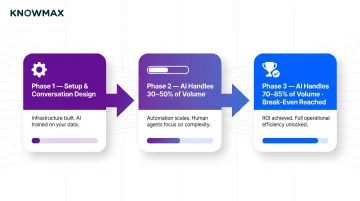
Typical deployment timeline:
- Months 1-2: Setup and conversation design
- Months 3-4: AI handles 30-50% of volume
- Months 5-6: AI handles 70-85% of volume, break-even typically reached
The Metric Distinction Buyers Miss
AI BPO providers often report "blended accuracy"—the combined success rate of AI plus human agents. AI software platforms report "pure AI resolution rate"—conversations resolved by AI alone without human intervention.
When evaluating vendors, ask:
- What percentage of queries does AI resolve autonomously, without escalation?
- What is your human escalation rate?
- How do you define "containment" vs "resolution"?
Industry caution: containment rates can be gamed by blocking human access. True resolution rate—queries fully resolved without escalation—is the preferred 2026 KPI.
Standard deployments achieve 40-60% Tier 1 containment at launch, with optimised deployments targeting 65% or higher by week 12.
QA Monitoring and the Iteration Lag
Those metrics matter more because AI-augmented BPO monitors 100% of interactions vs traditional BPO's 2-5% sampling, enabling full-coverage quality oversight. However, iteration speed depends entirely on the provider's internal team. Knowledge updates, tone adjustments, and workflow changes require coordination—often taking weeks where AI software would take hours.
Use Cases of AI-Augmented BPO
Choosing between AI software and AI BPO often comes down to operational context. AI BPO tends to deliver the strongest results in these four scenarios:
Organizations Lack Internal AI Operations Resources
If you have no knowledge manager, no AI ops lead, and no appetite to build that capability, AI BPO delivers faster ROI than a poorly-maintained self-managed platform.
Unpredictable Volume Spikes and Seasonal Surges
E-commerce contact volumes increase 200-400% during seasonal peaks; flash sales can spike volumes 500%+. BPO providers can ramp agents in weeks rather than months, absorbing volatility your internal team cannot scale to meet.
75% of BPO clients cite demand spike management as a primary value driver.
Multilingual Coverage Without Building Language-Specific Teams
AI chatbots can cover 85+ languages from a single platform, but many organizations prefer BPO providers with native-speaking human escalation paths for complex multilingual support.
Transitional Model
Many enterprises use AI BPO as a bridge strategy—outsourcing operations while simultaneously building internal AI capabilities. Once their team matures, they migrate to self-managed software. Knowmax, for instance, serves both BPO clients like Concentrix and direct enterprise customers, enabling smoother transitions because the knowledge layer remains consistent.
AI Software vs AI BPO: Which Model Is Better?
There is no universal winner. The right model matches your current capabilities and 12-to-24-month AI strategy. Weigh five factors:
1. Internal AI Operations Capability
- AI Software: Requires knowledge manager or CX ops lead to maintain content and monitor performance
- AI BPO: Provider absorbs this complexity; no internal AI ops team needed
2. Product/Policy Change Frequency
- AI Software: Updates deployed in hours; ideal for SaaS, fintech, fast-moving retail
- AI BPO: 6+ weeks for knowledge updates; lag compounds in dynamic industries
3. Volume and Cost at Scale
Gartner research confirms median self-service cost of $1.84 vs agent-assisted cost of $13.50—a 7x difference. However, Gartner also predicts GenAI cost per resolution will exceed $3 by 2030 as vendors shift from subsidized growth to profitability.
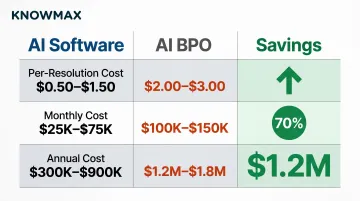
Cost Comparison at 50,000 Resolutions/Month:
| Model | Per-Resolution Cost | Monthly Cost | Annual Cost |
|---|---|---|---|
| AI Software | $0.50–$1.50 | $25,000–$75,000 | $300,000–$900,000 |
| AI BPO | $2.00–$3.00 | $100,000–$150,000 | $1.2M–$1.8M |
| Savings (AI Software) | — | $25,000–$75,000/month | $300,000–$900,000/year |
Note: Costs based on vendor-reported benchmarks; actual pricing varies by contract structure and deployment complexity.
Cost is only part of the equation. For companies treating AI as a long-term strategic investment, who owns the data matters just as much.
4. Data Ownership and Long-Term AI Strategy
For companies building AI as a core capability, the institutional knowledge accumulated in a self-managed system—conversation history, resolution patterns, content architecture—represents a compounding asset.
With BPO, that asset lives inside the vendor's infrastructure and is difficult to migrate. The global Conversation Intelligence market is projected to grow from $1.25B (2024) to $12.02B (2033), reflecting how seriously enterprises are investing in proprietary data capture.
5. The Hybrid Path
Many enterprises now use AI BPO for fast initial deployment while simultaneously building internal knowledge infrastructure. Platforms like Knowmax can serve both models: equipping in-house AI agents with structured knowledge while also providing BPO agents (such as those at Concentrix or Tech Mahindra) with consistent guided resolution content. This dual capability makes the eventual transition from outsourced to self-managed significantly smoother.
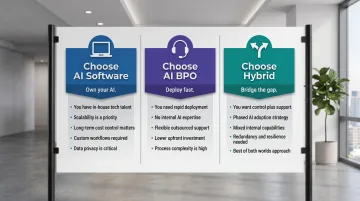
Situational Decision Guide
Choose AI Software if:
- You have (or will hire) a knowledge manager or CX ops lead
- Product or policy changes occur frequently (monthly or quarterly)
- You handle 50,000+ resolutions/month
- Data portability and compliance matter (fintech, healthcare, telecom)
- You're building AI as a core competency
Choose AI BPO if:
- You have no internal AI ops capability and no immediate hiring plan
- You need production-ready deployment in under 60 days
- You manage unpredictable seasonal volume spikes (e.g., e-commerce holidays)
- Multilingual coverage with native-speaking escalation is required
Choose Hybrid if:
- You want speed to market now (BPO) with planned transition to ownership later (AI software)
- You're building internal knowledge infrastructure while outsourcing live operations
- You need consistent knowledge layer across both BPO agents and future in-house AI agents
Conclusion
The choice between AI software and AI BPO isn't about which model is objectively superior—it's about which matches your organization's current capabilities and AI trajectory. A company with no AI operations staff and urgent volume pressure will extract more value from AI BPO today than from a poorly-maintained self-managed platform.
What both paths share is this: the quality of your knowledge layer determines resolution rates, CSAT, and long-term ROI. Whether you choose AI software or AI BPO, the platform must draw from accurate, structured, intent-driven content.
Organizations that invest in knowledge infrastructure—decision trees, visual guides, AI-powered search, continuous content improvement—consistently see higher first-contact resolution and lower handling times, independent of delivery model.
Whichever path you choose, start by auditing your knowledge layer. That's where AI customer service wins or fails—before vendor selection, before deployment, before any ROI calculation.
Frequently Asked Questions
How do I choose a leading AI customer service solution?
Evaluate internal AI operations capacity, monthly resolution volume, data ownership requirements, and whether your team is building AI as a core capability or treating it as managed utility. Organizations with 50,000+ resolutions/month, frequent product changes, and dedicated CX ops resources typically favor AI software; those needing fast deployment without internal AI staff favor AI BPO.
What metrics should companies use to evaluate the success of AI in customer support?
Track pure AI resolution rate (queries resolved without human escalation), CSAT, first-contact resolution (FCR), average handle time (AHT), and escalation rate. When comparing vendors, distinguish pure AI resolution rate from blended (AI + human) accuracy — many BPO providers report blended metrics that obscure true autonomous AI performance.
Which AI model is best for customer service?
No single model leads across every use case. Evaluate candidates on multilingual coverage, integration depth with your CRM and ticketing stack, accuracy benchmarks on your specific query types, and total cost at your resolution volume. Request vendor benchmarks on pure AI resolution rate — not blended figures — before committing.
What are the key components of a successful AI customer service automation system?
Five components drive autonomous AI resolution: a structured knowledge base with decision trees and visual guides, intent-based AI search, CRM and ticketing integrations, human escalation pathways with full context transfer, and a continuous improvement loop for knowledge content. Knowmax delivers all five as a unified platform rather than separate tools requiring custom integration.
How is AI used in the BPO industry?
AI in BPO handles Tier 1 queries autonomously (password resets, order tracking, billing FAQs), routes complex cases to human agents with full conversation context, monitors 100% of interactions for quality assurance (versus 2-5% manual sampling), and reduces per-contact costs. McKinsey reports 40-50% interaction reduction from well-implemented AI BPO deployments.