Introduction
Customers don't think in channels anymore. They don't mentally categorize "this is my mobile app experience" versus "this is the website experience." They simply expect every digital interaction with your brand to be fast, intuitive, and personalized—whether they're browsing your product catalog at 2 AM, troubleshooting an issue through a chatbot, or tracking an order on their phone during their morning commute.
This shift has made digital customer experience the primary battleground for brand loyalty. The stakes are real: bad customer experiences put $3.8 trillion at risk in global sales, with 53% of consumers cutting spending after a single poor interaction. Most of the time, the product isn't the problem. The disjointed, impersonal, or sluggish digital touchpoints surrounding it are.
TLDR
- Digital customer experience (DCX) covers every interaction customers have with your brand across digital channels
- Customers benchmark your digital experience against the best interaction they've had—with any brand
- Strong DCX depends on omnichannel continuity, personalization at scale, and self-service that resolves issues
- Tracking CSAT, NPS, CES, and task completion rates is essential as customer expectations keep rising
What is Digital Customer Experience?
Digital customer experience (DCX) is the sum of all perceptions a customer forms through interactions with your brand across digital channels — from initial discovery through purchase, support, and renewal. What matters isn't whether you have a website or mobile app. It's whether those touchpoints are fast, consistent, and leave customers feeling good about doing business with you.
Core digital touchpoints that shape DCX include:
- Brand website and mobile applications
- Live chat and AI-powered chatbots
- Email communications and push notifications
- Social media platforms and messaging apps
- Self-service portals and knowledge bases
- Digitally connected environments (IoT devices, voice assistants)
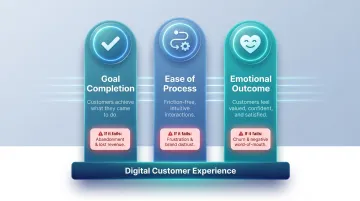
The Three Pillars of Good Digital CX
Every successful digital interaction rests on three fundamentals:
- Goal completion – Could the customer finish what they came to do? Complete a checkout, find an answer, or close a support ticket without dead ends?
- Ease of process – Did they have to repeat information, navigate confusing menus, or wait too long? High effort is a direct path to churn.
- Emotional outcome – How did the interaction leave them feeling? Customers forget fast resolutions but remember frustrating ones — sometimes for years.
Always-On and Omnichannel by Nature
Unlike traditional customer service with fixed store hours or call center shifts, DCX operates 24/7 across every device a customer might use.
There's no single frontline representative shaping perception. Instead, three properties of your digital ecosystem build or erode trust with every interaction:
- Speed — slow load times and delayed responses signal that you don't value the customer's time
- Coherence — disconnected channels create friction; a unified experience removes it
- Personalisation — generic interactions feel transactional; contextual ones feel like service
What Customers Demand Today
Modern digital experiences must deliver:
- Speed and instant responses – Customers expect sub-second page loads and immediate chatbot acknowledgment
- Contextual continuity – Starting a transaction on mobile and finishing on desktop should feel seamless, not like starting over
- Meaningful personalization – Recommendations and content must reflect actual behaviour and preferences, not generic segments
- Self-service that works – Options to resolve issues independently must actually solve problems, not just deflect tickets
Digital CX vs. Customer Experience vs. User Experience
Digital CX vs. Customer Experience (CX)
Customer experience encompasses every touchpoint a customer has with your brand—online and offline, from walking into a physical store to calling support to browsing your mobile app. Digital CX is the subset of CX that exists entirely within digital channels.
Customers don't consciously separate the two. A seamless mobile checkout can be instantly undermined by a frustrating in-store return process.A seamless mobile checkout can be instantly undermined by a frustrating in-store return. That disconnect shapes how customers feel about your brand as a whole — not just the digital parts.
Digital CX vs. User Experience (UX)
User experience focuses narrowly on the usability and design of a specific digital product or interface — how intuitive your app navigation is, how quickly users complete a form, whether buttons are easy to find.
Digital CX is broader. It covers the entire relationship a customer builds with your brand across all digital interactions over time: emotional responses, support quality, information consistency, and how well channels hand off to each other.
Scope Comparison
| Dimension | UX | Digital CX | Overall CX |
|---|---|---|---|
| Scope | Single product/interface design | All digital interactions across the brand journey | All interactions including physical, human, and digital |
| Focus | Usability, navigation, task completion | Relationship, emotion, consistency across digital channels | End-to-end brand relationship across all channels |
| Timeframe | Single session or task | Ongoing digital relationship | Lifetime customer journey |
Why Digital Customer Experience Matters for Businesses
Experience Drives Purchase Decisions
73% of customers point to experience as a critical factor in their purchasing decisions, ranking just behind price and product quality. 65% of U.S. customers find a positive brand experience more influential than great advertising, and customers will pay up to a 16% price premium for superior experience.
The Revenue Consequences of Poor Digital CX
When digital experiences fail, customers don't wait around. They move to competitors immediately. Research shows 53% of consumers reduce or stop spending with a brand after a bad experience, putting $3.8 trillion at risk globally.
A single slow checkout process, an unhelpful chatbot, or inconsistent information across channels can permanently damage customer relationships. Those losses multiply as repeat purchases, referrals, and long-term loyalty disappear with them.
Positive Business Outcomes of Exceptional DCX
Companies that get digital experience right see:
- Faster conversion rates and higher average order values
- Stronger customer retention and increased lifetime value
- Organic brand advocacy through positive word-of-mouth and social sharing
- Operational efficiency gains from effective self-service deflection
Research shows that increasing retention rates by just 5% can boost profits by 25% to 95%, and acquiring a new customer costs 5 to 25 times more than retaining an existing one.
The Self-Service Expectation Gap
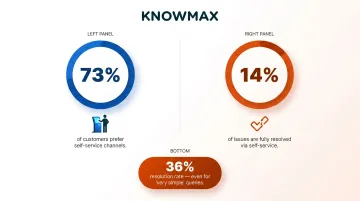
Those retention gains depend on one channel most companies still get wrong. 73% of customers use self-service during their support journey, yet only 14% of issues are fully resolved through these channels. Even for queries customers describe as "very simple," only 36% reach resolution without escalation.
This gap is both a critical failure point and a significant improvement opportunity. Customers prefer self-service — the problem is that most self-service tools aren't built to actually resolve issues on first contact.
Key Components of a Strong Digital Customer Experience
Seamlessness and Omnichannel Continuity
Customers expect to pick up exactly where they left off, regardless of device or channel. This looks like:
- A user starting a support conversation on a chatbot and seamlessly transitioning to a live agent without repeating their issue
- Switching from mobile app browsing to desktop checkout without losing cart contents or session context
- Receiving consistent pricing, product information, and policy details whether interacting via email, website, or social media
Personalization at Scale
Modern DCX personalization extends far beyond inserting a customer's first name into an email. It means using real-time behavioral data, purchase history, and intent signals to deliver relevant content, recommendations, and support at the right moment.
Done poorly—recommending products the customer already bought, or pushing irrelevant offers—it actively damages brand perception. Done well, it creates experiences that feel anticipatory rather than intrusive.
Consistent and Accurate Information Across All Touchpoints
One of the most common DCX failures is customers receiving different or outdated information depending on which channel they use. A chatbot provides one answer, a FAQ says something else, and an agent gives a third response—eroding trust instantly.
Maintaining a unified knowledge layer that powers everything from self-service portals and chatbots to agent responses eliminates this friction.
Platforms like Knowmax enable this consistency by connecting the same accurate, guided information across all digital touchpoints: customer-facing self-service, chatbot integrations, and agent desktops via CRM tools like Salesforce or Zendesk.
Self-Service That Actually Resolves Issues
Most organisations offer some form of self-service. What separates good DCX from poor is whether that self-service actually resolves issues—or just frustrates customers into calling anyway. Effective digital self-service includes:
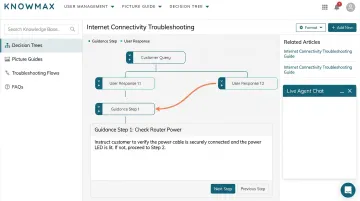
- Decision-tree guided troubleshooting that adapts to customer inputs
- Visual how-to content and device-specific guides
- AI-powered search that understands intent, not just keyword matches
- Clear escalation paths when self-service reaches its limits
Knowmax addresses this through interactive decision trees, visual troubleshooting guides, and semantic search that surfaces answers by intent rather than exact phrasing. A leading telecom company achieved a **21% improvement in first call resolution** after implementing Knowmax's guided workflows. Another reduced call volume by 46% by empowering customers to resolve issues independently.
Speed and Reliability of Digital Infrastructure
Page load times, form functionality, payment gateway reliability, and mobile responsiveness directly shape customer perception. Research by Google and Deloitte analyzing 37 million user sessions found that a 0.1-second improvement in mobile site speed increased retail conversions by 8.4%, travel conversions by 10.1%, and luxury add-to-basket rates by 3.6%.
In e-commerce specifically, conversion rates drop by an average of 0.3% for every additional second of load time—performance optimization is a direct revenue driver.
The Digital Customer Journey: Stages That Shape DCX
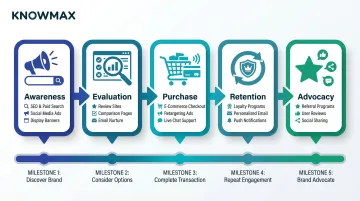
The Five Core Stages
Awareness – Customers discover your brand through SEO, social content, paid ads, or word-of-mouth. Digital touchpoints include search results, display advertising, social media posts, and influencer content.
Evaluation – Customers compare options through demos, reviews, comparison pages, and educational content. Key touchpoints here — product pages, video tutorials, customer testimonials, and comparison tools — directly shape whether they move forward or leave.
Purchase – The transaction phase where checkout UX, payment security, mobile optimisation, and confirmation communications determine success. Digital touchpoints include shopping carts, payment gateways, order confirmations, and tracking portals.
Retention – Post-purchase engagement through loyalty programmes, proactive support, onboarding sequences, and personalised emails. Touchpoints include:
- Customer portals and renewal notifications
- Product usage guides and onboarding flows
- Feedback requests and re-engagement emails
Advocacy – Satisfied customers become promoters through referral programmes, user-generated content, reviews, and social sharing. Digital touchpoints include referral dashboards, review platforms, community forums, and social advocacy programmes.
Non-Linear Journeys Are the Norm
Customers don't follow prescribed paths. Research tracking 46,000 shoppers found that 73% used multiple channels during their journey. Those using four or more channels spent 4% more in-store and 10% more online than single-channel users.
The implication is clear: design for intent-driven, non-linear journeys — not a tidy funnel. On average, customers use nine different channels to communicate with companies, often switching between them multiple times within a single stage.
Moments That Matter
Certain digital touchpoints carry outsized influence on loyalty and conversion:
- First website visit – Initial impressions of speed, design, and clarity
- Checkout – Friction here (hidden fees, complex forms, payment errors) kills conversions
- First support interaction – Sets expectations for how the brand handles problems
- Renewal decision point – Whether the digital experience during the contract period justified continued investment
Optimising these moments specifically — rather than spreading effort evenly across every touchpoint — is where DCX strategy delivers the clearest return.
How to Build and Improve Your Digital CX Strategy
Start with Deep Customer Journey Intelligence
Map how customers actually engage across digital touchpoints using behavioral data (clickstreams, drop-off rates, time-to-completion, session recordings) combined with qualitative feedback (surveys, voice-of-customer programs, user interviews).
Static journey maps created once and filed away aren't sufficient. The goal is a dynamic, continuously updated view revealing where friction exists and how customer behavior evolves over time.
Establish Continuous Feedback Loops
Embed feedback mechanisms at critical touchpoints—post-transaction, post-support interaction, post-onboarding—to create timely signals about where the experience is working—and where it isn't.
Effective formats include:
- CSAT surveys deployed immediately after key interactions
- Customer Effort Score (CES) to gauge how much effort customers had to put in
- Open-text voice-of-customer analysis to surface specific pain points by topic or channel
- Behavioral analytics that catch abandonment patterns before customers even complain
Acting visibly on customer feedback—and communicating changes made in response—builds trust and encourages continued participation.
Invest in the Right Enabling Technologies
Those feedback signals are only actionable if your technology stack can act on them. A well-connected set of tools turns insight into consistent, channel-agnostic execution:
- CRM integration that unifies customer data and full interaction history in one place
- AI-powered service tools covering chatbots, intent recognition, and predictive routing
- Omnichannel platforms that keep the experience consistent across web, mobile, voice, and messaging
- Knowledge management systems that eliminate the information gaps agents and customers regularly fall into
Knowmax addresses the knowledge consistency gap specifically—delivering guided, accurate responses through self-service portals, chatbots, and agent-facing systems. It integrates natively with Salesforce, Zendesk, Genesys, and Freshdesk, so agents access current knowledge without switching tabs.
For example, Concentrix handled over 3.7 million chatbot transactions and improved knowledge access for more than 120 agents using Knowmax's omnichannel deployment, while Vodafone reported measurable reductions in average handle time and increases in CSAT scores through consistent service delivery across voice, chat, and email.
Measure, Optimize, and Iterate—Never "Set and Forget"
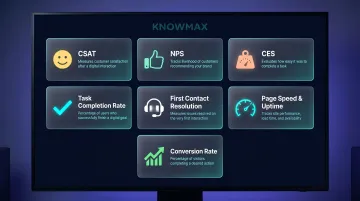
Track these core DCX metrics continuously:
- CSAT (Customer Satisfaction Score) — captures immediate reaction to a specific interaction
- NPS (Net Promoter Score) — measures longer-term loyalty and likelihood to recommend
- CES (Customer Effort Score) — reveals how easy or hard it was for customers to get things done
- Digital task completion rates — percentage of users who successfully finish key workflows
- First contact resolution on digital channels — issues closed without escalation or callback
- Page speed and uptime — technical performance floors that affect every other metric
- Conversion rates — the commercial proof that experience improvements are paying off
Forrester's 2025 CX Index analysis found that 25% of brands declined in CX quality while only 7% improved, indicating that most organizations struggle to keep pace with rising expectations. With the gap between leaders and laggards widening each year, the organizations that treat measurement as an ongoing discipline—rather than a quarterly review—are the ones that move into that 7%.
Frequently Asked Questions
What is digital customer experience?
Digital customer experience is the sum of all interactions a customer has with a brand across digital channels—websites, mobile apps, chatbots, email, social media, and self-service portals—and the perceptions and emotions those interactions create.
How does digital customer experience (CX) differ from user experience (UX)?
UX focuses on the usability and design of a specific digital product or interface. Digital CX encompasses the full spectrum of a customer's relationship with a brand across all touchpoints over time, including emotional responses and information consistency.
What is an example of digital customer experience?
Consider a customer who finds a telecom provider through search, compares plans on the website, resolves a setup issue via self-service chatbot, then receives a personalized renewal offer by email. Each of those digital touchpoints, taken together, is their digital customer experience.
What are the key channels that make up digital customer experience?
Core digital channels include brand websites, mobile apps, live chat, AI-powered chatbots, email, social media platforms, and self-service portals. The specific channel mix varies by industry, customer segment, and use case.
How do you measure the success of digital customer experience?
Common metrics include CSAT, NPS, CES, digital task completion rates, first contact resolution, page load speed, bounce rates, and conversion rates. No single metric captures everything. A balanced scorecard across these dimensions gives the clearest picture of digital CX performance.