
Research shows $3.7 trillion in global sales were at risk in 2024 due to poor customer experiences, with 50% of customers cutting spending after a single bad interaction. This reality underscores that perception—the collective impression customers hold about your brand—drives revenue outcomes more powerfully than features or pricing alone.
This guide covers what customer perception is, why it directly impacts business outcomes, the factors that shape it, and the actionable strategies companies can use to measure and improve it.
TLDR:
- Customer perception is shaped by every interaction, not just purchases
- Positive perception drives loyalty; negative perception accelerates churn
- Consistency across channels matters as much as quality in any single interaction
- First contact resolution significantly impacts how customers view your brand
- Active review management and visible response to feedback build trust
What Is Customer Perception?
Customer perception is every thought, feeling, and expectation a customer holds about a brand. It forms through every interaction—website visits, support calls, social media posts, and product usage—not just the purchase moment.
Perception is subjective and rarely mirrors objective quality. A technically superior product can still be perceived as inferior if support is slow or confusing. Conversely, brands with adequate products but exceptional service often command premium pricing.
What drives this? Customers act on what they believe about your brand — not what your product specs say.
The Three Stages of the Perception Process
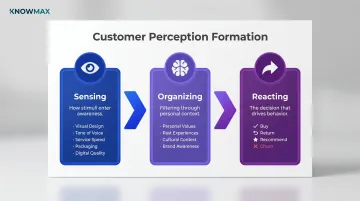
Understanding how perception forms helps explain why it's so hard to control. It moves through three sequential stages:
- Sensing: Customers absorb inputs across channels — visual design, tone of voice, service speed, packaging, and digital interface quality
- Organizing: The brain filters these inputs through personal values, past experiences, cultural context, and existing brand awareness
- Reacting: Customers decide to buy, return, recommend, or churn based on the perception they've assembled
Perception forms fast — often before a customer interacts with you directly. Someone may arrive at your website with opinions already shaped by a review they skimmed or a comment a colleague made. That means your pre-sale touchpoints (search snippets, review responses, social posts) actively shape perception just as much as the product itself does.
Why Customer Perception Is Critical for Business Success
Customer perception directly links to revenue. When perception exceeds expectations, loyalty builds. When it falls short, churn follows swiftly.
PwC research found that customers will pay up to a 16% price premium for a great customer experience, and 73% of all consumers point to experience as an important factor in purchasing decisions. Positive perception, in short, gives businesses room to charge more — and customers who willingly pay it.
Brand equity follows the same logic. Apple and Nike command premium pricing not because their products are objectively superior in every category, but because perception has made them feel trustworthy and aspirational. That kind of equity accumulates slowly — and disappears faster than any competitor can cause it to.
Word-of-mouth amplifies all of this. Nielsen research found that 92% of consumers trust recommendations from friends and family over any other form of marketing. Customers with strong positive perception become advocates who reach audiences your marketing budget never could.
The downside is equally sharp. PwC data shows the cost of getting perception wrong:
- 55% of consumers stop buying from a company after several bad experiences
- 32% leave specifically due to inconsistent experiences across channels
Key Factors That Influence Customer Perception
Customer perception is shaped by a layered combination of external stimuli and individual internal factors. Businesses can influence both through deliberate design and consistent execution.
Personal Experience with the Brand
Direct experience is the most powerful perception driver. This includes:
- Product quality and ease of use
- Consistency of service across every touchpoint—pre-sale, during purchase, and post-sale
- Whether the brand delivers on promises made through marketing
A single poor experience can override dozens of positive ones. Conversely, exceptional moments create lasting positive perception that buffers against future friction.
Customer Service Quality
Customer-facing support interactions are perception events in real time. How quickly issues get resolved, how knowledgeable agents are, and whether customers feel heard all shape how they view the brand.
SQM Group benchmarking data shows 95% of customers continue doing business when first contact resolution (FCR) is achieved, while approximately 40% defect when it is not. This reveals that customers who have issues resolved on first contact often walk away with stronger brand perception than those who never had an issue.
Root causes of FCR failure include organizational policies (49%), agent mistakes (38%), and customer miscommunication (13%). Agent knowledge gaps, whether from high turnover or scattered information, are among the most preventable drivers of inconsistent experiences.
Platforms like Knowmax address this by giving contact center teams access to accurate, unified knowledge in real time, so customers receive consistent answers regardless of which agent or channel handles their request.
Marketing, Advertising, and Brand Identity
Marketing shapes perception for both customers and non-customers through:
- Tone of voice and messaging consistency
- Visual identity and design standards
- Values the brand publicly champions
Inconsistent branding across channels breeds distrust. When advertising promises simplicity but the product experience is confusing, perception collapses. Alignment between what you say and what customers experience builds the kind of trust that compounds over time.
Price as a Perception Signal
Price is not just a cost figure—it is a signal. Pricing too low can imply poor quality. Pricing too high without matching experience breeds resentment. Pricing must align with the perception position the brand is trying to occupy. Research shows 87% of consumers cite "trusting a brand" as the number one reason they are willing to pay more for a product or service.
Online Reviews, Social Proof, and Word of Mouth
Third-party validation carries more perceptual weight than brand messaging. BrightLocal's survey found 97% of consumers read online reviews for local businesses, and 80% are more likely to use a business that responds to every review.
Customers actively seek social proof before forming or revising opinions. 31% of consumers now only use businesses with 4.5+ stars, and 74% only consider reviews from the last three months. For brands, that means review management and response cadence directly affect whether new customers trust you enough to engage.
How to Measure Customer Perception
Structured Feedback Tools
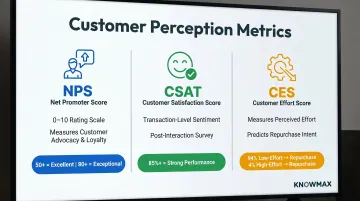
Three core metrics capture perception at different levels:
- Net Promoter Score (NPS) measures advocacy likelihood on a 0-10 scale. Scores above 50 are excellent; above 80 are exceptional
- Customer Satisfaction Score (CSAT) captures transaction-level sentiment. Scores above 85% indicate strong satisfaction
- Customer Effort Score (CES) reveals friction in the experience. IBM reports 94% of customers who reported low-effort experiences expressed intention to repurchase, compared with only 4% of those who reported high-effort experiences
A declining score in any metric signals perception health issues that require investigation. But structured surveys only capture what customers choose to report — organic signals often surface faster.
Social Listening and Digital Monitoring
Tracking unsolicited mentions, reviews, and sentiment across social media and online publications gives a more unfiltered view of perception than surveys alone. Tools like Google Alerts and social media monitoring platforms can automate this, surfacing real-time perception shifts before they appear in quarterly metrics.
Qualitative Methods
Customer interviews and focus groups explain the "why" behind metric trends. Quantitative data tells you perception is shifting; qualitative research tells you what's causing it and what to change.
The scale of the gap makes this step critical. The Bain & Company finding that **80% of companies believe they deliver a "superior experience," yet only 8% of customers agree shows how sharply internal assumptions can diverge from external reality. More recent Sprinklr data (2025) confirms the gap persists: 91% of business leaders believe customers experience their brand as intended, yet only 36% of consumers agree. Closing that gap starts with knowing where your measurement is blind.
How to Improve Customer Perception
Improving perception requires consistency across people, processes, and messaging—not just isolated campaign-level fixes.
Deliver Consistent, High-Quality Customer Experiences
Consistency is the foundation of positive perception. Salesforce found 79% of customers expect consistent interactions across departments, yet 55% say it generally feels like they are communicating with separate departments rather than one company.