Customer service experience is the cumulative impression customers form across every interaction with your support team. It's distinct from the broader concept of customer experience (CX), which includes product quality, marketing, and sales. Customer service experience specifically captures how customers feel after reaching out for help — and it heavily influences whether they stay, spend more, or walk away.
This article covers what customer service experience means, why it drives revenue and loyalty, the five pillars of a great experience, how to measure it, and proven strategies to improve it.
TLDR
- Customer service experience is the overall impression customers form across every interaction with your support team
- 88% of customers say good service makes them more likely to purchase again — it's one of the strongest competitive levers available
- Great customer service experience depends on responsiveness, empathy, knowledgeability, personalization, and consistency
- It's measured using CSAT, NPS, FCR, and CES
- Improvement comes through agent empowerment, AI-assisted knowledge delivery, omnichannel support, and feedback loops
What Is Customer Service Experience?
Customer service experience is the cumulative impression a customer forms across every interaction with a company's support function — from the first pre-sale inquiry to long-term post-purchase support.
It covers a wide range of touchpoints and channels, including:
- Pre-sale inquiries and onboarding assistance
- Post-purchase problem resolution and returns
- Billing questions and account management
- Technical troubleshooting and device support
- Channels: phone, email, live chat, social media, and self-service portals
How It Differs from Customer Experience
Customer experience (CX) covers the entire journey: product quality, marketing, brand perception, sales process, and support. Customer service experience is the subset shaped specifically by support interactions. That said, it carries disproportionate weight in overall CX outcomes. A great product can't compensate for consistently poor support.
Direct and Indirect Interactions Both Matter
Customer service experience includes indirect interactions — how a brand responds to public complaints on social media or review platforms. Handling these proactively can turn a negative moment into a loyalty-building one. 63% of consumers say companies need to do a better job of listening to them.
Pre-Sale and Post-Sale Stages
Customer service experience isn't just about fixing problems. A friction-free purchase process, proactive outreach, and timely follow-ups all contribute to the overall experience score. Each of these moments either builds or erodes the customer's confidence in your brand.
Customer Service vs. Customer Service Experience
Customer service is the reactive act of helping a customer with a specific issue — resetting a password, processing a refund, troubleshooting a device. Customer service experience is the holistic, cumulative perception that builds over time across all such interactions. Customer service is a single action; customer service experience is what that action — repeated across every channel and interaction — adds up to over time.
Why Customer Service Experience Matters
It Drives Revenue Directly
The revenue case for customer service is well-established:
- 75% of consumers will spend more with businesses that provide a good customer experience
- Customers will pay up to a 16% price premium for a great experience
- 88% of customers say good service makes them more likely to purchase again
Service quality doesn't just influence satisfaction scores — it directly shapes what customers spend and how often they return.
Poor Service Drives Customers Away — Fast
Bad experiences don't just frustrate customers — they accelerate churn:
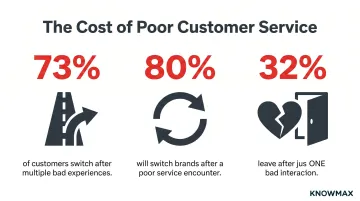
- 73% of consumers will switch to a competitor after multiple bad experiences; over 50% leave after just one
- 80% of customers have switched brands due to poor customer experience
- 32% of customers globally would stop buying from a brand they loved after a single bad interaction
No amount of brand loyalty fully insulates against repeated service failures.
Satisfied Customers Advocate; Dissatisfied Customers Broadcast
When customers leave, many don't go quietly. Consumers are 3x more likely to trust and recommend a company after a five-star experience. The downside is steeper: 96% of customers with high-effort service experiences become less loyal, and 81% intend to spread negative word of mouth.
One difficult interaction can undo months of positive history — and reach far beyond the original customer.
It's a Competitive Differentiator
In markets where products and pricing are increasingly similar, the quality of the customer service experience separates market leaders from the rest. Customer-obsessed organizations report 41% faster revenue growth and 51% better customer retention. 85% of customer service decision-makers believe customer experiences will have an increasing impact on revenue.
For enterprises competing on slim product margins, service quality has become one of the few remaining levers for differentiation.
Retention Is Cheaper Than Acquisition
Acquiring a new customer costs 5 to 25 times more than retaining an existing one. Increasing customer retention rates by just 5% can boost profits by 25% to 95%. Consistently positive service experiences are, in that light, one of the highest-ROI investments a business can make.
Key Elements of a Great Customer Service Experience
A great customer service experience is built on five interconnected pillars. The absence of any one noticeably degrades the overall perception a customer forms.
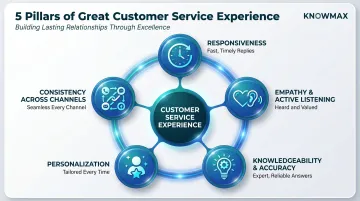
Responsiveness
Customers expect fast responses and swift resolutions. The data backs this up:
- 66% of consumers expect a response within five minutes or less
- 72% of customers want immediate service
- Consumers are 2.7x more likely to be satisfied when they're happy with their wait time
Delays, long hold times, and unresolved tickets are among the top drivers of frustration. Responsiveness applies across all channels and should not vary based on how a customer chooses to reach out.
Speed alone isn't enough, though. Setting accurate expectations matters more to customers than raw response time. Responsiveness is about expectation management as much as it is about velocity.
Empathy and Active Listening
Empathy means understanding and genuinely acknowledging the customer's emotional state — and active listening means hearing the full context of an issue before responding.
Consumers are 5.2x more likely to be happy with the overall experience when they interact with an empathetic agent — nearly double the impact of short wait times (2.7x). Empathy outweighs speed as a driver of satisfaction.
Yet the gap between expectation and delivery is significant. 36% of consumers are unhappy with the level of empathy they received from a customer service agent, and 55% say they have had customer service issues go unresolved.
Customers who feel heard are more likely to remain loyal even when their issue isn't fully resolved. Two-thirds of consumers who believe a business cares about their emotional state are likely to become repeat customers.
Knowledgeability and Accuracy
Customers lose confidence in a brand when agents give inconsistent, incorrect, or incomplete answers. This erodes trust faster than almost any other failure.
Equipping agents with structured, always-current knowledge directly improves answer accuracy and reduces resolution time. AI-powered knowledge management platforms like Knowmax address this directly — guided decision trees convert complex SOPs into step-by-step workflows, reducing agent errors by 40% and improving first contact resolution rates. Vodafone, for instance, uses this approach to deliver consistent service across voice, chat, and email channels.
Personalization
Customers increasingly expect interactions to reflect their history, preferences, and prior issues — not a generic, scripted response. The numbers reflect how central this has become:
- 78% of customers expect more personalization options than ever before
- 88% of CX specialists view personalization as critical for driving customer loyalty
- 64% of consumers prefer to buy from companies that tailor experiences to their specific needs
Personalization signals to customers that they are valued as individuals, not just ticket numbers. Platforms that integrate with CRM systems can surface customer history and tailor knowledge delivery based on agent context or customer segment, ensuring every interaction feels relevant and informed.
Consistency Across Channels
Inconsistency across support channels — where a customer gets one answer via chat and a different one on a call — destroys trust and creates additional effort for the customer.
70% of consumers expect anyone they interact with to have the full context of the conversation. 60% report that when agents have little to no context of the previous interaction, the experience is frustrating and forces them to repeat information.
When agents across channels work from a single, unified knowledge source, those gaps close. Knowledge management platforms that integrate with CCaaS tools like Genesys, Talkdesk, and Zendesk give every agent — regardless of channel — access to the same accurate, up-to-date information.
How to Measure Customer Service Experience
The most complete picture of customer service experience comes from combining quantitative metrics with qualitative signals. Without both, you're either flying blind on sentiment or drowning in numbers you can't act on.
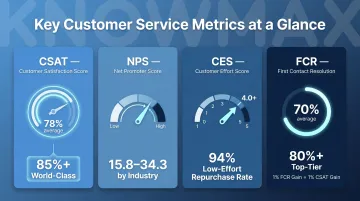
Four Primary Metrics
- CSAT (Customer Satisfaction Score): Post-interaction survey rated on a 5-point scale. Industry average sits at 78%; world-class organisations clear 85%+.
- NPS (Net Promoter Score): Measures loyalty by subtracting % Detractors (0–6) from % Promoters (9–10). 2024 benchmarks range from 15.8 in car rental to 34.3 in grocery — context matters when interpreting your score.
- CES (Customer Effort Score): Tracks how easy resolution was for the customer. Target 4.0+ on a 1–5 scale. Worth prioritising: 94% of low-effort customers intend to repurchase.
- FCR (First Contact Resolution): Percentage of issues closed on the first interaction. Industry average is 70%; top-tier centres hit 80%+. Each 1% FCR gain typically drives a 1% CSAT increase.
Supporting Operational Metrics
| Metric | Industry Average | What to Know |
|---|---|---|
| Average Handle Time (AHT) | 7 minutes | Lower AHT correlates with higher FCR when agents have the right tools |
| Average Speed of Answer (ASA) | 34.4 seconds | No CSAT penalty if calls are answered within 120 seconds |
Qualitative Signals
Customer feedback, sentiment analysis from interactions, and agent performance reviews reveal what metrics alone cannot. Teams that review these signals consistently — not just during QBRs — tend to catch friction points before they show up in CSAT drops.
How to Improve Customer Service Experience
Empower Agents with the Right Tools and Training
Agents can only deliver great experiences when they have the authority to make decisions and access to accurate, relevant information in real time.
Ongoing training and coaching — not just onboarding — is essential to maintaining high service quality as products, policies, and customer expectations evolve. Knowmax's Learning Management System (LMS) supports continuous agent development through:
- Guided learning journeys with structured paths, interactive lessons, and assessments
- Gamification with badges, points, and quizzes to boost engagement
- Real-time assessments and feedback to track progress
- Scheduled content delivery for new products and policy updates
- AI-powered content creation to auto-generate quizzes from existing articles
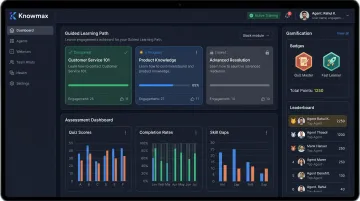
These features reduce time to proficiency by up to 40% and improve agent confidence.
Leverage AI and Knowledge Management
AI-powered knowledge management platforms help agents retrieve accurate answers faster, follow guided resolution workflows, and deliver consistent responses across channels.
GenAI-enabled agents achieved a 14% increase in issue resolution per hour and a 9% reduction in handle time. That impact extends to self-service too — AI-powered knowledge tools can deliver a 20% boost in CSAT scores and a 55% increase in self-service resolution rates.
Knowmax's decision trees and visual troubleshooting guides give agents structured, step-by-step guidance that reduces errors and accelerates resolution. Key capabilities include:
- Finds precise answers regardless of how the question is phrased (intent-based search)
- Auto-fills workflows from live CRM data, simplifying complex SOPs
- Creates, summarises, and repurposes content across formats with AI authoring tools
- Translates content across 25+ languages for multilingual support teams
For example, Knowmax helped Concentrix handle over 3.7 million transactions via chatbots while improving knowledge access for over 120 agents.
Build a True Omnichannel Support Strategy
Customers expect to move between channels without losing context or having to repeat themselves. In fact, 70% of consumers will spend more with companies that offer seamless conversational experiences, and 89% of customers are retained by companies with strong omnichannel strategies. Those numbers reflect a simple truth: consistency across channels is no longer a differentiator — it's the baseline.
Achieving this requires integrated technology and unified knowledge access so every agent, across every channel, works from the same source of truth.
Knowmax integrates with CCaaS platforms like Genesys and Talkdesk, enabling agents to:
- Access real-time information directly within their workflow
- Retrieve structured knowledge and step-by-step guidance without leaving their console
- Maintain context and deliver consistent support across voice, chat, email, and self-service
This approach has helped organisations like Vodafone achieve consistent service delivery and reduce AHT by 15% while improving FCR by 21%.
Collect Feedback and Close the Loop
Regular feedback collection through post-interaction surveys, NPS campaigns, and social listening reveals where the experience is breaking down. But improvement only happens when teams act on that data, communicate changes back to customers, and track whether the issue recurs.
Knowmax's platform includes analytics and reporting features that help contact centre managers:
- Identify knowledge gaps and track article usage
- Monitor resolution quality over time
- Analyse user engagement patterns and content performance
- Link feedback with the learning management system to ensure continuous improvement
Organisations using these tools have seen AHT drop by 20% and FCR improve by 15% — concrete evidence that closing the feedback loop translates directly into better service outcomes.
Frequently Asked Questions
How do you explain customer service experience?
Customer service experience is the cumulative impression a customer forms through all their support interactions with a company, spanning every channel and every stage of their journey with the brand.
What are the top 3 skills of customer service?
The three most critical customer service skills are empathy (understanding the customer's emotional state), effective communication (clear, simple dialogue), and problem-solving (finding accurate, timely resolutions).
What are examples of customer service?
Examples include a support agent resolving a billing dispute over live chat, a chatbot walking a customer through product setup, or an agent proactively following up after a complex issue to confirm the resolution held.
What is the difference between customer service and customer experience?
Customer service is a reactive function focused on resolving specific issues, while customer experience is the broader, proactive sum of all interactions a customer has with a brand — including product quality, marketing, and sales.
How do you measure customer service experience?
Key metrics include CSAT, NPS, FCR, and CES. Combining these with operational data like average handle time and qualitative feedback gives the most complete picture.
How does knowledge management impact customer service experience?
Well-organized, accessible knowledge helps agents give faster, more accurate, and more consistent answers. This directly reduces resolution time, cuts errors, and improves CSAT — contact centers that invest in structured knowledge management typically see gains across both AHT and first-contact resolution rates.