The stakes are high. Employees spend 1.8 hours per day searching for information — that's nearly 20% of the workday lost to knowledge gaps. Meanwhile, poor customer service costs businesses between $75 billion and $1.6 trillion annually, with 96% of customers willing to leave a company after a bad experience.
This guide evaluates the top customer service tools for 2026 across core categories — ticketing systems, knowledge management, live chat, CRM, and AI — based on their ability to reduce agent effort, improve resolution speed, and deliver measurable impact at enterprise scale.
TL;DR
- Top-performing service teams in 2026 run a layered stack: ticketing, knowledge management, live chat, CRM, and AI
- AI is no longer a differentiator — tools compete on measurable impact: FCR gains, AHT reduction, and agent accuracy
- Knowledge management is the often-overlooked layer that makes every other tool work better
- The best tools reduce agent effort, not just ticket volume — prioritize measurable impact on FCR and CSAT
- Choose tools based on integration depth, scalability, and fit with your existing channels
What Are Customer Service Tools?
Customer service tools are digital platforms and software that help support teams manage, respond to, and resolve customer inquiries across channels. The landscape includes several core categories:
- Ticketing and helpdesk systems — centralize customer conversations across email, chat, phone, and social
- Live chat software — enable real-time customer messaging and engagement
- Knowledge management platforms — organize and deliver accurate information to agents and customers
- CRM tools — provide 360-degree customer context across sales, marketing, and support
- AI chatbots and automation — handle routine queries and guide customers through self-service
- Analytics and reporting tools — track performance metrics and identify improvement opportunities
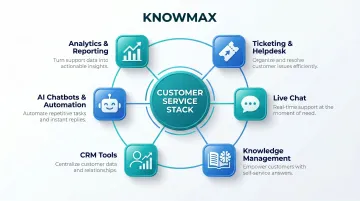
Enterprise teams typically operate a layered stack rather than relying on a single platform. Each category serves a distinct operational need — and how well these tools share data with each other often determines whether the stack performs or creates friction.
In 2026, three shifts are shaping how teams approach tool selection. AI features — from smart search to auto-generated responses — now ship as standard in most categories, not as premium add-ons. Self-service demand keeps rising, yet only 14% of customer service issues are fully resolved through self-service, leaving most platforms well short of what customers actually need. And as customers move between chat, phone, email, and portals in a single interaction, consistent cross-channel experience has become a direct driver of retention — making the choice of tools more consequential than ever.
Top Customer Service Tools for 2026
These tools were evaluated based on AI capability, omnichannel support, integration ecosystem, scalability, and measurable impact on key support metrics — not just feature checklists.
Zendesk
Zendesk is one of the most widely deployed helpdesk and ticketing platforms globally, serving support teams across SMBs and enterprises. Teams use it to manage customer conversations across email, chat, phone, social, and messaging channels from a unified agent workspace.
What sets Zendesk apart is its granular reporting through Zendesk Explore, highly customizable self-service knowledge base with theme and layout options, and advanced AI features including sentiment analysis, predictive ticket routing, and intelligent chatbots. The platform offers access to a marketplace of 1,800+ integrations, enabling deep customization for enterprise workflows.
Zendesk was named a Leader in the 2025 Gartner Magic Quadrant for CRM Customer Engagement Center, moving up from Visionary in 2024 — a reflection of its AI-first platform evolution.
| Key Features | Omnichannel ticketing, AI-powered routing, advanced analytics, customizable knowledge base |
|---|---|
| Best For | Teams needing deep customization and enterprise-grade reporting |
| Pricing | Starting at $19/agent/month (Support Team plan, billed annually) |
Freshdesk
Freshdesk by Freshworks is a cloud-based helpdesk platform known for its powerful ticket management capabilities and AI assistant, Freddy AI. It serves businesses ranging from startups to large enterprises with a feature set that delivers well beyond its cost tier.
Freshdesk's differentiators include skill-based ticket assignment, advanced agent overlap prevention, and Freddy AI Copilot for real-time response suggestions. Freddy provides AI writing assistance, real-time translation across 60+ languages, conversation summarization, and sentiment detection to flag customer frustration. Freshchat delivers unified multi-channel management across email, phone, chat, and social.
A generous free plan makes Freshdesk accessible to smaller teams, while enterprise features scale to meet growing operational needs. Forrester's Total Economic Impact study found Freshdesk Omni delivers 225% ROI.
| Key Features | Freddy AI Copilot, skill-based routing, SLA management, Freshchat omnichannel inbox |
|---|---|
| Best For | Teams prioritizing ticket automation and multi-channel management |
| Pricing | Free plan available; paid plans from $19/agent/month (Growth plan, billed annually) |
Intercom
Intercom is an AI-first customer communications platform built around its Fin AI Agent, which handles frontline customer queries across languages, formats, and complexity levels while seamlessly handing off to human agents when needed.
The Fin AI suite includes Fin Voice for phone support, Fin Vision for understanding images and screenshots, and Fin Guidance for training the bot on brand policies and tone. Intercom's intuitive bot builder supports multi-path conversation flows, and the AI-powered inbox provides real-time translation.
Intercom sits at the premium end of the market, targeting teams that prioritize AI-first messaging experiences over cost.
| Key Features | Fin AI Agent, real-time AI inbox translation, customizable bots, omnichannel messaging |
|---|---|
| Best For | Teams seeking a premium AI-first support and messaging experience |
| Pricing | Starting at $29/seat/month (Essential plan, billed annually) plus usage-based Fin charges |
Salesforce Service Cloud
Salesforce Service Cloud is an enterprise-grade customer service platform built on the Salesforce Customer 360 ecosystem, offering a complete view of every customer interaction across sales, support, and field operations.
Einstein AI runs throughout the platform via Einstein Bots, Einstein Case Classification, and Einstein Service Replies for real-time agent response suggestions.
Omnichannel routing directs inquiries from email, phone, chat, and social to the right agent by skill and workload. Macro automation handles complex case resolution workflows.
Salesforce was named a Leader in the 2025 Gartner Magic Quadrant for CRM Customer Engagement Center and is purpose-built for large enterprises already running on Salesforce.
| Key Features | Einstein AI, omnichannel routing, macro automation, knowledge management, case 360 view |
|---|---|
| Best For | Large enterprises needing deep CRM-service integration and complex workflow management |
| Pricing | Starting at $25/user/month (Starter Suite, billed annually) |
HubSpot Service Hub
HubSpot Service Hub is a customer service platform built natively on HubSpot's CRM, enabling seamless visibility across sales, marketing, and support interactions in a shared inbox — ideal for organizations already using HubSpot.
Breeze Copilot provides AI-assisted case summarization and cross-team context sharing, while the AI Customer Agent handles routine tasks with generative AI. The platform includes AI-powered duplicate detection and a unified conversations inbox across departments.
Teams new to HubSpot face a steep learning curve, but existing users gain full-funnel customer context that few standalone support tools can match.
| Key Features | Breeze Copilot, unified CRM inbox, AI Customer Agent, shared cross-department visibility |
|---|---|
| Best For | Teams already on HubSpot seeking full-funnel customer context in support |
| Pricing | Starting at $15/seat/month (Service Hub Starter) |
Zoho Desk
Zoho Desk is a cloud-based customer support platform that punches above its price point with its AI-powered virtual assistant Zia, offering advanced features at a cost accessible to small and mid-sized businesses.
Zia's capabilities include auto-tagging tickets, detecting customer sentiment, suggesting knowledge base responses, and generating one-click conversation summaries. Blueprint enables teams to map support process flows visually, while the team feed collaboration feature functions like an internal communication channel.
| Key Features | Zia AI assistant, Blueprint process automation, sentiment analysis, self-service portal |
|---|---|
| Best For | SMBs and growing teams needing advanced AI features at an affordable price point |
| Pricing | Starting at $7/user/month (Express plan, billed annually) |
Knowmax
Knowmax is an AI-powered knowledge management platform designed for enterprise contact centers and support teams. It gives agents accurate, guided information through decision trees, visual troubleshooting guides, and an AI-powered search that interprets customer intent rather than matching keywords.
The platform integrates natively with leading CRM, telephony, and helpdesk platforms — including Zendesk, Freshworks, Salesforce, Genesys, and Talkdesk — delivering knowledge directly within the tools agents already use.
What sets Knowmax apart in 2026:
- AI author tools that create, rephrase, summarize, and auto-translate content across 25+ languages
- Ready repository of 18,000+ device guides built for Telecom and Broadband support
- Interactive decision trees for guided issue resolution that reduce agent error and AHT
- Omnichannel knowledge delivery across agent desktop, self-service portals, chatbots, and mobile
- Enterprise-grade compliance covering GDPR, SOC 2, ISO 27001, and HIPAA
Knowmax is trusted by global enterprises including Vodafone, Airtel, Walmart, Concentrix, and Tata. Customer-reported outcomes include a 15% reduction in AHT (leading food delivery app), 21% improvement in FCR (leading telco), and 40% reduction in employee onboarding time.
| Key Features | AI-powered intent search, interactive decision trees, visual guides, omnichannel knowledge delivery, 25+ language AI authoring |
|---|---|
| Best For | Contact centers and support teams that need a centralized, AI-powered knowledge layer to reduce AHT, improve FCR, and ensure consistent agent responses across channels |
| Pricing | Available on request; visit Knowmax.ai or request a demo for enterprise pricing details |
How We Chose the Best Customer Service Tools
Tools were assessed not just on feature depth but on real-world impact on support outcomes — specifically, how they affect First Call Resolution rates, Average Handle Time, agent onboarding speed, and customer satisfaction scores.
Many teams choose based on brand recognition or feature lists alone — and end up with tools that look good on paper but break down against their actual workflows, CRM stack, or telephony setup.
Evaluation criteria included:
- AI maturity: measurable impact on resolution speed and agent guidance, not just marketing claims
- Omnichannel coverage: unified management of email, phone, chat, social, and messaging
- Integration depth: compatibility with existing CRM, telephony, and helpdesk platforms
- Agent adoption: tools that slow agents down or require weeks of training fail regardless of features
- Security and compliance: GDPR, SOC 2, HIPAA, and ISO 27001 certifications
- KPI impact: demonstrated improvements in FCR, AHT, and CSAT scores
Every 1% improvement in FCR produces a corresponding 1% increase in CSAT, and customers are 2.4 times more likely to stay when issues are resolved quickly. A 15% improvement in FCR leads to a 57% drop in repeat call numbers. That's the performance threshold any serious tool selection should be measured against.
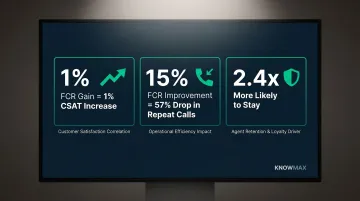
No single tool covers everything. High-performing support teams in 2026 run a layered stack: typically a ticketing platform, a live chat tool, a CRM, and a knowledge management system. The strongest results come from tools that integrate well with each other, not from hunting for one platform that does it all.
Knowledge management is the foundational layer that makes every other tool perform better. Without accurate, accessible knowledge, even the best helpdesk fails. Organizations using AI-driven knowledge management systems with established governance have seen a 20-40% reduction in issue volume, with 10-15% gains in accuracy.
Conclusion
The right customer service tools for 2026 are those that reduce friction for agents, not just for customers. The goal is faster resolutions, fewer escalations, and consistent quality at scale, regardless of channel or query volume.
Evaluate tools against your specific operational goals:
- Team size and growth trajectory
- Primary support channels (phone, chat, email, social)
- Existing integrations and technology stack
- Industry compliance requirements
- The KPIs that matter most to your business — FCR, AHT, CSAT, or agent onboarding speed
Don't default to the most popular option. The right tool fits your workflows, grows with your team, and moves the metrics you've committed to improving.
If slow or inconsistent knowledge access is limiting your agents, Knowmax's AI-powered knowledge management platform helps contact centers surface accurate answers faster — across chat, phone, and self-service. Book a demo or explore how Knowmax fits into your existing stack at Knowmax.ai.
Frequently Asked Questions
Which tool is most useful in helping customer service?
The right tool depends on your team's primary challenge. Zendesk and Freshdesk lead for ticket management; Knowmax for knowledge delivery and guided resolution; Intercom for messaging and chat. Most enterprise teams run a combination rather than relying on a single platform.
What are the tools for customer service?
The main categories include ticketing/helpdesk software (Zendesk, Freshdesk), live chat tools (Intercom, LiveAgent), knowledge management platforms (Knowmax), CRM systems (Salesforce Service Cloud, HubSpot), AI chatbots, and social media management tools. Teams typically use a layered stack combining multiple categories.
What are CRM tools used for customer service?
CRM tools used for customer service give agents a unified view of the customer's history, preferences, and prior interactions — enabling personalized, context-aware support. Tools like Salesforce Service Cloud and HubSpot Service Hub combine CRM data with helpdesk features to streamline both support and sales workflows.
What are the 5 C's of customer service?
The 5 C's of customer service are:
- Competence — ability to resolve issues effectively
- Courtesy — respectful, professional tone
- Communication — clear, timely information sharing
- Credibility — trustworthiness and reliability
- Consistency — same quality experience across every channel
What are examples of CRM tools?
Examples include Salesforce Service Cloud (best for large enterprises), HubSpot Service Hub (best for cross-team visibility), Zoho Desk (best value for AI-assisted CRM), and Kustomer (best for omnichannel CRM-support integration). Most now bundle helpdesk functionality alongside core CRM capabilities.
What is the 10/5/3 rule in customer service?
The 10/5/3 rule sets response time expectations: acknowledge within 10 seconds of contact, greet warmly within 5 seconds of a live interaction, and begin resolution within 3 minutes. It's most common in retail and high-volume contact center environments.