for Scaling Support Teams in 2026](https://file-host.link/website/knowmax-9pnv2t/assets/blog-images/554ff739-8e45-4a7f-818e-cae3a7bd71bc/1778157264295048_c4849a60e79f4e3eb8d3a96aa57b4ecb/360.webp)
Introduction
Hiring more agents doesn't automatically improve customer experience. Organizations face a scaling trap where new agents take 3 months on average to reach full proficiency, yet the average agent tenure is just 14 months. Over 20% of an agent's entire career is consumed by onboarding. Meanwhile, response consistency deteriorates, knowledge gaps multiply, and quality erodes even as headcount climbs.
Agent assist tools represent the operational shift that breaks this equation. Unlike autonomous AI chatbots that handle interactions independently, these solutions augment human agents in real time — surfacing knowledge, guiding resolution steps, and suggesting responses — without replacing them.
The financial stakes are substantial: $3.7 trillion in global sales are at risk from poor customer experiences, and 50% of loyal customers abandon brands after a single bad interaction.
This guide breaks down the most effective agent assist solutions available in 2026 — what they do, how they compare, and what to prioritize when your support team needs to scale without losing quality.
TLDR
- Agent assist solutions provide real-time AI guidance that helps agents resolve issues faster and more consistently
- The most effective 2026 solutions combine knowledge management, guided workflows, and deep CRM/telephony integrations
- Leading options include Knowmax, Zendesk AI Copilot, Salesforce Einstein, Forethought Assist, and Google Cloud CCAI
- Key selection criteria: integration capabilities, knowledge structuring, guided resolution support, and measurable KPI impact
- Match your choice to your core need: knowledge-first resolution, CRM-embedded assistance, or contact center-native support
What Is Agent Assist — and Why It's Critical for Scaling in 2026
Defining Agent Assist
Agent assist is software that provides real-time, contextual support to human agents during live customer interactions. It operates within the agent's existing workspace and delivers four core capabilities without interrupting the conversation:
- Suggested responses drafted from conversation context
- Knowledge article surfacing to find the right answer fast
- Guided troubleshooting steps for complex procedures
- Next-best-action prompts to keep agents on track
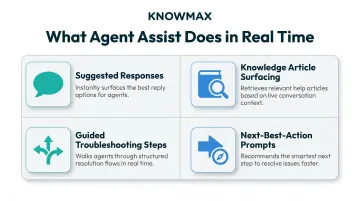
Think of it as a co-pilot: surfacing the right answer from a knowledge base or walking an agent through a complex process while the customer is still on the line.
The Scaling Pressure Driving Adoption
Support teams handling higher contact volumes with increasingly complex queries face a critical bottleneck. New agents struggle to ramp quickly, experienced agents become overwhelmed, and knowledge stays locked in individual heads rather than shared systems.
The business impact is measurable. According to recent research, 79% of customers expect consistent interactions across departments, yet 56% report having to repeat information to different representatives. This inconsistency directly correlates with churn—86% of customers will leave after just two poor experiences.
That gap between expectation and execution is exactly what agent assist is built to close. The five solutions below are evaluated on deployment fit, integration depth, and measurable outcomes — so you can find the right match for your team's scale and structure.
Key Features That Define Effective Agent Assist Solutions
Real-Time Knowledge Surfacing and AI Search
The foundation of any effective agent assist tool is its ability to instantly retrieve the right answer from a structured knowledge base based on live conversation context. Legacy keyword search fails here—agents searching for "billing issue refund" miss articles titled "payment dispute resolution process."
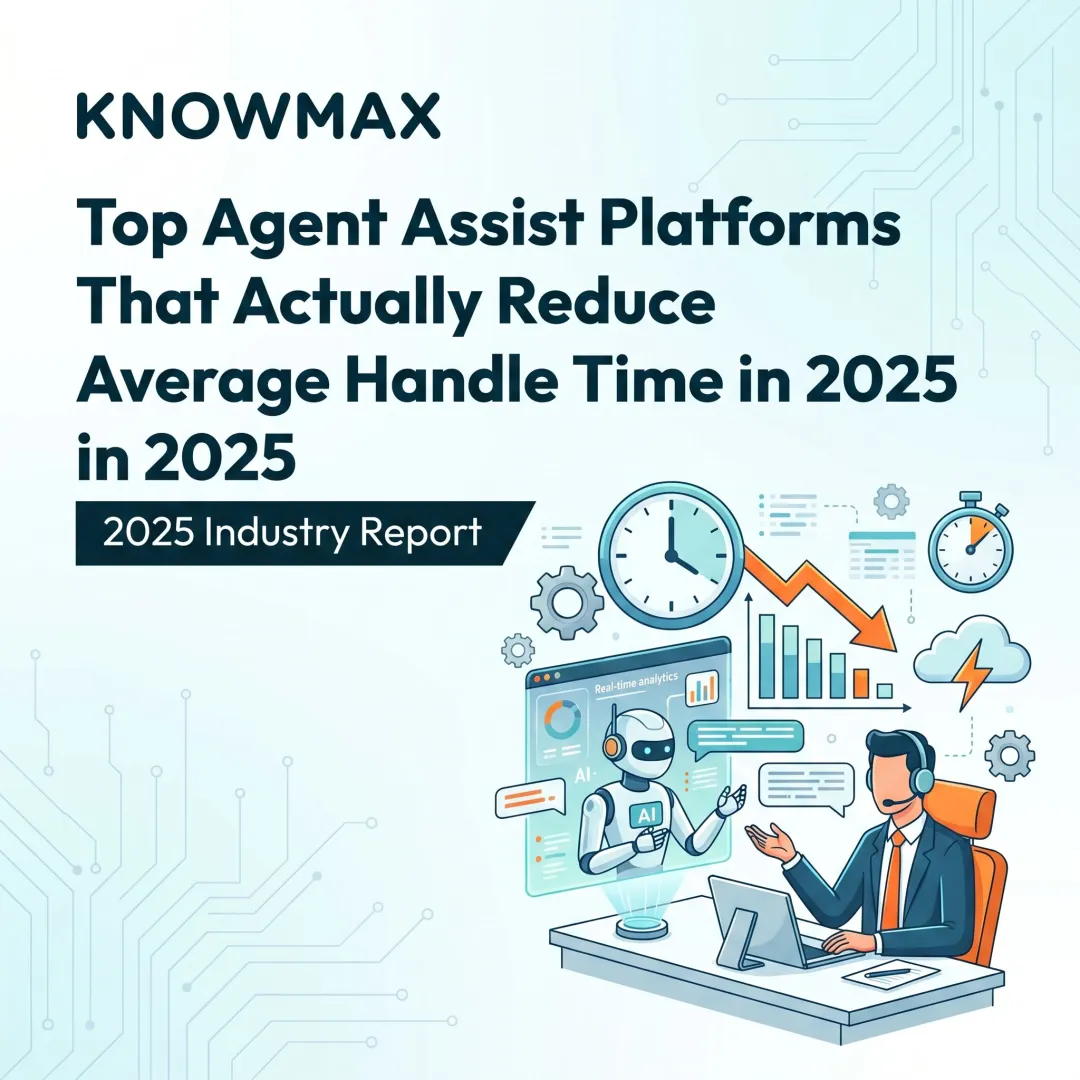
AI intent-based search understands what the agent needs, not just what they typed. Modern agent assist tools with AI-powered retrieval reduce Average Handle Time (AHT) by 20-30% because agents spend less time searching and more time solving. The distinction matters: faster answers mean shorter calls, fewer escalations, and better customer satisfaction.
Guided Resolution Workflows (Decision Trees)
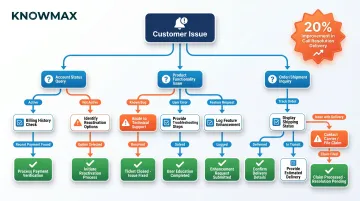
Interactive, branching decision trees walk agents step-by-step through issue diagnosis and resolution, reducing errors and eliminating the need to memorize complex procedures. Instead of an agent struggling to remember the 14-step process for a network outage diagnosis, the system guides them through each decision point based on customer responses.
This is especially impactful in high-variance environments like telecom, insurance, or banking. A leading fintech company achieved a 20% improvement in call resolution delivery using guided decision tree workflows. In insurance alone, where 46% of customers share bad experiences and 25% immediately switch providers, standardised workflows protect both consistency and retention.
Omnichannel and Integration Compatibility
Agent assist tools must work across the channels and platforms agents already use—CRM, telephony, messaging, ticketing systems. An assist layer that requires agents to toggle between windows defeats its own purpose.
Customer satisfaction reaches 67% with smooth omnichannel support versus just 28% for disconnected multichannel experiences. Integrated solutions also deliver a 31% reduction in first-resolution times and a 39% decrease in customer wait times.
Performance and Quality Analytics
Effective solutions provide visibility into:
- Which knowledge items agents use most (and which go ignored)
- Where agents deviate from recommended resolution paths
- Where bottlenecks slow down resolution times
- Whether poor outcomes stem from missing knowledge, unclear workflows, or skill gaps
That feedback loop is what separates a static automation tool from one that actually improves over time. Without it, support operations have no reliable way to distinguish a knowledge problem from a training problem — and both show up as the same symptom: poor resolution rates.
Top Agent Assist Solutions for Scaling Support Teams in 2026
These solutions were selected based on depth of agent-side functionality, integration ecosystem, deployment flexibility, and evidence of measurable impact on support KPIs like AHT, First Call Resolution (FCR), and Customer Satisfaction (CSAT).
Knowmax
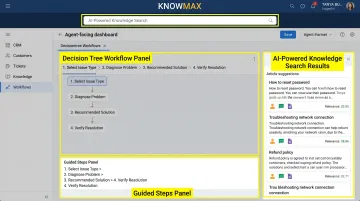
Knowmax is an AI-powered knowledge management and guided resolution platform trusted by global enterprises across telecom, banking, insurance, BPO, and eCommerce. It is purpose-built to serve as the knowledge backbone of support operations, equipping agents with structured, AI-searchable content and interactive decision trees accessible within their existing CRM or telephony interface.
Three capabilities define Knowmax's edge: AI-powered search that understands agent intent rather than just keywords, interactive decision trees for guided troubleshooting, and visual guides—all surfaced within existing workflows via integrations with Salesforce, Zendesk, Freshworks, Genesys, Talkdesk, and SAP.
Its AI authoring tools let knowledge managers create, translate (15+ languages), and update content rapidly, keeping the knowledge base accurate as products and policies evolve.
Customers like Vodafone, Airtel, Concentrix, and Walmart use Knowmax to reduce agent error, shorten onboarding time, and improve first call resolution at scale. One telecom operator achieved a 21% improvement in FCR after implementing Knowmax's decision tree workflows.
| Core Capability | AI-powered knowledge search, interactive decision trees, visual troubleshooting guides, AI authoring tools | | Integration Ecosystem | Salesforce, Zendesk, Freshworks, Genesys, Talkdesk, SAP, and custom CRM/telephony via API | | Best For | Enterprise support teams in telecom, banking, insurance, BPO, and eCommerce prioritizing guided resolution and consistent omnichannel knowledge delivery |
Zendesk AI Copilot
Zendesk AI Copilot is the agent-side AI assistance layer embedded within the Zendesk Suite, designed to help agents resolve tickets faster without leaving their existing workflow. It surfaces ticket summaries, suggested replies, and relevant knowledge articles directly within the agent workspace.
Its key strength is zero-friction adoption for teams already operating on Zendesk—no new platform, no separate interface. The Copilot draws on historical ticket data and knowledge base content to generate contextual suggestions, and it supports intelligent triage and macro recommendations.
However, there are limitations. Zendesk's search rules for knowledge sources have constraints: label-based search rules do not work for Confluence-imported knowledge sources, and accounts created before March 2026 lack certain filter parameters. For teams with segmented or regional knowledge bases, these restrictions may impact retrieval accuracy.
| Core Capability | In-workspace reply suggestions, ticket summaries, knowledge article surfacing, intelligent triage | | Integration Ecosystem | Native to Zendesk Suite; connects to Zendesk's app marketplace for CRM, telephony, and messaging integrations | | Best For | Support teams already standardised on Zendesk who want embedded AI assistance without adding new tooling |
Salesforce Einstein for Service (Agentforce)
Salesforce Einstein for Service, now packaged under the Agentforce framework, provides AI-powered agent assistance embedded directly within Service Cloud. It delivers next-best-action prompts, case classification, reply recommendations, and knowledge suggestions powered by real-time CRM data.
Its primary differentiator is the depth of CRM context it brings to each interaction. Agents receive suggestions informed by the customer's full purchase history, previous cases, and entitlements, enabling personalised, data-rich guidance.
However, implementation complexity and total cost of ownership are considerations. Salesforce uses a Flex Credits pricing model, with credits priced at $500 per 100,000 credits or per-conversation pricing at $2 per conversation. Agentforce for Service is priced at $125 per user tier. This consumption-based model requires careful forecasting and makes Einstein most suitable for organisations already invested in the Salesforce ecosystem.
| Core Capability | Next-best-action prompts, case classification, reply generation, knowledge surfacing with CRM context | | Integration Ecosystem | Native to Salesforce Service Cloud; AppExchange ecosystem for extended integrations | | Best For | Enterprises already on Salesforce CRM that need AI assistance deeply personalised to customer data |
Forethought Assist
Forethought Assist is a standalone AI layer that integrates with existing helpdesks (including Zendesk, Salesforce, and Freshdesk) to provide agents with real-time response suggestions, case summaries, and notably, knowledge gap detection that flags content missing from the help center.
For scaling teams, this dual function matters: it accelerates agent responses in the short term while proactively improving the knowledge base over time, flagging the questions neither agents nor the AI can answer with confidence.
Pricing is quote-based and usage-driven. Key figures to plan around:
- Average contract value: ~$55,500 (based on 49 purchases)
- Observed range: $33,484 to $155,000+; enterprise deployments can exceed $300,000
- Implementation costs: $10,000 to $50,000+
- Timeline: Engage vendors 60-90 days before go-live; implementation lead times are significant
This cost structure suits mid-market and enterprise teams with dedicated CX operations resources.
| Core Capability | Real-time reply suggestions, case summaries, knowledge gap detection, automated article creation prompts | | Integration Ecosystem | Zendesk, Salesforce, Freshdesk, and other major helpdesks via native connectors | | Best For | Mid-market and enterprise teams wanting agent assistance plus a continuous knowledge improvement loop |
Google Cloud CCAI Agent Assist
Google Cloud Contact Center AI (CCAI) Agent Assist is designed for contact center environments handling voice and chat at scale. It provides agents with real-time transcription, smart reply suggestions, and knowledge article surfacing during live calls and chats, all powered by Google's NLP and Dialogflow infrastructure.
Voice-channel support is where CCAI Agent Assist stands apart. Live call transcription and AI-generated recommended responses during phone interactions remain a gap for most helpdesk-native tools. The platform helps service reps handle 28% more conversations and delivers 15% quicker response times using Smart Reply.

Pricing is usage-based via Google Cloud, with chat sessions at $0.06 per session; voice pricing is available on request. Meaningful deployment typically requires integration work with existing telephony infrastructure using SIPREC endpoints and Session Border Controllers from AudioCodes, Ribbon, or Cisco, which makes it best suited to technically resourced enterprise contact centers.
| Core Capability | Real-time transcription, smart reply suggestions (voice + chat), knowledge surfacing, conversation summarisation | | Integration Ecosystem | Google Cloud ecosystem; integrates with leading CCaaS platforms and telephony via CCAI APIs | | Best For | Enterprise contact centers running high volumes of voice interactions who need real-time AI assistance during live calls |
How We Chose the Best Agent Assist Solutions
Solutions were assessed on agent-side functionality depth — not just chatbot deflection. That means evaluating integration flexibility with major CRM and telephony platforms, ability to manage knowledge at scale, and measurable impact on KPIs like AHT, FCR, and agent ramp time.
A common mistake buyers make: selecting agent assist tools based on autonomous resolution metrics (like deflection rate) rather than agent-side productivity gains. These measure entirely different things. Deflection rate can reward AI that frustrates customers into giving up, whereas resolution rate verifies the AI actually helped.
The factors that distinguish lasting value from superficial features include:
- Agents retrieve the right answer in under 10 seconds — no manual searching required
- Guided workflows cut decision errors instead of just digitizing existing chaos
- Knowledge managers can update content without filing an IT ticket
- The platform handles growing team complexity without forcing a future replacement
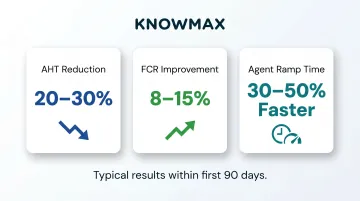
Industry data shows mature agent assist deployments deliver 20-30% AHT reduction, 8-15% FCR improvement, and 30-50% faster agent ramp time in the first 90 days. Those are the numbers that justify the investment — and the baseline any serious evaluation should hold vendors accountable to.
Conclusion
Scaling support in 2026 means making every agent faster, more accurate, and more consistent from their first day on the floor. Agent assist solutions are the operational layer that enables this transformation.
The right choice depends on where your team operates, what systems you've already invested in, and how structured your knowledge environment is:
- Zendesk-native teams may prioritise embedded simplicity and in-ticket guidance
- Salesforce organisations will value deep CRM context surfaced at the point of interaction
- Contact centres with high voice volumes need real-time transcription and response suggestions
- Enterprises with complex product sets benefit from AI search, decision trees, and visual guides across all channels
Evaluate solutions against your actual agent workflows and knowledge management maturity, not vendor demo scenarios. The best agent assist platform is the one that fits how your agents actually work, delivers measurable KPI improvements within 90 days, and grows with your operational complexity.
If knowledge-first guided resolution is your priority, see how Knowmax supports agent teams across telecom, banking, insurance, and eCommerce through AI-powered search, interactive decision trees, and integrations with Salesforce, Zendesk, Genesys, and more.
Frequently Asked Questions
What are the most effective tools for scaling customer support operations?
Agent assist tools—AI-powered knowledge platforms, guided decision trees, and in-workspace copilots—are among the most effective for scaling. They improve per-agent efficiency and consistency without requiring proportional headcount growth, reducing ramp time and standardising quality across the team.
What is the difference between agent assist and autonomous AI agents in customer support?
Agent assist tools augment human agents in real time by surfacing knowledge and guiding resolution, while autonomous AI agents handle customer interactions independently without human involvement. Agent assist enhances agent performance; autonomous agents replace it. The two approaches serve different operational goals and are often deployed together.
How does agent assist software reduce average handle time (AHT)?
AHT is reduced because agents no longer need to search for answers manually or navigate complex procedures from memory. AI surfacing and guided workflows deliver the right information at the right moment, shortening each interaction and reducing after-call work.
What features should I prioritise when evaluating agent assist solutions?
Prioritise real-time AI knowledge search, guided resolution workflows, integration with existing CRM/telephony platforms, and performance analytics that enable continuous improvement. These four capabilities are where measurable productivity gains are won or lost.
Can agent assist tools integrate with CRM and helpdesk platforms like Salesforce or Zendesk?
Yes. Most enterprise agent assist solutions offer native or API-based integrations with major platforms. Verify that the integration surfaces information within the agent's active workspace rather than requiring a separate window or login. That single distinction has an outsized impact on adoption rates.
How long does it take to deploy an agent assist solution and see results?
Deployment timelines range from a few weeks for helpdesk-native tools with existing knowledge bases to several months for standalone platforms that require knowledge structuring and CRM integration. Measurable AHT and FCR improvements typically appear within the first few months after go-live, with full payback at 6–12 months depending on team size and complexity.