Introduction
Contact center agents manage between 50 and 100 calls daily, navigating up to 20 different applications per interaction while recalling product details, policies, and procedures on the fly. Yet traditional coaching systems can't keep up: organizations review just 2-3% of customer conversations, meaning the vast majority of errors go undetected and uncorrected.
Timing is the deeper problem. Most feedback arrives hours or days after a call ends, when agents have already lost the context. Research on the Forgetting Curve shows agents lose up to 70% of new information within 24 hours without immediate reinforcement. And 60% of failed first-contact-resolution attempts come down to agents simply not having the right information during the call.
This guide covers exactly how AI delivers feedback to agents during live interactions, and why shifting from post-call coaching to in-call guidance changes both agent performance and customer outcomes.
TL;DR
- AI monitors live interactions and delivers in-the-moment guidance — not hours-later coaching
- Continuously analyzes conversation signals against knowledge bases and performance rules
- Common feedback types: answer suggestions, sentiment alerts, compliance prompts, and next-best-action recommendations
- Cuts handling time, reduces escalations, improves first-contact resolution, and speeds up new-hire ramp-up
- Agents catch and correct mistakes mid-conversation — not after the call is already over
What Is Real-Time AI Feedback for Customer Service Agents?
Real-time AI agent feedback refers to systems that monitor live customer interactions across voice or digital channels and deliver contextually relevant guidance—such as answer suggestions, tone alerts, or resolution steps—directly in the agent's interface without requiring manual search.
Unlike post-call quality scoring (which reviews completed interactions), AI chatbots (which replace agents entirely), or static knowledge bases (which require manual searching), real-time AI is assistive, in-context, and proactive — it works alongside the agent during the conversation.
IBM defines agent assist as technology where "machine learning and artificial intelligence provide customer service representatives with relevant information in real time" for more effective support. Gartner classifies the agent assistant as a "likely win" use case—both high-value and highly feasible—because it helps agents source insights and provide real-time answers to queries.
Why This Capability Exists Now
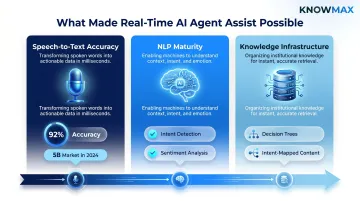
Three technical advances made real-time agent assist viable:
Speech-to-text accuracy and speed: Commercial automatic speech recognition (ASR) systems now exceed 92% transcription accuracy with processing times measured in hundreds of milliseconds. The speech-to-text API market reached $5 billion in 2024 and is projected to grow at 15.2% CAGR toward $21 billion by 2034.
Natural language processing maturity: NLP models can now identify customer intent, detect sentiment shifts, and extract key conversation elements in near real time — understanding not just what customers are asking, but how they're feeling as the conversation unfolds.
Knowledge infrastructure improvements: Modern knowledge platforms structure content as intent-mapped articles, decision trees, and guided workflows. This makes it possible for AI to retrieve precise, context-matched answers — rather than generic results — during the interaction itself.
A decade ago, supervisors had to "whisper" into agent headsets to provide real-time guidance. Now AI does it automatically, at scale, across every interaction.
How Does Real-Time AI Feedback Work?
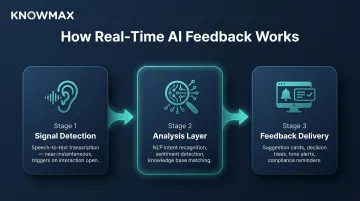
Real-time AI feedback runs as a continuous, multi-stage process parallel to the live interaction — from the moment a call or chat opens until resolution. Here's how each stage works.
Signal Detection
AI begins by listening to or reading the interaction in real time. For voice channels, speech-to-text transcription converts spoken language into analyzable text continuously; for digital channels, chat content is read as it arrives. This process is near-instantaneous and doesn't require the call to end before analysis begins.
The whole process triggers automatically the moment an interaction opens in the agent's workspace — no manual action required.
Analysis Layer
NLP and intent recognition models analyze the transcribed or written conversation to identify:
- What the customer is asking
- How they are feeling (sentiment)
- What stage of the interaction is underway
The system connects this context to performance rules, compliance requirements, and the organization's knowledge base.
Accuracy at this step depends directly on the quality of the underlying knowledge system. A platform with well-structured content, decision trees, and intent-mapped articles lets the AI retrieve precise, relevant guidance rather than generic suggestions.
Knowmax approaches this using AI-based intent identification combined with keyword and context-based search, surfacing the most relevant documents or solutions for the specific moment in the conversation.
Feedback Delivery
The analyzed output appears on the agent's screen as:
- A suggestion card
- A prompted knowledge article
- A decision tree path
- A tone alert
- A compliance reminder
All guidance surfaces within the agent's existing workspace—no tab-switching or search required. Knowmax, for example, integrates with platforms like Salesforce, Zendesk, Genesys, and Talkdesk, embedding actionable knowledge directly into the agent's workflow through browser extensions and platform-native integrations.
AI applies relevance thresholds and contextual rules to decide what to surface and when, filtering out noise so agents receive guidance only when the conversation signals a specific need—not constant pop-ups.
Types of Real-Time Feedback AI Can Deliver to Agents
Real-time AI doesn't deliver a single type of feedback—it operates across several distinct modes, each addressing a different agent need during an interaction.
Instant Answer and Knowledge Suggestions
When the customer's question or issue is detected, AI surfaces the most relevant knowledge article, FAQ answer, or step-by-step resolution guide directly in the agent's workspace, eliminating manual searching and reducing response lag.
McKinsey research shows employees spend nearly 20% of their workweek searching for information across documents, emails, and internal systems. In contact centres, agents must access upward of 20 different applications during a single interaction, creating cognitive load and hold time.
The cost of search delays is measurable: 60% of customers will hang up if hold time exceeds two minutes, and only 34% are willing to wait six minutes. The average hold time is 69.4 seconds — a figure real-time knowledge surfacing directly attacks by pushing relevant answers automatically.
Knowmax addresses this through AI-powered search that understands intent, not just keywords, and by transforming complex procedures into interactive decision trees that guide agents step-by-step through resolutions.
Sentiment and Tone Alerts
AI continuously monitors language patterns and vocal cues (on voice channels) to detect customer frustration, confusion, or escalation risk. When negative sentiment is detected, the agent receives a real-time alert to adjust tone, offer empathy, or loop in a supervisor, before the customer disengages.
Sentiment detection accuracy ranges from 70% to 90% on clean datasets, with real-world production accuracy between 60% and 80%. Not infallible — but directionally reliable enough to flag probable frustration while a call is still live.
The coverage gap this closes is striking:
- 45.7% of contact centres don't track customer emotion at all
- Most support teams manually review only 1–2% of inbound messages for sentiment
- Real-time AI systems analyse every conversation in under a second
In Balto's insurance case study, deploying real-time guidance that included sentiment-informed prompts correlated with CSAT scores rising from 75% to 94%, a 19-point improvement.

Compliance and Script Adherence Prompts
For regulated industries like banking, insurance, or healthcare, AI can flag when required disclosures, legal phrases, or policy steps have been missed mid-interaction, allowing the agent to correct course before the call ends.
Non-compliance carries real costs: the HHS Office for Civil Rights imposed $13.5 million in HIPAA fines in 2020, with maximum penalties reaching $2.19 million per violation category per year.
Research from Balto found that 66% of contact centre agents want to change their scripts, suggesting widespread deviation from approved language. Deploying real-time guidance instilled "more uniformity in agent interactions" by matching key phrases to clear scripting prompts during live calls.
Knowmax supports compliance through real-time guided workflows and decision trees integrated into agent interfaces, providing step-by-step instructions that ensure adherence to regulatory standards during interactions. The platform also enables automated updates and notifications, so agents always have access to the latest compliant scripts.
Next-Best-Action Recommendations
Based on conversation context and the customer's history, AI can suggest the most appropriate next step: offering a targeted solution, escalating the issue, or surfacing a product relevant to the customer's situation.
Knowmax retrieves that history through native integrations with:
- Salesforce, Zendesk, and Freshworks
- Genesys and Talkdesk (CCaaS platforms)
This context feeds directly into the agent's workspace, reducing average handling time and improving first-contact resolution without requiring agents to switch between systems.
Live Quality Scoring Nudges
Some AI systems calculate a real-time quality score as the interaction progresses, surfacing cues when the conversation drifts away from resolution benchmarks. If handle time is running long or the agent hasn't confirmed issue resolution, a prompt surfaces immediately — while there's still time to course-correct.
The Business Impact of Real-Time AI Agent Feedback
First-Contact Resolution Improvements
When agents receive accurate answers during the interaction rather than guessing or placing customers on hold to search, the likelihood of resolving the issue in a single interaction increases. SQM Group's 2025 research places the industry-average FCR rate at 70%, with 60% of failed FCR attempts caused by agents lacking the right data or resources during the call.
Real-time knowledge surfacing targets this root cause directly. In healthcare, where industry FCR averages sit between 55% and 65%, AI-assisted voice agents regularly achieve 80% to 85% FCR—a 15- to 30-point improvement over unassisted performance.
A leading telecommunications company achieved a 21% improvement in FCR accuracy after deploying Knowmax's real-time agent assist capabilities, demonstrating the practical impact of instant knowledge delivery.
Compressed Onboarding and Ramp-Up Time
The typical agent ramp-up time—from hire to minimum proficiency—ranges from 60 to 90 days. High attrition compounds the cost: agent turnover averaged 52% annually in 2023.
New agents who would typically take weeks to develop proficiency can handle complex queries confidently from their first days when AI bridges the knowledge gap in real time.
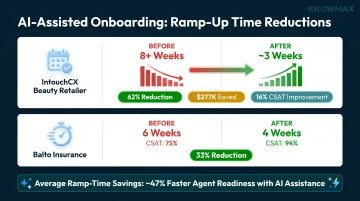
Documented ramp reductions:
- IntouchCX's beauty retailer case: Reduced ramp time from 8+ weeks to ~3 weeks—a 62% reduction—saving $277K, with 16% CSAT improvement and 93% of associates citing better technology as a driver of job satisfaction
- Balto's insurance case: Compressed onboarding from 6 weeks to 4 weeks—a 33% reduction—while CSAT climbed from 75% to 94%
Reduced Average Handle Time
Industry AHT benchmarks cluster around 6 to 7 minutes per call, with an average cost of $5.50 per inbound call. Even modest per-call time savings compound into significant capacity gains.
Documented AHT reductions:
- Balto's multinational insurer: Reduced AHT by 50 seconds per call, enabling agents to handle 4 additional calls daily
- Food delivery app using Knowmax: Achieved 15% AHT reduction alongside 10% C-SAT increase
- Fortune 500 retailer with Knowmax: Achieved 13% reduction in handling time through visual guides and next-best-action workflows
Shorter calls are a byproduct of agents who know what to do next — not a target they're chasing.
Lower Escalation Rates
QLM Business Solutions reports an average escalation rate of 10% for unresolved calls, with customers transferred an average of 2.6 times before resolution. SQM Group places the industry-standard call transfer rate at 19%, with 15% or less considered strong.
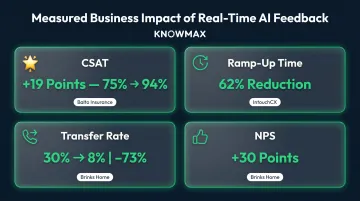
When agents catch frustration signals early, they can de-escalate proactively rather than reactively—reducing the volume of calls requiring supervisor intervention. Brinks Home reduced its transfer rate from 30% to 8%—a 73% improvement—after deploying Cresta's real-time guidance and sentiment analysis, while also achieving a 30-point NPS increase.
Higher Customer Satisfaction Scores
SQM Group defines a "good" CSAT score as 75% to 84% and "world-class" as 85% or higher, achieved by only 5% of call centres.
By enabling faster, more accurate, and more empathetic interactions, real-time AI feedback directly influences CSAT and FCR metrics:
- Balto insurance case: CSAT rose from 75% to 94% (+19 points)
- IntouchCX beauty retailer: 16% CSAT improvement
- Brinks Home with Cresta: +30 NPS points
The connection between agent wellbeing and customer outcomes runs deeper than most metrics capture. Cresta's State of the Agent Report 2024 found that agents receiving personalised AI coaching reported 91% workplace happiness, versus 57% for those with standard coaching—a 34-point gap. Reduced burnout and lower turnover translate directly into more consistent, higher-quality customer interactions.
Conclusion
The defining value of real-time AI feedback lies in its timing: it converts the live interaction from a high-pressure, memory-reliant event into a guided, knowledge-supported exchange—consistently, across every agent and every channel.
Contact centre leaders evaluating AI investments should look not just at post-call analytics tools, but specifically at systems that intervene during interactions. The quality of that guidance depends entirely on the knowledge infrastructure behind it.
Platforms like Knowmax are built on this principle. When knowledge infrastructure combines AI-powered semantic search, structured decision trees, automated maintenance, and content governance, agents consistently access current, approved content at the moment they need it. The result is faster resolutions, higher first-call resolution rates, and guidance that actually changes outcomes during the conversation — not after it ends.
Frequently Asked Questions
How can AI help customer service agents?
AI helps agents by surfacing relevant information, detecting customer sentiment, flagging compliance gaps, and suggesting next steps during live interactions. This reduces cognitive load, eliminates manual searching, and improves response accuracy in real time.
What is real-time AI agent assist in a contact centre?
AI agent assist refers to AI tools that run alongside live interactions, analyzing conversation content and delivering contextual guidance—such as answer suggestions or escalation prompts—directly in the agent's interface without requiring manual searching or screen toggling.
How does AI detect customer sentiment during a live call?
AI uses speech-to-text transcription combined with NLP models to analyze tone, language patterns, and word choice in under a second. When it detects emotional signals like frustration or dissatisfaction, it alerts the agent immediately so they can adjust their approach mid-conversation.
Does real-time AI feedback replace human supervisors?
No. Real-time AI handles in-call guidance at scale, which frees supervisors to focus on escalations, coaching strategy, and complex exceptions rather than monitoring every interaction manually.
What types of interactions benefit most from real-time AI feedback?
High-volume, time-sensitive interactions—particularly in regulated industries like banking, telecom, and insurance—and interactions handled by newer agents benefit most. These scenarios involve the highest risk of error, compliance gaps, or knowledge shortfalls mid-call.
How does real-time AI feedback affect customer satisfaction scores?
Published case studies show CSAT improvements of 15 to 20 percentage points when real-time AI assist is deployed. Customers get accurate answers on the first attempt—without holds or unnecessary transfers—which directly lifts both CSAT and FCR scores.