Introduction
B2B support agents operate under pressure B2C teams rarely face: multi-stakeholder accounts, technically complex products, and enterprise relationships where a single wrong answer can jeopardize renewal. Yet most teams still rely on fragmented, keyword-based knowledge systems built for far simpler scenarios.
The operational cost is real:
- Agents spend nearly 20% of their time searching for information across siloed systems while customers wait
- First Call Resolution rates sit at just 69% industry-wide, largely due to inconsistent answers
- New hires take 8–12 months to reach full productivity, dragging onboarding costs higher
This article breaks down exactly how AI addresses these structural knowledge management problems — and what that means for resolution speed, answer consistency, and agent ramp time.
TLDR
- AI intent-based search surfaces the right answer even when agents aren't sure what to look for — no slow keyword matching required
- Automated gap detection identifies missing or outdated knowledge before it causes resolution failures
- AI authoring tools cut content creation time and auto-translate across 25+ languages
- Guided resolution flows ensure even new agents handle complex B2B scenarios accurately and consistently
- The result: measurable gains in FCR, CSAT, agent onboarding speed, and omnichannel consistency
Why Traditional Knowledge Management Falls Short for B2B Support Teams
B2B support demands far more than standard FAQs can deliver. Enterprise interactions involve technical complexity, account-specific configurations, multiple stakeholders within a single organization, and relationships that span years. A single incorrect answer can jeopardize a six-figure renewal.
Traditional knowledge bases fail this test structurally. They're static snapshots that go stale the moment a product updates or an SLA requirement shifts. Agents routinely encounter outdated articles with no reliable way to know what's missing or wrong.
Three specific failure patterns drive the gap:
Fragmented Knowledge, Inconsistent Answers
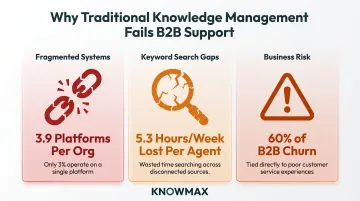
Critical resolution knowledge scatters across internal wikis, email threads, PDFs, and individual agent expertise. Only 3% of contact centers operate on a single platform, with the average organization managing 3.9 different systems. The same question gets five different answers from five agents — eroding exactly the kind of trust enterprise clients expect.
Keyword Search That Can't Keep Up
When an agent types a technical error code or product-specific query, keyword matching returns irrelevant results or nothing at all. Knowledge workers spend 5.3 hours per week waiting for information or recreating undocumented knowledge. Agents escalate or improvise, and both outcomes inflate handle time and error rates.
Real Business Risk at Stake
60% of B2B customers who left a vendor cited poor customer service as the reason. In enterprise accounts, inconsistent or incorrect support directly threatens renewal and expansion. B2B customers have far less tolerance for repeated failures than B2C consumers — and that's exactly where AI-powered knowledge management changes the equation.
How AI Transforms Knowledge Management: Core Capabilities
Intent-Based AI Search
AI search understands what an agent means, not just the words they type. When an agent asks "why is the dashboard not loading after migration," AI surfaces the exact troubleshooting article even if that article never uses those exact terms. It interprets semantic intent, matching queries to solutions based on meaning and context.
This matters especially in B2B environments where technical terminology varies widely and issue descriptions are never standardized. GenAI-enabled agents achieved a 14% increase in issue resolution per hour and a 9% reduction in handle time, according to McKinsey research.
In one enterprise case study, AI-powered knowledge retrieval reduced average search time from 23 minutes to 4 minutes for a 50-person team — recovering 79 hours of productivity per day, equivalent to 10 full-time employees.
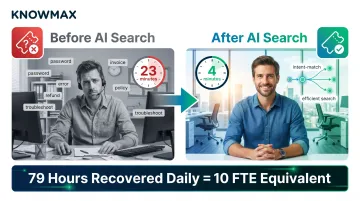
Knowmax's AI-powered search delivers this across all knowledge formats, surfacing decision trees, visual guides, and articles instantly based on query intent rather than keyword matching.
AI-Powered Content Authoring and Maintenance
Creating technical B2B knowledge has historically required subject matter experts to spend hours writing, editing, and translating content. AI authoring tools change this equation.
Support teams can now handle content production without burdening SMEs:
- Draft new articles from bullet points
- Rephrase existing content for clarity
- Auto-summarize long resolution threads
- Translate content across 25+ languages
Knowmax's AI author tools cover all four — a practical advantage for global B2B operations serving enterprise clients across regions.
88% of support teams offer multilingual service, yet only 28% of customers actually receive support in their native language. 70% of customers feel more loyal to companies that do, and 35% would switch products to get it. AI translation closes this gap without adding headcount.
Automated Knowledge Gap Detection
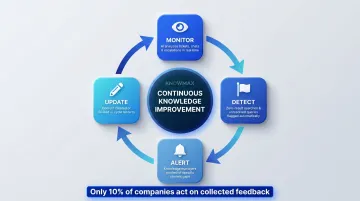
Traditional knowledge management is reactive. Teams discover gaps when agents escalate or customers complain. AI flips this model by continuously analyzing support interactions — tickets, chat logs, escalations — to identify topics lacking adequate coverage.
Instead of waiting for quarterly audits, the platform flags gaps in real time as agents encounter unresolved queries. Knowledge base maintenance shifts from a periodic chore into a continuous, data-driven process.
Knowmax tracks zero-result searches, unused content, and micro-segmented engagement patterns, surfacing exactly where knowledge deficiencies exist before they cause resolution failures.
95% of companies collect customer feedback, but only 10% use it to drive improvements — and only 5% close the loop with customers. Automated gap detection addresses this directly, turning passive data into actionable knowledge updates.
Guided Resolution Flows for Complex B2B Scenarios
Complex B2B products demand structured troubleshooting. The correct diagnosis often depends on configuration, account type, symptom sequence, and product version. Decision trees and guided workflows ensure agents navigate these paths consistently.
For example, a fintech startup using decision trees achieved a 20% improvement in call resolution and reduced average handle time by 35 seconds — directly attributable to standardized workflows that newer agents could follow confidently from day one.
Knowmax provides interactive decision trees and visual troubleshooting guides that give even newer agents the same resolution accuracy as experienced ones, reducing escalations and eliminating guesswork.
Continuous Content Quality and Freshness
AI doesn't just create content — it monitors performance. The platform tracks which articles successfully resolve issues versus which consistently lead to escalations or re-contacts, automatically surfacing underperforming content for human review.
This feedback loop ensures the knowledge base actively improves alongside the evolving B2B product and support landscape. Knowmax's analytics identify content gaps, track time spent per article, and flag outdated information, enabling knowledge managers to prioritize updates based on actual impact rather than guesswork.
The Business Impact: Key Benefits for B2B Support Teams
FCR Gains and Faster Handle Times
When agents retrieve precise, guided answers instantly, they resolve issues in the first interaction more often and faster. The industry average FCR rate is 69%, with only 5% of call centers achieving world-class performance (80%+). Every 1% FCR improvement delivers $286,000 in annual savings for a midsize call center and increases interactional NPS by 1.4 points.
Knowmax deployments have achieved measurable results:
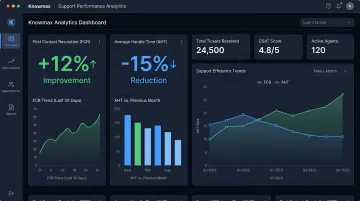
- 21% improvement in FCR for a leading telecommunications company
- 15% reduction in average handle time for a major food delivery app
Single Source of Truth Across Every Channel
AI-powered knowledge management enforces a single source of truth. Whether a B2B client contacts support via phone, chat, email, or self-service portal, they receive the same accurate, up-to-date answer. This eliminates the inconsistency that damages enterprise relationships.
Knowmax delivers knowledge from a centralized repository across:
- Agent desktops
- Self-service portals
- Chatbots and mobile apps
- Websites and voice channels
Real-time updates reach all channels simultaneously — no lag, no version drift.
Shorter Onboarding, Faster Productivity
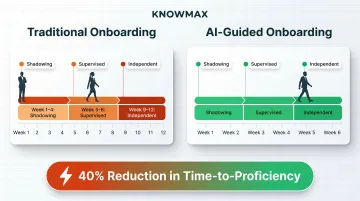
With AI-guided knowledge access and structured resolution flows, new agents handle complex B2B queries confidently from day one instead of shadowing colleagues for months. New contact center agents take 8-12 months to match tenured productivity, yet annual turnover runs 34%.
Knowmax has documented a 40% reduction in time to proficiency for new agents, using interactive decision trees and instant AI search to guide agents through complex queries from day one. One manufacturing sector case study showed onboarding time reduced by 50% — from 12 weeks to 6 weeks.
Those numbers matter when replacing a single agent costs $10,000–$20,000, with training accounting for 47% of total turnover cost. Faster onboarding cuts directly into that figure.
How Resolution Quality Drives Retention and Revenue
Faster resolution, fewer errors, and consistent service drive the business outcomes B2B support leaders care about most: higher customer satisfaction, lower churn, and expansion opportunities.
- 95% of customers continue doing business when FCR is achieved
- 50% of B2B buyers switched vendors in the past year due to poor service
- A 5% increase in retention boosts profits by 25% to 95%
For Knowmax customers like Vodafone and Jupiter, these aren't projections — they're measured outcomes tied to consistent, channel-wide knowledge delivery.
Building an AI-Ready Knowledge Base for B2B Support
Structure Content for AI Consumption
AI systems require well-structured, clearly written content to deliver accurate results. Apply these foundational practices:
- Use clear, unambiguous language without excessive jargon
- Apply consistent taxonomy and metadata tagging
- Organize articles with proper headings and structured formatting
- Avoid image-only content that AI cannot process
B2B knowledge bases should also include technical documentation types often missing from consumer-facing systems:
- Product specifications and integration guides
- Escalation procedures and account-specific configurations
- Troubleshooting workflows and device setup instructions
Knowmax supports multiple content formats — FAQs, visual guides, decision trees, and technical articles — with interlinking capabilities that connect related content into a single, navigable structure.
Use Live Interaction Data to Seed and Improve Coverage
The fastest way to build high-coverage B2B knowledge is systematically mining resolved support tickets, agent collaboration threads, and escalation records. This captures tribal knowledge in structured, reusable articles before experienced agents leave.
42% of institutional knowledge is unique to individual employees, and tacit knowledge represents approximately 80% of an organization's total knowledge base. Median employee tenure for workers aged 25-34 is only 2.7 years. Documenting this expertise proactively is critical.
Knowmax enables bulk content uploads and AI-assisted content generation from existing resources, accelerating knowledge base population without burdening SMEs.
Establish Governance for Continuous Updates
Capturing knowledge is only half the work — keeping it accurate requires lightweight but consistent governance:
- Assign article ownership by product area to ensure accountability
- Trigger mandatory reviews when products update or policies change
- Use AI performance signals (gap flags, deflection rates) to prioritize updates
Knowmax provides article ownership assignment, maker-checker approval workflows, content scheduling, and archiving capabilities. AI-driven analytics identify zero-result searches and underperforming content, enabling knowledge managers to focus updates on high-traffic, low-performing articles first.
Frequently Asked Questions
What is the role of AI in knowledge management?
AI makes knowledge management dynamic rather than static. It accelerates content creation, surfaces relevant information through intent-based search, automatically flags gaps by analyzing live interactions, and refines knowledge quality using real usage data — all without manual intervention.
How to use AI to improve customer support?
Start with AI-powered search so agents retrieve answers in seconds, then layer in automated content maintenance and guided resolution flows for complex issues. Together, these reduce handle time, improve first-contact resolution, and accelerate new agent ramp-up.
Which AI tool is best for automating customer support?
The best fit depends on your organization's needs. B2B teams with complex technical products benefit most from platforms combining AI search, knowledge creation tools, and guided resolution flows. Integration capability with existing CRM and helpdesk systems is a critical selection criterion — the right platform works alongside your existing infrastructure, not against it.
What is the AI strategy in B2B?
A B2B AI strategy should start with knowledge management as the foundation. AI cannot deliver accurate, consistent support without a well-structured, continuously maintained knowledge base. Build from there — adding automation, guided resolution, and omnichannel delivery tied to measurable goals like FCR improvement and churn reduction.
How does AI help agents find information faster during live support interactions?
AI search interprets query intent — not just literal keywords — and surfaces the most relevant articles, decision trees, or troubleshooting guides in real time. Even complex B2B queries with varied terminology return accurate results in seconds.
Can AI-powered knowledge management reduce agent onboarding time?
Yes. AI-guided resolution flows and instant knowledge retrieval allow new agents to handle complex queries accurately from early in their tenure with less reliance on senior colleagues. This compresses the time to full productivity — Knowmax has documented a 40% reduction in time-to-competency for new agents.