Introduction
Support teams are under serious pressure: 77% of agents report their workload has increased over the past year, yet 56% are already experiencing burnout. At the same time, 75% of customer service reps saw their highest-ever ticket volume in 2024, while customers increasingly demand faster, more personalized service.
The result is a widening gap between what customers expect and what understaffed, under-equipped teams can realistically deliver.
Agent performance is not purely a hiring or training problem. When knowledge workers spend 30% of their workday searching for information, even skilled agents underperform. This is an infrastructure problem. Agent enablement software fixes that infrastructure gap — giving agents instant access to the right answers, guided workflows, and contextual knowledge exactly when they need it.
This article examines what agent enablement software is, the specific tool categories that comprise this stack, and the measurable advantages it delivers — all focused on real operational outcomes, not vendor feature lists.
TL;DR
- Agent enablement software equips support agents with the information, guidance, and workflow support needed to resolve customer issues faster and more accurately
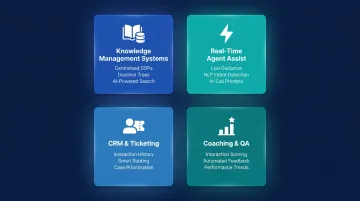
- Core tool categories include knowledge management systems, real-time agent assist tools, CRM and ticketing platforms, and coaching and QA software
- Teams that deploy these tools see faster issue resolution, shorter agent onboarding cycles, and consistent service quality as volume scales
- Without this infrastructure, teams face inconsistent outcomes, high error rates, and difficulty scaling support without proportionally growing headcount
- Gains build as knowledge bases mature — teams that start early typically reach full operational efficiency months ahead of those that delay
What Is Agent Enablement Software?
Agent enablement software is the category of tools designed to help human support agents do their jobs more effectively. It covers everything from surfacing the right information at the right moment, to guiding agents through complex resolution workflows, to helping managers identify coaching opportunities. The key distinction: unlike customer-facing automation (chatbots, IVR), agent enablement tools support the person handling the interaction — they don't replace them.
Agent enablement software is typically deployed within contact centres, BPO environments, and enterprise customer support teams where agents handle high volumes of diverse queries across channels. It works alongside CRM, ticketing, and telephony infrastructure — not instead of it. The goal is consistent, accurate support across every interaction — not a replacement for existing infrastructure, but an enhancement of it.
Most support team underperformance traces back to the same problem: agents spending time searching for answers, delivering inconsistent responses, or escalating issues that structured guidance could have resolved. Agent enablement software tackles exactly that.
The Core Types of Agent Enablement Software
Agent enablement is not a single product but a stack of complementary tools. The most effective support operations use several of these categories together. Gaps in any one area tend to create bottlenecks.
Knowledge Management Systems
Knowledge management systems serve as the single source of truth for support agents — centralising SOPs, product documentation, troubleshooting guides, and policy content in one indexed repository. Without this, agents waste time searching across disconnected sources or relying on tribal knowledge, leading to inconsistent and often incorrect answers.
Contact centre agents spend only 39% of their time actually servicing customers — the remainder is consumed by internal meetings, administrative tasks, and manual case logging. Much of this lost time stems from fragmented knowledge access.
AI-powered knowledge management platforms address this by using intent-based search, interactive decision trees, and visual troubleshooting guides to surface contextually relevant answers in real time. Platforms like Knowmax reduce the cognitive burden on agents during live interactions by eliminating manual navigation across multiple systems. Agents equipped with visual guides and decision trees handle complex queries faster and with greater accuracy.
Key capabilities to look for:
- AI-driven search (understanding intent, not just keywords)
- Guided resolution workflows (decision trees)
- Multi-language content support
- CRM/telephony integration
Real-Time Agent Assist Tools
Real-time agent assist software functions as an in-conversation intelligence layer: it listens to or reads live interactions and surfaces relevant answers, suggested responses, compliance cues, and next-best-action prompts directly in the agent's workspace — without requiring the agent to leave the interaction to search.
These tools use natural language processing (NLP) and intent detection to understand what the customer is asking, then pull relevant information from connected knowledge bases and CRM data.
Organisations using AI-powered real-time guidance achieve a 2.3x greater year-over-year increase in First Contact Resolution (FCR) rates compared to those without. The same research found these organisations achieve a 3.5x greater year-over-year increase in Customer Satisfaction (CSAT) scores.
Real-time guidance reduces agent error, lowers escalation rates, and cuts handle time — gains that compound directly into the CSAT and FCR improvements the data above reflects. That performance foundation is what CRM and ticketing tools build on next.
CRM and Ticketing Systems
CRM platforms give agents immediate access to a customer's interaction history, account details, past tickets, and preferences — enabling personalised, context-aware responses without asking customers to repeat themselves. Ticketing systems complement this by organising, routing, and prioritising incoming queries so agents spend time resolving issues rather than manually triaging them.
Connecting CRM, ticketing, and knowledge tools creates a unified agent workspace. Common platforms include Salesforce, Zendesk, Freshdesk, and Genesys — but integration depth matters. Done well, this consolidation delivers:
- Reduced context-switching during live interactions
- Eliminated redundant data entry
- Real-time access to current customer information
- Lower handle time through fewer system toggles
Coaching and Quality Assurance Tools
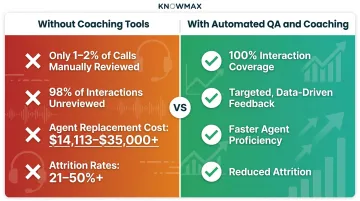
Coaching and QA software closes the performance feedback loop: by automatically scoring interactions, detecting sentiment and compliance risks, and surfacing coaching opportunities, these tools help managers scale quality oversight beyond the small percentage of calls that can be manually reviewed. Most contact centres rely on manual sampling of only 1–2% of calls for quality assurance, meaning 98% of interactions go unreviewed.
Automated QA tools enable 100% interaction coverage, surfacing errors, compliance gaps, and coachable moments as they happen. Agents receive targeted, data-driven feedback instead of generic coaching sessions.
The compounding benefit: agents who receive regular, specific feedback improve faster and retain more. This matters most in high-turnover contact centre environments where new agents must reach proficiency quickly. Replacing a single contact centre agent costs between $14,113 and over $35,000 fully loaded, and 54% of contact centres experience attrition rates ranging from 21% to over 50%. Coaching tools that give agents clear, timely feedback on what to improve — rather than quarterly reviews — are one of the more direct levers for keeping that attrition rate down.
Key Advantages of Agent Enablement Software
The advantages below are grounded in operational outcomes — the KPIs that support leaders and business stakeholders actually track. These aren't abstract improvements; each one maps directly to metrics that affect cost, quality, and retention.
Faster and More Accurate Issue Resolution
Agent enablement software — particularly knowledge management and real-time assist tools — eliminates the primary causes of slow, inaccurate resolutions: agents having to search multiple systems for answers, relying on memory for complex procedures, or escalating queries that should be resolvable at the first tier. When the right information is surfaced automatically during an interaction, resolution speed and accuracy improve simultaneously.
Resolution speed is one of the most direct drivers of customer satisfaction, and inaccurate resolutions create repeat contacts that increase operational cost. For every 1% improvement in First Contact Resolution (FCR), operating costs decrease by 1%, CSAT improves by 1%, and Net Promoter Score (NPS) increases by 1.4 points.
KPIs impacted:
- Average Handle Time (AHT)
- First Contact Resolution (FCR)
- Repeat contact rate
- Cost per interaction
- CSAT score
When this advantage matters most: High-volume environments where agents handle diverse query types; teams managing complex, multi-step resolution processes (telecom troubleshooting, financial account queries, insurance claims); organisations with frequent product or policy updates that make knowledge currency a persistent challenge.
For example, one telecom operator using Knowmax achieved a 21% improvement in FCR accuracy and approximately 90% call quality, whilst an online food delivery app reduced AHT by 15% through improved agent workflows and contextual knowledge access.
Consistent Service Quality at Scale
One of the hardest operational challenges in customer support is maintaining consistent quality as teams grow, agent tenure varies, and support spreads across channels. Agent enablement software — especially standardised knowledge bases, guided workflows, and automated QA — creates a baseline of consistency that isn't dependent on individual experience or memory.
Whether an agent has been with the team for two weeks or two years, they surface the same accurate information and follow the same resolution process.
Inconsistency is a leading driver of both customer dissatisfaction and regulatory risk. 41% of consumers identify "different agents give different answers" as the single biggest pain point in customer service; a further 34% say agents simply don't know the answer. When responses vary by agent or contradict policy, trust erodes — and in regulated industries, the consequences go further than a bad review.
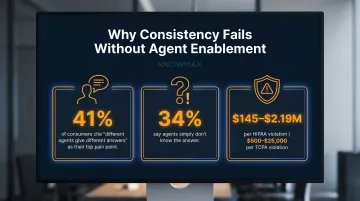
This advantage is particularly critical in regulated industries (banking, insurance, healthcare) where incorrect information can have legal and compliance consequences. HIPAA violation penalties range from $145 to $2,190,294 per violation, whilst TCPA fines range from $500 to $25,000 per violation. In these environments, agent enablement software is not just a CX tool but a legal safeguard.
KPIs impacted:
- Quality assurance scores
- Compliance audit outcomes
- CSAT
- Customer Effort Score (CES)
- Escalation rate
When this advantage matters most: Distributed or remote support teams; BPOs managing agents across multiple geographies; organisations with large seasonal or temporary agent populations; industries with strict regulatory or compliance requirements.
Reduced Onboarding Time and Lower Agent Attrition
New agents become productive faster when tools guide them through processes, surface answers in real time, and reduce the cognitive load of navigating unfamiliar systems. Instead of relying entirely on classroom training and shadowing, agents with access to decision trees, contextual knowledge, and real-time coaching can handle live interactions confidently — earlier in their tenure.
McKinsey client engagements show 20 to 30 percent reductions in agent time-to-proficiency through simulation-led agent onboarding and training tools. Knowmax customers have reported reducing employee onboarding time by approximately 40% through guided workflows, visual guides, and centralised knowledge bases.
Standard time-to-competency for new contact centre agents is 6 to 12 months; for complex operations, up to 2 years. New agents operate at only 50% of a tenured agent's productivity, and 25% of their contacts initially require correction or rework. When agents feel equipped from day one, engagement and retention both improve.
KPIs impacted:
- Time-to-proficiency for new hires
- Agent attrition rate
- Training cost per agent
- Quality scores for agents in their first 90 days
When this advantage matters most: Organisations with high seasonal hiring needs; BPOs and contact centres with structurally high turnover; support teams launching in new markets or supporting new products where knowledge depth is low across the team.
What Happens When Agent Enablement Software Is Missing or Ignored
Without structured knowledge tools, agents default to improvised answers, creating inconsistency that erodes customer trust over time. Real-time guidance gaps push error rates higher and stretch resolution times — driving up cost per interaction. 26% of agents report they often lack context about a customer's situation, while 80% say better access to data from other departments would improve their work.
The compounding effect of under-equipping agents is severe. Under-tooled agents report higher stress, lower job satisfaction, and leave faster — creating a cycle where turnover drives quality down, and rising workloads wear out the agents who remain. 69% of agents say juggling competing priorities of service speed and quality is difficult.
Adding headcount before fixing the tools problem multiplies the dysfunction at scale. The operational fallout is predictable:
- Management time shifts to escalation handling rather than improvement initiatives
- Knowledge gaps go undetected, so the same errors recur across agents and shifts
- Reactive issue-handling replaces planned service improvement
- 29% of consumers stop buying from a brand due to poor customer experience — a direct consequence of unresolved tooling failures
How to Get the Most Value from Agent Enablement Software
The technology alone does not create the outcome — agent enablement software delivers compounding value when implemented as a consistent operational system, not a one-time project. Start by auditing where agents currently lose the most time or make the most errors: these signal which tools are most urgently needed.
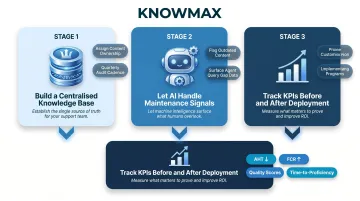
From there, build out your implementation in three stages:
Build a centralised knowledge base first. It is the foundational layer that real-time assist, decision trees, and QA tools all depend on. A KB that goes unmaintained degrades fast — especially when products, policies, or processes change. Assign clear content ownership and establish a quarterly audit cadence at minimum.
Let AI handle maintenance signals. Platforms like Knowmax flag outdated content and surface knowledge gap data based on agent query patterns. This gives team managers a continuous view of what agents cannot find — so deficiencies get closed before they affect call quality.
Track KPIs before and after deployment. Measure AHT, FCR, quality scores, and time-to-proficiency from the start. Use QA and coaching data to identify recurring skill gaps. Teams that treat agent enablement as a living system — not a one-time rollout — see results that compound over time.
Integration depth matters. Shallow integrations that still require screen-toggling impose cognitive load and limit the effectiveness of the tools. CRM, ticketing, and knowledge systems should connect into a single agent workspace — because even the best tools underperform when agents have to jump between them.
Conclusion
Agent enablement software is not a luxury or a future investment — it is the operational infrastructure that determines how well a support team can actually perform. The advantages (faster resolution, consistent quality, faster onboarding) compound over time when teams apply and maintain them with discipline.
The best place to start is a clear-eyed assessment of where agents are losing time and accuracy today. From there, the path is straightforward:
- Start with the knowledge layer — structured, searchable, and consistently maintained
- Integrate with existing CRM and ticketing systems to eliminate context-switching
- Use QA data to identify gaps and improve content over time
Support teams that build this infrastructure don't just resolve more tickets. They resolve them faster, more accurately, and with less friction for everyone involved.
Frequently Asked Questions
What does agent enablement mean in support operations?
Agent enablement is the practice of equipping support agents with the tools, information, and processes they need to resolve customer issues effectively. Unlike customer-facing automation, it focuses on human agent performance, not replacing agents.
What types of software solutions are used for agent enablement in support operations?
The four primary categories are knowledge management systems, real-time agent assist tools, CRM and ticketing platforms, and coaching and QA software. Effective agent enablement typically involves several of these working together.
What software tools best help customer service support sales strategies?
CRM integration gives agents customer context for cross-sell or upsell conversations, while knowledge tools ensure agents can answer product questions accurately — reducing the chance of incomplete or dropped interactions.
How does agent enablement software reduce average handle time?
Agent enablement tools reduce AHT by eliminating time spent searching for information, navigating between systems, and recovering from errors. Relevant answers and next steps surface directly in the agent's workspace during the live interaction.
What is the difference between agent assist software and agent enablement software?
Agent assist is typically one component of agent enablement, specifically the real-time guidance layer active during an interaction. Agent enablement is the broader category that also includes knowledge management, training tools, CRM access, and QA platforms.
How do I know if my support team needs agent enablement tools?
The most common signals are high AHT, frequent escalations, inconsistent answers across agents, long onboarding timelines, high agent attrition, or repeated quality failures on the same issue types. Any of these suggest agents lack the infrastructure to perform consistently.