This moment of friction is increasingly common. Nearly 1 in 5 consumers who used AI for customer service reported "no benefits"—a failure rate 4x higher than AI used for other tasks. The problem isn't AI adoption itself. It's the assumption that one or two generic AI agents can perform everywhere—from awareness to advocacy.
The solution: a multi-agent architecture where each customer journey stage has a purpose-built AI agent optimized for that specific moment's goals, context, and customer needs.
TLDR
- Each customer journey stage demands different AI capabilities: one agent cannot handle lead nurturing and complaint resolution equally well
- Gartner predicts 70% of multiagent systems will use narrowly specialized agents by 2027
- Stage-specific agents drive measurable results — higher conversion at discovery, faster resolution at support, and stronger retention at the loyalty stage
- Start deployment with journey mapping, stage-specific knowledge bases, and structured context handoffs between agents
Why One AI Agent Can't Do It All
Deploying AI and deploying AI right are fundamentally different. Customer intent, emotional state, data needs, and expected interaction style change dramatically between the awareness stage and a post-purchase service call. A discovery agent needs to inspire and educate. A support agent needs to diagnose and resolve. These goals don't just diverge — in a single-agent system, they actively undermine each other.
Generic AI agents are trained on a broad mix of signals, making them mediocre at everything instead of excellent at one thing. Gartner recorded a 1,445% surge in multiagent system (MAS) inquiries from Q1 2024 to Q2 2025, noting that monolithic AI "struggles with complex workflows." MAS break through these limits by orchestrating specialized agents, each focused on a specific task, reducing the errors that plague one-size-fits-all systems.
That specialization gap has a direct cost. FCR for complaint calls sits at just 47%, versus 73% for general inquiries, and 96% of customers who face high-effort service experiences become disloyal. Put a mismatched agent on a complaint or high-stakes purchase decision, and satisfaction plummets — customers don't give second chances.
The mismatch plays out predictably in both directions. A discovery-optimized agent at the support stage delivers vague, unhelpful responses. A support-trained agent at discovery overwhelms prospects with procedural detail they're not ready for. Every stage of the journey requires an agent purpose-built for that moment.
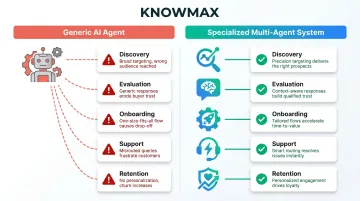
What Each Customer Journey Stage Actually Demands from AI
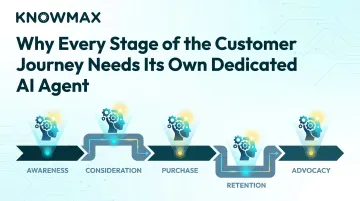
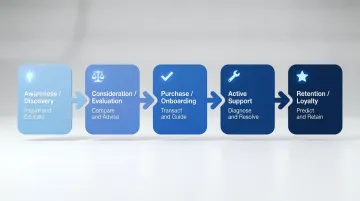
The customer journey segments into five functional stages, each with a distinct "AI job description." The agent deployed at each stage should be treated like a specialist hire, not a universal assistant.
Awareness and Discovery Stage
The AI agent here operates in exploratory territory—browsing behavior, vague queries, comparison searches. Its job is to surface relevant information, answer "what is this?" questions, and reduce decision friction, not close a sale.
67% of B2B buyers prefer a rep-free experience, and 61% of the B2B buying journey completes before any vendor contact. Discovery-stage AI must operate autonomously, without human sales support.
Required capabilities:
- Intent detection across non-specific queries
- Personalized content recommendation based on browsing patterns
- Ability to answer broad "education" questions without over-selling
- Engagement depth tracking to identify qualified leads
A support-trained agent fails here because it's tuned for specificity and problem-solving—the wrong tool for customers still exploring possibilities. Discovery agents must inspire curiosity and build confidence, not troubleshoot problems that don't exist yet.
Consideration and Evaluation Stage
Customers at this stage are comparing options and building objections. The AI agent must handle detailed side-by-side comparisons, proactively surface proof points (reviews, product specs, use cases), and address hesitations—functioning as a knowledgeable pre-sales advisor.
Forrester found B2B buyers engaged in an average of 27 interactions with a vendor over the course of making a purchase decision. A post-sale support agent fails here because it lacks the persuasion logic and product-depth context needed to guide evaluations.
What "good" looks like:
- Multi-turn, context-rich conversations that build toward confident decisions
- Proactive objection handling without pressure
- Comparison capabilities that highlight differentiators
- Behavioral context capture (what they compared, what they hesitated on) passed to the next stage
McKinsey's AI-powered next best experience research shows personalized AI-assisted interactions can enhance customer satisfaction by 15-20% and increase revenue by 5-8%. But only when the AI is calibrated for the evaluation mindset.
Purchase and Onboarding Stage
The purchase agent's job is transactional accuracy and trust: confirming choices, managing cart friction, surfacing payment options, delivering instant confirmation. The onboarding agent picks up immediately after, focused on reducing "time to first value."
Poor onboarding is the third leading cause of churn. The data is unambiguous:
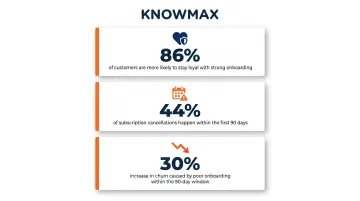
- 86% of customers are more likely to stay loyal to businesses that invest in onboarding—yet over 90% feel companies could do better
- 44% of subscription cancellations happen within the first 90 days
- Poor onboarding increases churn by 30% in that same window
Enterprises often fail here by treating onboarding as a "support ticket," routing new customers to the same queue as veteran customers with complaints—a mismatch that damages early relationship trust. The onboarding agent needs step-by-step visual guides, proactive check-ins, and usage tracking, not generic FAQ responses.
Knowmax's picture guides and visual device guides deploy step-by-step onboarding flows across web, mobile, and chat—reducing time to proficiency without requiring a support ticket to get there.
Active Use and Support Stage
Once customers are actively using a product, the nature of AI's job shifts completely. They have a problem and want it resolved, not redirected. The AI agent must have deep access to product knowledge, order history, account data, and be capable of walking customers through guided resolution flows.
An agent powered by structured decision trees and an indexed knowledge base guides both customers and human agents to the right answer faster. Knowmax's AI-powered knowledge base and interactive decision trees enable guided resolutions, reduce agent error, and improve First Call Resolution rates—one telecom customer reported a 21% improvement in FCR after deployment.
Contrast this with what happens when a discovery or marketing-trained agent handles a technical complaint: it either hallucinates an answer, deflects to a human too early, or fails to follow the correct resolution protocol. The support stage demands procedural accuracy above all else.
Key requirements:
- Deep product and policy knowledge access
- Step-by-step troubleshooting workflows
- Real-time account and order data integration
- Escalation protocols with full context handoff
Knowmax's decision trees navigate dynamically through predefined steps based on customer inputs, with media integration (images, videos, links) to simplify complex instructions and real-time analytics to surface bottlenecks before they become patterns.
Retention and Loyalty Stage
After the issue resolves, the journey shifts to engagement, loyalty, and re-purchase. The AI agent at this stage needs a completely different posture: proactive rather than reactive, personalized rather than procedural.
Bain & Company research by Frederick Reichheld found that a 5% increase in customer retention produces 25-95% more profit. Retention-stage AI agents carry outsized ROI potential as a result.
Retention agents monitor engagement frequency, flag customers showing disengagement patterns, and trigger personalised outreach before churn becomes a decision. McKinsey case studies show AI-powered next best experience can reduce churn intention by 59% and increase CSAT by 800% for at-risk customers.
Required data layer:
- Engagement frequency and usage depth
- NPS signals and satisfaction trends
- Product adoption patterns
- Lifetime value trajectory
A support agent was never designed to synthesize these signals. Retention requires predictive modeling and proactive outreach—the moment the AI waits for a customer to complain, the window to save the relationship has likely already closed.
The Cost of Getting It Wrong: Risks of Non-Specialized AI
When one agent is stretched across multiple stages, it optimizes for the average, performing below threshold at every critical moment. A discovery interaction that needed inspiration gets a procedural response. A support interaction that needed precision gets a sales pitch.
85% of CX leaders state customers will abandon a brand over unresolved issues—even on the very first contact. Worse, repeat interactions account for 23% of contact center operating costs, with each unresolved issue averaging 1.5 additional follow-up calls.
Context Collapse
Without stage-specific agents that pass structured context to each other, the customer experience fragments. The customer who just completed a difficult onboarding call shouldn't be immediately targeted with an upsell. Without intelligent handoff logic, that's exactly what happens. This is the AI equivalent of being transferred between departments and repeating your issue from scratch.
74% of consumers are frustrated by having to repeat their stories to different agents, and only 29% provide direct feedback after a bad experience. The rest simply leave — and that silent churn is what makes non-specialized AI so costly to detect.
Compliance and Governance Risk
In regulated industries like banking, insurance, and healthcare, using a generic agent at the wrong stage can result in policy violations, incorrect disclosures, or inappropriate advice.
Under the EU AI Act, AI use cases involving creditworthiness evaluation and risk assessment for life and health insurance are classified as "high-risk", requiring full explainability and human oversight. Generic agents without explainability create material compliance exposure.
Stage-specific agents let organizations apply the right guardrails at the right moment, without slowing down the interaction. That means:
- Authorization workflows triggered only at financial decision points
- Content versioning tied to policy update cycles
- Compliance-specific knowledge controls scoped to regulated interaction types
Knowmax's platform supports this through maker-checker approval workflows, role-based access control, version control, and certifications including GDPR, SOC 2, ISO 27001, and HIPAA — giving regulated-industry teams the controls they need at each stage.
How to Deploy Dedicated AI Agents Across the Customer Journey
Start with Journey Mapping Before Agent Design
Document your customer journey in detail, identifying the distinct "mode switches"—moments where customer intent, emotion, and information needs shift. These mode switches are the natural boundaries between agent roles.
Treat this as a strategy exercise first. Map where customers currently experience friction, where drop-off rates spike, and where complaint volumes concentrate. Those moments signal the stages that need specialized agents first.
Define the "Knowledge Contract" for Each Agent
Each stage-specific agent should be trained and grounded on a curated, stage-relevant knowledge base:
- Discovery agent: Product content, FAQs, comparison guides
- Evaluation agent: Use cases, proof points, objection handling
- Onboarding agent: Step-by-step setup guides, visual walkthroughs, first-use tips
- Support agent: Resolution procedures, escalation paths, troubleshooting decision trees
- Retention agent: Engagement triggers, upgrade offers, loyalty program details
Knowmax's multi-format knowledge authoring lets teams create articles, FAQs, decision trees, and picture guides tailored to each stage, then push them across CRM (Salesforce, Zendesk), telephony (Genesys), and messaging platforms (Freshchat).
For example, a support agent can access Knowmax's decision tree workflows directly within Salesforce Service Cloud. A self-service discovery agent pulls from the same knowledge base via a web portal or chatbot, keeping content consistent without duplication across channels.
Design Explicit Handoff and Context-Passing Protocols
A multi-agent architecture depends on continuity as much as specialization. Each agent should pass a structured "context packet" to the next:
- What the customer asked
- What was resolved
- What remains unresolved
- Current sentiment signal
- Behavioral history (what they compared, what they hesitated on)
Design explicit handoff protocols so each agent picks up where the previous one left off. Knowmax's integrations with Salesforce, Zendesk, and Genesys support context-passing natively, giving teams a practical foundation to build on.
Establish Stage-Specific Success Metrics
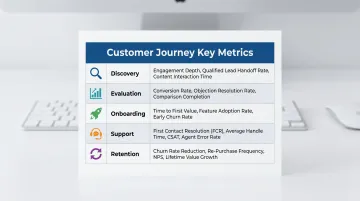
Measuring all agents by the same metric obscures performance gaps and prevents targeted improvement. Define success differently for each stage:
| Stage | Key Metrics |
|---|---|
| Discovery | Engagement depth, qualified lead handoff rate, content interaction time |
| Evaluation | Conversion rate, objection resolution rate, comparison completion |
| Onboarding | Time to first value, feature adoption rate, early churn rate |
| Support | First Call Resolution, Average Handle Time, CSAT, agent error rate |
| Retention | Churn rate reduction, re-purchase frequency, NPS, lifetime value growth |
Knowmax's analytics module tracks FCR, CSAT, deflection rates, and knowledge article utilization by channel, team, and use case, enabling micro-segmented performance monitoring.
Deploy Incrementally, Starting with the Highest-Impact Stage
Organizations don't need to deploy all five agents simultaneously. Start with the stage where the biggest drop-off or complaint volume exists:
- Identify the stage with the highest friction or cost
- Deploy a purpose-built agent there
- Measure impact using stage-specific metrics
- Expand outward to adjacent stages
For most enterprises, the active support stage shows the fastest ROI — it handles the highest volume of structured, resolvable interactions. A leading online food delivery app using Knowmax's decision trees and knowledge base achieved a 15% reduction in Average Handle Time.
Retention agents, by contrast, often deliver the highest long-term value. McKinsey's case studies on personalized retention programs show ROI nearly 4x higher than traditional mass-outreach approaches — making them a strong second priority once support is stabilized.
Frequently Asked Questions
What is a dedicated AI agent for the customer journey?
A dedicated AI agent is a purpose-built system trained and optimized for a specific stage of the customer journey (such as discovery, purchase, or support) rather than a generic agent deployed across all interactions.
How many AI agents does a business need to cover the full customer journey?
Most enterprise journeys have 4-6 distinct stages, each requiring a specialized agent. The practical starting point is identifying the 1-2 stages with the highest friction or drop-off and building dedicated agents there first.
What's the difference between a generic chatbot and a stage-specific AI agent?
A generic chatbot responds to inputs using broad training data, while a stage-specific agent is grounded in curated, stage-relevant knowledge, guided by stage-appropriate goals, and integrated with the systems most relevant to that moment in the journey.
Which customer journey stage benefits most from a dedicated AI agent?
The active support stage typically shows the fastest ROI because it handles the highest volume of structured, resolvable interactions. However, retention agents often deliver the highest long-term value by preventing churn.
How does a knowledge base support dedicated AI agents across the journey?
A structured, indexed knowledge base acts as the intelligence layer each stage-specific agent draws from—keeping every agent anchored to accurate, current information rather than generic or hallucinated responses. Knowmax lets organizations author stage-specific knowledge once and deploy it across all relevant channels and agents.