Introduction
Retail customer support teams face mounting pressure. Customers expect instant, accurate answers whether they're browsing online, checking their app, or reaching out via chat — yet 57% of business leaders expect service call volumes to increase by up to 20% over the next 1-2 years. Many retail support teams still work from scattered spreadsheets, outdated wikis, and tribal knowledge passed between agents during shift changes. Meanwhile, customer experience quality in North America hit an all-time low in 2025, with 25% of U.S. brands' CX rankings declining.
The retailers pulling ahead have one thing in common: structured knowledge management systems that turn raw customer interaction data into answers agents can actually use — at the moment a customer needs them. This guide breaks down how retail teams are doing it, and what the measurable results look like.
TLDR:
- Retail KM structures customer interaction data into agent-ready knowledge across every channel
- KM integration drives 21%+ FCR improvements and cuts agent errors by 30%
- High retail turnover (60% annually) makes centralized knowledge critical to survival
- AI-powered platforms reduce AHT by 13-15% through decision trees and visual guides
- Self-service powered by KM deflects 60%+ of routine queries when implemented properly
What Is Knowledge Management in Retail?
Knowledge management (KM) in retail is the systematic process of capturing, organizing, and distributing operational and customer knowledge so agents and customers can resolve issues accurately — without hunting through outdated documents or escalating unnecessarily. This includes product specifications, return policies, promotional terms, shipping rules, and troubleshooting workflows.
KM Is Not the Same as Data Analytics
Big data captures what customers are doing — browsing behavior, purchase patterns, service interactions, cart abandonment. Knowledge management is the layer that turns those insights into usable protocols.
The difference is practical: data tells you that 40% of support tickets involve return eligibility; KM gives your agents a decision tree that walks them through every return scenario with zero errors.
This distinction matters. McKinsey found that organizations using big data paired with effective KM report stronger improvements in knowledge management capabilities than those relying on data alone.
The Scope of Retail KM
Retail knowledge management spans:
- Customer-facing support teams (chat, phone, email, social)
- Back-office operations (order processing, inventory queries)
- In-store associates (product information, POS troubleshooting)
- Employee onboarding and training
The sections that follow focus on the customer experience dimension: how structured KM enables support teams to resolve issues faster, reduce errors, and deliver consistent service regardless of channel.
The Big Data and Knowledge Management Connection in Retail
What Big Data Means in Retail
McKinsey Global Institute characterizes big data in retail as the continuous streams of structured and unstructured data captured at every customer touchpoint: point-of-sale transactions, e-commerce sessions, CRM records, customer service calls, returns, social media interactions. At Walmart scale, this generates approximately 2.5 petabytes per hour across all systems — far beyond what traditional processing tools can handle.
Four Types of Retail Data That Feed KM Systems
Customer Data:
- Behavioral patterns (browsing, cart activity, service history)
- Demographics and segmentation
- Spending capacity and lifetime value
Product Data:
- Demand trends and seasonal patterns
- Performance metrics (returns, reviews, defects)
- Feature comparisons and compatibility
Inventory Data:
- Real-time stock levels across locations
- Demand forecasting inputs
- Supplier lead times
Sales Data:
- Directional market insights
- Promotional performance
- Channel-specific conversion patterns
Each type contributes a distinct dimension of usable knowledge — but without a KM layer, these insights stay locked in dashboards that frontline agents never access.
The Critical Handoff: From Data to Action
Big data platforms surface patterns, but knowledge management is what converts those patterns into searchable, structured, role-specific resources agents can use during live interactions.
Example: Your analytics dashboard shows a 35% spike in "order status" queries during holiday promotions. Without KM, agents scramble to answer these manually. With KM, that insight triggers an automated update to your chatbot's FAQ, a new decision tree for agents, and a banner alert in your self-service portal — all updated from one centralised content layer.
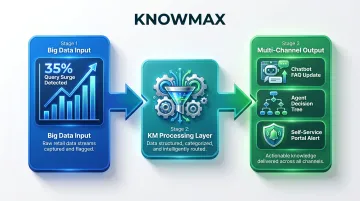
Customer-obsessed organisations using data plus KM report 41% faster revenue growth and 51% better customer retention than those treating data and knowledge as separate functions — a gap that widens the longer the two remain disconnected.
The Competitive Stakes
The retail analytics market is projected to grow from $11.31 billion in 2026 to $20.65 billion by 2031, while the knowledge management software market will reach $74.22 billion by 2034. That parallel growth isn't coincidental — it reflects how retailers are realising that analytics without knowledge delivery is incomplete. The data tells you what customers need; the KM layer determines whether your teams can actually act on it, at speed and at scale.
How Knowledge Management Drives Better Retail Customer Experience
Personalization at Scale
When customer behavioral data is organized through a KM system, support agents and AI tools can instantly surface the right product information, order history, or preference data during any interaction. Platforms like Knowmax integrate directly with CRMs such as Salesforce, Zendesk, and Freshdesk, pulling customer-specific context into the agent's workflow without requiring tab-hopping.
This enables personalized service without agents needing to dig through multiple systems. A returning customer asking about a delayed shipment sees their full order history, previous interactions, and current delivery status — all in one view. The agent delivers a tailored answer in seconds, not minutes.
First-Contact Resolution (FCR)
In retail, a huge proportion of customer frustration stems from agents giving inconsistent or incorrect answers about orders, returns, pricing, and policies. The average retail FCR benchmark is 78% — meaning 22% of customers must contact support multiple times for the same issue.
Structured KM — particularly decision trees and guided workflows — enables agents to navigate complex queries accurately the first time. Instead of relying on memory or hunting through policy documents, agents follow a visual workflow that accounts for every scenario:
- Return window eligibility
- Product condition assessment
- Purchase channel verification
- Payment method constraints
A leading telecom using structured KM achieved a 21% improvement in FCR accuracy. For retail, where every repeat contact erodes trust and adds cost, this improvement directly impacts the bottom line.
Omnichannel Consistency
Consider this scenario: a customer checks a return policy on your chatbot, then calls support the next day — and gets a completely different answer. 73% of customers use multiple channels during their shopping journey, yet 70% expect anyone they interact with to have full context. That gap is where trust breaks down.
KM closes it by maintaining a single source of truth across every channel. Knowmax deploys the same knowledge simultaneously to:
- Agent desktops and self-service portals
- Chatbots and mobile apps
- In-store and voice channels
Updates sync in real time — so when a return policy changes, every channel reflects it instantly, eliminating the "different answer every time" problem.
Training and Onboarding for High-Turnover Teams
The average retail employee turnover rate is approximately 60% annually, with convenience stores hitting 130%. This constant churn creates a knowledge crisis: experienced agents leave, taking their expertise with them, while new hires struggle to reach proficiency.
Structured KM reduces onboarding time. Instead of shadowing veterans or memorizing policy manuals, new agents rely on searchable, guided knowledge from day one. Knowmax's LMS integrates training content directly into the knowledge platform, reducing time-to-proficiency by up to 40% in high-turnover environments.
A major retail client documented a 24% reduction in turnover after implementing mobile-first knowledge and training systems, proving that accessible knowledge improves both retention and performance.
Real-World Results: What Structured KM Delivers
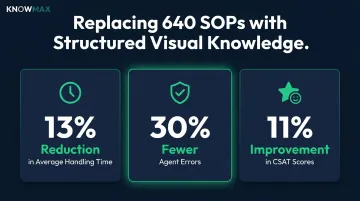
A Fortune 500 retailer replaced 640 complex SOPs with Knowmax's structured, visual knowledge system. The results:
- 13% reduction in average handling time
- 30% fewer agent errors
- 11% improvement in CSAT scores
The mechanism was straightforward: AI-powered search, interactive decision trees, and visual troubleshooting guides gave agents instant, accurate guidance during live interactions — no manual-hunting, no guesswork.
Key Applications of Knowledge Management in Retail Customer Support
Personalized Support and Product Guidance
KM systems allow agents to access customer purchase history, browsing context, and preference data in real time. This enables them to:
- Proactively suggest solutions based on past orders
- Recommend relevant products that match customer preferences
- Resolve issues with context that feels informed, not scripted
A quick commerce brand using Knowmax achieved a 140% increase in CSAT by centralizing knowledge and eliminating silos, allowing agents to provide faster, more personalized responses.
Handling Returns, Complaints, and Policy Queries
Returns, refunds, and policy clarifications are the highest-volume and most error-prone interactions in retail support. KM-powered decision trees guide agents through exact steps for each scenario:
- Is the product within the return window?
- What's the item's condition?
- Was it purchased online or in-store?
- What payment method was used?
Each answer branches to the next step, ensuring compliance and accuracy. Teams using this approach typically see AHT drop by 13–15%, alongside measurable gains in first-contact resolution.
Demand-Driven Knowledge Updates
Retail knowledge bases need to move as fast as the business. Product launches, seasonal promotions, pricing changes, and supply disruptions all require rapid, accurate updates.
When agents work from stale information during peak demand, resolution quality drops and customer trust follows. Structured content governance prevents this through:
- Version control that tracks every change
- Approval workflows ensuring accuracy before publishing
- Scheduled updates that activate content at campaign launch and archive it afterward
- Real-time syncing across all channels simultaneously
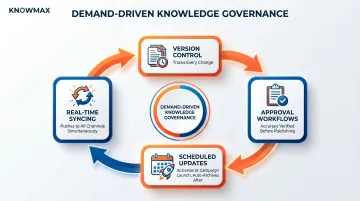
Knowmax's platform supports scheduling, maker-checker approval processes, and bulk updates, keeping content accurate through high-stakes periods like Black Friday or back-to-school season.
Self-Service and Deflection
All that governed, current knowledge doesn't just help agents — it directly powers customer-facing self-service. Shoppers can resolve order status, return eligibility, or product questions without waiting in a queue.
75% of consumers prefer to try self-service before calling, particularly for simple tasks like tracking orders or checking return policies. Yet only 14% of customer service issues fully resolve in self-service, most often because the right answer isn't surfaced fast enough.
AI-powered search closes that gap. Knowmax's intent-based search understands customer queries even with typos or vague phrasing, surfacing the right answer without requiring exact keyword matches. During the 2025 holiday season, Pandora achieved a 60% case deflection rate using an AI-powered service agent, with a 10% increase in NPS.
Challenges of Knowledge Management in Retail (and How to Address Them)
Employee Turnover and Knowledge Loss
With frontline retail turnover hitting 60% annually, institutional knowledge walks out the door constantly. Tribal knowledge — the informal tips and shortcuts that experienced agents share — disappears with every resignation.
The fix is documenting that knowledge into structured, centralized systems rather than relying on person-dependent expertise. Knowmax captures workflows, FAQs, and troubleshooting steps in formats that survive attrition — decision trees, visual guides, and searchable articles — so when a veteran agent leaves, their knowledge stays with the team.
Converting Raw Data into Actionable Knowledge
Retail generates enormous data volumes, but refining that data into agent-ready formats requires deliberate effort. Raw analytics output doesn't translate directly into clear SOPs, decision trees, or searchable articles.
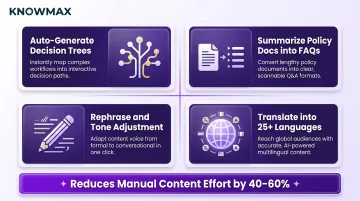
AI-assisted content authoring closes that gap. Knowmax's Max AI helps knowledge authors:
- Generate decision trees automatically from text inputs
- Summarize lengthy policy documents into bite-sized FAQs
- Rephrase content for clarity or adjust tone with one click
- Translate articles into 25+ languages with high accuracy
This reduces manual content management effort by 40-60%, allowing retail KM teams to keep pace with operational changes.
Integration with Legacy Systems and Omnichannel Complexity
Many retailers run fragmented tech stacks: legacy POS systems, separate e-commerce platforms, multiple CRM instances. KM must pull from and feed into all of them without creating data silos or requiring agents to switch tools.
The right KM platform resolves this through broad, native integration. Knowmax connects directly with Salesforce, Zendesk, Freshworks, Genesys, SAP, and Talkdesk via browser extensions and embedded APIs. Agents access decision trees, visual guides, and FAQs without ever leaving their CRM or ticketing system.
Frequently Asked Questions
What is big data and knowledge management?
Big data refers to the massive, high-velocity datasets retailers generate across all customer touchpoints. Knowledge management is the process of capturing, organizing, and distributing insights from that data so teams can act on it effectively in real time.
What are the benefits of big data in retail?
Big data enables retailers to improve customer personalization, forecast demand more accurately, optimize pricing, and enhance support quality through data-informed agent guidance. It also strengthens inventory management and supply chain efficiency — giving operations teams visibility they can act on quickly.
How is big data used in e-commerce?
E-commerce retailers use big data to personalize product recommendations, optimize search and discovery, predict demand, detect fraud, cut logistics overhead, and improve customer support. KM systems ensure these insights are accessible to the people and tools delivering the experience.
How does knowledge management improve customer experience in retail?
KM gives retail support agents instant access to accurate, structured information, enabling consistent and faster responses across every channel. Fewer errors, higher first-contact resolution rates, and stronger customer loyalty follow as a result.
What are the biggest challenges of knowledge management in retail?
Retail KM faces three recurring obstacles:
- High turnover: Continuous staff churn erodes institutional knowledge faster than teams can document it
- Data conversion: Turning raw operational data into usable, structured knowledge content is resource-intensive
- Tech fragmentation: Connecting KM across siloed retail systems requires careful platform selection and integration planning
How can AI improve knowledge management for retail teams?
AI-powered KM platforms automate knowledge discovery, enable intent-based search, surface the right information during live interactions, and help authors create and update content faster. The result: retail teams handle more customer queries without adding headcount or expanding content teams.