Introduction
Organisational change creates an immediate knowledge crisis. Whether it's a restructure, a system migration, or a policy overhaul, every change initiative demands that new information reach every team member simultaneously and without error — often while operations continue at full speed.
Most change management frameworks focus heavily on leadership alignment and communication strategy. Yet they routinely underestimate the operational side: what happens when a frontline agent, contact center rep, or newly transferred employee simply doesn't know what to do under the new process?
The numbers back this up. McKinsey reports that 70% of change programs fail to achieve their goals, and 67% of well-formulated strategies fail due to poor execution — not poor strategy.
An AI knowledge base is not just a documentation tool. It's an active change enablement layer — one that puts verified, up-to-date process information directly in the hands of the people executing the change, at the moment they need it.
TL;DR
- Organizational change fails at the point of execution — where employees encounter new processes without the knowledge to navigate them
- An AI knowledge base gets change knowledge to every team from day one — not spread over weeks of staggered training
- AI-powered search and guided workflows ensure consistent execution before formal training is complete
- Skip centralized knowledge and you get inconsistent execution, compliance exposure, and error rates that quietly kill change ROI
- The value compounds: each change handled through an AI knowledge base makes the next transition faster and less disruptive
What Is an AI Knowledge Base?
An AI knowledge base is a centralised, intelligent system that stores, organises, and delivers organisational knowledge — policies, SOPs, product information, process guides — to employees at the point of need. Unlike traditional keyword-based systems, it uses AI-powered search that understands intent, not just exact matches.
It's most commonly deployed in customer-facing operations: contact centres, support teams, and BPOs. During organisational change, though, that scope widens — any employee navigating new workflows, updated policies, or restructured processes becomes an immediate beneficiary.
The gap between the two models is significant in practice:
- Traditional knowledge base: A static repository employees search manually, often returning irrelevant results or outdated content
- AI knowledge base: Actively surfaces the right information — in the right format (text, decision tree, visual guide) — at the right moment, without employees needing to know exactly what to search for
That difference becomes especially consequential when your organisation is mid-transition and employees can't afford to lose time hunting for answers.
Key Advantages of an AI Knowledge Base for Organizational Change Management
The advantages below tie directly to measurable operational outcomes: speed, consistency, and quality of knowledge transfer during transitions. These matter most in environments where large volumes of employees must absorb and act on new information quickly — contact centers, BPOs, distributed enterprise teams.
Instant, Organization-Wide Knowledge Dissemination
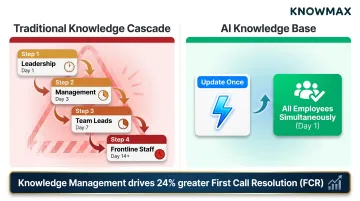
The most common failure mode in change management is the knowledge cascade delay. Updated information moves slowly from leadership to middle management to frontline staff over days or weeks. During that time, different people operate on different versions of the truth.
An AI knowledge base eliminates this delay. When a new process, policy, or product goes live, it's updated once in the knowledge base and becomes immediately available to every employee across every location and channel simultaneously.
Why this matters:
The speed of knowledge reach directly determines the speed of behavioral change. The faster teams have accurate information, the faster they adopt the new way of working. Contact centers investing in knowledge management systems achieve 24% greater first contact resolution (FCR) rates compared to peers without them.
Every day agents operate on outdated or incomplete information generates customer-facing errors, repeat contacts, and escalations — each carrying measurable cost. GenAI-enabled contact center agents achieve a 14% increase in issue resolution per hour.
Every day agents operate on outdated or incomplete information generates customer-facing errors, repeat contacts, and escalations, each carrying measurable cost. GenAI-enabled contact center agents achieve a 14% increase in issue resolution per hour.
KPIs impacted:
- Time-to-competency
- First Contact Resolution (FCR)
- Average Handling Time (AHT)
- Agent error rate
When this advantage matters most:
This is critical during large-scale transitions such as M&A integrations, system migrations, or simultaneous multi-site rollouts where information cannot be delivered through centralized training sessions alone.
Consistent, Guided Process Execution Across Teams
During organizational change, process variation is the single biggest compliance and quality risk. Different agents, departments, or locations follow different versions of a new process based on what they were told in a training session or read in an email.
An AI knowledge base with embedded decision trees and guided workflows enforces the correct process path for every employee interaction, regardless of their individual training status or tenure. The system walks them through the right steps in real time.
What the data shows:
Decision-tree-guided resolution removes reliance on individual memory or interpretation of change instructions. This is especially critical in regulated industries — banking, insurance, healthcare — where non-compliant handling carries legal and financial consequences.
The industry-average FCR rate is 70%, meaning 30% of all contact center volume consists of repeat contacts. SQM Group identifies "Agent Knowledge" and "Access to Information" as the number-one driver of FCR. Approximately 30% of non-FCR calls are caused by "Internal Errors," including incorrect information provided by the agent.
When agents follow inconsistent new processes, customers receive inconsistent answers. This erodes trust at precisely the moment the organization is asking them to adapt to new ways of engaging.
Compliance failure: TSB Bank
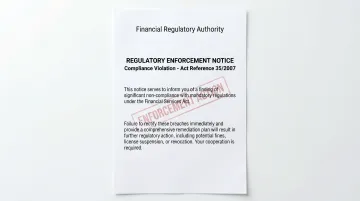
The FCA fined TSB Bank plc £10,910,500 for failing to ensure customers in arrears were treated fairly. TSB paid £99.9 million in redress and £105 million in remediation costs — total financial exposure of approximately £215.8 million. Key findings: training programs failed to provide staff with necessary support; staff incentive schemes prioritized quantitative benchmarks over qualitative assessment of customer needs.
KPIs impacted:
- Process adherence rate
- Compliance rate
- CSAT/NPS
- Escalation rate
- Re-contact rate
Best-fit scenarios:
This is most valuable during process redesigns, new system go-lives (ERP, CRM), and compliance-driven changes where deviation from the new process carries regulatory risk. Organizations with distributed or outsourced contact centers (BPOs) see the greatest benefit here.
Platforms like Knowmax combine AI-powered search with interactive decision trees so that even during a transition, agents can be guided through unfamiliar new processes without waiting for formal training completion.
Faster Onboarding and Reskilling During Transitions
Organizational change frequently triggers a secondary challenge: a wave of new hires, role changes, team restructures, or department transfers. All of this requires intensive onboarding at the exact moment the training team is already stretched managing the change itself.
An AI knowledge base enables self-directed, role-specific learning. Employees can search, access visual troubleshooting guides, and follow guided workflows independently, reducing dependency on dedicated trainers and classroom sessions.
Why this matters:
Self-serve knowledge access compresses the time between an employee's start date (or role-change date) and their first independent resolution. Speed to full competency in contact centers ranges from 6-12 months, extending up to 2 years for complex operations. During that ramp-up, a new agent is only 50% as productive as a tenured agent.
When a large organization is simultaneously managing change and hiring, the traditional onboarding model cannot absorb the volume. An AI knowledge base scales training without proportionally scaling trainer headcount.
Cost context:
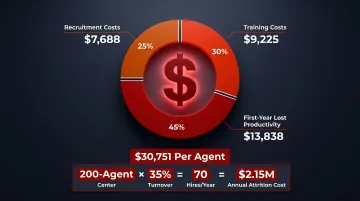
Total agent replacement cost (including recruitment, training, and first-year lost productivity): $30,751 per agent. At a benchmark annual turnover rate of 35%, a 200-agent center hires approximately 70 agents per year at a total annual attrition cost of $2.15 million.
KPIs impacted:
- Onboarding duration
- Time-to-first-resolution
- Training cost per employee
- Trainer-to-trainee ratio
High-impact use cases:
BPOs scaling capacity for a new client, enterprises undergoing post-merger integration, and organizations restructuring customer support operations all face this compounding challenge most sharply.
What Happens When There's No AI Knowledge Base During Organizational Change
Without a centralized, AI-driven knowledge system, change-related information spreads through informal channels: email threads, shared drives, trainer memory, team WhatsApp groups. Each creates a different version of what "the new process" is.
The consequences compound over time:
Knowledge drift: Inconsistent customer outcomes follow when teams interpret the same change differently. Only 3% of contact centers operate on a single, unified platform — the average organization manages 3.9 different contact center technologies, each potentially carrying a different version of the truth.
Error spikes: Frontline staff making decisions without updated, accessible knowledge generate measurable increases in error rates and repeat contacts. CSAT scores drop by an average of 15% every time a customer has to call back.
Reactive firefighting: Supervisors spend their time correcting individual errors instead of managing the broader transition. That's a leadership bandwidth problem, not just an operational one. Repeat contacts can inflate call volume by 20–30%, pushing organizations to hire more staff when the real fix is better knowledge access.
Rising costs: U.S. companies lose an estimated $75 billion annually due to poor customer service.
Each of these outcomes shares a common cause: knowledge gaps left open during the transition window. The longer that window stays open, the more expensive it gets to close.
How to Get the Most Value from an AI Knowledge Base During Change
An AI knowledge base delivers maximum value in change management when it is treated as infrastructure, not afterthought. It must be updated before the change goes live, not after employees have already encountered gaps.
Three operating principles separate high-impact implementations from underperforming ones:
Pre-load before go-live
Employees who hit a knowledge gap on day one of a change lose confidence fast — and that friction compounds across the team. Every process guide, decision tree, FAQ, and policy update needs to be live in the knowledge base before the change activates, not after the first wave of confusion hits.
Knowmax's AI author tools support rapid pre-launch content preparation:
- Generate and rephrase articles in seconds using AI-assisted authoring
- Auto-translate content into 25+ languages for global rollouts
- Review drafts through an intuitive editing panel and publish instantly across all channels
Review and retire outdated content
A knowledge base containing both old and new process information is more dangerous than no knowledge base at all. During any change period, establish a content governance cadence to flag, archive, and replace superseded content before it misleads anyone.
Knowmax's scheduling and archiving features allow teams to assign beginning and end dates to content, ensuring it's only accessible when relevant. The maker-checker approval process ensures only verified, updated information is published.
Close the loop with usage data
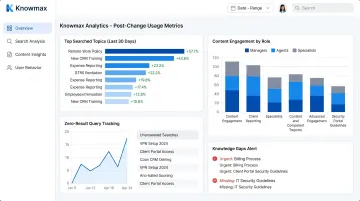
Post-change search behaviour tells you what training and documentation actually missed. Monitor which topics employees search most frequently, which queries return no results, and where agents are spending disproportionate time — these patterns reveal the gaps that no change plan anticipated.
Knowmax's analytics dashboard tracks the metrics that matter most post-change: top searched topics, zero-result queries, and content engagement by role. Teams that act on this data in the first few weeks consistently close knowledge gaps before they become support failures.
Conclusion
Organizational change is ultimately a knowledge problem as much as a leadership or strategy problem. An AI knowledge base is the operational mechanism that converts change plans into consistent, day-one employee behavior.
The advantages — faster dissemination, consistent process execution, and accelerated onboarding — compound over time. Each change initiative handled through a mature AI knowledge base builds institutional knowledge that makes the next transition faster and less disruptive.
Organizations that treat an AI knowledge base as a permanent operational capability, rather than a one-time change tool, absorb each new initiative with less friction, shorter ramp times, and fewer execution errors. The average employee now experiences 10 planned change programs per year — a fivefold increase from a decade ago. The organizations that hold up under that pace are the ones that have made knowledge infrastructure a permanent priority, not an afterthought.
Frequently Asked Questions
What is the role of an AI knowledge base in organizational change management?
An AI knowledge base acts as a centralized, real-time source of truth — giving every employee access to the latest process, policy, and product information the moment a change goes live. This bridges the gap between change planning and frontline execution, driving consistent adoption at scale.
How does an AI knowledge base reduce employee resistance during organizational change?
Resistance usually stems from uncertainty about how to perform under the new model. An AI knowledge base addresses this directly — giving employees immediate, guided access to exactly what they need to do and when, reducing anxiety and building confidence in the new process.
Can an AI knowledge base replace traditional change management training?
It does not replace training, but it changes its role. Formal training covers context and rationale; the AI knowledge base handles real-time task execution support. Used together, they cut the learning curve significantly — something training alone rarely achieves.
What types of organizational changes benefit most from an AI knowledge base?
Changes involving process redesign, system migrations, regulatory updates, large-scale hiring, or post-merger integration — especially in customer-facing operations — see the most measurable benefit. High employee volume, tight timelines, and zero tolerance for process inconsistency make these scenarios ideal.
How does an AI knowledge base ensure consistency across distributed or outsourced teams during change?
Because all employees access the same centralized, cloud-hosted knowledge base regardless of location, language, or channel, there is no version fragmentation. A BPO agent in one country follows the exact same updated process as an in-house agent in another, ensuring uniform outcomes.
How quickly can an AI knowledge base be updated when a change happens?
With AI authoring tools, content can be created, reviewed, and published within hours rather than days. Updates propagate instantly to all users, eliminating the lag that makes traditional document-based knowledge management a bottleneck during fast-moving change initiatives.