A knowledge management process is a structured sequence of steps organizations use to capture, organize, share, and continuously improve the collective knowledge within their teams. For contact centers, BPOs, and support operations, this process is critical: agents must access accurate, up-to-date information instantly to resolve issues and deliver consistent customer experience.
This article breaks down the six core steps of an effective KM process, what makes each step succeed, and the common pitfalls teams run into when they skip or misapply them.
TL;DR
- The KM process is a continuous cycle covering capture, organisation, delivery, and ongoing optimisation — not a one-time project
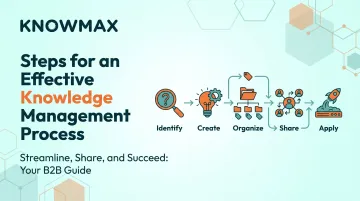
- Six core steps: audit, goal-setting, knowledge capture, structuring, omnichannel delivery, and ongoing optimisation
- Reduces agent errors, shortens onboarding time, and improves FCR across customer-facing teams
- Fails most often when organisations skip the audit, lack clear ownership, or treat knowledge as static after launch
- Choose a KM platform that supports each step at scale and keeps knowledge accurate and accessible
What Is the Knowledge Management Process?
The knowledge management process is the end-to-end method by which organizations identify, create, store, share, and update knowledge so that the right information reaches the right people at the right time. It's designed to reduce knowledge silos, prevent teams from solving the same problems twice, and enable faster, more accurate decisions across the organization.
It's worth distinguishing this from a knowledge management system (KMS). The process defines the workflow and strategy — how knowledge gets captured, validated, and distributed. The KMS is the technology platform that puts that strategy into practice.
| Process | KMS | |
|---|---|---|
| What it is | Workflow and governance strategy | Software platform |
| Without the other | Can't scale | Becomes a storage dump |
| Together | Consistent, accessible knowledge across teams |
Why an Effective KM Process Matters in Customer-Facing Operations
Poor knowledge management has measurable operational costs in contact centers. Agents spend excessive time searching for answers, deliver inconsistent responses across channels, and struggle with high average handle time (AHT). Research from Talkdesk and IDC shows that hold time accounts for 11% of total call time on average, much of it driven by agents hunting for information mid-call.
Customer-facing teams demand speed, accuracy, real-time updates, and consistency. According to Forrester, 55% of U.S. online adults will abandon a purchase if they can't find a quick answer, and 77% say valuing their time is the most important thing a company can do to deliver good service.
Without a defined KM process, critical problems emerge:
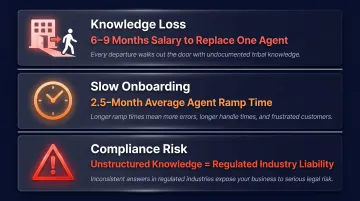
- Senior agents carry troubleshooting logic and process expertise in their heads — when they leave, it leaves with them. Replacing one agent can cost six to nine months of their salary, and undocumented knowledge multiplies that loss
- New hires take longer to become productive when onboarding resources are scattered; contact center ramp benchmarks average 2.5 months, but that stretches further without structured knowledge
- Outdated or inconsistent information in regulated industries like healthcare, finance, and telecom creates real exposure — incorrect guidance, compliance violations, and direct customer harm
Key Steps in an Effective Knowledge Management Process
The following six steps form a continuous cycle rather than a linear checklist. Each step feeds into the next and loops back for ongoing improvement.
Step 1: Audit Your Existing Knowledge
A knowledge audit means cataloging existing content assets — SOPs, FAQs, training materials, agent notes — and assessing whether current content is accurate, accessible, and complete. It also identifies what knowledge is documented versus tacit (held only in people's heads).
How to identify knowledge gaps during the audit:
- Analyze top customer query types and recurring agent escalations
- Look for areas where multiple agents give inconsistent answers
- Review quality assurance (QA) feedback and customer complaints
- Track failed search queries and unanswered tickets
COPC recommends establishing a cross-functional knowledge governance council and conducting routine audits at least quarterly. Use analytics dashboards to track usage trends, feedback ratings, and aging reports. Integrate QA insights and agent feedback into updates.
Signs from ICMI's qualitative research that you have a knowledge problem:
- Agents report difficulty finding information and conflicting answers
- Customers receive inconsistent responses between channels
- Team leads see overreliance on a few subject matter experts
- Content editors see no standard feedback process and multiple versions of the same document
Step 2: Define Goals and Prioritize Knowledge Needs
Before building or restructuring a knowledge base, teams must set clear, measurable objectives. Examples include:
- Reducing AHT by 15%
- Improving FCR rates by 20%
- Cutting new agent ramp-up time from 10 weeks to 6 weeks
- Achieving 70% self-service resolution for tier-1 queries
Avoid vague goals like "improve knowledge access" or "make it easier for agents." Contact centers surveyed by IDC set self-service goals averaging 68%, with high performers targeting up to 90%.
Apply the 80/20 principle: Prioritize documenting the 20% of knowledge that addresses 80% of incoming queries first. Don't try to capture everything at once. Focus on high-volume, high-impact content that delivers measurable operational improvement.
COPC and HDI both recommend tracking AHT, FCR, usage rates, accuracy, and feedback scores as KM-related KPIs, and aligning KM metrics to operational outcomes from the start.
Step 3: Capture and Create Knowledge
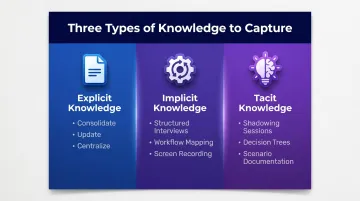
Three types of knowledge need to be captured, each requiring a different method:
- Explicit knowledge (documents, guides, policies): Consolidate, update, and centralize content that already exists but may be scattered or outdated
- Implicit knowledge (undocumented process know-how): Map through structured interviews, workflow documentation, and screen recording
- Tacit knowledge (expert judgment, troubleshooting logic): Extract via shadowing sessions, decision tree creation, and case-based scenario documentation
Best practices for the capture stage:
- Involve frontline agents and subject matter experts in the creation process
- Start from the customer problem, not the internal process
- Validate captured knowledge with a small pilot group before publishing
- Use simple language and avoid jargon agents won't understand
Knowmax supports AI-assisted content creation — drafting, rephrasing, summarizing, and auto-translating into 25+ languages — so teams can scale knowledge capture without compromising accuracy.
Step 4: Organize and Structure the Knowledge Base
Without logical categorization, tagging, and clean taxonomy, even the best content becomes invisible to agents under pressure. Good organization makes knowledge findable when it matters most.
Key structuring elements:
- Categorize by topic, product, issue type, or customer journey stage
- Use consistent tagging and indexing conventions
- Maintain a clean taxonomy that evolves with business needs
- Interlink related content (e.g., link decision trees to detailed articles)
AI-powered KM platforms like Knowmax let teams structure content into:
- Interactive decision trees that guide agents step-by-step through complex troubleshooting
- Visual guides with picture-based instructions for device setup, returns, or technical support
- Searchable articles and FAQs accessible via intent-based search
The result: agents spend less time hunting through documents and more time resolving issues.
Step 5: Deliver Knowledge Across the Right Channels
Knowledge delivery must be contextual and channel-aware. A one-size-fits-all approach fails everyone.
Channels Knowmax supports for knowledge delivery:
- Agent desktop — embedded directly into CRM (Salesforce, Zendesk, Freshdesk) or telephony tools (Genesys, Talkdesk, Exotel) via widgets and browser extensions
- Self-service portals — customer-facing FAQs, decision trees, and visual guides for independent resolution
- Chatbots — AI-powered bots that pull structured answers from the knowledge base for instant, consistent responses
- Mobile apps — on-the-go access for customers and field agents
- Web and social — knowledge embedded on websites and social platforms
Role-based and persona-based delivery:
Not all knowledge is relevant to all users. Segment delivery by role:
- Agents see guided workflows, compliance scripts, and troubleshooting trees
- Managers access performance dashboards and content governance tools
- Customers interact with self-service FAQs and chatbots tailored to their needs
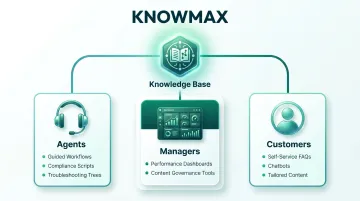
Scoping delivery by role keeps each user focused on what's relevant to their task.
Step 6: Monitor, Measure, and Optimize
KM process effectiveness is visible in measurable KPIs:
- Content usage rates: How often articles, decision trees, or guides are accessed
- Agent search success rates: Percentage of searches that return a relevant result
- FCR: Percentage of issues resolved on first contact
- AHT: Average time spent per call, chat, or ticket
- Knowledge gap flags: Unanswered queries, failed searches, and repeated escalations
ICMI notes that structured decision trees and guided content correlate with higher FCR and reduced AHT in contact centers. Knowmax customers have reported a 21% improvement in FCR and a 15% reduction in AHT after implementing the platform.
These metrics feed directly into a continuous improvement loop:
The optimization loop:
- Use analytics to identify low-performing or outdated content
- Flag articles for review based on usage, feedback, and age
- Surface new knowledge gaps from agent feedback and unanswered queries
- Feed insights back into Step 3 (capture) and Step 4 (structuring)
- Repeat quarterly or as needed
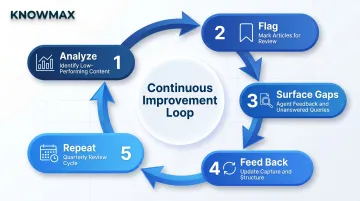
This loop ensures the knowledge base evolves with the business, product changes, and customer needs.
Key Factors That Affect KM Process Success
Internal factors:
- Leadership buy-in and ownership: 50% of KM initiatives fail, most often due to lack of executive sponsorship and unclear ownership. A KM process without an accountable owner stagnates
- Knowledge-sharing culture: Organizations that reward knowledge hoarding instead of sharing will never build a functional KM program
- Content governance: Who can publish? Who reviews? How often? Without answers, content quality degrades
Technology factors:
The KM platform must:
- Support the organization's channel mix (voice, chat, email, self-service, social)
- Integrate natively with existing CRM and ticketing systems
- Offer AI-powered search that understands intent, not just keywords
Forrester's 2024 KM Wave identifies must-haves (security, compliance, workflow integration, intuitive interfaces) and differentiators (AI-driven discovery, advanced analytics, gamification). A platform that buries answers behind ten menu clicks will be abandoned, no matter how strong the content underneath.
Scale and content freshness:
As organizations grow, content volume grows. Without a systematic review cycle — scheduled audits, expiry dates, and archiving workflows — the knowledge base becomes a liability. Outdated or conflicting information creates more confusion than it resolves.
Platforms that handle this automatically make a real difference at scale. Knowmax's scheduling and archiving features let teams set content start and end dates, flag articles for review, and retire outdated material without manual intervention — keeping large enterprise knowledge bases accurate and current.
Common Mistakes Organizations Make in the KM Process
Skipping the Audit Stage
Many organizations jump straight to building a knowledge base without understanding what they already have. This leads to duplication, conflicting information, and wasted effort — teams rebuild what already existed, or bury it under new layers of contradictory content.
Treating KM as a One-Time Project
Organizations launch a knowledge base and consider it "done." Without a regular review cycle, content decays, gaps multiply, and agents stop trusting the system — reverting to informal channels like messaging colleagues or guessing. Subject matter experts may update date fields without actually updating content, giving the illusion of freshness while the knowledge rots.
Confusing the Knowledge Base with the Process
Deploying a KM tool is not the same as implementing a KM process. A tool without a defined workflow for capture, review, and delivery is just a storage system. It won't improve FCR, reduce AHT, or onboard agents faster. The process — governance, roles, workflows, metrics — is what actually delivers results.
Frequently Asked Questions
What are the main processes of knowledge management?
The core processes are knowledge creation/capture, storage/organization, sharing/delivery, and ongoing review/optimization. These form a continuous cycle rather than discrete, one-time phases — each feeding into the next to keep knowledge accurate, accessible, and actionable.
What are the 5 P's of knowledge management?
The 5 P's are Purpose, People, Process, Platform, and Performance — covering why KM exists, who uses it, how knowledge flows, what technology enables it, and how impact gets measured. Each dimension reinforces the others; a gap in any one undermines the whole system.
What are the 5 C's of knowledge management?
Stan Garfield's 5 C's are Capture, Curate, Connect, Collaborate, and Create. Each maps to a practical step in the KM lifecycle — from gathering raw knowledge to generating new insights through active use.
What are the 7 levels of knowledge management?
No universally recognized "7 levels" framework exists. The most credible reference is APQC's 5-level KM Maturity Model, which tracks progression from ad hoc storage to innovative, insights-driven knowledge use. Organizations should use that as a benchmark rather than searching for a definitive 7-level standard.
How do you measure the effectiveness of a knowledge management process?
Track content usage and search success rates, First Call Resolution (FCR), Average Handling Time (AHT), agent onboarding speed, and the reduction in repeated errors or escalations. These metrics show whether knowledge is findable, accurate, and improving operational outcomes.
What is the difference between a knowledge management process and a knowledge management system?
A KM process is the strategic workflow defining how knowledge is captured, organized, delivered, and reviewed. A KM system (KMS) is the technology platform that operationalizes that process. Both are necessary — the process without a system lacks scale; the system without a process lacks direction.